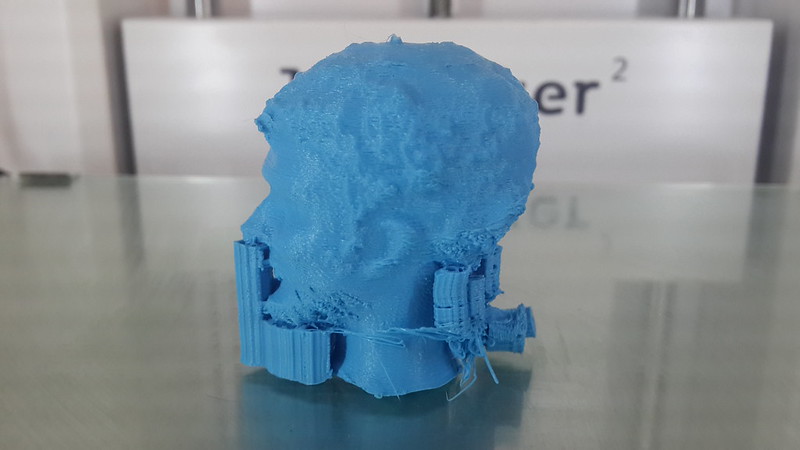
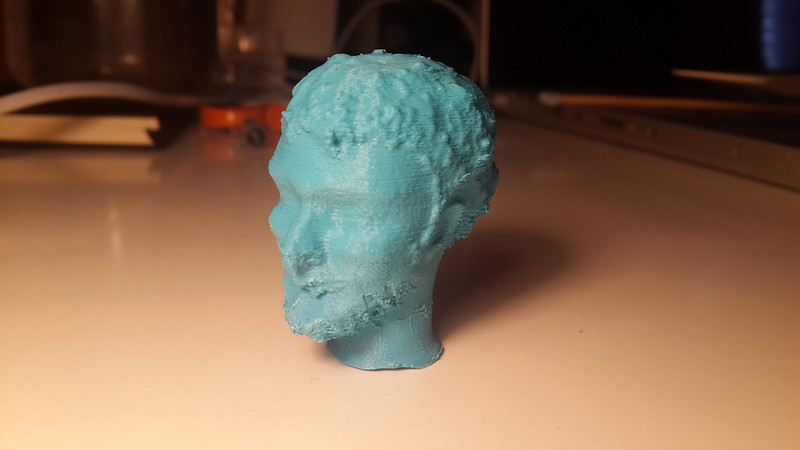
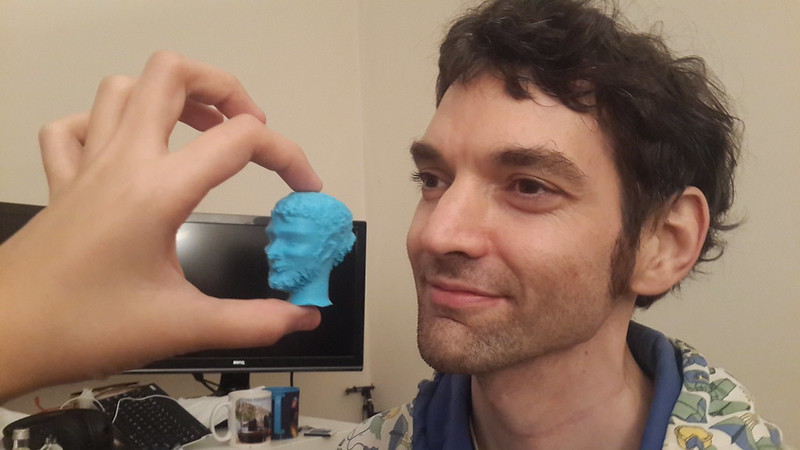
Recently I attended a brilliant two day workshop on skull-based facial reconstruction conducted by forensic artist Richard Neave. Here is a documentation of the process...

Making the eyes and the nose...

Added Buccinator muscles on the cheek area.

Added lips.

Adding the Temporalis muscle - note how it continues under the zygomatic arch. These are all muscles which are responsible for mastication (chewing) and facial expressions.

Building up the muscles on the face - added the masseter muscles on top of buccinator muscles, added forehead muscles and muscles around orbital area.

Adding some fat in the cheeks.

Adding the zygomaticus major and minor muscles. I was quite confused with the names by this point so if there are inaccuracies you should let me know. I think there was also a levator muscle along with the parotid gland which looks like a tiny squiggle in there.

Added the ears.

End of Day 1 - Looking quite like a face now

Nose underside closeup


Other people in the class and their work

Day 2 - we add more fat

More fat

Suddenly after lunchtime I've suddenly decided to use reference pictures to make it look more like a certain (ahem!) face. I am told this is not necessarily the right way to go as the bone structure should be the thing which brings out the face (hence, reconstruction from skull and building up layer by layer). But I've decided to try to sculpt a replica of George's face since this is an artificial plaster casting of a skull I'm working on anyway so there is no real specific bone structure to reveal here (and we haven't really been properly calculating how much fat and muscle is to be on this face...)

Our tutor Richard was quite helpful nonetheless in giving some tips on which prominent features I should try to bring out more in the face to make it look more like this.

Fattening up the chinpad!

Completed work!


Some more pictures of the work of other classmates:


Anatomy of the Spine
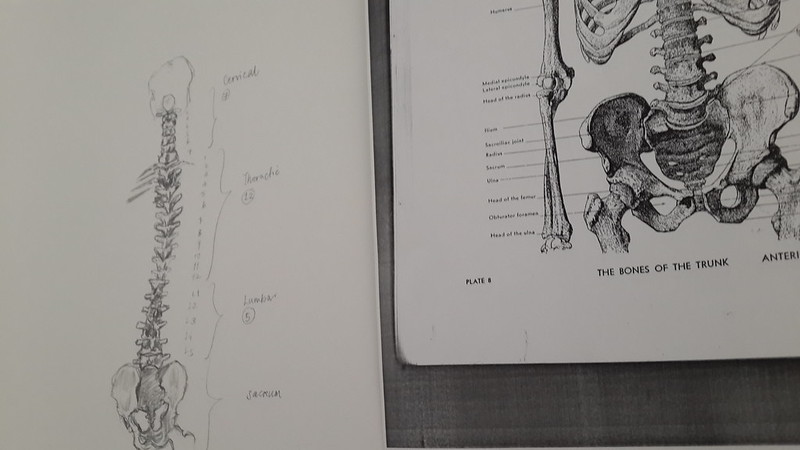
On a previous occasion I also attended the first day of an anatomy class conducted by Eleanor Crook (anatomical waxwork and effigy maker, artist in residence at Guy's Hospital Gordon Museum of Pathology). We studied the structure of the human spinal column and counted each vertebrae off as we drew them.
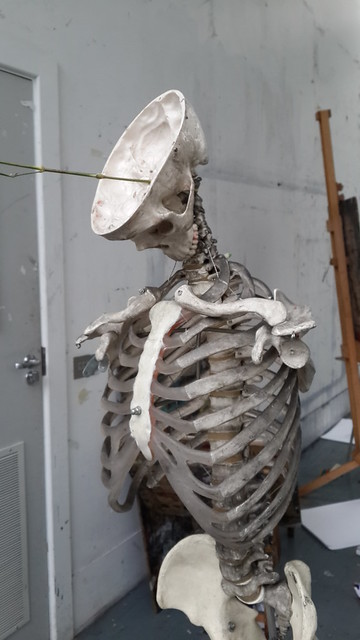
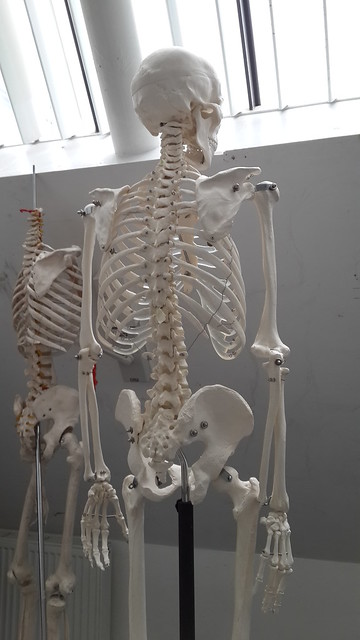
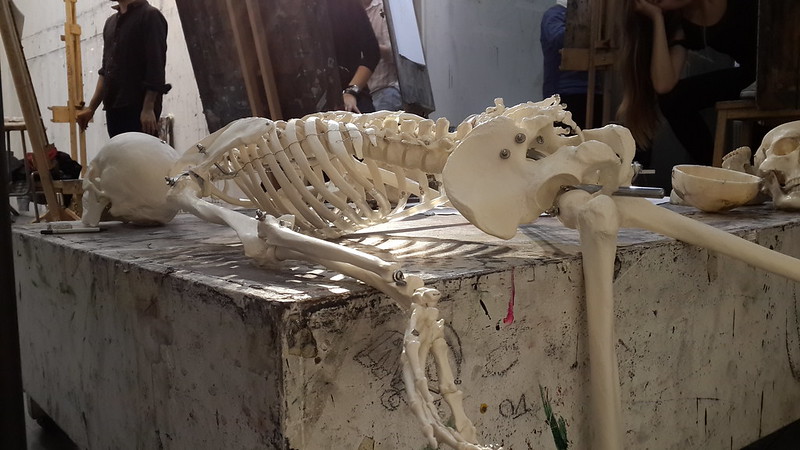
Humans have 33 vertebrae in total - 7 cervical vertebrae, 12 thoracic vertebrae, 5 lumbar vertebrae, 5 sacral vertebrae which are fused together to form the sacrum, and 4 caudal vertebrae which are fused together to form the coccyx (tailbone).
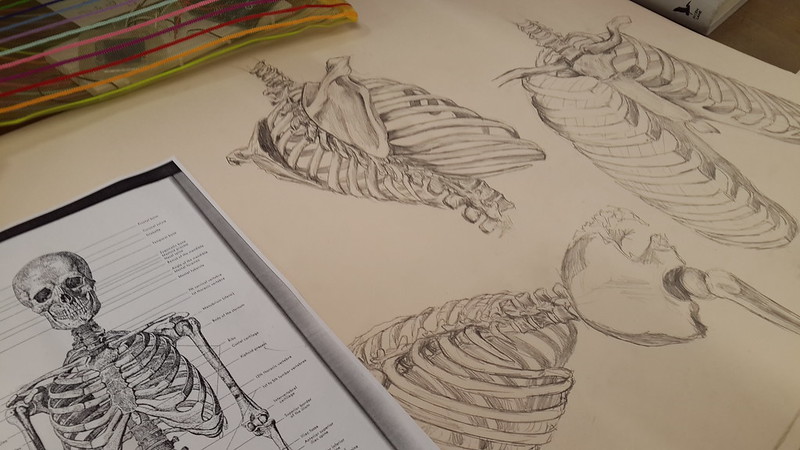
It's been really nice attending the various anatomy classes at the Drawing Studio - I haven't attended a drawing or sculpture class since I was a kid so it's been quite exciting - and sometimes baffling - so many things that they assume all students at the Royal College of Art must already know! - yes I know its an art school but I've never attended a drawing studio class before! What are all these strange sculpting tools? How do I use the easel without accidentally turning it into a murder weapon by having it dramatically fall apart in 3 pieces in the middle of class? How do i even affix the paper to easel...?
Tiny confusions aside, I was quite surprised how easy it was to sculpt a face which does look like a face. However, if you ask me, my objective for attending such classes is not because I want to produce my own artistic rendition of a human face, but more because I just want to understand the bone structure and musculature inside the face which contribute to the overall appearance of a human face. (I suspect that the interest of most students was to produce a face which displays specific emotions or age, or to iterate on the shape of the human face to see what alien-looking variations could be produced - a process that might be useful to an animator or a filmmaker or sculptor...)
But for me, I suppose I would like to know how one would compute a face. Could we reverse-guessstimate the shape of a person's skull based on photographs of a person's face (and information on the person's gender and age)? And if a face does indeed exude some sense of heightened emotion, what are the specific muscles or bones contributing to such an appearance? For example, I've noticed that I have never been able to look convincingly angry. Could it be that being asian in descent I simply lack a specific angry-face muscle that causes me to be unable to look more than slightly annoyed even if I am very angry?...