The documentation on this blog makes a beeline towards the domestic! For we have begun works on what will probably be two very major long-term projects in 2018/2019 - the first of which is the HOUSE PROJECT, which I thought I should document for the benefit of others who have come after us since we too relied a lot on the power of INTERNETS to find out how to do all this.
The cost of renting a well-located 3-room HDB flat in Singapore actually exceeds that of the cost of a HDB Loan / Mortgage on a 3-room HDB flat (Public Housing), so it was a no-brainer for us to stop renting in Singapore and simply buy a flat here. Naturally, I will start from the very beginning of our search for a flat in Singapore...
Table of Contents:
- Flat Viewings
- Online Research
- HDB Resale Flat Purchase Process
- HIP Options
- HIP Works & Bathroom Fixtures
- Renovation Budgeting
- Appointing Renovation Contractor
- House Design Layout
- Windows Installation
- Kitchen Appliances and Sink
- Tiling Selection
- Aircon Installation
- Lighting Design
- Electrical Layout
- Paint Scheme
- Doors
- All the rest of the Non-built-in Furniture
- Soft Furnishings
- MORE TO COME...
1. Flat Viewings
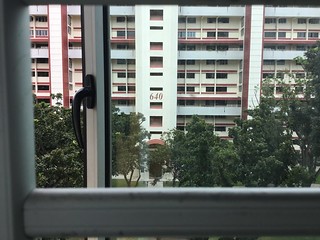


HDB HEARTLANDS: ER.... NOT REALLY A ROOM WITH A VIEW...
We began our house search by doing viewings in earnest. Or sorta kinda. The first few random estate agents whom we had called up also seemed to know that we were NOOBS/NOT YET FULLY FORMED/NOT ACTUALLY VERY SERIOUS BUYERS because they were as awkward as we were. But the point of flat viewing was to accrue an understanding of the public housing flat formats available in Singapore. In order to ease us into the business of flat viewing, the first flats that we viewed were also in the same block that we were renting, so it was like looking into a duplicate or mirror image of the flat we were in - at least this was something we were a little familiar with and could comment on. (Looking into strangely depopulated duplicate husks of our own flat...)

Fun fact: Our flat is an older 3A model which is 796sqft (74sqm), meaning our flat is actually larger than the standard 3-Room or 3-NG flat.
Type/Size of flat: Based on our MINI budget we decided to look for 3 room and 3.5 room HDB Resale flats (public housing in Singapore). (This is equivalent to a "2 bedroom flat" in the UK, is usually around 60 to 65 sqm, and has 2 bathrooms). Private/condos were out of the question because I didn't have that amount of savings and also that would be pushing ourselves into a hard financial position. But a very modest HDB flat was definitely within our means.
In my personal experience, I've always felt that the quality of public housing in Singapore exceeds the quality of private housing in London! During the first year I lived in London, I developed the misconception that the housing stock in London was on the whole extremely ancient and backwards because all the rental flats (private flats, bedsits, House of Multiple Occupation types) I had seen and visited were all incredibly run-down compared to the average Singapore flat, featuring interesting details like holes in the stairs, holes in the exterior boundary walls, rickety and unlevel floors, broken windows, cabinets that were falling apart, and rats the size of beer cans. I didn't know any better at the time, so I very joyfully accepted whatever I could get, leg through the stairs be dammed, nothing could dampen my enthusiasm for living in these weird houses!
And then at some point I visited a friend's council flat (bought with a generous gift of a deposit paid by parents - a financial feat otherwise impossible in this lifetime for someone working in Design/Advertising in Shoreditch at the time ahem...) and I was surprised as to how similar it was to a normal Singapore flat. SO, NORMAL FLATS EXISTED IN LONDON. But then, there aren't really a lot of council flats to go around. So people are just being screwed by the awful private rental market in London, where the price of rental is extremely high and what you get is very little. It also feels like part of UK government welfare goes straight into subsidising private landlords because of the housing benefit payout, which doesn't go towards really solving any of people's problems. I suppose it would be more accurate to describe London housing as possessing both extremes - a wide range of extremely nice and architecturally interesting flats (aspirational Georgian front rooms! eco-homes! historical houses! art deco! or industrial/warehouse conversions???) and extremely terrible flats (a lot wider than the range of flats you would get in Singapore). Somehow, although the diversity of types of housing in London is so much wider, this also has somehow meant that the average standard of the affordable London flats is far lower than the average standard of the affordable Singapore flats...)
For public housing in Singapore we had the option of either BTO (Built-to-order) or Resale. It would take an estimated 3-5 years to wait for a Build-to-Order (BTO) flat because you would have to register first and wait for the flat to be built! That also would mean 3-5 years more of interminable renting, plus I was only eligible for a 2-room BTO under the Singles (Non-Citizen Spouse) scheme, so we went straight into focusing our energies on looking for a 3/3.5 room Resale flat (I'd be 'sole owner' under the Non-Citizen Spouse Scheme, George would be my 'essential occupier', and we would still receive a housing grant of S$25,000).
Agent/No Agent: Next, there was the question of whether we would work with an estate agent or not. The good thing about an agent is that they can do all the leg work and arrange for multiple viewings in one evening. However, you run the real risk of it being a sort of psychological game, where the highs and lows of the tour experience may have been designed by the agent to convince you of the virtues of a particular flat, by contrasting different elements, such as seeing a flat with strange or extreme modifications, followed by a normal boring flat, and then another strange flat with a crazy saxophone player outside it who toots away every evening [REAL INCIDENT] - by contrasting an ordinary flat with a TERRIBLE FLAT it obviously helps to make even the most ordinary flat seem a little better than it really is. But hey, we aren't really wanting to see the worse case scenarios here when searching for that dream house...
Criteria: After many viewings, we devised our own criteria for what we were looking for. We liked things like the old terrazzo that often came with old flats, but not TOO CRAZY COLOURED. We were also very particular about the view. We liked either a city view, or a nature view, but not really a suburban view. It also seemed that some people liked being able to see their cars from their flat, so they enjoyed seeing a view of a carpark, but we were not those people. A lot of the "FULLY FURNISHED MOVE-IN IMMEDIATELY" type flats were not our style, so their fully furnished nature was not a plus point for us either.
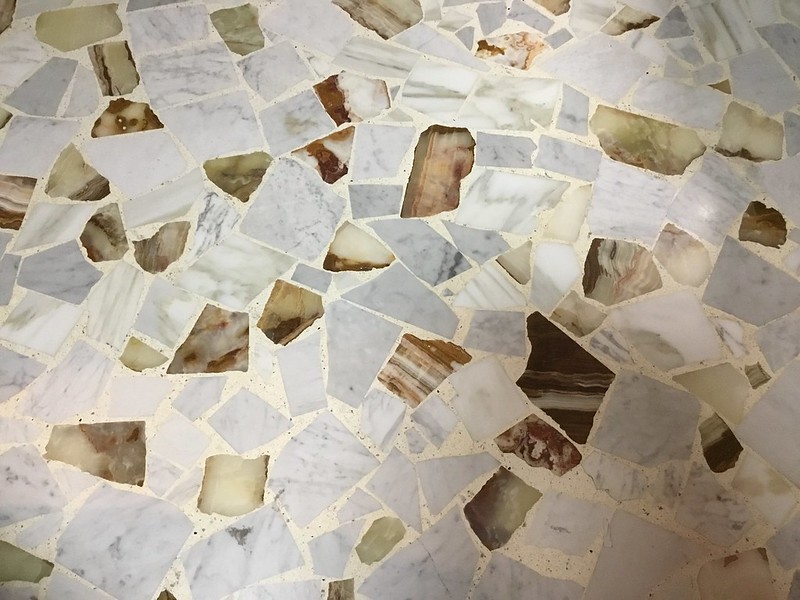
Big Terrazzo!
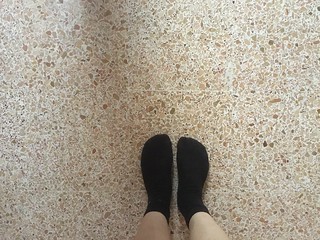


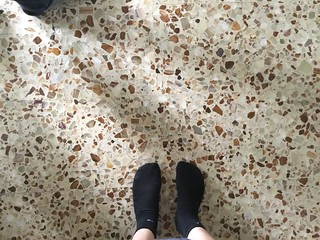
So many different Terrazzos in HDB Flats!
* George also pointed out that it was quite odd to him that both me and Dingmother always started talking about visibility of ANTS whenever we looked at surfaces and that maybe people in other countries did not have "VISIBILITY OF ANTS" as a criteria for flooring/countertop colours. But we have so many different ants here in Singapore. CAN WE SEE THE ANTS WHEN THEY ARE WALKING OVER THE FLOOR? THAT IS A SERIOUS QUESTION! [And for those living in cold non-tropical ant-less countries who have never thought about whether ants will be visible on your floor or countertop, the answer is: Yes, yes, I would actually like to be able to see the ants. I do want to know where the ants are. I WOULD LIKE MAXIMUM ANT VISIBILITY!!]
Seeing a lot of the same size of flats gives you an idea of the possible fittings, layouts and modifications of that type of flat. For example, we viewed a lot of 3.5 room flats in the AMK area and these were always the ones that received an upgrade of an additional room at the end of their flats. A lot of them had reconfigured their walls in different ways, such as by knocking down the store or hacking down walls and erecting different walls to make different shapes, which gives one ideas about the possible iterations on the same template...
On our individual efforts, as well as the help of an agent for some part, and the Dingfather (our honorary agent for a while), we saw a grand total of 22 flats before finding the ROWELL FLAT.
What we chose: See a lot of flats on our own with no fixed agent
2. Online research

Unfortunately, all of the flats that we 'kinda' liked in Ang Mo Kio were on the pricey side (nearly 400k / over 400k) which really could not really be justified because it was just so far away from Fun Things in Town and it might result in us having a very socially isolated existence. Some other flats we saw had red flags, such as CCTV cameras being installed everywhere (for what reason did the owner justify to HDB on the installation of CCTV? loanshark? private dispute? etc), weird looking doors and doors which could not be unlocked (was this really a home? why were rooms inaccessible to potential house viewers? why had these unusual office/industrial/shop doors been installed into the residential apartments?), very low floors (potentially affected by smoke from the incessant burning of taoist offerings, and noises from roads, funeral trumpets, construction sounds, schools, etc). All in all, its just not that cheap to buy a flat in the heartlands! And more crucially, some of these flats were older than me (a few were over 40 years old), which could result in loan issues (if you buy or take over a flat with less than 60 years, the housing loan may be disallowed) - and in the distant future, by getting an extremely old flat, we might deprive ourselves of the option of being able to sell and buy a different flat if we so wished to...
George found Edgeprop's website which had a useful map detailing the per square foot cost of all the public housing in Singapore - Edgeprop Analytic Heatmap - which gave us a better picture of the prices in different areas of Singapore, and which areas tended to have the lowest per square foot pricing. AMK Central was far from being the the cheapest zone despite being so far away from the town area.

Inspired by a visit to a friend's house in Little India (an area that both me and George were extremely fond of) we began looking at the lowest price per square foot that could be had in the Jalan Besar District. And to our surprise, there was a unit on the market that seemed to fit all our criteria! It even seemed to overlook my old flat in Rowell Road!
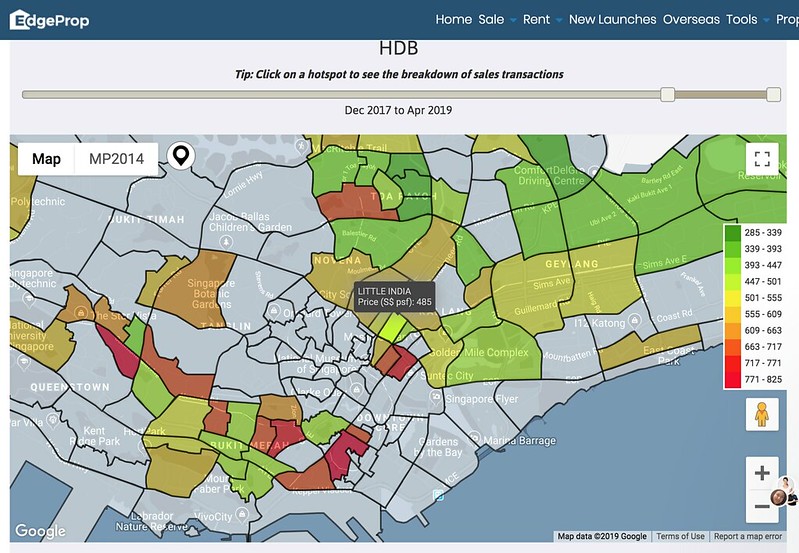
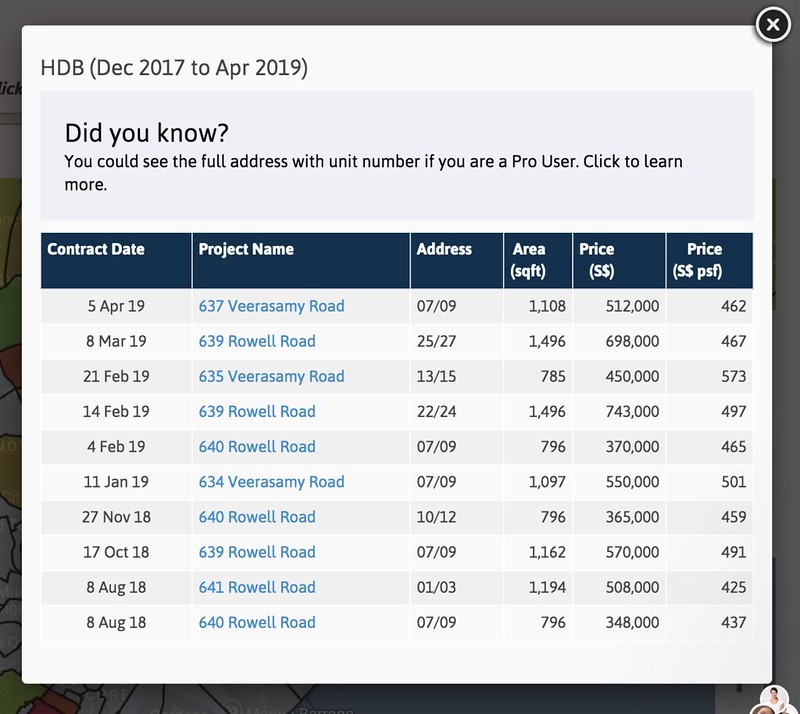
FUN FACT: Our transaction is reflected on this list (screenshot taken in May 2019), and yes we did get the best per square foot price for our size of flat. Singaporeans familiar with the square footage of flats here can probably easily guess which one was our transaction...
FUN FACT 2: The HDB flats on Kelantan lane average about 450 upwards psf to even 500+. As for Rowell Road, the road that I have the most emotional attachment to, it turns out it is the cheapest price per square foot in the whole Jalan Besar area. Well fancy that!...
Thanks Singaporeans with your racially suspect CMIO policies which has resulted in the Indian enclave near central becoming less popular with Chinese buyers - thus giving us (I'm classed as a Chinese buyer) a chance to find the most favourable price! Your loss is our gain!
What we chose: Little India with per square foot prices as low as SGD 420-440 psf
3. HDB Resale Flat Purchase Process


Here is a record of our timeline. It took 5 months & 6 days (159 days, not including end day) from start to finish - calculated from the date we applied for the eligibility letter, to the date we completed the purchase.
20 April 2018 - Applied for HLE (HDB Loan Eligibility) Letter
27 April 2018 - Received HLE Approval (which will also tell you what is the max loan possible / what is your max budget)
18 May 2018 - Registered Intent to Buy
** WE THEN COMMENCED THE WILD VIEWINGS UNTIL THE ONE TRUE HOUSE WAS FOUND **
13 June 2018 - First viewing of the Rowell Flat
14 June 2018 - Second viewing of the Rowell Flat. Made offer.
15 June 2018 - Obtained Proof of Ownership from Owner.
25 June 2018 - Owner issues the OTP (Option to Purchase) Form
26 June 2018 - Request for Value Submitted
15 July 2018 - Exercise Option to Purchase (Seller completes portion of form)
16 July 2018 - Submission of Resale Application (Buyer completes portion of form)
20 August 2018 - Acknowledgement of Resale Documents (Confirmation of Purchase of Resale Flat, Housing Grant Agreement, Application of Housing Loan), Payment of Conveyancing and Caveat Fees. [Additional: in our case the seller wished to bring forward the date for Completion of Sale due to travel plans so we also arranged for an earlier date]
26 Sept 2018 - Completion of Sale at HDB Hub, Opening Utilities, SLA Caveat, Property Tax
* I wish to also add the note that when you go down to HDB Hub for the final completion, you don't really have to bring any other documents previously submitted, besides your original IDs. Its a formality in which buyer and seller just sign the final papers in each other's presence, the seller get a cute little HDB tote bag full of papers and HDB branded keychains and magnets and swag, and then you go off with the keys. Unfortunately, about 5 minutes before I was to leave the house to attend this momentous event, I became convinced that I needed to bring the original copy of some document that I couldn't recall whether it should be in my possession or the seller's possession. The result is that I tore through the house like a mad person tornado of flying papers (I realised later that the original was with the seller), and I went to HDB Hub in a nervous wreck - only to slowly realise that the completion was more a formality of signing and shaking hands and smiling at each other and receiving the keys... OH WELL NOW WE KNOW.
On hindsight, there are also three other VERY IMPORTANT things that you'll need to do as a new home owner (but no one is going to remind you to do these):
- Conservancy Charges: Set up giro/direct debit for conservancy charges to the town council (you'll have to contact your town councils after 2 weeks, or in my case, if you forgot to contact them, they will send you a bill for your overdue conservancy charges ho ho ho)
- Change of address: Change your registered address to the new one anytime within the next 3 months (or in my case, SUDDENLY PANIC ABOUT THE POTENTIAL ADMINISTRATIVE BOO-BOO YOU MAY OR MAY NOT HAVE CAUSED BY ACCIDENTALLY FORGETTING TO DO IT FOR SEVERAL MONTHS AND RUSH IMMEDIATELY TO THE POLICE POST TO CHANGE IT IMMEDIATELY SO HELP ME OH GOD)
- Renovations: Start your house renovations so you can move into the flat! DUH. But because I was so busy with my PYT show and the 'accidental commencement of MAJOR LONG-TERM PROJECT #2' I admit that I was unusually slow to start the renovation process....
4. HIP Options
We were extraordinarily lucky in that the HIP timing coincided with the time we were purchasing the flat, meaning that I had taken ownership of the flat in time to make the decisions on what HIP options I wanted.
HIP stands for Home Improvement Programme (HIP), and HDB flats of a certain age are all slated for this programme in which their 30+ year old plumbings and toilets are replaced, spalling issues and leakages are fixed, and safety features like anti-slip coatings, handlebars and mobility ramps are installed for the elderly who need them - all for what is a mere token sum (if you are Singaporean the costs are almost negligible and can be paid through CPF in a few years time). You also get a new front door and front gate (optional Ease items)

The HIP contractor will erect a toilet showroom that looks like this masterpiece below (with a bow on the toilets), and you get to choose from a few inoffensive colour themes such as grey, blue, or sand...


The HIP works are usually accompanied by great upheaval in the block itself, with everyone taking advantage of the chaos to embark on their own noisy renovation projects as the HIP works sweep through the block for the duration of the better part of a year. I must admit that I subconsciously ended up delaying the renovation of our flat because of the knowledge that HIP was coming soon and it would have been ideal to move in after HIP had been completed for our flat, otherwise we would have to endure another round of having to trot down to the common toilets during the shock of the 10-day disruption.
5. HIP Works & Bathroom Fixtures
In Feb 2019 the HIP Works finally commenced! We received a one month advance notice letter and a two week advance notice letter before the date, and someone came around to check the condition of the flat before we started, and where they pointed out to us a few weird parts of our flats.

Seems like all the flats in the block have a slightly un-aligned kitchen toilet door. But no big deal... *TWITCHES*
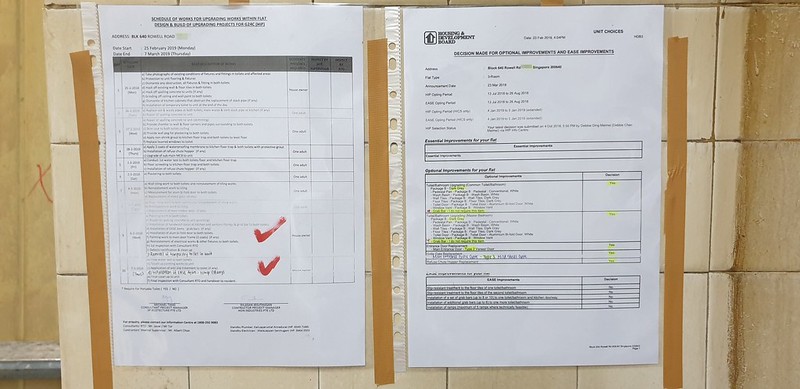
Based on the option form given back in October 2018, they printed out the list of works to be done in the house. With the works commencing, we also had to ensure we had all the new fixtures present for them to install during the process. We visited all the usual megastores for bathroom fixtures in Singapore such as Bathroom Warehouse, Hoe Kee, Sim Siang Choon, but ultimately decided to try the smaller bathroom fixture stores on Geylang. After doing a price comparison with HomeOne and Universal Union, we eventually bought our fixtures from Heritage Bathroom Gallery (we were served by a lady called Irene Chong).
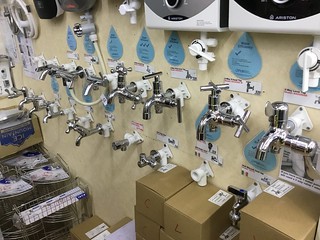

As the sink and WC were provided by HIP, we just had to supply the rest of the basic fixtures found in a bathroom. Here is a breakdown of the unit prices for which we got our basic fixtures (after comparing at least 6 different shops):
- Mirror Cabinet with Internal Shelving - $118 (we chose one that was big enough to hold an entire Listerine Bottle)
- Instant Heater with Rain Shower, Standard Shower, and DC pump - $249
- Foldable Towel Rack with additional hooks - $88 (we had seen similar units for over $100 elsewhere)
- Two way Tap - $33 (we had seen the same unit sold elsewhere in Geylang for $45)
- Hooks in a row - $42 (we had seen the same unit sold elsewhere in Geylang for $53)
- Toilet Paper Holder - $28 (we had seen the same unit sold elsewhere in Geylang for $39)
- Bidet Sprayer - $39
Other things we got separately from Ikea:
- Glass shelf - $12.90 (We didn't fancy any of the designs we saw in the bathroom shops - too fancy! - and we wanted something even simpler. We also weren't sure if this was absolutely necessary, so we got a cheap backup one with an extremely simple design in case we changed our minds about not having a simple glass shelf)
- Toilet Brush - $9.90 (Don't really need a fancy branded toilet brush considering that its something we'll use and replace over time!!!)


HIP usually finishes within 10 days and the owner just has to be present on the 1st day, 9th day (when the fixtures go up), and last day (where the entire construction team will come up to take a congratulatory picture with you upon the completion of your brand new TOILETS.
In Part 2 of this post I will continue with how we figured out a budget, design layout, and the all important task of appointing a main renovation contractor!