Here's a recent visual experiment that I made in the stolen moments of Beano's naps. The setting is the 3-room rental flat we used to stay in, a very mundane 3-room "New Generation" (slab block) default template HDB flat built back in the 70s and 80s. And I think I've finally found a way to explain this thing that I've tried to explain many times before (but struggle to explain, similar to how its hard to explain my experience of taste-shape and mirror-touch synthesthesia).
For me, at any one time I always feel other superimpositions or juxtapositions of other places that feel a bit like memory palaces where I can store facts, thoughts, and memories of another time. Its hard to explain, but it is like when you have a work phone call, you might start doodling nonsense on a piece of paper. But in my case, when I start to daydream or let the mind wander (also: this happens when I am extremely focused on an urgent task and everything else zones out), I always end up recalling a visual memory of a place I've visited in the past. I am imagining tracing out its contours, I am imagining what the details must be like, what the lighting must be like. Honestly, I can't really explain why certain views for me just keep popping up as the 'memory palace', as some of the locations are pretty inconsequential and emotionally insignificant to me. Yet! My mind returns to them for further rumination. To what end? I do not know.
I began writing the following some time back when Beano was a much smaller baby. But now that we are all locked down at home for the corona, and I haven't left the house and its vicinity in days, fleeting memories of parks I've walked in come to mind. I found myself scrubbing through these albums trying to find the name of a particular memory that may as well be a dream. There was something oddly compelling about these images I had taken of my walks and frustratingly I COULD NOT FIND THAT ONE IMAGE OF THAT ONE WALK IN MY MIND. And turns out some of these images are pretty weird. Why are there no people in them?
It was always in the back of my mind to do something with this huge lot of photographs, so.... now they have ended up in this visual experiment. I actually think it looks better than I expected it; so I think I might even make more of them soon...
New motherhood is like a trip to a foreign country. Firstly, the middle of the night feedings are conducted in near-darkness, with the endless droning of the white noise machine in the background, and some random show on Netflix playing to sustain your consciousness beyond all normal hours lest you fall asleep on the sofa and baby accidentally rolls off; not unlike when one takes a plane and night-time is arbitrarily enforced upon you, the sound of the engines whirring is ubiquitous, and all you've got to watch are some random blockbusters or episodes of Big Bang Theory on the inflight.
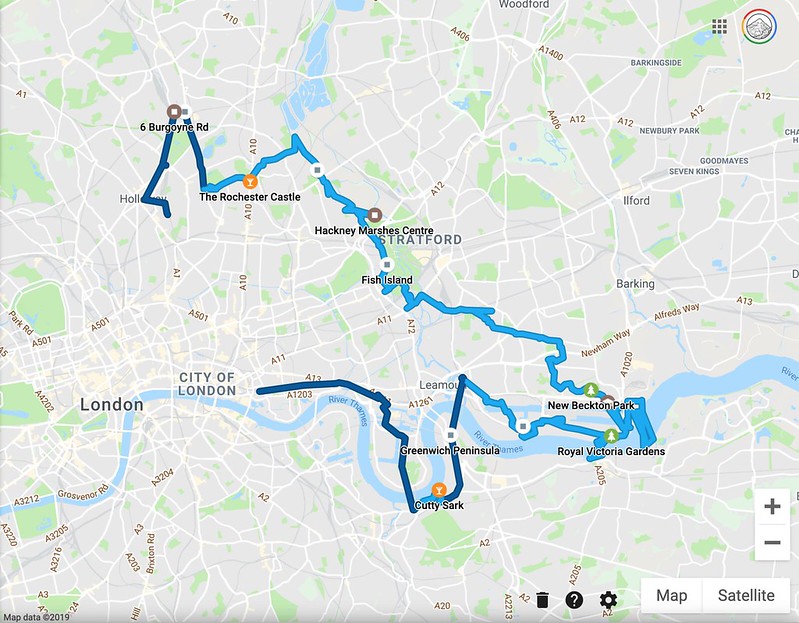
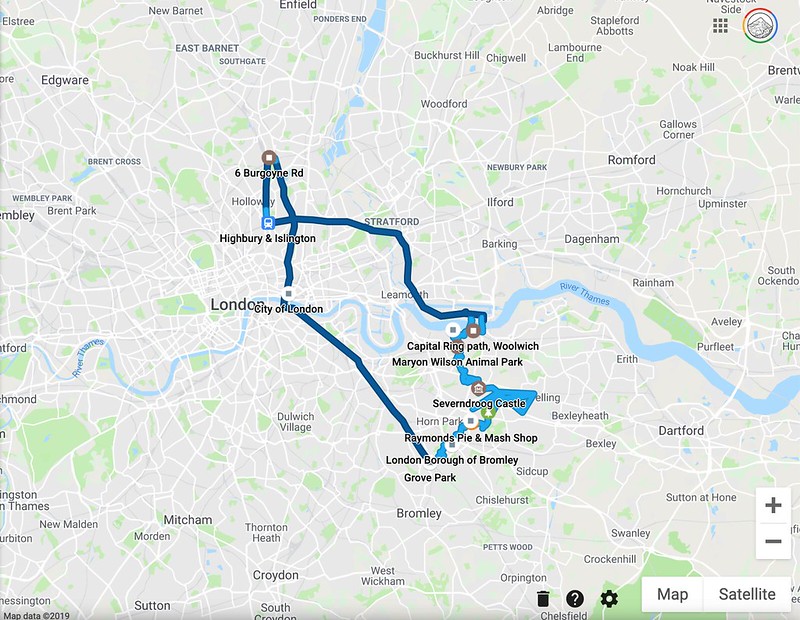
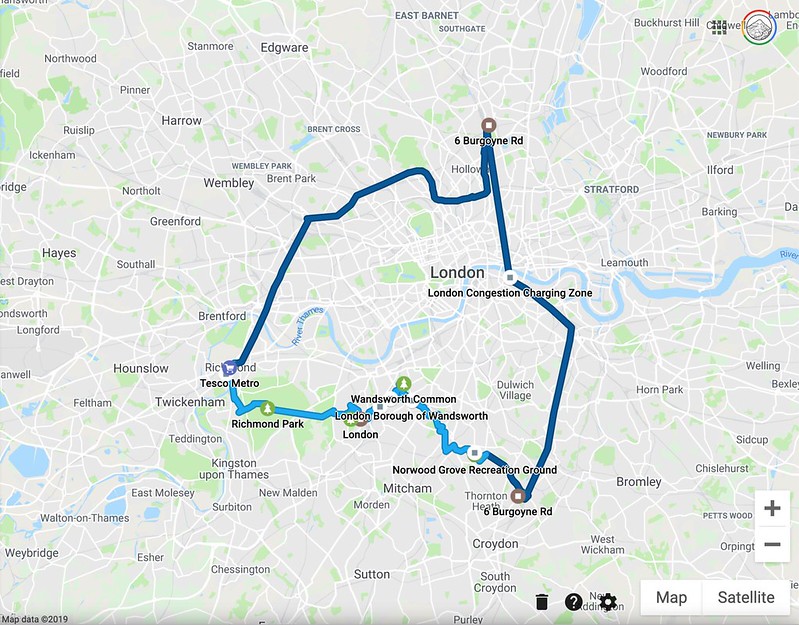
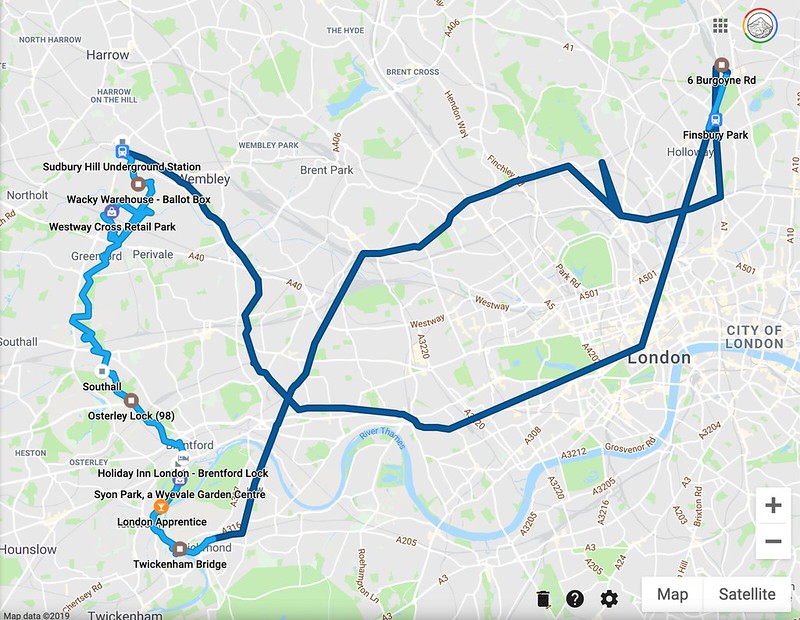
When Beano was very very small, I found myself trying to claw back a sense of mobility through a series of ever increasingly longer walks with Beano strapped to me. In some ways, this strategy reminds of me of the Capital Ring walk I did in 2017. Living in Greater London makes one feel crushed by one's own insignificance in a big city that is too vast to know by foot, so I thought I'd try to complete a ring around the city.
Once upon a time I was going to do a detailed expository blog post for each leg but AINT NOBODY GOT TIME FOR THAT so here are quite simply the photo albums for each leg of the walk...
Debbie's 2017 Capital Ring Walk!
The source material for "Flatlands"
"I decided to walk the supposedly 78 mile Capital Ring over 6 consecutive days. I say "supposedly", for Debbie does not go "as the crow flies" but rather haphazardly in a squiggly line all over the map, and according to other mapping devices it seems I may have walked more than 150 miles in total. Rather than starting with the traditional route as listed in TFL's maps and David Sharp's guide book to the Capital Ring, I decided to start and end my journey at Stoke Newington's Rochester Castle."
Day 1: Stoke Newington to Hackney Wick
Day 1: Hackney Wick to Beckton District Park
Day 1: Beckton District Park to Woolwich Foot Tunnel
Day 2: Woolwich Foot Tunnel to Falconwood
Day 2: Falconwood to Grove Park
Day 3: Grove Park to Crystal Palace
Day 3: Crystal Palace to Streatham Common
Day 4: Streatham Common to Wimbledon Park
Day 4: Wimbledon Park to Richmond
Day 5: Richmond to Osterley Lock
Day 5: Osterley Lock to Greenford
Day 5: Greenford to South Kenton
Day 6: South Kenton to Hendon Park
Day 6: Hendon Park to Highgate
Day 6: Highgate to Stoke Newington
Recently I attempted to go headstone hunting or grave hunting in Abney Park Cemetery after noticing there were many requests for people to find the grave sites - from descendants who no longer lived in the UK. There were so many plaintive requests for photos of lost memorials. I wondered why no one had helped these people with their requests for photos, and I thought I'd try to do this over the weekend, for just an hour or two. You know, just head on to Abney one afternoon and FIND ALL THE GRAVES. Fulfill a photo request. Or two. Or three.... Or a hundred and eighty five?
At first when I scrolled down the list I thought it would be a piece of cake to help search for the graves. There didn't seem so many when you're just speed scrolling through the names. But when I tried to copy out the data, I realised there were actually a whopping total of 185 requests. This was more than I had expected in terms of a number. 185 individuals had clicked on this site wanting to find a specific grave for a specific person in this cemetery. And these were just the people who knew where the memorials were located in the cemetery. I mean, from a brief glance, I had thought there were just a few dozen requests online, but not 185 requests. Perhaps I was out of my depth trying to attempt to fulfill all 185 requests. It sounded like a tall order to photograph, let alone locate 185 graves in an afternoon. But every name was a person, and how could I miss a single name on the list?
As I copied out the names, I began to develop the illusion that this was not a world so far away. I knew the area and the roads of Stoke Newington like the back of my hand, I had already read a lot about the local history, I could imagine the roads and places and houses and the work and lives that went on inside them; certain surnames resurfaced many times like Wood, Woods, Watts, Loomes, Levesque,... as I copied the names out I began to imagine I could understand how this cemetery worked, but that was definitely just some weird kind of survivorship bias...
For some reason I erroneously had the number "40,000" in my head - I thought there were 40,000 people buried in Abney Park's 12.53 hectares (31.0 acres). I realise now that I thought this because I must have seen this signboard stating that there were 40,000 headstones still remaining. But the real number of burials in Abney Park is actually well over 200,000 at this point! I was surprised by this density. For my own reference I went to google the size of one of Singapore's oldest cemeteries, Bukit Brown, which occupies about 85 hectares (211 acres) and is said to house "over 100,000 graves". The British Isle Genealogy website keeps an online index of the 194,815 burials that took place in Abney Park from 1840 to 1978. 185 out of the 194,815 graves tabulated in 1978 in a time before I was even born - that makes a mere 0.09496188691 % of the graves there at Abney. Alas, 'twere nothing but an illusion of understanding the sheer volume of graves at Abney....
After tediously copying out and cross referencing the lost graves and memorials onto a section map I made my way down to Abney. By the way, if anyone wants a copy of my list, here is the google doc: Abney Park Cemetery Photo Requests
I was instantly overwhelmed and completely thwarted by thick overgrowth. It was not even possible to go beyond the second or third row of graves in a section unless I wanted to step on countless gravestones which had fallen over. Now I always knew it was thick in there, but until you attempt to match a name to a grave in a specific section, you may not fully appreciate how many graves there are!
There were Commonwealth war graves at this cemetery - instantly recognisable from afar - now that I've visited many Commonwealth war memorials...
Because the war graves were standardised through the war graves commission, I always knew what I was looking at when I saw a war grave.
But graves come in all shapes...
in all formats...
in all sizes....
Some are very wordy...
Some get straight to the point...
Many are standing (or falling over) in all sorts of different angles...
I have a newfound respect for gravehunting as it is extremely difficult. In fact, I think it is entirely impossible. George also said I shouldn't just go around the cemetery "randomly" shrieking out names as I was looking for them.
"SECTION D06!!! HENRY VALE! WHERE ARE YOU?"
"Could Henry Vale be in there?"
"Or is Henry Vale in there?"
"Ada Wincup? Is that your headstone?"
"Mary Wood? Is your stone somewhere in there?"
CONCLUSION:
When people post a request for a photo of a grave, it is probably because:
- the grave stone no longer exists
- the grave stone cannot be found within the cemetery due to overgrowth
- the grave stone is broken or in pieces (sad but common sight)
- the text on the grave stone was too worn to read
- the location provided was wrong
- the surname provided was wrong because the female had her surname changed from her maiden name to married name
- the person requesting for the photo was simply hoping for a complete miracle
And speaking of the impossibility of finding graves in Abney, its worth noting that Abney Park Cemetery is no longer a 'working' cemetery accepting new burials, so you can't find a grave plot there anymore even if you were wanting to have yourself buried there. In case you were wondering what is the cost of being buried at one of London's 'finest' such as Highgate Cemetery, it was mentioned in a Guardian article that the cost of being buried at Highgate is currently £18,325. £16,475 for the plot and £1,850 for digging. So... yep, unless you are rolling in the money, it would truly be pretty impossible to find your grave here...
"Oaken richness", one reviewer begrudgingly writes, "but at other times, there is a sense of linguistic overload"...
Common at the National Theatre until 5 August 2017
For some time now I've had the habit of purchasing those £15 Travelex National Theatre tickets way in advance and completely forgetting about then until the day rolls along. I usually don't write reviews or keep notes on the plays and performances that I attend in London, but today after seeing Common at the Olivier I happened to google it - only to find it had received such scathing reviews for the very reason that I had most enjoyed it for: its incredibly dense language and rich imagery, all quite frenetically delivered. So I have decided to quickly write this.
I always find it hard to believe, but apparently semantic density is not quite everyone's cup of tea? "Oaken richness", one reviewer begrudgingly writes, "but at other times, there is a sense of linguistic overload". What is wrong with everybody? I don't know about you, and I'll admit I'm no theatre critic either, but when I go to the theatre, I've come to be dazzled by nonstop theatrical epiphanic glossolalia and outlandish lexical gymnastics beyond what my puny mind can conjure up on the spot. Common delivered it with a flourish, or rather, a big fat noisy hit on a clangy tin pan. A thunderous chorus of rough music.
And as for complaints of the plot being 'too obscure', and another reviewer writing "As to what the play is about: well, that’s not exactly clear." - Well excuse me, not clear? Did we even watch the same play? Surely it was not that hard to follow the logical progression of Mary's ever increasingly preposterous schemes. (SPOILER ALERT) So the play begins with Mary returning to her homeland to figure out what her homeland means to her, and she has come to take her lover away from this parochial land to America where together they can build a new home. However, her lover can no longer recognise Mary after her many years of hard grafting in the big city; her lover also rejects her city attitudes, foreign voice and foreign dressing, and her lover refuses to escape with her because of what Mary believes to be a mistaken notion of loyalty to the soil.
The backdrop of the play is 19th century England just as the Enclosure Act was passed to force people from their land so that larger and more 'efficient and profitable' farming techniques could be put in place; but with the inhumane effect of painfully separating people from their land and villages, producing a large landless labour force that would eventually fuel the industrial revolution in the big cities and the modernisation of agriculture.
At first Mary is led to believe that if she can prevent the land from being enclosed, her lover will finally feel free of her shared responsibility to help keep the common land free for the common people. Her lover tells her she might consider running away to a new land with Mary if only she could be freed of her common responsibility to the land. But it turns out this was all a trick; the land comes before love, her lover only asked her to a late-night rendezvous in order to lure her into becoming the next sacrifice for the village's harvest.
Having somehow survived the murderous plot, Mary then hatches a scheme to accelerate the loss of the commons to eject all those who had ousted her from her homeland in the very first place, taking advantage of the largess of the weak aristocratic lord of the land and using his men and his powers to obliterate the villagers who had tried to sacrifice her for the harvest and who stood protecting their common farming land from becoming Enclosed.
What makes it hardest of all is that the land that the villagers are being forced to leave behind is depicted as cruel and unsympathetic to their emotions and attachment to it; the land is harsh and barren and can hardly sustain them; in turn the land has fomented the villagers into helplessly continuing their strangely cruel practices of paganistic harvest sacrifice rituals. With the failed harvest looming, the only cycle to be seen is that of an eye for an eye, a murder for a murder, the displacement of people being followed by more displacement as those who are forcefully displaced move on and try to take other territories for their own. In a memorable fight-to-the-death scene, Mary turns the knife that her lover has prepared to stab her with - back upon on her lover! As life ebbs out of her lover, Mary uselessly tries to tell her that there is actually a bigger world out there to be lived in, but her lover will never get to see that. Mary cries at her own actions, but there is nothing left for her in that land, nothing else she can do but gather herself up and ready herself for a new life in a new land.
I wonder, did I have such a strong impression of clarity (if "mumbling" was an issue) because I sat in the front row where I was so close I could hear every single word in perfect detail; so close I could even see a stray fibre on Anne-Marie Duff's finger, illuminated in the stage light from above? Or is it only my own reading of the play that gives the play meaning to me? Or has the play been cut down in length since the previous reviews? For £15 it also seemed amazing to have what seems like the finest seat in the house - dead centre of stage, so close you can lean over and breathe on the soil itself. I understood the set with its soil-splattered cyclorama to be a depiction of the terrifying barrenness of the land - certainly amplified from the angle I was seated at, with my face in line with the ground, gazing up at the actors. Perhaps for a venue as large as the Olivier, the presence of the play may have been diminished if you were seated at the opposite end of the house; instead of the sublime barrenness experienced at the first few rows in the stalls, it might have been read as boringly empty from a seat at the top.
You can call me of simple tastes, but if you ask me, never was there a dull moment in the play for me, what with the fences set on fire, the dead animals, Mary's entertaining "clairvoyance" performances, Eggy Tom's tarry hand covered in feathers, a talking mechatronic crow (with fine comedic timing!), intimations of incest, lost lesbian love, fear of a wasted life, fear of mortality, the digging (and filling) of many holes, an Irish man reduced to begging to be allowed to finish his last song before being sacrificed for the harvest, disembowelment, English villagers donning sinister pagan masks, a human heart in a bag, ribbons of blood spraying everywhere, sudden death, sudden gunshot, smoke and fire. As Mary left the stage presumably walking into her new life, I could have sworn she winked directly at me.
I'm currently working on an "index" or documentation of 10 years of the Design Interactions Department (Royal College of Art) which I hope to finish soon (ie: before December). Much gratitude goes to Nina Pope who was the one who suggested it in the first place and allowed me to retrieve whatever flotsam and ephemera was left in the studio. I still have many people I want to write to and I confess that I originally meant to finish it by September, but it has taken me more time than expected and I am also now in Singapore working on other things. But since this is already coming after the graduation and there are no real deadlines except the one where I throw in the towel - I thought I should exercise due diligence, and do a little more digging into the wider history of design education as well as other courses which have since ceased to be, such as the Environmental Media course which was intrigued about some time back (but found not very much information about it online)...
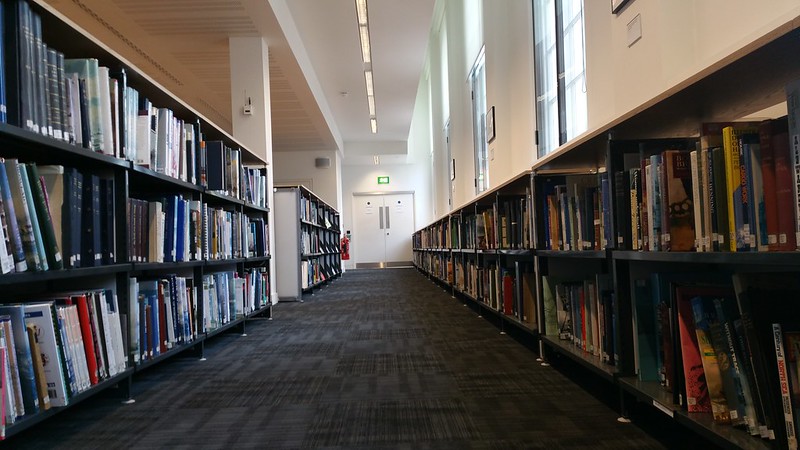
I had never been to the Special Collections prior to this, nor was I particularly enthused about the College Library with its considerably short opening hours whilst I was studying (Imperial's library was very close by and I had access to it 24-hours). I suppose the thing is that I wanted a more general library at the time but the RCA Library collection does seem quite... idiosyncratic, as is likely to become the case with any modest-sized library of about 70,000+ books (in comparison with an extreme example, the British Library holds 170 million books). As a result, I've always felt that the RCA Library is more like a kind of place you wander into and encounter some pictures in an old book that you've never seen before - rather than a comprehensive place you could go to find any specific book in a university course reading list.
With the present difficulty of entering the college outside of term time without a pass (now becoming a real schlep with all the signing-ins, waiting to be collected, etc - despite ostensibly working on/for the college in some capacity!), I was determined to MAXIMISE MY LIBRARY EXPERIENCE! FIND ALL THE MATERIALS! SEE ALL THE BOOKS! And so scoured its lending shelves quite thoroughly for interesting, rare or antiquarian finds! (In this one respect, I recommend the very first section to the right on the ground floor. One usually might not think to go there as there are no books on the right wall which is the only wall you can see, but the left wall does hold what are probably some of the most expensive books which are hidden out of view. That one wall seems to be holding the bulk of the variously large and oversize books - where you will find gems such as an ORIGINAL 1904 edition of Haeckel's Kunstformen der Natur).
Never did I think that one day I would actually read a book about the Royal College of Art from the context of a former student looking at its history. Several years ago, when I first entertained the thought of further studies, I began copying the statements issued by universities and departments to potential students into my wiki. Don't laugh, but I was so serious about applying to RCA that I actually pasted a statement from the RCA prospectus onto the front page of my wiki: "The criteria for acceptance by the Royal College of Art are talent and potential, along with the commitment and the ambition to make a difference within an art or design discipline".
If this is the statement issued by the university to the student, then what is the equivalent of the statement issued by the monarch to the institution which seeks to be a royal university? I mean, what makes the college so "royal"? There is in fact the Royal Charter that the RCA received in 1967 which made it a university (which I must admit I had not read before):
Royal Charter: Our objectives are 'to advance learning, knowledge and professional competence particularly in the fields of fine arts, in the principles and practice of art and design in their relation to industrial and commercial processes and social developments and other subjects relating thereto, through teaching, research and collaboration with industry and commerce’.
Emphasis above is mine, but what is interesting is the repeated mention of industry and commerce in the charter. No such mention of industry and commerce is in the call to students, but I suppose the state of industry and commerce in the country is less the prerogative of the individual student and more that of those who are steering the college.
In former Rector Christopher Frayling's book on the History of the Royal College of Art, Frayling writes that "it was clear in late 1970s that college was becoming test-case pour encourager les autres" - with the Undersecretary for Higher Education threatening that it might receive "less recurrent grant" in the future if the RCA did not respond enough to National needs and priorities as per its Royal Charter. In Spring 1981 a visiting committee also reported that although the RCA may be "thriving", "it was neglecting its duty enshrined in Royal Charter" by not having enough links to industry and not making the revitalisation of the British economy its ultimate priority.
In a way I feel like the dissolution of avant-garde courses such as Environmental Media in the mid 1980s foreshadows that of the present day situation. Of course, these are two different situations, but the point to be made of both is that there has always posed a great difficulty in quantifying the value of art and design education. I suppose this is why a design school prospectus is always sure to have lists of graduates who have made it big in the industry or with their own commercial success stories or commercial companies. And an art school prospectus is going to write of the big international museums, fairs, and prestigious galleries their graduates have gone on to show and sell work at. How else do you quantify success? With significant HEFCE education funding cuts in the UK, the pressure is definitely on to "prove" that funding education is still a good investment.
For example, the strategic plan 2010-2016 by current Rector Paul Thompson stated outright a goal of "Expand(ing) the programme of Master’s courses to advance new developments in design and art, ensuring twenty-first century relevance". As to the metric used to determine the success of this particular goal, the intended outcome was to be "a 50% increase in student numbers to approximately 1,500 by October 2014; this will be caused by additional recruitment to existing courses, combined with recruitment to new courses that have been successfully validated". Strategic plan 2016-2021 envisions four new research centres and ten new postgraduate taught programmes and the student body will consequently have increased to between 2,300–3,000 by 2021. [You can read the strategic plans here on the list of RCA's Corporate Publications]
Personally I would have expected "increase in student body" to have been classed under "Finance" goals from the beginning - instead of under the goal of "Relevance"; it comes across a little disingenuous when phrased as such. Only 5 years away and an expected 200% increase in the student body from 2011? I really don't see how massive increases in student numbers will directly ensure twenty-first century relevance; it will instead increase the college's income from tuition fees and reduce its dependence on HEFCE funding - which is a perfectly legitimate goal for the college.
Also, I find it problematic when I see statements like "unified, customer-focused approach to the delivery of academic and operational services" and "value-for-money" bandied about. Is this how one must write or speak in order to be understood by funding bodies? But what happened to the human poetry of intellectual curiosity that should be the foremost driving factor behind art and design research excellence today? I'm not really comfortable seeing a document that is being disseminated to students and stakeholders entirely wrapped up in jargon that may not be universally understood.
And it is not just this issue of quantifying value, which we see when a document is expressed entirely in business jargon. To speak of terminologies, I suppose the bottom line of programmes like Environmental Media and Design Interactions was to some extent, an insistence on ambiguity. Ambiguity in its materiality in the former, and ambiguity through its materiality in the latter.
An account from Frayling's "The Royal College of Art: 150 Years of Art and Design": "One reason why conceptualism, minimalism and performance art never developed solid roots within the existing Fine Art schools was that from 1975 onwards, the Department of Environmental Media had been created to teach the more avant-garde students who were emerging from post-Coldstream painting, Sculpture, and Film courses. This catch-all Department started life as "the Light Transmission and Projection unit" under Bob Hyde, rather uneasily sharing studios with Hugh Casson's interior designers. But as the unit came of age - and in particular, as it proved to be more expensive than anticipated, with increasing use of video (or rather "time-based media") - no one seemed to be sure whether it had more in common with Stained Glass (coloured light) or Sculpture (spatial art)."
[...] "In which case," yelled the Glaswegian, "you're like a surrealist painter trying to paint a picture of someone trying to paint a picture of someone trying to paint a picture of someone trying to paint a picture... If you're not a dialectical materialist you're not in the picture at all." At that point he stormed out of the room, muttering about the secret police."
At Design Interactions, the goal as I understand it, was that tutors were trying to guide us towards the production of a work that might only be partially contextualised within our world, presenting itself ambiguously as a physical object from another world within our world, simultaneously juxtaposing multiple 'realities' but crucially never allowing total escape from remembering that we are still from our own reality. Doing so would allow the work to transcend plain commentary into something more uncanny? More perturbing? Something supposedly more effective in stimulating the audience into a deeper engagement with the work and issues at hand.
The issue of ambiguity lies not only in the reception of the work but also each individual artist/designer/technologist who produces the work. How confusing that must be for anyone working OUTSIDE of the discipline looking at it, especially if the confusion arises for those trying to determine an institutionalised metric for calculating the efficacy of the works. Equally confusing it must be for artists or designers with a more malleable 'voice' - it is certainly not for all. My issue with the production of works (particularly in the case of student works, if I may be honest) was that sometimes as an outside viewer I simply could not read what the designer/artist's intentions were. Whether a work is capable of concealing and revealing its position at the same time may be dependent entirely on the viewer's common knowledge and shared understandings with the producer of the work, so the onus would be entirely on the viewer whom the author has no control over. In a sense then, the work doesn't really end until you see what comes out from the other end (ie: the engagement of the viewer), leaving us with the problem of the black box that we have yet to unpack...
As this is getting quite long, I'm going to stop here for now and move on to... an anecdote about another black box!
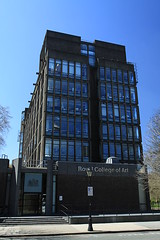
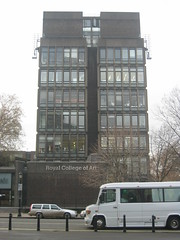
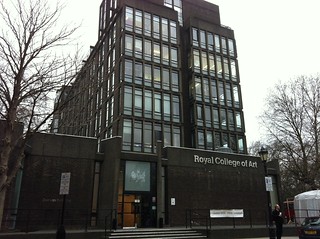
Why is the Royal College of Art black?
It never occurred to me to google for a picture of the architecture of the school until I first personally visited it for an open day, but knowing on paper that it was in the grand old Albertopolis area with a long history with the South Kensington Museum, I actually expected it to be less... harsh and BLACK. One might imagine that this was meant to make the building stand out in the area - however, it appears the truth is actually quite the opposite!
Images found on flickr by Chmee2, typeoneerror and Vicky Teinaki
The Darwin Building (Grade II listed) was designed in 1961, some years after the great Smog of 1952, which purportedly contributed to the demise of up to 4000 Londoners. This was also just before the Clean Air Acts of 1956 and 1968 banning black smoke emissions and requiring urban residents and factory operators to use smokeless fuels. Even in 1962 there was a significant fog which killed around 750 Londoners due to the extreme levels of pollution caused by black smoke (burning of coal, etc).
So in the 60s, the other buildings in the area such as the Albert Hall and the V&A Museum's terracotta design would have been covered in decades of thick black soot. Therefore, the RCA had been specially designed to have a "black brick and black concrete fondus" (both of which were rather expensive at the time) to suit the fabric of Albertopolis!
The entry on Historic England (the public body tasked with preserving and listing historic buildings/monuments) also makes this clear: "Reinforced concrete clad in dark red-brown brick intended to complement Norman Shaw's Albert Hall Mansions, then uncleaned, on the other flank of the Royal Albert Hall." In appearance, it is so dark as to appear black or grey from certain angles.
A couple years after its construction, London decided to clean up in the 1970s, perversely leaving the Darwin Building as the only outstanding sooty black building in Kensington Gore...
HELLO WORLD! I've actually got several important announcements to make and projects to document here, but before I do that, FIRST OFF, today I am going to try to push online my entire backlog of half-written posts piled up from the last few months of my semi-digital-hermitage... all of my half-baked notes on various things of interest such as Funtasy Island, the Clothworkers Company, Crystal Palace Dinosaurs, Royal College of Art's Darwin Building, Boukaloids, etc... WILL I BE ABLE TO GET IT DONE? STAY TUNED!
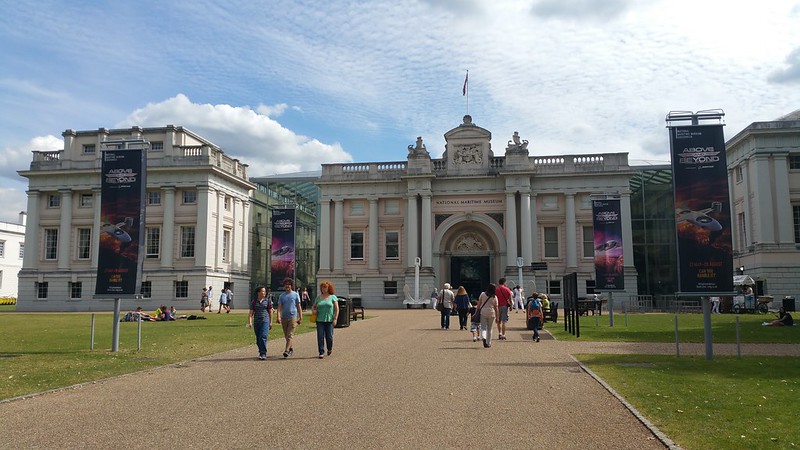
Caird Library, National Maritime Museum, London
The Caird Library is located inside the National Maritime Museum. After being to many old libraries in London it was a little surprising to see the contemporary and modestly-sized Caird - despite being housed within a rather historic building. However, what's on shelf is only a small fraction of its collections - and the staff there are also incredibly helpful if you need help in locating resources!
I was admittedly being unrealistic about what information I could actually find there - as ship logs and documents that survived long sea journeys were often only kept out of particular necessity. Furthermore the conditions at sea are in fact particularly unconducive to the preservation of information about cargo (esp since commanders and sailors often supplemented their paltry emoluments with smuggling and privateering). So instead I spent a fruitful afternoon (but quite different to how I imagined) reading up on the history of maritime insurance...
At the time the name 'Lloyd' was neutral - very ordinary but not too commonplace and held no other associations or particular connotations of class, making it suitable as the name for a coffee house which turned into a business centre; information about the progress or fate of merchant ships and other maritime intelligence were ultimately obtained by overhearing the conversations and gossip of sailors who had returned. Early underwriters would have done their underwriting at the Exchange but then the merchants and underwriters alike would seek out news through the coffee houses where people gathered.
As Charles Wright and C. Ernest Fayle's "A History of Lloyds: 1689-1713" noted: "At no time, so far as we are aware, did any group of men say to each other, "Go to; let us make the greatest centre of insurance in the world!".
There were ample opportunities where fraud could be committed where the information upon which people made business decisions was entirely hearsay, and it is also written in 1728's The Case of the Coffeemen of London and Westminster (Or An Account of the Impositions and Abuses, Put Upon Them By the Present Set of News-writers), that the coffee men complained that the news-men would come to their coffee shops where "all sorts of rousing falsehoods" were uttered until they became news, and that the coffee shops effectively played a similar role in distributing news for free, whereas the news-writers were raking in money from advertisements.
The earliest surviving copy today is from Friday Jan 3 1740 (#560)
In response to the haphazard state of the news, the coffee men decided to utilise their position as the centre of shipping intelligence of the day and make their own news. This was years after the titular Lloyd (Edward Lloyd) had passed but the name Lloyd had already become . Lloyd's List - a public report published every friday and tuesday, gathering up all the scattered pieces of shipping intelligence - covering a gamut of events such as sinkings, disasters, abandonments, vessels spoken with, ships saved, damaged, fate of crews, lost cargo, mysterious floating objects, and from time to time, occasional extraordinary occurrences.
Example: random fragments from the year of 1834...
Brest 7 Jan 1834
A quantity of Canadian timber marked M.B & SW has been driven on shore on this coast.
Neath 12 Jan 1834
A considerable quantity of palm oil and a great number of hides have been washed on show at Newton with two lower masts and several other articles
Liverpool 31 Jan 1834
Charles Joseph saw a vessel bottom up, nearly new, bottom painted green.
Liverpool 31st March
Articles picked up: segarbox, dealboxes marked D545 & a quantity of segar washing about the rocks...
From May 2 1834
Singapore, 19th Dec
"The Baltic" sailed from Marietta for this port and has not since been heard of...
If this were to be a story about the changing modes of transmissions of shipping knowledge and intelligences, then one would also imagine that by today most of the above records (even historical records of shipping information) would all have been digitised; and this should not have required my pilgrimage all the way down to these physical repositories to read them...
Digital Sheds
Source: Wikipedia (Screenshot retrieved 02 Oct 2016)
And indeed I've also noticed that Wikipedia actually has an extremely detailed list of shipwrecks - even if you wanted to search about something as specific as 1834, there is a list of shipwrecks in 1834 which from a quick glance seems to be largely written by a very prolific wikipedia editor'Mjroots' (who describes himself as someone with a hobby/interest in "molinology, deltiology, civil aircraft, railways and Dutch").
I've been fascinated by Mjroots' general sandbox - which is truly an amazing digital "junk shed-cum-workshop" of snippets. As so much of the text within seems to have been written to be the very example of a well-written wikipedia page, the Sandbox where the user Mjroots has collected all his half-written draft pages reads like a techno-poetic dream; an Infobox which tries to define all the possible parameters that might need to be known about a windmill; a Human-Markovian-wikipedia-daydream of lost ships, steam trains, windmills, tramway track maps and aircraft crash investigations...
Located in a prime spot opposite Liverpool Street and on the A10, I have walked past this place countless times, with its beautiful entrance sign. Paradoxically repelled by its grand entrance (designed by late Victorian architect Charles Harrison Townsend who also famously designed the Horniman Museum and Whitechapel Gallery), I never once stepped in, having previously simply assumed it must be one of those private workingmen's clubs to which I had no business barging into.
No doubt today I only have my own ignorance to blame for my failure to investigate further into the Bishopsgate Institute earlier, but in a document about the history of the institute released on its centenary, it seems that I am not the only confused person - "It appears that the Institute had something of an identity problem in its early years; when the caretaker was interviewed in 1899, he noted that "One ingenious person entered with a pair of roller-skates in one hand and asked to be directed to the rink. On Saturday a gentleman, carrying a Gladstone bag, and with a travelling rug thrown over his arm, rushed up and asked when the train left. But the most disconcerting experience was when a young woman entered and demurely asked 'Is this a matrimonial agency?" Her disappointment was quite saddening when informed that marriages were not performed there..."
(I was so excited about being inside this place that I forgot to take interior pictures of the main reading room. It is oddly almost exactly the stereotype of the grand old public library I had in my head when I say "I'm going to the library". And in the past, so many a time have I languished around the Brick Lane area, eventually sitting in the Old Spitalfields Market wishing there was somewhere to sit and read or do something other than jostle with rushing business people in suits and angsty travellers speeding past with their angrily overweight luggages. If only someone had told me about this back then!)
Unlike many other libraries in London, no registration or proof of identity is required to come to peruse the library's books (or make use of its fine reading tables). Besides the reference library, on request it has an amazing collection of books, maps and other materials on London, the East End, labour, and activism/protests. A very enthusiastic archivist/librarian whose name I sadly didn't manage to catch showed us around and told us briefly about the history of the collection. First established as a workingmen's library for the working class in London's East End, many of the books in the collection today were the result of one librarian - Charles Goss. His unbridled collecting was not so much celebrated during his time, but he was responsible for building up the significant collections on London history, labour history, freethought and humanism whilst going on his extremely long lunch breaks and buying insane amounts of books by the wheelbarrow. (While he was with the library, he also campaigned to raise the status and pay of library staff. Also the man had a magnificent moustache...)
In the main reading room, there's a magnificent skylight which has survived the Blitz (and people throwing small rocks at it), and the original bookshelves have also survived till today - they have got little handles on the side which people could use to climb up and access books on the higher shelves by themselves. However, this useful design addition proved to be divisive for the sexes - victorian notions of women's ankles being "indecent" resulted in women asking for a separate reading room so that men would not glimpse their ankles as they climbed up using the handles and reached up for the books in a flash of prudish ankle absurdity. (I'm curious how the books were separated then between the rooms...)
The Minute Book of the First International Working Men's Association, 1866-69
Apparently the library had been consciously painted in a neutral calm colour as in the past there were concerns that the books alone being read in an excitable environment might spark some sort of mad revolt. In fact, the single most famous manuscript in the collection is the Minute Book of the First International Working Men's Association, 1866-69. The book was allegedly hailed by some as the moment of the birth of socialism, although disputably being just an ordinary meeting which just happened to be followed by an argument between George Howell and Karl Marx. (It's also got squiggles on the back, speculated to have been made by a bored notetaker). Due to the book's popularity status (even Stalin wrote to the Institute to ask to see the book!), the book was eventually deposited at the bank across the road for safe-keeping for over 20 years...
I was very fortunate to have had the chance to visit the Parliamentary Archives, which holds the official records of the UK Parliament including acts, acts, journals, appeals, peerage claims, architectural plans, sessional papers, hansard (debates), various personal papers, etc.
The earliest document they hold is from 1497 for the House of Lords, and as for House of Commons the earliest they have is from 1547, but it would have been much earlier if not for the 'tally sticks' fire of 1834 and the small, unassuming "Jewel tower" standing across the road...
Apparently in 1834 the Exchequer/National Treasury had to dispose of a bunch of tally sticks, which were a physical form of accounting system that was becoming obsolete at the time. A primitive form of accounting which could be used even if you were totally illiterate, they were basically sticks marked with notches that were split lengthwise. These sticks were used to keep track of taxes that had been paid and an example of them can be seen here at the National Archives. Unfortunately the obsoleted sticks had their revenge just as they were being disposed of by being burnt in the basement of the House of Lords, resulting in a fire that consumed many records, except the ones in the Jewel Tower and ones that were furiously pushed to safety out of the window by a clerk...
We entered the grounds via Black Rod's Garden Entrance, and having never come explicitly to see Big Ben and the other the "touristic" sights of London before, I was shocked at the extreme numbers of people walking all around in all directions. People of every size, colour, and age, milling about on the greens and all over the roads, in every direction! "Is there a protest? Is something special going on today?" "Are these people coming to a festival? Is this place like this because Theresa May was just appointed as PM? Or is it because of Brexit??" No. Just another day at Westminster, inundated with an endless stream of flashing cameras and transient sightseers who have come to see the spectacle of parliament...
The persistence of the monarchy in the UK is a curious anachronism. From the perspective of a visitor coming from a foreign republic, the notion of it doesn't really bother me, but up close it is truly a very strange vestigial limb, wrapped up in a bizarre spectacle and ritual that I half-expect to be parody or a satire of itself.
We went up on an old lift and found ourselves in a maze of tiny passageways. The funny thing about very old and important buildings is that sometimes they seem to have been built for people who were much smaller, perhaps harking back to a time when the world's population was also smaller. You couldn't really expect to bring a big group through these tiny corridors, there just wouldn't be any space!
For those uninitiated with televised broadcasts of the State opening of the UK Parliament at the start of each new parliamentary session, Black Rod (whose Garden Entrance we used) has a very visible role in the ceremony of the opening of Parliament and the Queen's speech, where Black Rod (as representative of the Queen) summons the Commons to come to the Queen's speech. As he approaches the door of the House of Commons the door is slammed in his face, symbolising the independence that the Commons have from the queen. He then uses his black rod to knock on the door 3 times and then is admitted in to summon the Commons to attend the Queen's speech. (The short explanation of why this ritual exists is that in 1642 Charles I attempted to arrest 5 MPs which constituted a breach of the constitution, so the monarch's representative has to ask to be let into the Chamber of the house of commons, symbolising the right of the commons to question the right of the monarch's representative to enter the Chamber...)
We were shown the spot from which some strategic camera angles of the Queen are had... as the opening of this former ventilation chimney lies directly above the Sovereign’s Entrance.
"Hmm... did you say this entrance is only for the Queen? But the inside of this chamber is covered in pencils and small bits of stationery carelessly dropped in by other butterfingered visitors and researchers passing through! What will happen during the next opening?..."
Here is the famous room where all of the UK's parliamentary acts are stored - a controlled climate room to keep over 60 thousand vellum scrolls in the best condition possible.
These are actually the first scrolls I've ever seen in my life in person (I'm definitely no medievalist!). All written in iron gall ink apparently. I've never had occasion to request for a document in scroll form from any archive or library in the past. In fact I've never had to think about real scrolls in this way before, or to have to use the word Codex to distinguish it from the Scroll. [Codex being individual sheets of vellum which are then bound along one side.
I think of the Page/Codex as the "older" format from which tyrannous Infinite Scroll has emerged out of. But historically, the scroll came first. To see the scrolls as retired format for the archive is vindication that the infinite scroll is indeed a regression in terms of design - an abomination of both readability and function. I hate the infinite scroll with no end in sight, which overwhelms with too much information and takes control away from the reader who may have wished to index, bookmark or access the text with more precision. Often it is sometimes difficult to pinpoint the location of the data that one wishes to find back later, especially if you have pressed the back button on an Ajax loaded infinite scroll. As for a page/codex format, even though one can only read one page at any one time, it is also easier to make a decision on whether any material of interest will be present in a document by reading one highly specific page, as opposed to skimming through a potentially infinite chunk.
Strangely when I look at these very old scrolls, I think of them almost as a painted landscape, of them painting an infinite, continuous history. (Also: I suppose that if the scrolls consisted of only visual material and formed a continuous narrative, perhaps I'd be less prejudiced against the infinite scroll itself...)
Another significant change has recently happened, or rather, NOT HAPPENED. Although legislation has been printed and paginated for quite some time, this year there was a big decision on the material to be used. Vellum which is made out of calfskin (actually sheep and goat too) has been the traditional material used to inscribe or print upon because of its longevity - it survives thousands of years and has enabled the persistence of documents in the parliamentary archives for a thousand years! (except for humidity and fire! it can't do fire!) But earlier this year, the House of Lords debated that legislation should be printed on archival paper in order to save tens of thousands of pounds a year. The use of vellum was argued as being "vanity printing" and "frivolous flummery" in an age where efficient digital alternatives seem exist)... But of course this begs the question, how much trust can we put in digital alternatives? Can there really be any digital media storage solution which isn't inherently unreliable or under the physical threat of becoming obsolete as a format further down the line, when we are talking about 500, 1000, 5000 year time scales?
Paper lasts around 200-500 years (probably more in the range of 200), but vellum purportedly can last 5000 years. The Domesday Book was written on vellum in 1086. The Magna Carta was put on vellum in 1215. Unbelievably we can still see those very documents today. Vellum from 600 can be found in excellent condition today. There is no telling how paper will survive beyond 200 years. So, although the material change would result in some savings for parliament, it might mean jeopardise the accessibility of historical documents in the long term future - assuming that we also believe that time will go on and switching to paper might even result in costly preservation issues in 200 years time!
At the time, Paul Wright, William Cowley's general manager and Britain's remaining maker of vellum was quoted in The Telegraph as saying: "What they have decided is that future generations will be denied the privilege of touching history and no man has the right to make that decision."
Fortunately, after protests from MPs and many other supporters, it was decided that they would continue using vellum. The ability of people in over 500 years time to touch legislation made today may seem rather inconsequential in the short term, and obviously a vellum maker also has vested interests in the matter, but it touches on something quite important: indeed one may argue that we can let go of things, and sometimes we may even be forced to let go of things, but I think the desire to touch and hold these historic things in our own hands will continue to persist. A primal desire to prove its existence by squeezing it in our own hands, to have that personal tactile connection with something that we believe is real and authentic...
Here is the original FOI act printed on Vellum.
Thank you to archivist Mari Takayanagi for showing our group around the archives.
Update: On more recent attempts to gather galls to make Iron Gall Ink!
So all the acts were written in Iron Gall ink on Vellum. We know where the Vellum came from, but where does the iron gall ink come from? Where did it come from in the past? Was this ink imported, and where from?
At first, I began by doing the obvious - trying to find oak marble galls myself. Whenever I read online that galls are "widespread" around the world, I weep because for some reason, I must be living in an area of London that is somehow devoid of the specific wasps which are responsible for causing those characteristic oak marble galls.
After hours in my nearest park, Finsbury Park, I determined that there are probably only just 3 large English oak trees of note. You'd have thought there'd be more Kings of the Forest in there, but noooo, it is mainly populated with London Plane trees and a smattering of other trees including cedar, horse chestnut, holly, willow, lombardy poplar, beech, and a fair number of hornbeam trees. (NOTE: not an exhaustive list!)
English Oak
Baby Acorn (English Oak aka pedunculate oak has acorns with stalks, sessile oaks which are also known sometimes as irish oaks have stalkless acorns. These have got stalks)
Spangle Galls
Knopper Galls
Every acorn, a knopper gall!
Out of these three English Oak trees in Finsbury Park, two have a lot of galls on them, but only spangle galls and knopper galls. Funny enough, as I was searching for galls under the oak trees, I found myself being bizarrely hit on the head by a constant rain of knopper galls (the very things I came for!) as it turns out that there was a small squirrel very very high up in the tree trying to eat the baby acorns but it was discarding all the excrescences and throwing the gnarly bits down on to the ground!
Half eaten acorn, only excrescence is left!
The miscreant who is pelting me with galls
Anyway with my handful of knopper galls, I went home to read up more about galls, and on closer reading I realised that the Andricus kollari wasp itself responsible for galls was not introduced to the UK until the 1800s!!! In any case it is reported that galls on English Oak trees are ascertained to contain little tannic acid, and are of little value. I haven't verified this properly but it seems Aleppo galls from Syria and Asia Minor are said to have been shipped over in boatloads to Europe for the production of iron gall ink???