Showing posts with label rock collecting. Show all posts

Thursday, 18 December 2014

Autodidactism, The Totality of Being, and Hollow Plastic Shells.

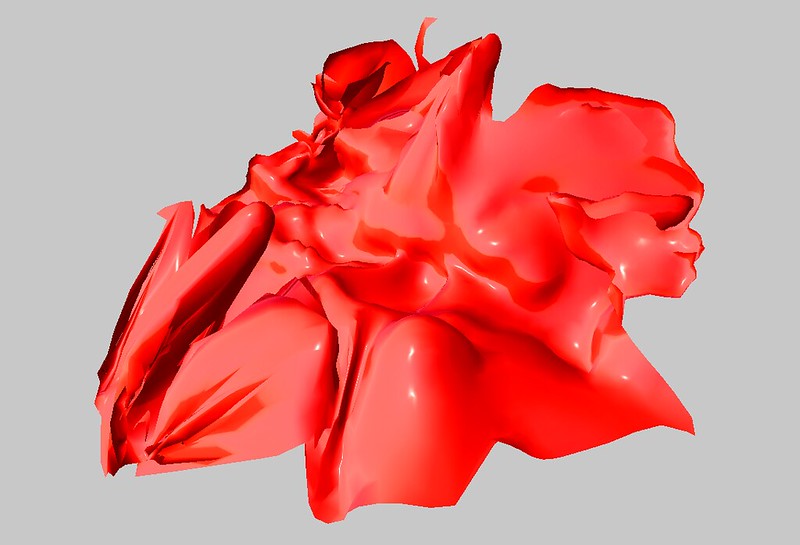
Screen Shot 2014-12-02 at 2.38.35 pm
Meshmixer Experiment (Hollow Pink Scooped Out Shell)

Georges Bataille in The Object of Desire is the Universe, or the Totality of Being (The Accursed Share II) writes:
“The intellect fails, in fact, in that with its first impulse it abstracts, separating the objects of reflection from the concrete totality of the real. It constructs, under the name of science, a world of abstract science, copied from the things of the profane world, a partial world dominated by utility. Nothing is stranger, once we have surpassed it, than this world of the intellect where each thing must answer the question "what is the use of that?" We then realise that the mental process of abstraction never gets out of a cycle in which one thing is related to another, for which the first is useful; the other thing in turn must be useful...for something else. The scythe is there for the harvest, the harvest for food, the food for labour, the labour for the factory where scythes are made. If, beyond the labour necessary for the manufacture of as many new scythes as are needed to replace the old ones, there is a surplus, its utility is defined in advance: it will serve to improve the standard of living. Nowhere do we find a totality that is an end in itself, that is meaningful as such, that doesn't need to justify itself by pleading its usefulness for some other thing. We escape this empty and sterile movement, this sum of objects and abstract functions that is the world of the intellect, only by entering a very different world where objects are on the same plane as the subject, where they form, together with the subject, a sovereign totality which is not divided by any abstraction and is commensurate with the entire universe.”
Recently, someone asked me why I make “work” and the phrase that instantly sprung to mind was “totality of being”. Like Bataille writes, the object of my desire is the totality of being. What I understand is that the utility or use-value of an object or an action is often taken to provide meaning or its raison d’etre, but this exists in an absurdly endless deferral of utility; of an action or object deriving its meaning from being useful to someone or something else. As Bataille points out in many of his writings, this could end in two ways: one could be that there could be an infinite cycle of deferral to the point where every single thing (which relies on something else for meaning) actually has no meaning at the end; or that the point is that there must be a “true end” – something with no use-value in itself. Therefore the only way to escape this cycle of abstraction is to look to a state of totality with the entire universe. A totality of knowledge of the universe.
minerals
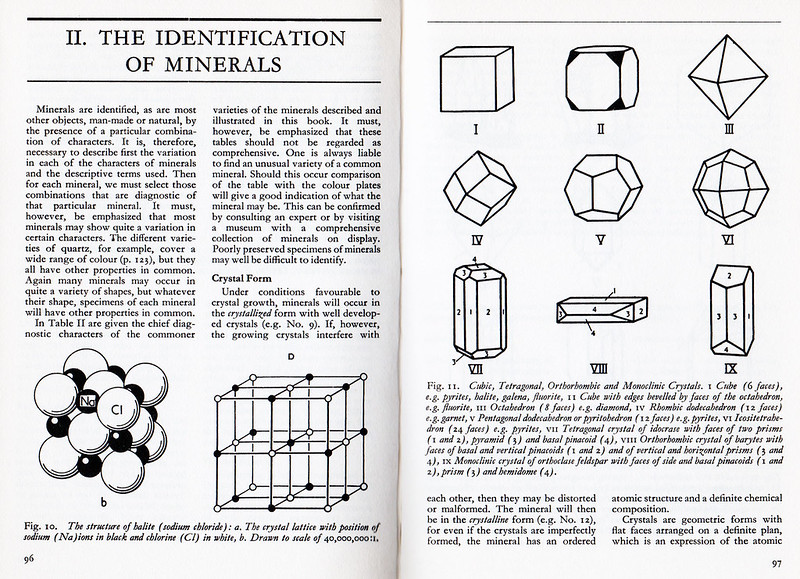
From a book I picked up at the Sussex Mineral Show. This year I wanted to restart the Royal Amateur Expedition Society for the benefit of all the amateur geologists, amateur archaeologists, amateur rock collectors - anythings. Collecting Rocks and Minerals are a good example. What use is it to start a rock collection, or to be able to identify and organise a vast collection of minerals?

Is "endless" autodidactism or the acquisition of knowledge something with no use-value in itself? I think the purest reason for learning is for learning's sake; for sheer curiosity; to remain in a state of mystery - to not find a use for the knowledge one is about to gain (at least not yet); therefore to me the more obscure, technical, or specialist "anorak" fields are of most interest - even or especially if at present I don't have any reason for making use of the knowledge I have or will acquire. In an urban life (and I know no other way of life), there is no need to learn or understand "everything" as many systems and workings of things are rendered opaque or intentionally occluded from the end-user. We do not need to understand power/electrical systems, lighting systems, HVAC systems (heating, ventilation, and air conditioning), fire alarms, plumbing systems, lifts, elevators, security systems - in order to work or live in a place with all of the following. Specialisation apparently frees us up to focus on other things, but at the expense of a rich, full understanding of how the world works. But how much of this is abstraction - or perhaps even a misreading...?

I have always thought of autodidactism as something that exists between production and consumption; I have to be a voracious consumer of information, data, or technology before I have the sufficient fundamentals to launch off and produce new observations, connections and predictions. I often wonder if the data collection and information gathering can be considered of no use-value in itself and the process of producing something useful out of the data is infact the ability to discard or 'sacrifice' data. Meaning and value then is gained from being able to throw away most of the data collected, insofar as a poem is a text with most of the words removed/sacrificed. The sign (data) is fixed in its function in having to transmit to us practical information that is turned to knowledge; but I think of the sign itself like a ridiculous, weird plastic scooped out shell to be discarded once its function is fulfilled. Why does the wrapper or the shell even remain behind? It is such a terrible distraction!

In speculation, reverse engineering or creating an artificial universe, its the other way around. You start with the knowledge that the sign ought to have transmitted. And that is where I find that the forms I have found for expressing the story is thus far inadequate. And ridiculously, I seem to instinctively turn to writing to find a clue for the visual form. At its most fundamental level, to me, the act of writing is similar to arranging a collection of items on a shelf and imbuing them with systems of enumeration - systems by which knowledge can be organised. Names and description - like ridiculous plastic vac-forms sucked over objects.
lump20141109_131146_Green Lanes_1024

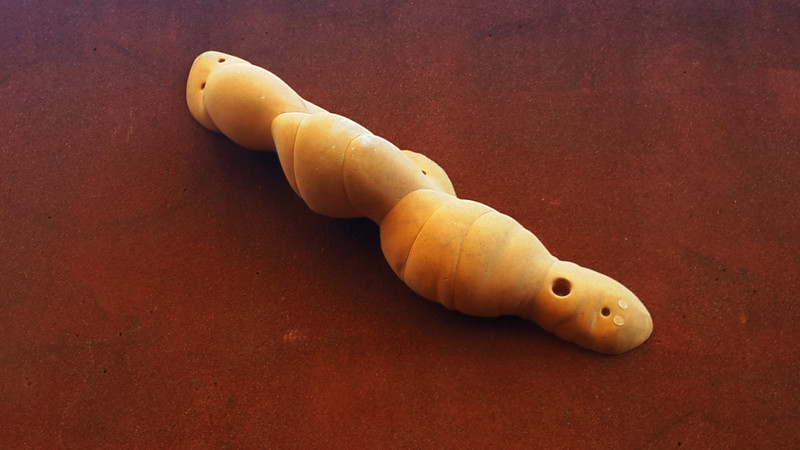
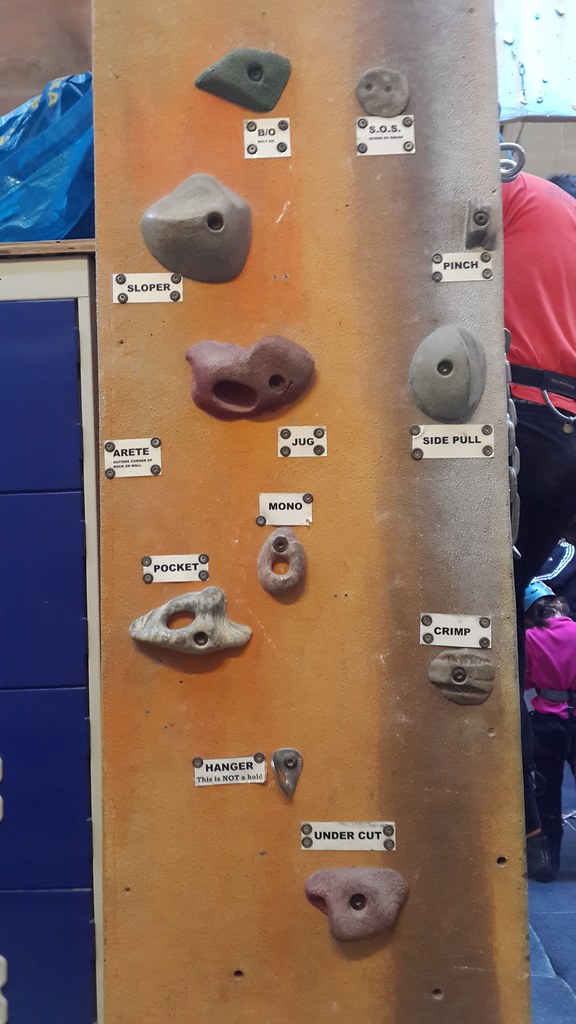
Climbing rocks. What a ridiculous sport. Look at this ridiculous rock climbing grip, presumably cast in something like resin. A plastic form cast over a rock-shaped object, or sculpted to look a bit like one, or at very least a cartoon-shaped rock I suppose. The other day we accidentally went to the climbing centre to have breakfast. Accidentally! I have never been to a climbing centre but I will go anywhere and do anything at least once. I bumped into my friend James there, and he asked me if I was climbing that day. "NO! I HATE CLIMBING!" I instinctively said, a little too forcefully. Poor James was confused. "What are you doing at the climbing centre then?" At that moment I realised that I did hate climbing. (It was a meeting that should never have happened)

20141109_132539

20141109_132505(0)

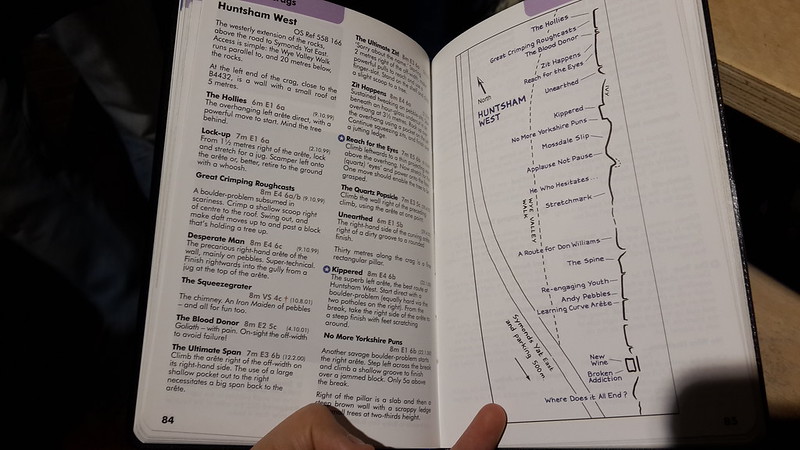
At The Castle I discovered that everything from rock climbing routes - to even the ropes are given elaborate, seemingly euphemistic names by unknown climbers that have come before you. I don't know, I guess climbers have a long time to think about it as they meditatively ascend to the artificially constructed indoor climbing peaks. I was simultaneously attracted and repulsed by the notion of allowing the person (who thinks they had first ascent) the right to give a rock climbing route a name of their choosing that may or may not have any direct relation to the route or location. There was such opportunity to choose a great name, but there was also the possibility of granting it a name that sounded more like a nasty piece of schoolboy doggerel gone way past its season.
20141109_131723_Green Lanes

Assuming one derives joy from climbing, if we were climbing for the joy of climbing up a vertical surface; if it were like being in a playground, then I too could understand it. But I was finding the ridiculous (and sometimes distractingly bright) rock climbing grips with their names, the panoply of complicated and expensive climbing gear with fancy aspiration names, and reams of books of techniques for conquering them all too heavy-handed and artificial. Who invented this whole industry of climbing? Who invented the shapes that are used on today's rock climbing grips? If we want to climb rocks, then let's go climb some real rocks! Let's stop messing about with these plastic shapes.
IMG_20141111_123927:nopm:
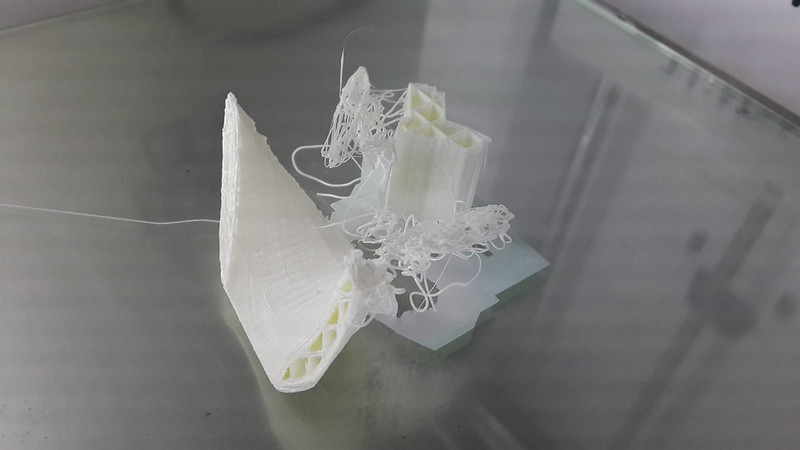
Failed Mobius Strip. 3d printed with Ultimaker 2. Used a brim and supports but the awkward angling meant it was still not enough support, patently.

Unfortunately, ironically, at the moment I seem to be buried under an unruly pile of hollow plastic shells of my own making. But slowly I am digging myself out of this pile of inconsequential prims, shapes and rubble...


I almost separated this post into a new blog but I've finally decided to compile everything into this page.

Monday, 19 August 2013

The Collectors of Pulau Saigon: Murex Trapa shells, and Pyrites (Fool's Gold)

Why do people collect things? Do we collect them to remember? Or do we collect things so we can examine them and understand them better. Or do people just collect things that look like each other in order to pass the time? Whatever the reason, I find it fascinating that in the attempt to relocate the present-day location of objects from Pulau Saigon, two small "collections" have come to my attention. They seem to be man-made collections of items that must have fallen into the Singapore River, resulting in us "collecting" them again, many years after they were first collected by someone else who might have been living on or near Pulau Saigon, the archaeological site from which these items were rescued. One is what appears to have been a collection of a very striking type of seashell, and the other is of some pyrites...

Murex Trapa, or Rare-spined Murex


IMG_9132

IMG_9133

According to a fact sheet on wildsingapore, the Murex Trapa is collected as food by coastal dwellers, and its strikingly beautiful shell is also coveted in the shell trade. It is also listed as Vulnerable and "seldom seen" today, because it is an intertidal creature that is easily affected by reclamation and over-collecting. These snails do not live in the Singapore River, so someone must have been collecting the shells from the intertidal zone and bringing them in, for there are so many of them!

[Thank you so much to Tan Swee Hee from the Raffles Biodiversity Museum for showing me the collections of the shells from Pulau Saigon and the other rock cores, meteorites, and other geological oddities from around Singapore!]

Pyrites


P8165193

P8165244

Pyrite can be used for a variety of uses such as for the production of sulfuric acid, or for uses in the paper industry. What could these have been used for in Singapore? It is not clear to me, perhaps it will take a closer study of the specific industries that used to be on Pulau Saigon to determine this. Pyrites are also used in fengshui, where they are considered to be a good fengshui stone to attract abundance. When I was young, I had a collection of semi-precious rocks and my collection included pyrites, or Fool's Gold. So I also instinctively think of pyrites as being a kind of "collector's item", having collected it before as well. So no matter what it might have been used for, it could also very well have been part of someone's collection of rocks...


For more on Pulau Saigon, see:
The Chert of Pulau Saigon, a former island in the Singapore River
Bone, Metal, Wood, and Other Artefacts found on Pulau Saigon

Saturday, 17 August 2013

The Chert of Pulau Saigon, a former island in the Singapore River

I must confess that I had not thought much about the chert of Southeast Asia until now. Is there a lot of chert in Southeast Asia? I don't really know firsthand. Most of the accessible beaches of Singapore are artificial and made of recent sand depositions from other places, and there are no points at which I can simply casually wade in and around the gravel of the Singapore River - much unlike the Thames in London, which has many wide banks upon which one can wander about without disturbance. I have, on past occasions, observed the proliferation of chert in the River Thames, and also, the endless amounts of chert/flint on Lyme Bay. So, what sort of rock is to be found in the rivers of Southeast Asia then?

IMG_0508

Chert/Flint with cute echinoid in Natural History Museum, London

IMG_5837

Chert/Flint on River Thames (London, 2012)

IMG_6151

Chert/Flint on Lyme Bay (Jurassic Coast, 2012)

To be honest, to this day I still feel that my definition of "chert" is a bit fuzzy, despite having several encounters with chert and having read up on chert before. I do know at very least that Chert is formed by the recrystallization of siliceous skeletons of marine animals into microcrystalline sedimentary rock. From what I have read so far on it, I'm going to just take it to be a more inclusive term for most of the microcrystalline quartz or silica. And as from what I saw and read at the Natural History Museum in London, flint refers to the chert commonly found in chalk or limestone...

From Wikipedia: "There is much confusion concerning the exact meanings and differences among the terms "chert", "chalcedony" and "flint" (as well as their numerous varieties). In petrology the term "chert" is used to refer generally to all rocks composed primarily of microcrystalline, cryptocrystalline and microfibrous quartz. The term does not include quartzite. Chalcedony is a microfibrous (microcrystaline with a fibrous structure) variety of quartz.

Strictly speaking, the term "flint" is reserved for varieties of chert which occur in chalk and marly limestone formations. Among non-geologists (in particular among archaeologists), the distinction between "flint" and "chert" is often one of quality - chert being lower quality than flint. This usage of the terminology is prevalent in America and is likely caused by early immigrants who imported the terms from England where most true flint (that found in chalk formations) was indeed of better quality than "common chert" (from limestone formations).

Among petrologists, chalcedony is sometimes considered separately from chert due to its fibrous structure. Since many cherts contain both microcrystaline and microfibrous quartz, it is sometimes difficult to classify a rock as completely chalcedony, thus its general inclusion as a variety of chert."

I am fed up with local people having the name "Chert", thus foiling my attempts to investigate whether Chert rock naturally occurs in this region. Anyway, the reason why I am wondering whether there is a lot of chert in the Singapore River is because of this chert specimen in the Singapore River. Knowing that some of the slate comes from the UK, I realised I had never seen THE CHERT OF SINGAPORE in person before, although I have many Chert specimens from the UK, so I wondered if this chert rock had actually come from elsewhere....

P8165496

P8165497

Chert rescued from Pulau Saigon, a former island in the Singapore River

How do we tell this is "chert"? Largely because of its "waxy luster" and conchoidal fractures, which produce a sharp edge. Brittle materials such as chert have this quality, allowing it to be shaped into knives and tools.

P8165540

P8165539

Conchoidal fractures

P8165502

P8165507

Waxy Luster

Today I was very fortunate to be able to spend a few hours at the Archaeology Lab at NUS, where I attempted to do a preliminary photoshoot of certain artefacts from Pulau Saigon, and began running some shots through Autodesk's 123d Catch in order to produce 3d models of some of the objects. Thank you to John Miksic and Goh Geok Yian for letting me occupy their pantry for the entire day and sharing with me about their work. It will take me some time to process all the information captured today, but you can expect more posts on the topic in coming weeks... (They always need more committed and responsible volunteers at their lab to help them sift through, sort through, and wash material, so if you're interested in archaeology in Singapore and are available to volunteer your time on Fridays between 10-5pm, leave me a note and I will pass your contact on to them.)

P8165432

Pulau Saigon (PSG) Stone and Rocks

P8165368

Crates

P8165694

Earthenware

P8165695

14th C Stoneware

P8165367

European Porcelain


Oh and another strange thing that happened is that I encountered the word "Diatomaceous" twice within one hour today. Whilst reading the comments to an instructable about building a solar food dryer to find out if others were worried about insects getting into their solar food dryer, I discovered a comment suggesting that "Diatomaceous earth" be scattered because its tiny, light yet highly abrasive nature makes it suitable as a mechanical insecticide, making it unpleasant for tiny ants to walk upon - basically getting inbetween their tiny exoskeleton joints and absorbing lipids from the waxy outer layer of insects' exoskeletons, causing them to dehydrate from the inside out rather quickly, leading to the death of the insects. A few minutes later I read that chert occurs in diatomaceous deposits and that kind of chert is known as diatomaceous chert. The word diatomaceous refers to diatoms, which consist of tiny microscopic marine phytoplankton, along with their fossils...

Which brings me to.... MICROPALEONTOLOGY, and the study of microfossils! Anything that you can study with the naked eye is probably considered a macrofossil. Micropaleontology is surely a field of study that is after my heart. A micropaleontologist might typically be a specialists in one or more taxonomic groups because it is something that requires so much specialisation to study the fossils of tiny tiny creatures. Speaking of tiny things, this reminds me of micrometeorites. And subsequently... astrogeology. I think this week if you asked me what is my dream job might be, it might be to study to become a micropaleontologist or an astrogeologist. Yeah, I can dream, can't I?


See also:

The Mineral collection at the Natural History Museum, and Flint Nodules along the River Thames
Bone, Metal, Wood, and Other Artefacts found on Pulau Saigon
Made-up Road Names and Temporary Islands
Ruins in Reverse

Friday, 10 May 2013

Sungei Road Findings

Yesterday night after FORK2 I was walking around Sungei Road where I discovered a few new things.

IMG_5563

The number of chairs on Sungei Road has multiplied exponentially. There is literally a chair on every other corner. Years ago there might be a few straggly chairs left on the fences. But now there are dozens of chairs everywhere.

IMG_5583

IMG_5580

IMG_5585

IMG_5593

IMG_5594

IMG_5597

IMG_5560

Compare this to my post on 13 April 2012 and 2 May 2012 when I first noticed that the number of chairs had started increasing. Perhaps it is people's only way of staking their presence on the very road itself, where no other permanent or physical structures have been allowed to remain.

IMG_5570

IMG_5575

At the corner where Larut Road, Weld Road, and Jalan Besar Road now meet, I also found a block that looked JUST like one of the fragments in the Ethnographic Fragments project (see: Jalan Besar Cement Block). It was exactly the same size, except that it had inscriptions on it. Notably, at the time, I had recorded down that I had picked up that block because there were no other rocks like it in the area and it was strikingly geometric. If that rock could talk I would have said to it, "HEY BABY, YOU LOOK FAMILIAR, HAVE I SEEN YOU AROUND SOMEWHERE BEFORE?" But I probably shouldn't be talking to rocks cos next thing you know I'd have turned into the Crazy Rock Lady...


Now I have developed this habit where every time I am in the area, I go around and snoop around all the electrical boxes that I know of. So I checked behind the electrical box along the Muslim Cemetery on Victoria Lane (pictured below, still there), and I checked the back of the busstop (long since cleaned away).

IMG_5601

On Victoria Lane, facing the Muslim Cemetery (First documented in March 2012)

I probably check every single box every few weeks, unless I am out of the country. Whilst waiting for Bus 7 I decided to use my phone as a torch to examine the back of another electric box near the busstop, one located at a more visible spot by the road, a spot with fairly high human traffic. Two Malay Men were standing there right next to the box, chitchatting, and the entire bus stop was very full as if there had just been a big social event at the Madrassah behind the Muslim cemetery. I expected to find nothing but...

IMG_5603

...BUT WHAT WAS THIS?

IMG_5604

A FAINT SIGN OF THE YANGTZE SCRIBBLER THAT WAS CERTAINLY NOT THERE A FEW WEEKS AGO!!!

I am thinking that due to the highly visible nature of this box, it must have been cleaned before I got here. However the traces remain! AND IN A HIGHLY VISIBLE SPOT. This wasn't like previous ones, tucked away in a stairwell, or hidden behind a tight corner where no one would usually see, but facing the main pavement next to a bus stop! Also, coincidentally, this sign also chose to reveal itself to me AT THE VERY MOMENT THE BUS 7 STARTED PULLING UP INTO THE BUS STOP BAY SO I JUST QUICKLY TOOK SOME PHOTOS AND RAN FOR THE BUS. The two men next to the box must have been wondering why someone would be pointing and making unintelligible excited sounds at the box and taking photos of it with a flash and then quickly running off.

So in conclusion, ladies and gentlemen, I think this means the trail of the Yangtze Scribbler is still hot. Whoever he/she is, he/she is probably still alive and active in the area.

Saturday, 5 January 2013

On the Rights of Rocks to Stay or to Go

IMG_0285

Yesterday, a strange incident occurred here in Stamford Hill. It was somewhere after midnight when there was suddenly a loud shattering of glass in the room. No one was hurt, but the whole room was covered in small glass fragments, even in the bookshelves. We had been facing the other wall when it happened. We looked at the lightbulbs to see if they had blown, but in the end discovered the source of all the broken glass was a gaping hole in the window. Somebody or something had broken the window with some projectile. We could not ascertain if it had been a rock or a pellet gun or something more sinister, so we called the police to let them know - just in case it had been a serial incident in the area.

IMG_0273

After we had called the police, we discovered a small half-rock on the sofa. By half-rock I mean a rock that looked like it had been shattered into two by a hammer. Unfortunately, as people who have been following my blog or my work will know, I collect rocks (and half-rocks in particular). This is probably the first time that I've discovered any downside to being a rock collector, and that would be: Not being sure if the rock on the sofa is the projectile that someone just used to break the window - or just another a rock from your rock collection?...

Screen Shot 2013-01-05 at 7.16.16 PM.png

Screen Shot 2013-01-05 at 7.16.51 PM.png

Screen Shot 2013-01-05 at 7.17.26 PM.png

Example: Thames River half-rocks from my rock collection

So when Hackney police called back (and came by to file the report), we told them about the rock but with the caveat that that one of us was a rock collector and could not tell for sure if it was our rock or the offending projectile. This did, however, prompt me to take out my bag full of Thames rocks and Paris rocks and I examined all of them. Based on its appearance, it seemed like it could conceivably be one of my rocks… but what would it be doing in the sofa that we frequently dusted off and rearranged? It was a far leap from G's mantlepiece. And the angle was all wrong for it to have come from the hole in the window…

"You can go ahead and touch the rock," the policeman said when he came around, "we can't take fingerprints on rocks or test for minerals or fibers, or that sort of thing." Good thing to know next time you need to commit a crime with a rock... They ain't gonna to be able to do much forensics with it after all...

photo (1)

Later that night, after we had picked up most of the glass off the carpet, I decided to pick up and read The Book of Books which I picked up at dOCUMENTA(13). The book itself is ridiculously huge (23 x 6.1 x 28 cm) and heavy (2.5kg), so I have been deliberating on whether to take the book back to Singapore in my check-in luggage.

Since I can't take an infinite amount of things in my luggage, I've taken the precautions of mailing back parcels of the large and heavy items I had accumulated over the last few months. Recently, I also shipped back a number of very heavy slabs of pavement rocks from Paris - rocks that technically had no value except that they were pavement rocks that I had collected by hand and exhibited in a show. People have been asking me whether I would bring the rocks back to Singapore - and I did think for a very long time about whether I should remove them from their country of origin. But there was no conceivable way that I could leave them there where I had found them, where no one would know their significance to me; how could I ever justify throwing them out? So, I was compelled to take them with me, no matter what. But 20kg of rocks is very expensive to ship from France to Singapore. Firstly, without the help of Elio I would never have been able to even shift them to the post office as they were too heavy for me to carry on my own; and secondly, as it was to be expected, it was enormously expensive to ship them back to Singapore: the resultant shipping for 20kg of rocks cost a few hundred Euros… and on top of that, they are still somewhere lost in transit as we speak… I suppose 20kg of rocks in a cardboard wrapping would look pretty suspicious…

IMG_7998

The weight of these items - which prevents them from being physically transported in a convenient or casual fashion - also gives them certain import. For example, after all these travels about Europe, I know for a certainty now that any single piece of luggage exceeding 28kg is physically impossible for me to lift - or so much as feebly drag along the ground, no matter how much I desire it. The truth of the matter is that it is physically impossible for me to lift any piece of luggage that is heavier than 28kg. If I had found a rock that was 28kg heavy, there would be absolutely no question of asking if I would carry the rock home with me because it would not be physically possible to do so in the first place.

I read Carolyn Christov-Bakargiev’s opening essay to The Book of Books with much interest because it involves a story about another abortive attempt to move a very big rock. She writes about one of the few projects that was publicly announced but eventually did not come to fulfillment at dOCUMENTA(13) - the proposal by Argentinian artists Guillermo Faivovich and Nicholas Goldberg to bring El Chaco, the second largest meteorite in the world, from its original resting place north of Argentina, to a temporary location in Kassel that would have been not far from Walter De Maria's Vertical Earth Kilometre (a metal rod of 5cm diameter that appears as a flat circular disc when viewed from the top but which goes 1km deep into the ground).

Apparently Argentine law prohibits the removal of any of the meteorite fragments from the Chaco province, but had made a turn-around and approved the move of El Chaco specifically for the purposes of documents, with the provincial government citing it as a chance to spread awareness of the impoverished area of Chaco and its meteorites. However, there was opposition to the move from the aboriginal Moqoit natives for whom the El Chaco is a sacred monument, backed by scientists, some of whom have written passionately on the issue.

meteor

Image from artinfo.com

As quoted in many articles, one of the most outspoken of letters is from a social anthropologist Alejandro López who wrote: "We firmly believe that this project implies a deeply colonialist attitude, wherein the artists’ desire is to link themselves with the wealth and valuables of the Chaco. Instead of this “transfer” of the meteorite as a sort of “cosmic curiosity,” it would be preferable for those who have the money and prestige to seek to promote the value of the meteorite within its place of origin."

Searching for other articles on El Chaco, I have to admit that I found it somewhat maddening that most if not all of the news reports follow in the same tone as the letter above, condemning the artists' intentions as "colonial" or upholding some manner of "deeply colonial attitudes" towards the ways in which "cultural objects" are to be handled.

An AFP report has the headline: "An unlikely alliance between the native Moqoit people and leading Argentine scientists has thwarted plans to ship the world's second largest meteorite to Germany as a prestigious art exhibit."

Thwarted! As if the artists were an evil and cruel money-grubbing force trying to steal the rock from the poor poor natives! No doubt, it remains indefensible that the artists failed to consult the Moqoit before submitting the proposal, and that past attempts by colonialists to steal their meteorites (because it was made of metal) have left "serious cultural damage" and left the Moqoit with a legacy of "suspicion and insecurity" towards anyone who should make advances on their rock.

But to chalk every subsequent proposal to move El Chaco down to an act of colonialism is surely just as much subjugating the Moquoi natives and forcing them to keep playing the role of "victim" -- trapped within the old colonised-vs-colonialist mindset!

To cry "colonialist" is like falling into the trap of the "anti-colonial" stance; it perpetuates the old narratives of imperialism, colonialism, conquest, oppression, emancipation, etc; it expects that the stories should play out as power struggles between the oppressed and the oppressor; it expects that everyone in the world still has identities fixed by cultural or geographical origins; it expects that artists should make works which then have to be explained from their country of origin or socio-economic background or upbringing. And that is just so... boring.

Carolyn Christov-Bakagiev: "And what if we asked ourselves, beyond this irresolvable contradiction, what it was to see things from the position of the meteorite? It had travelled through vertiginous space before landing on Earth and settling. Would it have wished to go on this further journey? Does it have any rights, and if so, how can they be exercised? Can it asked to be buried again, as some of the Moqoit argue, or would it have enjoyed a short trip to an art exhibition, rather than a science or world's fair? (…) What is this displaced position, generated by the perception of a simultaneous being in different spaces, where the collapse of time and distance provokes a new sense of what it means to be always in one place, and not in another place?"