Showing posts with label national library board. Show all posts

Saturday, 17 June 2017

The Invisible Holography Section and a Holographic Reading List

I've been doing a considerable amount of reading and research on holography (and fine art holography) lately, so as I was passing through the National Library of Singapore the other day I decided to look in on what they had in the general lending section. Much to my surprise I saw that Holography had its own category in the dewey decimal system!


Oh sweet well let's go to 774 then...


Alright here are all the books from 771...


And here are all the books from 775...


HOLD ON...

THERE ARE ABSOLUTELY NO BOOKS UNDER 774?


If you do search the NLB catalogue, you will find that they have got a few books on Holography at 774 - but these books are all reference books! So there are no books on holography for the masses. Oh no! So there is no chance that one might be blindly wandering through the shelves, hoping to randomly soak up ideas from library books and BLAM! A HOLOGRAPHY BOOK SECTION! But no! There isn't any Holography Section, even though the word appears on the bookshelves. OH BUT HOW WILL WE DEVELOP (OR REVIVE?) THE HOLOGRAPHIC ARTS IN SINGAPORE THEN?

When you google for "Dewey Decimal 774" it says that 774 is no longer being used for Holography. However, if you google for the most updated version of the DDC 23 it says 774 is still Holography. Maybe the wikipedia page needs editing. (I'm not an expert on DDC to be honest)

Nevertheless there are actually a whole lot of very excellent books about holography out there, which I don't feel have been represented here. So I've decided to write out Debbie's recommended reading list if one wants to read more about holography:

A HOLOGRAPHIC READING LIST!


1. Johnston, Sean. Holograms: A Cultural History. Oxford: Oxford University Press, 2016.
If you've ever asked the questions "why do we no longer see holograms everywhere? why did the medium fail commercially? and why does it persist as a science fiction staple?" then this book will answer all your burning questions! This book explores what caused the rise, demise, and apparitional persistence of the hologram in visual culture. Its publication was preceded by Johnston's 2006 book, Holographic Visions: A History of New Science, which is also definitely worth a read.

2. Schröter, Jens. 3D: History, Theory and Aesthetics of the Transplane Image. London: Bloomsbury Academic, 2014.
Beyond the term hologram, we can think of the 3D image as a transplane image, which Schroter's book attempts to trace through history and theory. Schroter also edited another book "Das Holographische Wissen" edited with Stefan Rieger but alas I do not read German.

3. Falk, David S., Dieter R. Brill, and David G. Stork. "Holography." Seeing the Light: Optics in Nature, Photography, Color, Vision and Holography. N.Y.: Harper and Row, 1986, 368-393.
There are tons of hardcore mathematical books explaining holography (interference pattern of coherent light is by now so well known to man and a staple in physics classrooms) but this remains one of the most classic textbook explaining the maths and optics behind much of photography and holography (Chapter 14). Practical yet poetic and accessible for readers even without maths or science backgrounds.

Other recommended readings:
(These are books which I've personally found useful in thinking about scientific approaches, technological innovations, and military technology's influence in ways of producing images / transplane images / art)
1. Galison, Peter and Caroline A. Jones, eds. Picturing Science, Producing Art. New York: Routledge, 1998.

2. Virillo, Paul. The Vision Machine. London: British Film Institute, 1994.

3. Bishop, Ryan and John Phillips. Modernist Avant-Garde Aesthetics and Contemporary Military Technology: Technicities of Perception. Edinburgh University Press, 2010.


To be honest the above list is simply whatever I've enjoyed reading recently - so if you asked me to compile another holographic reading list in a few months time I expect the list will have expanded over time... so this..... IS TO BE UPDATED IN THE FUTURE!

Sunday, 9 August 2015

In Praise of Insignificant Details

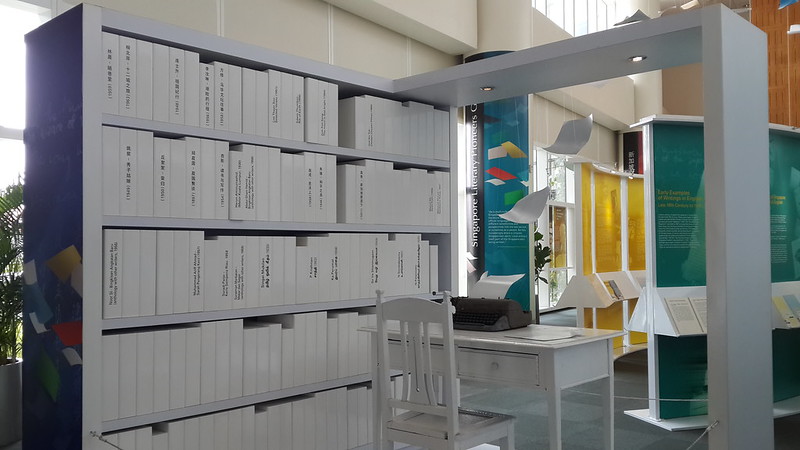
The other day I had a dream in which I wandered into a room and there was a white table with papers flying off into the sky. Behind it, there were shelves in which the books of all of Singapore's literary pioneers were arranged, as if these books had been magically plucked out from the shelves of the library and lovingly collected into one room for our easy access...

20150805_103108_Middle Rd

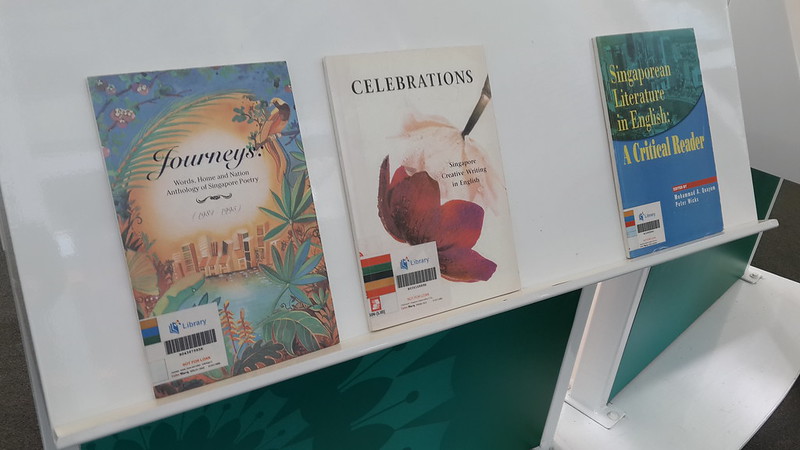
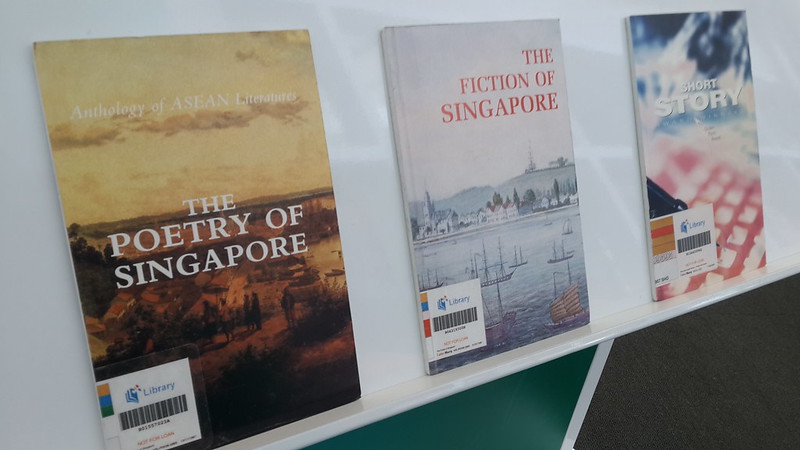
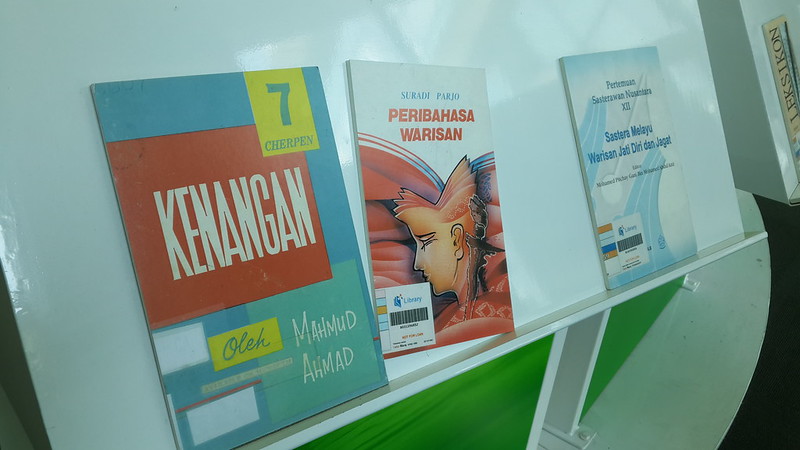
Oh wait! I'm kidding, it wasn't just a dream, it was real, and you don't even need to wait a moment longer to experience the exact same thing in person if you're in Singapore, for this very exhibition has actually been up at the National Library for the last ten years at Level 11. (Wait, what? Ten years??)

20150805_102723_Middle Rd

20150805_102852_Victoria St

20150805_102800_Middle Rd

20150805_102706_Middle Rd

20150805_102633_Middle Rd

Some of the books on these shelves lay in a disarray, as if others had also picked them up and flipped through them recently before replacing them back onto these shelves. So I picked up a book...

20150805_102643_Middle Rd

20150805_102640_Middle Rd

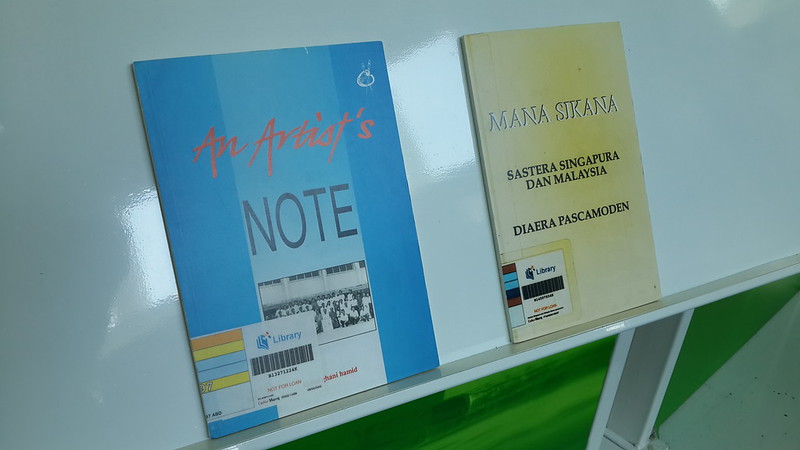
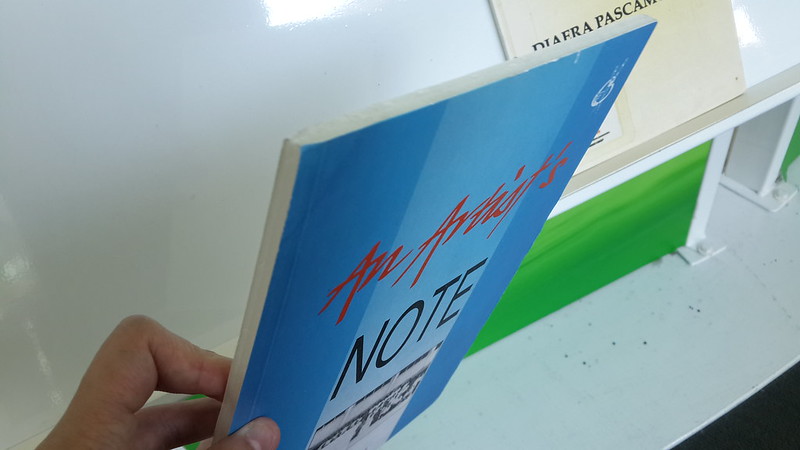
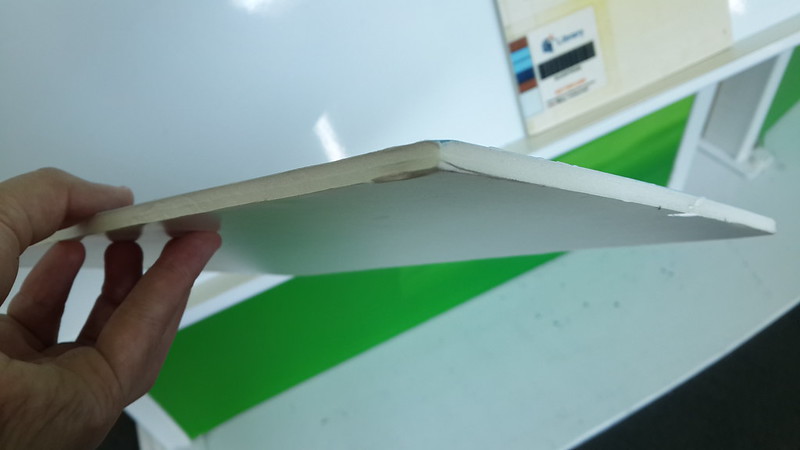
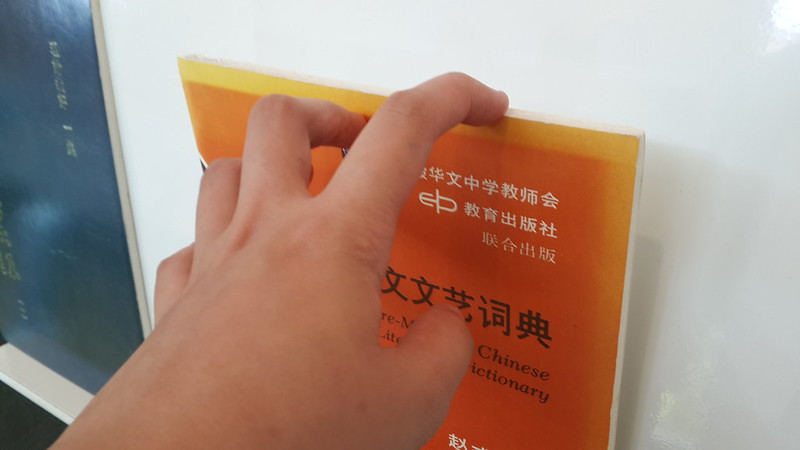
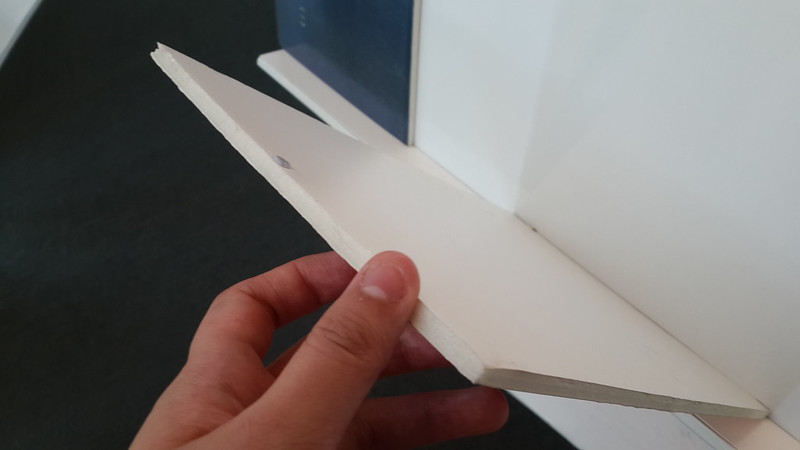
It was at that point that I realised it was not a book! It was just a solid block of foam with a scanned reproduction of the book cover printed on top of it! A bizarre Cronenburg-esque moment, all around me, what seemed like regular National Library books with the distinctively colour-coded stickers on their side turned out to be nothing more than hollow blocks of foam, devoid of words or detail on the inside!

20150805_102930_Middle Rd

20150805_102932_Middle Rd

Curious as to the origins of this exhibition, I looked it up and found records which show that the "Singapore Literary Pioneers" exhibition originally opened in November 2005, along with the National Library's move to Victoria Street. Perhaps at some point during the past, these shelves in this exhibition actually held the original books, yet by this point they had all been put back into the collections, leaving nothing more than the skeletal, hollow foam board simulacrums of themselves behind...

The National Library has now been at its Victoria Street site for ten years now! Prior to that, the National Library had been at Stamford Road behind The Substation since 1958. In 1953 the rubber and pineapple king Lee Kong Chian donated a large sum to set up a national library which would be open to the public; in 1957 he laid the foundation stone for that iconic red-bricked building. But in 2000 it was announced that the building was to be demolished for the construction of a road tunnel and the new SMU campus. So the site of the former red-bricked NLB building unfortunately became a vehicular tunnel; a cruel twist which seemed almost emblematic of the denigration of people's fondly remembered cultural spaces in the process of urban redevelopment - the library's architectural and historical merits apparently insufficient for it to be have been gazetted as a national monument.

There was also a practical reason for the NLB's move; I was reading the 1989 report of the advisory council on Culture and the Arts, which noted that book holdings in the National Library building in Stamford Road had already "exceeded the space available" - which was to the detriment of Singapore's cultural development. So moving to a new building on Bras Basah would in theory allow for much more space - space for more collections, more books and more exhibitions.


I've graduated from RCA and I'm back in Singapore now! I have lots of things to document from the last few months (which I will document here in due course), but right now I'm working on something in September, on behalf of The Substation. I’ve been spending a lot of time at The Substation and the National Library building of late, constantly pondering the dilemma of writing text for an exhibition that is about an art space - but the exhibition will be held in a site other than its own - it will be at a library!

Mind you, I've also basically spent two years at a design programme being reminded that the gallery is not a library, and that the number of words in a gallery and museum should be kept as few as possible, because people came to look at things, not to read! But even now, when I'm preparing an exhibition to be set in the library, where the words should be more plentiful, where we shouldn't need to be shy about shoving books in people's faces, the caveat about not overwhelming the reader/viewer with too many words still exists.

I wonder, if that is why there aren't words inside the books in the Level 11 exhibition? Would the presence of so many words in the space make everyone less likely to engage with the content fully? Perhaps it was feared that putting the actual books on show would induce viewers to get stuck at the first book they came upon, rather than skimming through this condensed history of Singapore's literary landscape.

Maybe this is a matter of exhibition design. Let's talk about in numbers, since most Singaporeans seem to understand things better in terms of numbers. How many words can we realistically hope that the average person will read at an exhibition? The average reading speed of a native English language speaker is said to be between 250 to 300 words per minute. Let's give it a bit of wiggle room and assume that the bilingual Singaporean (in a moment of idle distraction!) reads only 200 words per minute.

If an average visitor spends half an hour in our exhibition space, but only spends 50% of his or her time actually reading the text on the wall (the other 50% being spent on talking to people, looking at the pretty pictures, looking out of the window at the skyline, or watching the videos), then perhaps we can hope for 15 minutes x 200 words or about 3000 words to be consumed during an average visitor's half-hour long trip to an exhibition - if we are so lucky!

This means that if I write more than 300 words for each of the 10 sections of the exhibition, then maybe most people won't be able to read everything I've written in an average visit to the exhibition.

But how can I possibly tell you the 25 year history of The Substation within 3000 words - scarcely more than an essay's length? Would it be better if I put more shiny pictures on blocks of hollow foam? But the photos are so few. And all I have are so many of these texts, quotes, paraphrased rumours, and snippets - surely this amounts to more and more words being packed into the show!

But maybe the most important thing is not just the big, beautiful, totalising statement that will sum up everything within my 300 word count. The things I want to tell you come in the form of almost insignificant details. Maybe there isn't anything metaphorical about it.

I'd like to believe that what seems like textual fluff, the description of events and people and programmes and objects and their seeming insignificance in relation to the larger narrative, actually is key to our understanding of it. In his essay The Reality Effect, Barthes argues that these small insignificant details, when put together, signify the real, the l’effet de reel.

For me, there is something so important about all these insignificant, longwinded details. In La Nuit des prolétaires: Archives du rêve ouvrier (which was published in English as “Nights of Labor”, or “Proletarian Nights: The Workers' Dream in Nineteenth-Century France”), Rancière presents a series of fragmentary, seemingly insignificant details and contradictory accounts of a small group of worker-intellectuals in the 1830s and 1840s. I like his seemingly anti-sociology, anti-historicising approach in digging through the archives to excavate these accounts. In the introduction, Rancière writes:

If the protests of the workplace are to have a voice, if worker emancipation is to possess a human face, if workers are to exist as subjects of a collective discourse which gives meaning to their multifarious assemblies and combats, those representatives must already have made themselves other in a double, hopeless rejection, refusing both to live like workers and to talk like the bourgeoisie.

This is the history of isolated utterances, and of an impossible act of self-identification at the very root of those great discourses in which the voice of the proletariat as a whole can be heard. It is a story of semblances and simulacra which lovers of the masses have tirelessly tried to cover up.

The night forms the grey area where poor workers unexpectedly double up as clandestine intellectuals; Rancière chooses to give significance to quotes from hybrid figures, painting a much more incongruous picture of the digressions, distractions and conflicting motivations behind each individual that is often taken to be part of a whole, giving significance to the words and stories which could have easily dismissed as meaningless since they were hard for us to process or to summarise into a 'pure' or neat theory.

In choosing to structure an exhibition around “spaces”, I feel that the goal of my role as 'curator' or 'mediator' of the archive would be to position these hundreds of extracts from the Substation's archive in a space between a conventional confinement to their “place” in time and space - and a completely utopian or metaphorical abstraction of the spaces...

Friday, 11 July 2014

The Act of Rationalising the Destruction of Books: Singapore's National Library Board pulps books!

P7110131

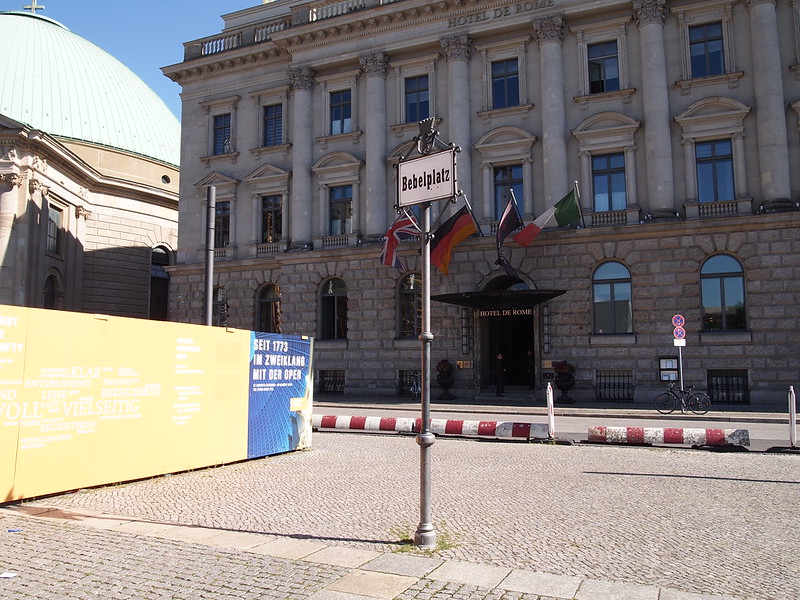
Today I had a walk around Mitte in Berlin, and I went past Bebelplatz.

P7110142

On 10 May 1933, in this open square next to the opera house and Humboldt University, over 20,000 books were burnt in the square after Joseph Goebbels gave an incendiary speech to a crowd of 40,000 people and students. The entire library of the Institut für Sexualwissenschaft (Institute of Sex Research) was first to go; dragged out on the streets and burnt to ashes. Books by numerous Jewish writers and pacifists were also pulled out from nearby public libraries and burnt. These included works by Heinrich Mann, Heinrich Heine, Stefan Zweig, Karl Marx, Albert Einstein, Kurt Tucholsky, and Erich Maria Remarque.

The Institut für Sexualwissenschaft was a non-profit foundation which conducted research on sexuality with regards to medicine, psychology, and ethnography. The Institute also had been an early advocate of sex education, contraception, and had been campaigning for the civil rights and acceptance of homosexual and transgender people.
P7110137

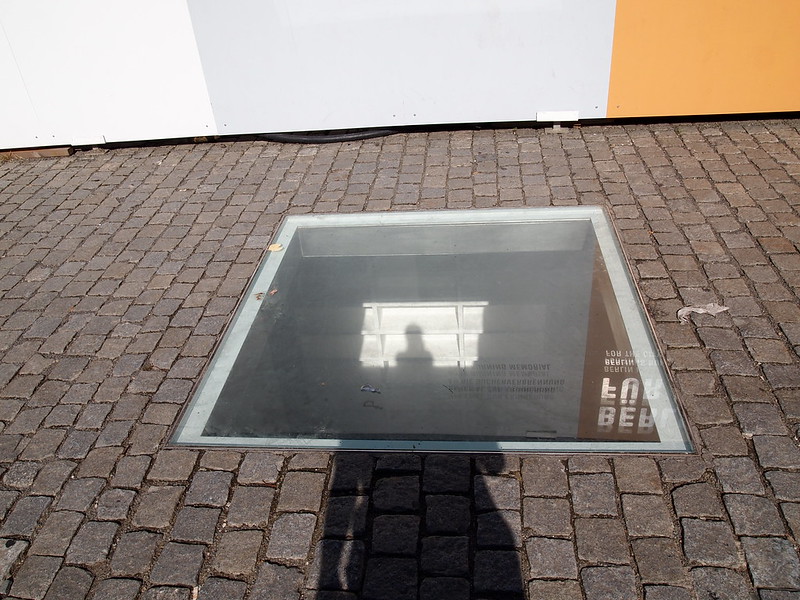
The Book-burning Memorial by Israeli artist Micha Ullman - consisting of an empty subterranean library that could have held 20,000 books

10 JULY 2014, STRAITS TIMES, SINGAPORE: Three children's titles recently removed by the National Library Board (NLB) as they were deemed not "pro-family" will not be put back on the public libraries' shelves. The three titles are: And Tango Makes Three, The White Swan Express: A Story About Adoption, and Who's In My Family: All About Our Families.

In a press conference held at the children's section of the Toa Payoh Public Library, Ms Jasna Dhansukhlal, assistant director of NLB's public library services, said the books will go through a "discarding process" where they will be pulped...

Pulped! One would reasonably expect that a library is a place where books will be kept safe, and where they would be a champion of freedom of information and speech. Yet this is not the case at the National Library Board; who after receiving a petition requesting for the books to be reinstated, instead announced that they decided that they would stick with their "pro-family" stand, and would be in fact pulping the books!

The pulping and destruction of literature because it isn't aligned with a particular set of values is something that a library should never be engaged in. Even with the way Singapore is generally thought of to be conservative, never did I expect that they would say that they would pulp the books to be withdrawn. Were we even talking about the same place where I spent hours and hours reading in the reference section as a young teenager? With one fell swoop they were going to stain all my happy hours there with the horror of imagining all the unknown books they may have withdrawn and destroyed over the years due to some conservative and religious complainants. At some point I had outgrown the National Library and had wondered why its collections in its public sections were so sparse and unrepresentative of the vast literature out there, and I thought it was likelier to be from a failure to acquire the books, rather than the possibility of there having been a slow but systematic culling of books along the way. But now even we cannot be sure, because we do not have the numbers.

There are also a few separate issues at stake here: (1) BIGOTRY: Can our national library be allowed to be openly anti-LGBTQ? should the library be allowed to impose a moralistic "pro-family" (anti-LGBTQ) policy over its public access collections and withdraw those books which do not reflect those so-called "community norms"? (2) CENSORSHIP: Can our national library be allowed to play moral watchdog and censor materials at will? Why should they be allowed to define what is an acceptable family structure, and why is it defined in such a narrow way? and (3) ACCOUNTABILITY & TRANSPARENCY: Can the library can be trusted to make the right decisions when it has shown that it is not accountable and transparent in its actions? Should a library be empowered to quietly withdraw books from their collection at will if a single individual with his or her personal moralistic/religious agenda complains about a book?

We do not have a Freedom of Information act in Singapore, therefore there is no official instrument with which to request for NLB to make the list of books which they have withdrawn public, unless they decide on their own to make this information public. The government-citizen relationship in Singapore is still largely a nanny-state in which the government exerts power over the people by withholding data and information, and by doing so restricting people from making autonomous decisions. For example, the belief that the government controls everything continues to influences people's behaviour, as evidenced from how opposition parties still have to reassure some voters that nothing bad will happen to them if they vote for the opposition.

A few days ago the government also announced that they would not be bringing Article 5(2A) of the Constitution into force, which means that it can make amendments to our Constitution without having a vote. The reason they cited was that they might want to make refinements to our tax system and the basis on which the Government can draw on net investment returns for current spending, so being able to amend the Constitution would save Singaporeans from the process of a potentially lengthy and protracted national referendum.

The issue then, is whether you trust the government to do exactly as they say, and whether you trust that the Government will truly be able to do everything in the people's interests.

Unfortunately, this is not a perfect world that we live in. I am always suspicious if I hear someone tell me that they know what's best for me - assuming that they must know better than I know it myself. As a logical and thinking individual, I would like to be able to make the decision for myself, instead of letting someone else summarily make the decision for me. It is not that I am being contrary for the sake of being contrary, but it is simply that I would like to understand how everything works for myself before I have an opinion, and to have the autonomy of making choices for myself. For me, this autonomy of choices also forms the basis of a democratic society, in a space where we can have open and honest discourse.

It is interesting to note how the destruction of those books is often very carefully rationalised by those who are homophobic; in all the reports, the suppression of the books is always described as a kind of positive action on the part of homophobics to stem the "pollution" before it "infects children". They describe the complete eradication of books with any representations of LGBTQ people (and penguins) as a way to attain a better society with better values, with none of that terrible corrupting gay influence.

The Nazis also used a lot of propaganda aimed at educating children and students about the so-called corrupting influences of the Jewish and gay people, to the point where the burning of libraries became a way of showing support for the government. They also had a War Manual, the "Kriegsbrauch im Landkriege" (The Usages of War on Land), in which they formally justified terrorising civilians and destroying the cultural capital of their enemies as such: "War cannot be conducted merely against the combatants of an enemy state but must seek to destroy the total material and intellectual (geistig) resources of the enemy."

In "Libricide: The Regime-Sponsored Destruction of Books and Libraries in the Twentieth Century", Rebecca Knuth writes an account of how the Nazis even made a point of their tactics of cultural warfare by completely destroying the same Louvain Library in Belgium not once but twice! - during both world wars, even though they had already been rebuked and widely deplored the first time around, and the US and Britain had spent considerable effort trying to rebuild the library only for the Nazis to destroy it for a second time.

I am disappointed to see so many people who have graduated from my alma mater National University of Singapore, saying such terrible things and supporting NLB's destructive actions in the name of so-called "pro-family values". In all of my years of education in Singapore, I was never taught to hate and discriminate and to force my views on to others! What happened to make so many Singaporeans so ignorant and intolerant of differences in views?

Has there been a lack of exposure to the outside world and the realities that exist outside it? Do these people know that many countries around the world recognise the human rights of LGBTQ people and ban all anti-gay discrimination? In countries such as UK, Denmark, Norway, Sweden, and Iceland same-sex marriages and same-sex adoption have been legalised as well. Those countries are all doing pretty fine and nothing much has changed, except that more people now have their human rights recognised.

To me, it seems that Singapore's public libraries and education system have completely failed if all they have done is to produce so many ignorant and intolerant people today who cannot think for themselves - people who would rather let the state control and define what their children can or cannot read, because they are apparently afraid that their children will become corrupted by a single book - presumably because they feel incapable of thinking for themselves after years of being told what to do - by their religious leaders or by the government.

Books and the dissemination of information through printing and technology are the very things which have enabled us to create and share ideas of identity, individualism, human rights, and even the idea of a nation. These are all potentially ideas and notions which different people may have very different views about.

How can a National Library be allowed to pulp books based on a single complaint without further consideration of other people's points of view? If it can pulp few children's books like this, how can it be trusted to manage the National Archives of Singapore, which moved under the National Library Board in 2012? A library that continues to promote intolerance, bigotry and destroys books should not be managing our National Archives, or the archive of books deposited by Singaporean authors by legal deposition.

Today as I walked around Bebelplatz, I was accosted by endless streams of young American and British tourists in huge numbers, distinctly audible from their accents, which made me bristle with the annoyance I frequently get in a place overrun by tourists and generic packaged tour groups; the pre-packaged, simplified narrative that tour groups invariably assign to hot tourist destinations. There was a tour guide standing close to me giving a description of the square to a dozen teenagers, talking about the significance of books and why the burning of books was such a terrible atrocity that should never be repeated again.

To me, it sounded so obvious and logical that his statements came across almost trite. Likewise I also find that my entire article is nothing more than stating the obvious. Yet as obvious as it seems, in the end it is a lesson that many still have not learnt.
P7110128

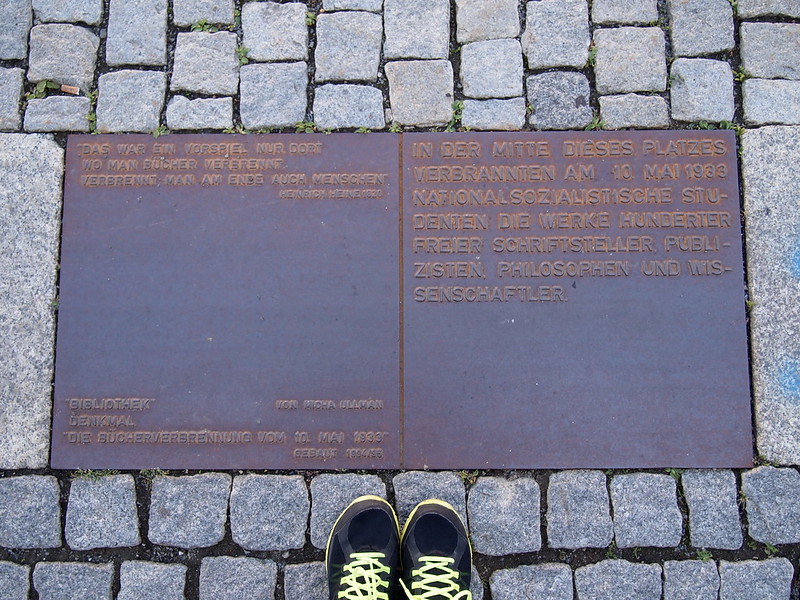
Das war ein Vorspiel nur dort
wo man Bücher verbrennt,
verbrennt man am Ende auch Menschen
- Heinrich Heine 1820
That was only a prelude, there
where they burn books,
they burn in the end people.
- Heinrich Heine 1820