Showing posts with label historical material. Show all posts

Sunday, 17 July 2016

General Colonial History, Explorations and Voyages, and Richard Hakluyt: A Visit to the Institute of Historical Research Library


This week I’ve been at a course at the Institute of Historical Research, and I wish I had done something like earlier – because prior to this, it was as if I had been hitting a nail into a plank with a smartphone and going about the historical portion of my research quite randomly and inefficiently. So I have decided that for documentation purposes (as a process blog!), I shall make short summaries of the trips to each of the the library/archive that I've visited this week (and separately on my own), including:

  • Institute of Historical Research Library
  • London Metropolitan Archives
  • Bishopsgate's Institute
  • The National Archive
  • Clothworkers' Company Archive
  • House of Lords Archive
  • Lambeth Palace Archive
  • London Archaeological Archive and Resource Centre
  • British Library
  • Wellcome Trust Library
  • …and more to come!

Beginning with... the IHR library itself!


Institute of Historical Research Library


Excuse me, for the massive gaps in my historical/geographical knowledge shall soon be showing! Is there a term for this kind of bias where you end up mainly reading first about the things which are seemingly more closely related to yourself, rather than reading EVERYTHING ELSE IN THE WORLD indiscriminately? I rather like the free-associating browsing of a physical library rather than a direct automatic search of a digital catalogue, but one does tend to gravitate to familiar territory for starters. And actually, I really shouldn't apologise for not knowing every single thing, but maybe this is some weird workaholic guilt at work here... but then, perhaps it would be great to exercise my right to have incomplete knowledge if I should want to, perhaps.. even as a political statement or as affirmation of one's position? Right! SORRY BUT NOT SORRY! (Sorry)

At junior college, which was the last time I actually studied history in school - what we were taught in schools in Singapore was local and regional history (Singapore History and Southeast Asian History) and as for that extra something to give us a bigger picture of historical context, the 'earliest' era we would have looked in the syllabus was Cold War, ie: 1945 onwards. ie: what I would call Modern History. I regret to say that I never took a History module in my undergrad years either. So... basically in all my life I've never attended a medieval history class.

An ex from many many years ago had specialised in Middle English poetry and once painstakingly wrote out a poem for me in Middle English. The unappreciative early-20something-year-old me at the time looked at it as some oddity but never tried to read it. I didn't quite concern myself about historical variations of Englishes since the main remit of my studies seemed to have nothing to do with it. Simply thought of the translation process as an fruitless endeavour to which there would be no point, just wanted to read the version I could read. And so the poem just went out of mind, undeciphered. I never really knew what the poem meant because I didn't read it. In fact, I don't even have the foggiest idea what it was about now! I guess I failed to appreciate the amount of hard work and scholarship that goes into studying MIDDLE ENGLISH - and the value of being able to personally read it! To be able to access the original text before translation!


At the end of the first day of the course I had time to explore the IHR's Wohl Library. Having no prior experience of studying European History, one might even ask - what is an uneducated philistine like me doing at the Institute of Historical Research then? Greeted by tall shelves of "Low Countries" (apparently one of the central collection priorities of the IHR!) I belatedly realised that all I knew of the “Low Countries” was that it was some kind of archaic term for some bits of Western Europe which were lower-lying but my spatial knowledge of European geography and topography was too embarrassingly fuzzy to be able to pinpoint or recall the countries encompassed by this term! [I went home in shame to read up about it properly and now know that the Low Countries refers to the coastal reason of western Europe including Belgium, the Netherlands, and Luxembourg. Ironically I also found out that I had indeed written this down in my wiki/notebook several years ago but clean forgotten it since. Oh forgive me Benelux, I have entirely failed at historical geographing!]

Grasping at straws for something I would be a bit more familiar with, I blithely went to investigate the COLONIES: GENERAL area.


Oh no! Dialed too far back on the time machine!!

Apparently the IHR’s collection of sources on British North America is “one of the best in the UK”. (And I’ve definitely never encountered a physical collection of books on British North America until this point in my life... so having the chance to grab random books off the shelf to read was a delightful first)

And actually, I realise I've never really read up about East India Company’s earlier history; certainly my (generalised) knowledge of its ministrations is largely from the period after the expansion of the opium trade and establishment of Straits Settlements.


Here, I found a copy of Hakluyt’s well-known The Principall Navigations Voyages and Discoveries of the English Nation. Famous early chronicler of maritime adventures! Early colonial ideologue, economic opportunist and promoter of proselytising... [Also the adopted namesake (no direct but only symbolic links) of the rather secretive business intelligence company “Hakluyt & Company” (which incidentally also has a base in Singapore)]


And there were entire shelves of the Hakluyt Society’s publications – who have been printing editions of first hand accounts of historic voyages and travels.


Anyway, so here this is the massive volume that constitutes The Principall Navigations Voyages and Discoveries of the English Nation - such an historic piece of English travel-writing! - and I can’t believe I can walk up to it and just pick this massive copy off a shelf!


....And naturally, it is either in Latin or Middle English. Its like a TRIAL BY FIRE WAIT THIS IS NOT EVEN CALLED "MEDIEVAL" IS IT? IS THIS WHAT YOU CALL EARLY MODERN TYPOGRAPHY? HELP! WHAT AM I DOING? WHAT DO I DO?


Yeah this is more like the level I'm at:
"What do you mean Lorem Ipsum is not Latin, but just Latin gibberish...??"

It must have been a translation into English I had seen in the past, or maybe was it secondary material through which I had first encountered Hakluyt? I don’t even know! Up to this point everything I’ve touched has arguably been secondary source material. Contemporary books, journals, newspapers mediated through the eyes of the reporter and the witnesses, government reports arguably evaluated through the viewpoint of the administrator… all of these facsimiles! Reproductions! Digital surrogates!

If there's one thing I’m comforted by is in this tale is that – actually, despite Hakluyt being known for his publications on voyages – actually he himself was not actually an explorer. Instead, he had begun as a university scholar who set out to read about all the voyages he could - and then specialised in writing, translating, contextualising them. And yet the writer wields such powers in the process of writing or record of the journey. How else would I know of these journeys today?


On an aside, here are two mad bookbinding covers for speeches/addresses of the Hakluyt Society, one of which is for the tercentenary or 300-year anniversary of Hakluyt's death in 1916. (This means that this year will be the 400-year anniversary, or quatercentenary... Yes I had to google for the right word for it... it is not a common term which is quite rolling off the tip of my tongue)


IN THE NEXT EPISODES: WE VISIT MORE ARCHIVES INCLUDING THAT OF HAKLUYT'S BENEFACTOR THE WORSHIPFUL CLOTHWORKERS' COMPANY (WHO GAVE HAKLUYT A PENSION), WHICH BY THEIR ADMISSION HAD BEEN ESTABLISHED "PRETTY LATE" IN 1528. COS YEAH... YOU KNOW... SOME OF THE OTHER LIVERY COMPANIES EVEN STARTED A FEW HUNDRED YEARS BEFORE THAT IN THE... ELEVENTIES #backtothe1100s #nobigdeal

Friday, 10 June 2016

Searching for British Library Manuscripts, Trying to understand 19th Century Palaeography through Calligraphy practice, and Iron Gall Ink!

The amazing treasure trove that is the British Library! Despite the wealth of resources available there, I always feel like its catalogues are so arcane and confusing that I think it is worth making a list of things I wish they told me from the start, if it will save someone else from the confusion I had in the reading rooms - with embarrassingly noisy book stand apparatus that no one tells you how to use, and thousand paged manuscripts wrapped in very complicated cake boxes with string!...

Untitled

THINGS I WISH SOMEONE TOLD ME EARLIER ABOUT USING THE BRITISH LIBRARY


  • Archives are in a separate catalogue. On the BL page and dropdown menu: Catalogues > MANUSCRIPTS > Archives and Manuscripts.
  • There may be a "handlist" on open shelves for reference. The handlist is a list of items which are on display or which are available for requesting within a specific collection.
  • Ordering Microfilm: There is a microfilm option hidden at bottom of Request Other Items. So even if the item is technically a copy of something from Private Papers, you should order it under Microfilm. Again, I wish this was explained clearly from the very beginning.
  • Before leaving the counter, check that the item you have received is actually the actual item you have ordered. Yes, I have had the unusual fortune of receiving the wrong item after patiently waiting well over an hour for it!
  • Although the rooms close at 5, it seems that by 4.30 they'll start to ask for the special materials to be returned.
  • You have to leave most things outside and you have to use a plastic bag to bring things in
  • You cannot bring pens in. You can only bring pencils.
  • You cannot take photos of some historical material. But if you have retrieved it in microfilm form, you can take as many pictures as you want for free on your mobile phone camera. (I'd really like to find out what is the rationale for this rule?...)
  • You need a pound coin to use the lockers downstairs. (Interestingly, people also regularly forget to take their £1 coin deposit from their lockers at the basement. Just sayin...!)

Recently I wanted to look for some historical documents which were held under the India Office Records. It was then that I realised that I have never handled primary historical material before, so when the librarian asked me if I wanted original or microfilm I was confused. ORIGINAL OR MICROFILM? No one had ever asked me to choose between the two! Should I want to see the microfilm instead of the original? Is the copy truly identical to the original? I suppose I am not a historian, and I'm not usually doing such research involving very old materials, hence most of the records I have sought out in the past were all microfilm. How did this happen???

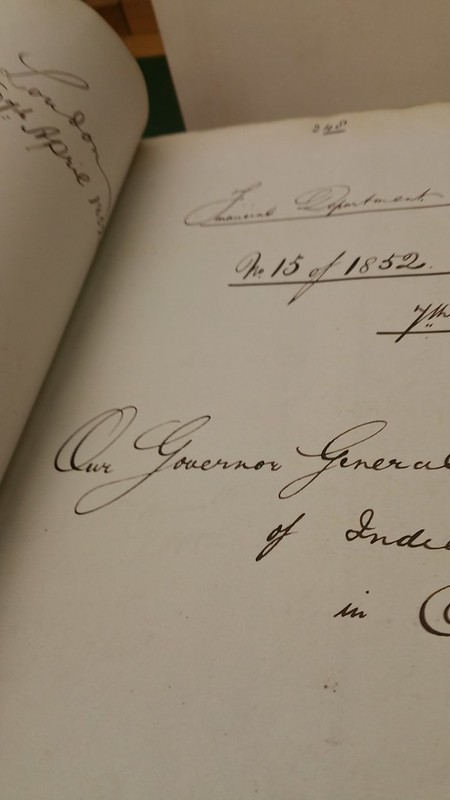
Aaaaaaaand that was how I ended up handling some original copies of Sir Stamford Raffles' letters to his sister. I became intensely afraid of suddenly developing a explosive nosebleed whilst hovering close to the thin slips of paper, almost translucent in the light. And tragically, it was then that I also realised... I COULD NOT READ THE HANDWRITING. It was almost a flat line! And what is going on the letter r and ff? And had all these weird squiggles about it! And why did people use only a perplexingly small portion of the entire paper???

Furthermore, whilst looking through other EIC documents, I realised that I had extreme difficulty with copperplate, even though it represented the standardisation of administrative script! Doom! I imagined the eagle eyes of the librarians boring into the back of my skull as I opened up the paper and could do nothing more than attempt to decode it letter by letter... I took so long that it was closing time. The librarian then told me, "You know, you should get the microfilm next time, then you can take photos and read it off the photograph more slowly." MORE SLOWLY? HOW MUCH MORE SLOWER CAN I DO THIS?

A few days later, I decided to should try to get to grips with things by learning calligraphy or copperplate. Again, this turned out to be another first for me, and I realised I had never used an ink pen. Oddly enough, I had used a lot of digital "grunge" or ink effects in photoshop when I was a teenager, because it was all the rage at the time. But ink splotches were nothing more than things people made as packs of images and shared online, or digitally mimicked with photoshop brushes! Ink wells? Actual ink? Who used ink? Unbelievable that my life has been dominated by the digital ways! Well, never too late I guess...

PROGRESSION: TWO WEEKS OF CALLIGRAPHIC MESSING ABOUT


On 27 May I decided to get a calligraphy pen set. These nibs were wack and not bendy in the least. The result was boring. And I had no idea what I was doing.


On 1 June I got some interesting nibs in the mail - the Brause Rose, Leonardt Hiro, and a few others. The results began to improve.


1 June 2016


6 June 2016


8 June 2016


Sumi Ink. I have learnt the hard way that you should not turn the bottle upside down....


The ink that came with this beginner's set of inks was Indian Ink, but apparently Indian Ink was invented in CHINA, but the carbon materials for Indian Ink come from India. At first I thought this carbon ink must be the ink that everyone had used for all the documents that I could expect to see in the British Library collections (originating from the UK). It sounded logical on the surface and it is an old ink with some history....

But as I looked into historical inks, I found out that the standard ink that was used in medieval europe (5th - 19th c) was actually an iron gall ink? Made specifically from.... OAK GALLS! Gallotannic acids were extracted from galls in trees (how did they find all these galls? Does it mean it would have been widely celebrated, to find these galls? Were there gall hunters??)

How on earth did they discover that these galls were useful for making ink??? The earliest mention appears to have been by Pliny the Elder (23AD - 75AD) who noted that verdigris (iron) + an infusion of nut galls equals BLACK ON PAPYRUS. A brief search online of the history of iron gall ink brings up many pages suggesting that it is not really known when people transitioned from carbon inks to iron gall ink, but for the most part by the medieval times people were mainly using iron gall ink due to its permanence, non-clogging action (compared to carbon-based ink like indian ink), and "relative ease of production" (WHERE WERE ALL THE GALLS COMING FROM? DOES THAT MEAN THERE WAS A WHOLE MARKET FOR TRADING GALLS?)

I guess galls are easier to find than carbon if that material had to come from overseas! And today it seems more likely for me to be able to buy a whole load of... carbon on ebay as opposed to locating elusive plant galls in nature!

Oak galls have been used in the production of ink since at least the time of the Roman Empire. From the Middle Ages to the early twentieth century, iron gall ink was the main medium used for writing in the Western world

Why did I not know this when I last did research about galls??? Apparently many significant manuscripts were written using iron oak gall ink, including one of the oldest Bibles, the Codex Sinaticus (around 4C). Also, despite not being used widely today, in the UK, registrars today still are required to use a special blue-black archival quality ink which apparently has ferro gallic compounds - used to sign official documents such as birth certificates, marriage certificates, death certificates and on clergy rolls and ships' logbooks!

Now.... I finally have a functional reason to go out and hunt for more oak galls!...

...SO I CAN EXECUTE ONE OF THESE RECIPES FOR IRON GALL INK!
http://www.instructables.com/id/Making-Iron-Gall-Ink/
http://www.transitionblackisle.org/oak-gall-ink
https://www.westdean.org.uk/study/school-of-conservation/blog/books-and-library-materials/making-testing-iron-gall-ink