Showing posts with label new foods. Show all posts

Thursday, 4 April 2019

The Last Meal: Hawker dishes in the future (The Substation, 29-30 March 2019)

20190330_214912

The documentation of this project, "The Last Meal", comes a bit late - although perhaps a little fittingly because a number of food-related ailments seemingly kept me from being able to work at my maximum potential.

Earlier this year, I was fortuitously brought together with Chef Ming (of JAM at Siri House) - by The Substation - and thus began a collaboration to reinterpret local/hawker fare into a kind of anxiety-provoking menu. A disturbingly uncanny trip up and down and around memory lane! A speculative vision of our human weakness fondness for nostalgia meets hard future utilitarian compromises! An experimental work for the palate! It was truly an pleasure and honour to be able to work with Chef Ming who took it on with so much energy and so many ideas to take it further, especially the start of the project coinciding with a period of severe fatigue for me.

I had recently sought treatment (CBT/Exposure Therapy) for what has been a lifelong affliction of emetophobia (a completely debilitating fear of vomiting) and an unreasonable aversion to acidic or vinegary foods (a difficult thing to explain at times, because it can sound absurd to preemptively tell everyone "NO VINEGAR PLZ" in the off-chance that any unknown dish might have vinegar). And I had also seen an endocrinologist to ask if there was anything to explain my ridiculously tiny appetite and aversion to cold temperatures - and was subsequently diagnosed with hypothyroidism (so said all the tests, despite me being an extremely hyper person). And finally, the biggest factor of all that had triggered this intense self-examination was: pregnancy! SHOCK! HORROR! Yes folks, the Ding and South are unexpectedly multiplying (stay tuned for a documentation of this new long-term project), and this meant that for a period of time during the first trimester I developed an strong aversion to my favourite food of all - eggs! This was very hard to live down indeed, compounding all of my food anxieties despite my attempts to deal with them head-on like an adult by following up with all these medical investigations. So all of this was in the background as we began discussions for this food project....

The starting point for our conversation had been one of my past projects from a Healthcare Workshop with the Kyoto Institute of Design x Royal College of Art, whilst I was doing my MA at Design Interactions (RCA). In a way, that workshop's premise was already a bit like smashing two worlds together: you had that base of a historically practical and functional Japanese approach to researching and designing for elderly care (I remember our Japanese collaborator bringing to us these booklets of amazing innovative mobility aids and novel healthcare aids designed to assist in every aspect of elderly care) - meeting the provocative, parallel realities of a speculative future (as students from our Design Interactions programme used to call it, ahem, a more "DI" approach).

PC133515 PC133512
PC143630 PC143606

Kyoto 2014: Kyoto D-lab held a Healthcare Futures Workshop centering on robotics in collaboration with the Design Interactions Course at the Royal College of Art - led by Professor Anthony Dunne and James Auger and D-lab’s Professor Julia Cassim.

Me, Calum Bowden, and Hiroko Narasaki worked on a project imagining a scenario where a robot was to prepare your "last meal", having collected a lifetime of data of your food preferences, being able to robotically prepare the food you wanted in a texture that you could consume despite all your age-related changes in chewing and swallowing physiology. We discussed the ways in which factors such as end-of-life, food preferences, and necessary food modifications could be determined, and surveyed Japanese people on a list of foods they liked most. (Obvs this was also borne from our common interests in eating lots of good food in japan and spending a long time in supermarkets and food halls looking at all the beautiful plastic foods and gorgeous food packagings...)

PC143679

At the time we also thought that there might also be the issue where a meal is the sum of many parts and that people develop habits for eating certain foods together with others. But when we collect the data about the meal, the essential connections between unusual connections could also be broken - and odd pairings might be made. For example, in this case someone told us they loved foods such as Annin Tofu, Premium Niigata Rice, and Ashirari Decorations (to liven up the plating of her food). But in reality, no Japanese person would logically make a menu of Annin Tofu (Almond Jelly) together with Rice.

This was the starting point of the conversations we had to develop The Last Meal in Singapore, and to engage with a wider set of concerns facing the food industry in the near future (and specific to Singapore). Rather than to capture nostalgia in a perfectly rendered dish, the idea was to invoke the sense of the uncanny through subtle means. A twist of presentation, an unfamiliar texture, a physical constraint. The amount of alienation had to be right, and it was good that Ming kept us all on track by focusing on elements that would be universally recognisable by all Singaporeans.

One thing that was clear was that when we imagined someone eating these foods in a near-future post-apocalyptic bunker, the person in the bunker was very specifically us. A Singaporean, here in the present. It wasn't a baby from the future who hadn't had the chance to gain the lived experience of enjoying hawker food in the form that we eat right now. It wasn't someone from a foreign country being introduced to Singaporean hawker cuisine for the first time. It wasn't about exoticising or fetishising our nostalgia for hawker cuisine and 'heritage foods'. It was instead about transporting a Singaporean living in the present into a distant, uncertain food future where perhaps food security was an issue; where automation and efficiency was top priority to the extent of influencing hawker practices, where alternative proteins had become widely accepted in an era of land scarcity; where steady state foods would be commonplace backups; where a rapidly aging population would seek out enzyme softened versions of favourite foods to recapture the tastes of olde...

DONT BE SAD, HAVE YOUR LAST MEAL WITH US! Tickets selling fast. Join us on 29 & 30 March for an interactive art experience with a four-course dystopian take on local hawker fare, designed specially by chef Ming Tan (@maehng), in collaboration with visual artist and technologist Debbie Ding. SAD: The Last Meal addresses Singapore's obsession with nostalgia, by looking at the alleged death of the Singaporean hawker, and the anxiety around losing a facet of heritage that this country holds so dear—our local food culture. Our 7pm slots are nearly sold out, grab your tickets for the 9pm slot at sadthelastmeal.peatix.com. Tickets are $35 per person. #thevanishing #citieschangepeopledie #subafterdark #hawkerculture #sgfood #singapore #nostalgicsg #heritagesg #nolstagicpanic

A post shared by The Substation (@the_substation) on


Somehow this also needed to be rooted in reality, so we planned to shoot a series of audiovisual stimulation aids to excite (or confuse) the senses and stimulate (or deflate) the appetite. With the help of Cain and the sub team, we shot Ming in his kitchen at Siri House cooking up the originals of the dishes that were about to be reinterpreted (or as Ming likes to say, that we were about to try to knock off the pedestal...)

20190213_170337

20190213_162327

20190213_152515

20190213_175629

Although we had recorded sound on site in the kitchen, the original sound was not usable - it held the sound of a living kitchen with food being prepared and a restaurant during service. If I had used that original sound, it would feel like you were a disembodied spectator looking into some other space when you listened to the video like that. But I wanted the cooking to sound like it was actually happening right front in front of you. LIVE SOUNDS in whatever space you were in. So the sound had to be totally manufactured from scratch....

I suppose sound design for a video to be played back in an open space is always like putting on overly-dramatic stage makeup so that the details can also be seen under harsh stage lights and from a distance. So I did make some of the sounds very extreme and almost comedic. For example, for a bouncing fish cake, I decided to use some exaggerated bouncing balloon sounds that surprisingly seemed to work. And I cut up a lot of juicy leaves (actually they were leftover strawberry tops and stems) and swished about a lot of polymorph beads and mic-ed everything up painfully closely to get the most goosebump inducing foley sound.

I was inspired by the foley sound I had heard on the documentary Fruit Hunters and a show about Chaoshan cuisine that has been on Netflix recently, Flavourful Origins. And I guess you could say I made it all in the spirit of ASMR videos.

These were to be screened in front of the audience as they ate the new reinterpretations of dishes... I am a little shy about showing the final mix in isolation online because it truly was a bit over-the-top (I also have to confess that I did some of the final edits in the controlled access machine room with two operational laser cutters and their giant extractor fans whirring noisily in the background so my working conditions were also less than ideal) but I might make a trailer mix when I have more time over the weekend.
20190330_182636

Some pictures behind the scenes...


20190330_210721

Chef Ming peeks through the curtain to see what guests we have for the night

20190329_210446

Chicken Rice in Kueh Form

20190329_210813

Chef Ron doles out the secret sauce (cucumber)

20190329_212425

20190329_214222

WhatsApp Image 2019-03-31 at 22.49.10

Retextured Carrot Cake, first lovingly batch-cooked in a wok with two different varieties of chai por, then brutally blended so to allow it to be hygienically and efficiently reheated in retort pouches; all to be squeezed directly (or sucked up) into the mouths of the audiences.

20190329_174740

Laksa in a dried form, vacuum packed for longevity and easy long term storage.

20190329_213805

20190330_214941

A special Laksa rempah coating the puffed rice, ready to be rehydrated at a moment's notice to produce a seriously authentic tasting laksa soup.

Now that I am writing out this post I realised I forgot to take a picture of dessert - the tau huay!


WhatsApp Image 2019-03-30 at 23.44.02

All of the production of this food was entirely undertaken by the amazing Chef Ming (and his assistant Chef Ron), who are both extremely knowledgeable and superbly skilled and inventive with the food they prepare. The actual realisation of this project completely wouldn't have been possible without Ming's professional and gastronomical expertise and his willingness to do something quite so daring with the food. For most chefs would rather make a pleasing menu, rather than one that draws gasps of shock from an audience; a menu that manages to bring the audience to relook their food with a critical eye. I am not qualified to cook the food and serve it to a public audience for I have not the required basic food hygiene training accreditation to do so, nor do I know the intricacies of how to organise or run a service! My role in collaboration felt much smaller; because ALL the props has to go to Ming's efforts and hard work to make this experience a reality! I only provided the idea and brain fodder for the project, but all of the amazing food (and food innovation work!) was the Chef's work! It was really my honour to be able to work with Ming.

Countless thanks must also go to The Substation: Annabelle and Si Min for facilitating the entire process and helping to take care of all of the small details, as well as all of the Substation staff (and interns Ariel and Celine) for all their help. Without the help of so many people this wouldn't have been possible!

WhatsApp Image 2019-03-30 at 23.09.35


Addendum:
20190330_221934 20190330_221929

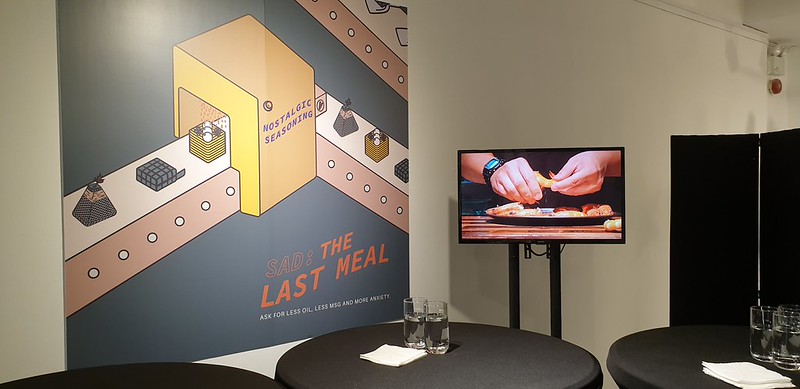
Some highly observant audience members asked me on the night why there wasn't ice kachang and nasi lemak on the menu. I was puzzled about the specificity of this question until I realised that they were referring to the image they had seen on the promotional material drawn by the designer, which ended up being printed in an unexpectedly huge size and mounted on the wall on the night of the event. Well, the answer is that at an earlier stage the shortlisted dishes originally included ice kachang and chicken rice so that was drawn into the flyer. However, the chicken rice was in a pyramid shape that could have been easily interpreted as the pyramid of a nasi lemak as well. Well spotted y'all.

20190329_175918

In case you were wondering yes to the credit of the designer the portraits did have a rather uncanny likeness...

In the Press...

Plural Mag - The Hunger Games
The Peak Magazine - SAD: The Last Meal art exhibition serves up dystopian versions of beloved hawker dishes
SG Magazine - This is how local chef Ming Tan interprets dystopian hawker cuisine
CNA Lifestyle - Kitchen Stories: Fighting insecurity and emotions to prove himself to older chefs

Friday, 21 July 2017

Foods of the Baltic: Kvass/Gira, Pelmeni, Cepelinai (Zeppelin), Pelēkie zirņi ar speķi (Grey Peas with Speck), and Beaver Stew

A quick compendium of notable foods consumed on a brief working trip to Lithuania and Latvia. Alright, let's be practical, chances are that the 5 people who still read this blog will probably never ever go to Lithuania or Latvia but yet I will say - IF YOU EVER DO, then these following foods are very much recommended.

1. KVASS / GIRA

Fermented Black Ryebread Cocktail

20170717_174220

Gira/Kvass from Forto Dvaras (Kaunas Old Town, Lithuania)

20170718_133136

Gira/Kvass from Zalias Ratas (Kaunas, Lithuania)

You may be wondering why would you drink this fermented non-alcoholic drink when you could drink a fermented alcoholic drink (BEER?) but the simple answer is that: it is super delicious. Like liquid bread candy. Like summery caramel raisin juice. As strangely and inexplicably addictive as Club Mate.

I had become really excited to try the Kvass after watching Life of Boris aka KVASSMAN demonstrate how to make it and all I can say is that... its indeed probably the best drink you can get in Lithuania and Latvia.


In the case of Latvia, if you are travelling in Riga... IT IS EVEN WORTH GOING TO RIGA AIRPORT 2 HOURS EARLY TO LEISURELY DRINK MORE KVASS AT THE LIDO. (There are Lidos all over Riga but having reached the airport means you can actually sit back in the Lido (the "Wetherspoons" of Latvia) and relax with your Kvass.

2. PELMENI

Tiny Slavic Ravioli

20170721_131335

XL Pelmeni in the morning

"What food is still available at this hour?" I asked a waitress at 11pm in Riga. She said, "well at this house there is only the McDonalds, Kebabs, or.... Pelmeni?" - with the Pelmeni being the only true 'local' option. So at almost midnight in Riga, I found myself at XL PELMENI, a curious buffet style fast food dumpling house with tacky plastic cave wall features, easy wipe-clean tables bolted to the floor, and an interesting mix of clientele. From families with young children, to young men wolfing down huge mountains of cheese dumplings, middle aged couples eating dumplings along with a bottle of wine, and old men nursing their beers alone in the corner with a tiny dill covered salad. Its young staff loitered around bored and uneasy, wearing generic hats and aprons.

20170720_230349

I was very confused as nothing was in English, but it appears that you simply pick up a series of tiny bowls on plastic trays and fill up your bowls with what looks like tiny white geometric tchotchkes, filled with rather delicious mystery meats (there were labels, but I couldn't read them).

20170721_131325

The Pelmeni is basically a very tiny ravoli made with a thin skin of white unleavened dough, very similar to the wonton or jiaozi or gyoza or mandu or pierogi or varenyky depending on where you're from. Garnish with white creamy substance (sour cream? kefir? yoghurt? mayonez??? help what is going on?) and let the dill rain from heaven. Unfortunately I did not take a picture of the pelmeni but you can see some of them in the top of this menu... that's what it looks like inside the pot!

3. ZEPPELIN / CEPELINAI

Lithuanian Potato Meat Blimp Sailing straight into your Mouth

20170717_173235

Named after the zeppelin airships, this is actually nothing like its floating namesake, and more like a dense bullet of pure plastinated potato. Sometimes served with a side of magic fat gravy. They mash the potato, then boil it into this ultra dense format with a thick layer of potato covering a delicious meat filling.

On a side note, in some strange ways it is reminiscent of the format of the traditional Hokchew (Foochow Chinese) ball if you replaced fish and flour with POTATO.

20170717_174408

If they give you an option to have a half portion, restrain yourself and order the half portion because they are basically SOLID POTATO BLIMPS and the average human adult can only realstically consume one of these zeppelins at a time. (For your reference a "debbieportion" is actually 1/2 OF AVERAGE LITHUANIAN ZEPPELIN)

4. GREY PEAS WITH SPECK / PELĒKIE ZIRŅI AR SPEĶI

Most Latvian Food according to random young Latvian boy at Lido

"What is your most Latvian food???" I asked the young server at the Lido.
He pointed to a mountain of peas. "Peas are very Latvian."
So here is an unfeasibly huge plate of Grey Peas that I ate at a Lido in Riga Old Town.

20170721_115440

They're not very grey actually.


BONUS: "Food from the Nobleman's Table"


20170718_131726

Menu at Zalias Ratas (Kaunas, Lithuania)

Often in the menus you will see the mention of "food from the peasant's table" vs "food from the nobleman's table"
All the potato-based foods I have listed above are typically classed as 'peasant food', although today there's hardly any real distinction between the two. For the most part, eating out (and eating well) in Lithuania seems exceedingly affordable.

20170719_212826

Menu at Restaurant Lokys (Vilnius, Lithuania)

20170719_215229

In Vilnius, I decided to go to one of these "Nobleman's Restaurant" to try Beaver Stew. Apparently beaver was historically quite commonly eaten by noblemen who went hunting; more than a hundred thousand beavers live in the Lithuanian forest and Lithuania and Latvia are probably the two countries in the world with the biggest numbers of Eurasian Beavers. (FYI: Beavers are actually completely vegetarian and their big teeth are only used to eat twigs and bark)

20170719_212702

Lokys means "bear" so there are huge wooden bears everywhere in Restaurant Lokys. In case one cannot travel all the way to Lithuania to eat Lithuanian Beaver Stew but still wishes to cook a Beaver (assuming one has already caught a beaver???) here is a recipe for Beaver that I found in the Kaunas Town Hall:

20170718_112732

Gero apetito / Labu apetīti!

Saturday, 1 February 2014

Exotic fruit and vegetable: Pepino, Curuba, Tamarillo, Lulo, Pawpaw, Kaki, Kohlrabi, Passionfruit


The Fresh & Fruity around the corner from our house is undoubtedly one of the main reasons I like living in Stamford Hill (despite its distance from RCA). I've always thought that having access and proximity to a good market or greengrocer is crucial to one's overall nutrition, because let's face it if you are hungry you are not going to want to walk very far or wait very long to get or make the food (unless you are strangely perverse, or George). When in South Kensington I have the tendency to devolve into a diet of box soups, instant bulgur pots and crisps from the vending machine, or the occasional starvation-induced splurge at the school canteen, but that is because that is the food which is most accessible to me there.

Recently I have been working on a project relating to plant growth regulators and I watched the most amazing fruit documentary (Thanks for the recommendation Katie!) so now I am even more mad for fruit. The funny thing is that around the same time I suddenly realised Fresh & Fruity were importing in different fruits and vegetable. (Whose smart idea was it? I'm totally sold on it.) Since their speciality is just fruit and vegetable, they really have a lot of it and its usually much better and cheaper than the Sainsburys/Asda (unless you want to have everything pre-washed for you in spring water). Sometimes you even get a whole box of produce for a pound or two when they're in excess and on their last legs. The other day I made mango sorbet out of a big box of mangos that I got for a pound. Recently they had an exotic fruit sale and we were fortunate to have gone there on the very day the fruits were being set out in their pallets for sale! They were so exotic that they even had to have long descriptions explaining what they were like on the inside!


The Fruit Portraits


Pepino Melon


The fruit of the Solanum muricatum is also known as sweet pepino, pepino dulce, pepino melon, melon pear. It is distantly related to melons and pears but more closely related to tomato and eggplant. This particular pepino melon came from Ecuador. The thin but surprisingly hardy skin is covered in brown stripes and on the inside the flesh is soft anne you will find a hollow in which there are white flat round seeds in a bunch. It tasted like a rock melon with a lighter, more delicate taste.


Curuba (Banana Passionfruit)


The Passiflora tarminiana is also known as Banana Passionfruit, banana poka (hawaii), curuba sabanera blanca (colombia), taxo/tauso/tacso (ecucaor), tumbo (bolivia). It is related to the passionfruit. Interestingly this is considered an invasive species in New Zealand as it thrives there and it is now illegal to sell or cultivate the plants and there are some concerns that the plant spreads too quickly in Australia and Hawaii. The taste of the fruit itself was very curious, sweet and quite tart with edible black seeds covered in orange pulp that is so intensely colored it is almost red. The seeds of the fruit had a lot more bite to them than a passionfruit we had also bought for comparison and we even worried for a moment that perhaps we shouldn't be eating the seeds. The fruit is covered with tiny hairs and it turns from green to light green/yellow as it ripens. Interestingly, it bruises very easily and is much unlike the passionfruit which you can throw at someone's head without worrying that the passionfruit will be dented. I found it to be very tart.


Tamarillo


The fruit of the Solanum Betaceum is native to the Andes of Peru, Chile, Ecuador, Colombia and Bolivia. It is also grown in other subtropical climates. It used to be known as "tree tomato" but the New Zealand Tree Tomato Promotions Council gave the fruit a new name to make it sound more exotic and seem less like a tomato. Tamarillo comes from the Maori word "tama" (leadership) and the Spanish word "amarillo" (yellow). I bought two types of tamarillos - red and yellow. The red one was more acidic and tart and the yellow one was softer and sweeter in general. Whilst the flesh is quite orange, the seeds are encased in bright red pulp which stains a bit as you cut or eat the fruit, the seeds are apparently edible but sometimes quite hard. In the end, it tasted like a mix between kiwifruit and tomato.


Lulo (Naranjilla)


The fruit of the Solanum quitoense is also known as naranjilla (ecuador, panama) or lulo (colombia). This one is from Colombia. The leaves of the plant have a very lovely shape so it is considered an ornamental plant in some parts; in general the plant itself is very delicate and cannot withstand high wind or sun, and is extremely susceptible to pests and diseases whenever grown on a large scale, often suffering from fungus attacks and pests. Apparently a few batches seeds had been sent to the USDA (United States Department of Agriculture) in the 1910s and attempts were made to plant it in greenhouses but all of them died! There is another story about how great attempts were made to grow it in Florida in 1948 where they flourished and 20 plants were about to fruit when they were all unexpectedly all destroyed in a hurricane! Basically the story of the naranjilla and the many attempts to grow it elsewhere has been historically a sad one. The fruit is soft and easily damaged when it is ripe and god knows how it even survived to get here. Its skin is looks leathery on the outside and it apparently has lots of hairs on the outside which are usually rubbed off when the fruit is prepared for sale. Its insides look a bit like a tomato but it tastes like a pineapple crossed with a citrus plant of some sort.


Kaki (Persimmon/Sharonfruit)


The Persimmon or SharonFruit needs no introduction. Its very common in Asia and I've eaten so much of it in the past. To be honest this has been one of my favourite fruits from Fresh and Fruity. The only fun fact I can offer about it is that it is technically a berry, but due to its solidly turgid fleshiness we often don't think of it as a berry.


Pawpaw


The Pawpaw is actually just a small papaya. In the UK they are small, unlike the huge ones I'm used to seeing in Southeast asia.


Kohlrabi (German radish)


The Kohlrabi is cultivated through artifical selection to get its distinctive swollen shaped stem. It is related to cabbage, broccoli, cauliflower, kale, collard greens, and Brussels sprouts - they all come from the wild cabbage plant (Brassica oleracea).


Passionfruit


I bought this Passionfruit so as to be able to crossreference its taste with the Banana Passionfruit. To be honest I preferred the Passionfruit to the Banana Passionfruit as the passionfruit was much sweeter.


The Insides of the Fruits


Pepino Melon


Curuba (compared with passionfruit)


Tamarillo


Lulo


Kaki


What happened next


The Kohlrabi never got eaten in the end. Unfortunately (or fortunately) after they sat on the arm of our sofa for a few weeks they eventually turned into some sort of vegetal housepets. We named one of them Smiles and the other Lao Wang. It is very hard to eat vegetables that you have given names and personalities. Maybe we will plant them in a pot for summer and give them a new life.

You might also have been wondering why there has been nary a blip from me online recently and it is because I have been slaving day and night over a synbio-related project at school which is about to come to fruition (ahem). This post has been days in the making because I can only manage to find a little bit of time in-between actual work to write these posts up. It has been really intense. Maybe more about my new projects in the next post.