Tuesday, 17 May 2016

Mysterious White Powders: Artificial Chicken Flavour

I've been thinking about writing several posts about mysterious white powders (and offwhite powders as well), such as citric acid, baking soda, kansui, and nutritional yeast, which I will do so over the next few weeks. For now I'm going to start things off with everybody's favourite.... ARTIFICIAL CHICKEN FLAVOUR!


"Artificial Chicken Flavouring"


Here is a picture of a chicken timer since its quite boring to look at a picture of white seasoning powder. A couple years ago I was taking apart a small chicken timer to send to George and I had just turned away for a moment when Kent happened to wander over and touched a spring inside the chicken. The result was that said chicken timer suddenly exploded. Oh chickens. So mysterious.

The other day we decided that we would try to "recreate a powdered Chicken seasoning". Our motivations for this were perhaps quite different: George being vegetarian perhaps wanted to find an vegetarian analogue of a seasoning that was usually paired with chicken - and he went out and got some "Jerk Chicken Seasoning" that was conveniently vegetarian. But the problem is that "Jerk Chicken Seasoning" is not really chicken seasoning. It happens to be a seasoning which is complementary with chicken, and perhaps is so very often eaten together with chicken that it has become synonymous with chicken. However, that still does not make it truly chicken flavoured. IT IS NOT EVEN CHICKEN IN FLAVOUR.

I would like to do is to reverse engineer INSTANT NOODLE CHICKEN SEASONING. What is the essence of a chicken flavour? Now at the time of writing, I don't think I'm even close to cracking it yet, but I want to find out the secret recipe for the seasoning packets in those bewitchingly addictive Mamee Noodle snacks. And I want to know the secret recipe behind the seasoning packet for the export-only Koka Stir Fried Noodles, which are very much unlike that of the emphatically health-conscious no-MSG recipes/formulations used for Koka's local markets in Singapore. The UK export version of the Singapore produced Koka noodles look different from the packaging in the Singapore and also all contain MSG. How do I recreate this "artificial chicken flavouring"? And perhaps more to the point: is "ARTIFICIAL CHICKEN FLAVOURING" already a well-known or patented formula within the food technology industry....?

Let us look a little more closely at the ingredients for both seasonins which are so bewitchingly addictive:

MAMEE CHICKEN NOODLE SNACK (FLAVOUR PACK): Salt, Contains Permitted Flavouring Substances (contains gluten,soybeans), Contains Monosodium Glutamate (E621), Disodium-Guanylate(E627) and Disodium-Inosinate (E631) As Permitted Flavour Enhancers, Spices, Sugar. Contains Permitted Food Additives of Plant, Animal (Chicken) and Synthetic Origin.

KOKA STIR FRIED NOODLE (FLAVOUR PACK)
: salt, sugar, artificial chicken flavouring [contains sesame seeds], pepper, msg, garlic powder, soya bean extract, dehydrated veg & spices.

Let's break it down a little:
Monosodium Glutamate (E621) - the sodium salt of glutamic acid (E620). gives foods an umami taste and enhance flavours. Because of its enhancing properties, it is great because it reduces the total amount of salt needed in order to make the food tasty to us. Commercially it is produced through the bacterial fermentation of molasses; glutamates are present in all proteins and can be found in many natural foods.

For starters I think MSG is an amazing invention! It is for me up there alongside the invention of instant noodles! It has been scientifically proven that glutamates (commercially synthesised or naturally occuring) have no particular adverse effect on the overwhelming majority of people. I personally enjoy food with MSG in it and all of the other naturally occurring glutamates. I usually assume that anyone or any website which denounces MSG has failed to do a basic fact check and can be dismissed as a quack (beware, for the world and internet is full of uninformed loons!)

Disodium guanylate (E627)
- the sodium salt of guanylic acid (E626), guanylates enhance other flavours but do not add any particular umami tastes. It comes from a part of RNA in cells of living organisms. Probably made from Tapioca Starch.

Disodium Inosinate (E631) - the sodium salt of inosinic acid (E630) inosinates enhance other flavours but do not add any particular umami tastes. Probably made from Tapioca Starch.

I noticed that Guanylates and Inosinates (aka the disodium ribotides) often come together. They obviously enhance savoury tastes so it is also worth noting that a lot of 'low sodium foods' may use these as a very tiny amount of them already magnifies the saltiness. I can see it as a useful way of cutting down on salt, but they can aggravate gout. But ultimately, as food additives, these ingredients might make up an exceedingly tiny portion of the ingredients of your food, so I am alright with a tiny amount of them in my food if it works so well in enhancing the taste in lieu of salt! It explains why instant noodle seasoning can taste so salty even though it amounts to little more than a tbsp of powder!

Garlic Powder - dehydrated garlic in powdered form. similarly, dehydrated onion in powdered form can also be found. these powders are not to be considered an inferior version of the fresh ingredient. It is in fact quite different from the fresh versions of itself. Both garlic and onion powders add a completely different dimension to food even if you are already using fresh garlic or onion within the food itself. However, they must be heated up in oil for best effect.

But... what is "artificial chicken flavouring"???

I'm assuming that since it is artificial, it means that it doesn't include any real chickens. Not that I care since I would eat real chickens anyway (and anything tastes better with a good homemade chicken stock mixed in), but this simply means that adding real chickens into the mix isn't the solution to this "reverse engineering" exercise...

Plus, the reason why we want to make a chicken seasoning is because WE WANT TO KNOW WHAT IS THE TASTE OF CHICKEN! I mean, have you ever eaten a chicken? I personally like chicken, although thesedays I haven't eaten as much of it as before. My mother makes an amazing steamed chicken, of which the ingredients are just chicken and salt, and it is one of the purest and most delicious chicken flavours I can imagine, if I had to describe what was chicken. I mean, what is this chicken flavour that we taste? Why do we know it is chicken flavour? How does we chicken flavour? HOW DOES WE ARTIFICAL CHICKEN???

The earliest patent I could find for a CHICKEN FLAVOUR was this from 1972, from a Marcel Andre Perret, an inventor who also devised a process for producing an artificial beef flavour in 1968. The patent application itself dithers through a few methods for producing artificial meat and poultry flavours, which Perret thoughtfully notes would be well suited for the use of a housewife who heats it and gets INSTANT CHICKEN FLAVOUR under conditions available to an ordinary kitchen:

From US 3689289 A: Chicken flavor and process for preparing the same:

Perret proposed a substitute artificial beef flavor formed by heating a hexose or pentose monosaccharide with cysteine and cystine to 90 to 100 C. for two hours in the presence of water, adding vegetable protein hydrolyzate and a 5'-ribonucleotide, and then heating again at at least 70 C. for about two hours, to develop the desired beef flavor.

Mortion et al. US. Pat. No. 2,934,437, patented Apr. 26, 1960, describe an artificial meat flavoring composition, composed of the reaction products of a pentose or hexose, cysteine or cystine, and water, reacted for at least one hour at the boiling point in the presence of water. This composition is similar to Perrets, without the ribonucleotide. Moreover, Perret requires that the mixture of hexose or pentose and cysteine or cystine be reacted at 90 to 100 C. in the presence of water, and that then the protein hydrolyzate and the ribonucleotide be added and a further reaction carried out at at least 70 C. for about two hours.

Giacino US. Pat. No. 3,394,017, patented July 23, 1968, describes a poultry flavor composition produced by reacting thiamine with a sulfur-containing polypeptide or an amino acid mixture derived therefrom, and thereafter add- United States Patent 0 ice ing an aldehyde and a ketone to the reaction product. An amino acid mixture for use in the composition includes at least one sulfur-containing amino acid such as cysteine or cystine. The mixture is heated at from 200 to 420 F. for from A minute to three hours, the shorter heating times requiring higher reaction temperatures.(...)

Belikov et al., Chemical Abstracts 62, 15339d (1965), (Z/h. Vses, K-him. Obshchestva im. D. I. Menedeleeva) 10 (1) (1065), in a study of the nature of food odors, reported that an aqueous solution of l-cysteine hydrochloride, dl-alanine, l-glutamic acid, glycine, glucose, l-arabinose and methyl arachidonate, after having been heated for two hours at to C. developed an odor resembling that of chicken soup. There was no report on the taste of the product.

In accordance with the invention, an artificial chicken flavor composition is provided which is capable of developing the flavor of chicken when heated in the presence of water for from five to ten minutes at temperatures within the range from about 60 to about 90 C. The composition can be formulated as a solid mixture, any liquids present being absorbed on the solid ingredients, and is stable indefinitely in this form, and develops a chicken flavor when heated under the stated conditions. Accordingly, this composition is Well suited for use by a housewife, who merely heats it at the time of use, and then can use it at once, without any need for storage, after the chicken flavor has been developed. This avoids the necessity of pre-heating the composition by the manufacturer, and eliminates the storage stability problems inherent in such preheated compositions. Since the composition can be heated under conditions available to the housewife in the ordinary kitchen, unlike the 125 to 135 C. temperatures of Belikov et al. (which require pressure), the compositions of the invention avoid all of the difficulties inherent in the prior flavoring compositions.

The artificial chicken flavor composition of the invention is a combination of a hexose, a bland protein hydrolysate, an arachidonic acid compound, such as arachidonic acid, or methyl and/or ethyl arachidonate, or a mixture of any thereof, and cysteine and/or cystine, or a nontoxic acid addition salt thereof.

It goes on to suggest some examples...


To be honest, it looks a lot like a recipe to me.


Oh look, not at all strange, but a patent for a TCM chicken feet recipe for tonifying qi???

Which leads on to some more "recipe" looking patents??? But can you patent a recipe? What is it under the patent classification anyway??

If you must know, the classification for Patent US3689289A is: A23L - FOODS, FOODSTUFFS, OR NON-ALCOHOLIC BEVERAGES, NOT COVERED BY SUBCLASSES A21D OR A23B-A23J; THEIR PREPARATION OR TREATMENT, e.g. COOKING, MODIFICATION OF NUTRITIVE QUALITIES, PHYSICAL TREATMENT (shaping or working, not fully covered by this subclass, A23P); PRESERVATION OF FOODS OR FOODSTUFFS, IN GENERAL (preservation of flour or dough for baking A21D) [2006.01]
1/227 · · · containing amino acids [2]
... which seems a little like a let down - what? Chicken is not its own category????


I mean like seriously this reads like a recipe for a roast duck... how do we classify patents anyway?

Which brings me to:
THE INTERNATIONAL PATENT CLASSIFICATION! classifying patents and allowing us to search for patent documents, "in order to establish the novelty and evaluate the inventive step or non-obviousness (including the assessment of technical advance and useful results or utility) of technical disclosures in patent applications.


AIEEEEE the mind boggles. All the terrifying inventions of food technology that I know so little of!
But now, it is dinnertime and I must make myself a dinner. Preferably with a chicken stock cube or something, for research purposes....

I still feel like there are insufficient pictures in this post so here is ROBOT CHICKEN...?

In the next episode, we continue to investigate: HOW DO WE ARTIFICIAL CHICKEN FLAVOUR AND WHY IS FRIED CHICKEN BATTER SO DELICIOUSLY ADDICTIVE (AND HOW DO WE RECREATE IT ALL WITH SCIENCE?)

Saturday, 19 March 2016

Second-hand Rocks and Prosperity Pricing

A long time ago, I remember reading a book which described sedimentary rocks as a kind of "second-hand" rock because they are formed from other materials - such as, from the remains of previously living organisms, or from fragments of other older rocks. But yesterday, I encountered some literal second-hand rocks!...

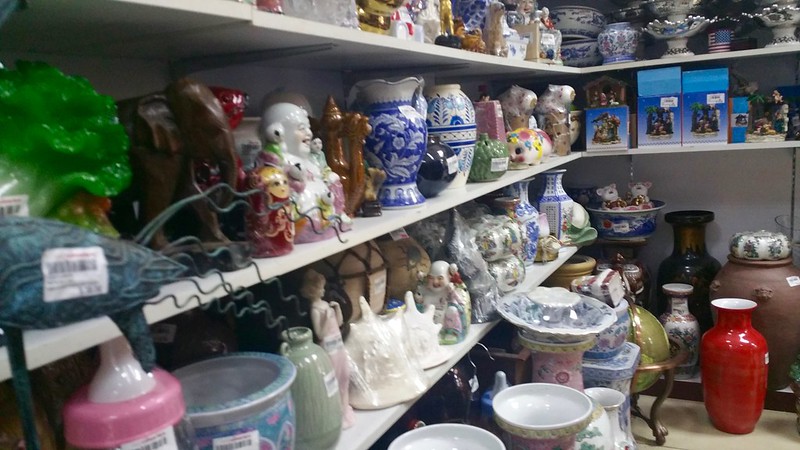
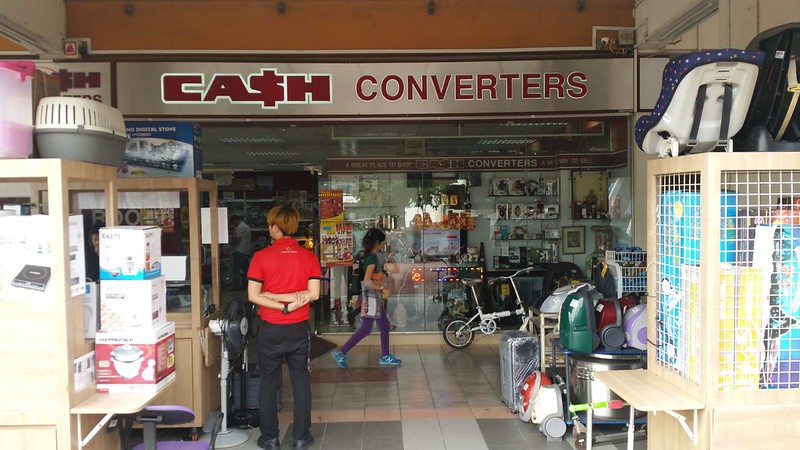
Whilst returning back to town from FOSSASIA 2016, I passed a familiar second-hand store that I used to go to whenever I was in Jurong East. CASH CONVERTERS! - that good ol brick-and-mortar franchise in the business of "buying and selling unwanted goods" - land of excess factory stock, used CDs and other outmoded forms of media entertainment, joblots of made-for-tv egg cooking devices, tennis racquets tanned yellow with age, furry massage mats, porcelain dogs, used mugs, extruded plastic god-of-fortune statuettes, bowling balls wrapped in cellophane...

Untitled

Untitled

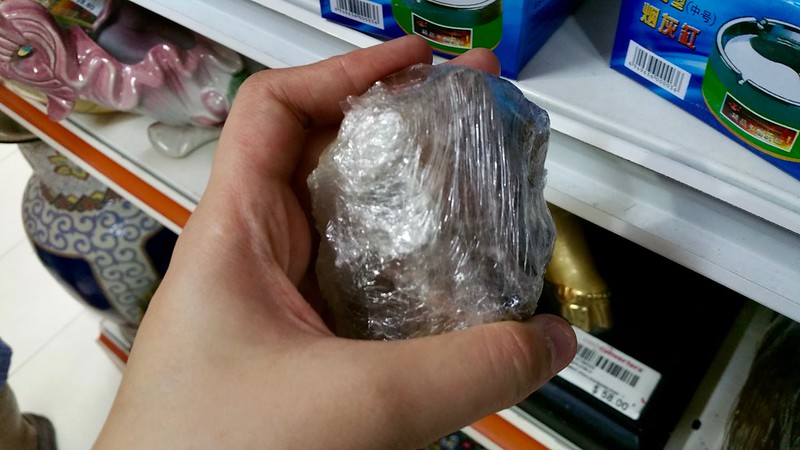
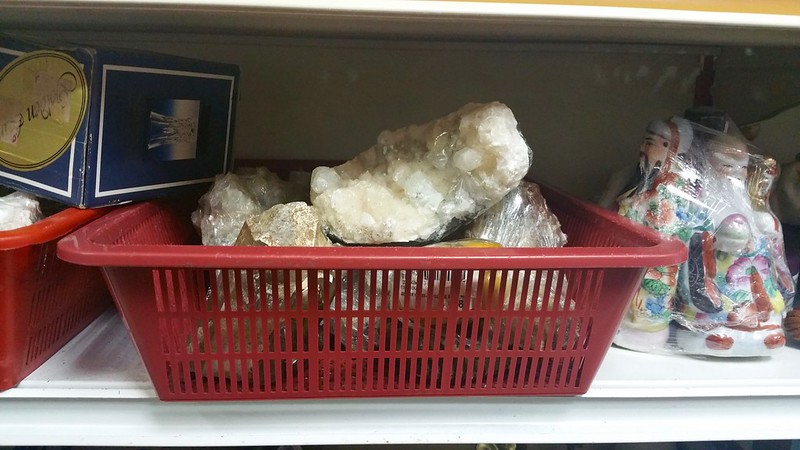
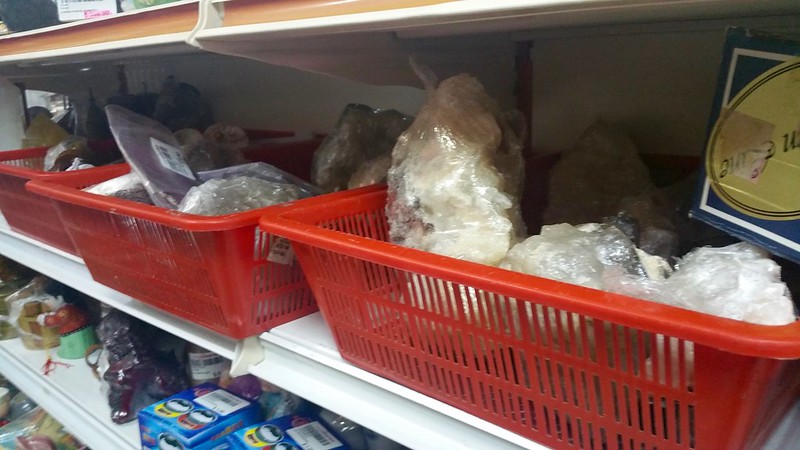
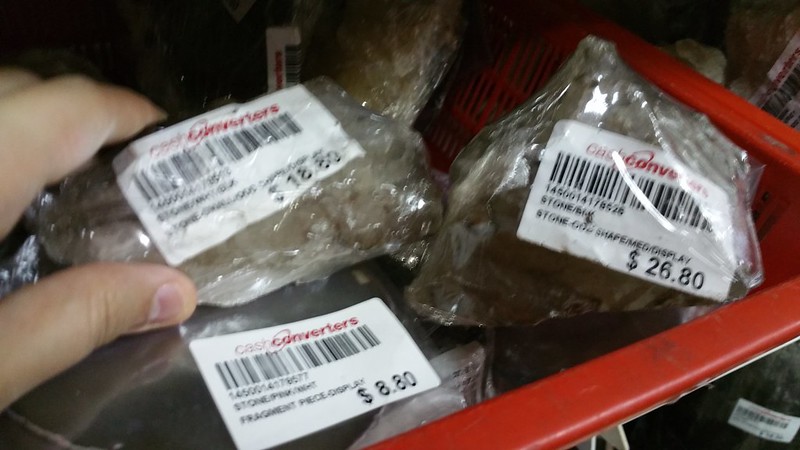
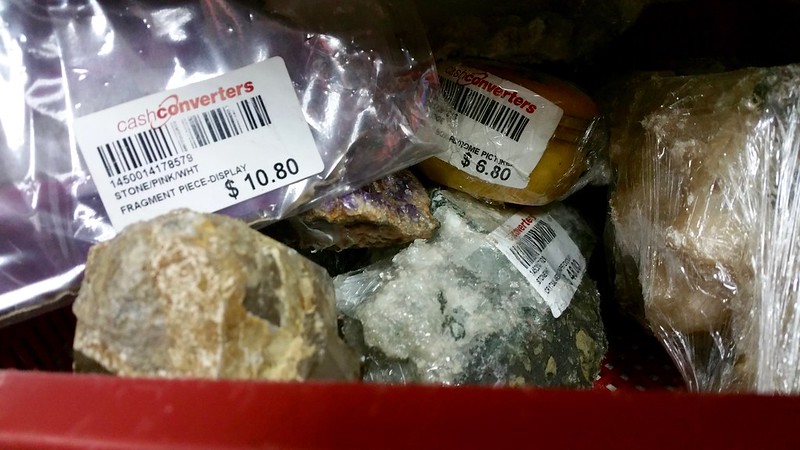
Speaking of hard objects enthusiastically wrapped in plastic, I came across a section that I hadn't quite noticed in previous visits. Lodged in a rather small shelf, in a few red plastic baskets (not dissimilar to the green plastic baskets I used for sorting my rocks in the past), I discovered that someone had secreted a whole cachet of rocks. Yes my friends. In the middle of Jurong East's Cash Converters is an entire SECOND HAND ROCK SECTION. (Maybe I should start my own rock shop like them too huh)

Untitled

Untitled

Untitled

Untitled
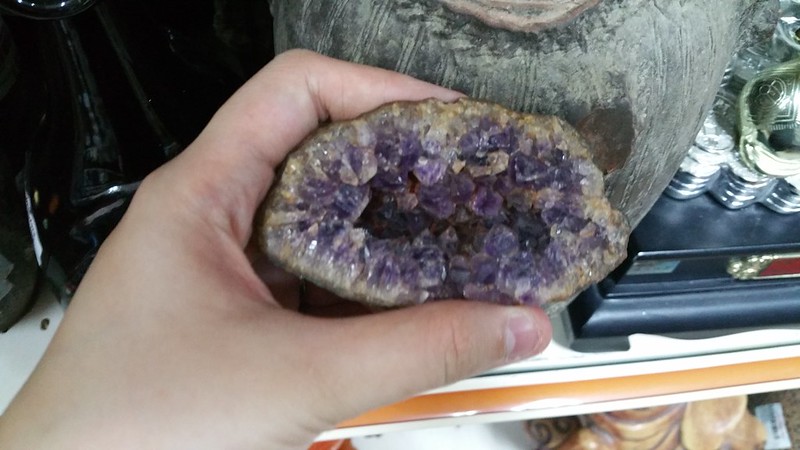
THIS IS A GEODE, BTW

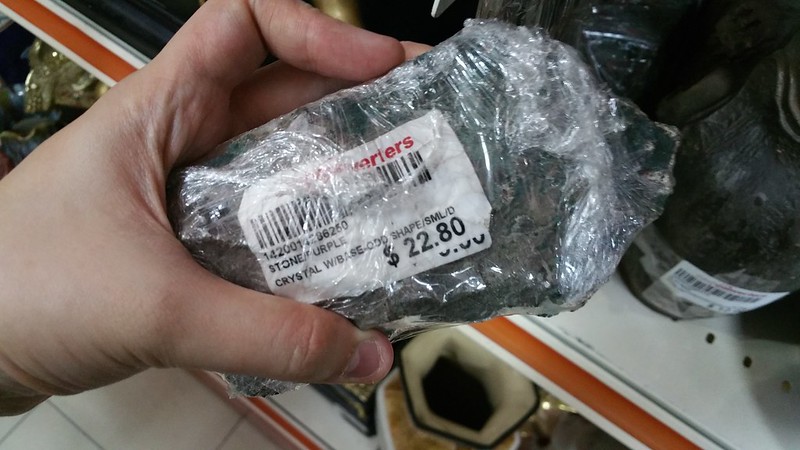
No provenance. No information. Just rocks wrapped so tightly in plastic that in some cases you couldn't see them properly. Which makes it slightly alarming when a few of them are not in protective plastic shells (I worry for a moment, is the sweat on my grubby hands in danger of inflicting corrosion upon these rocks??)
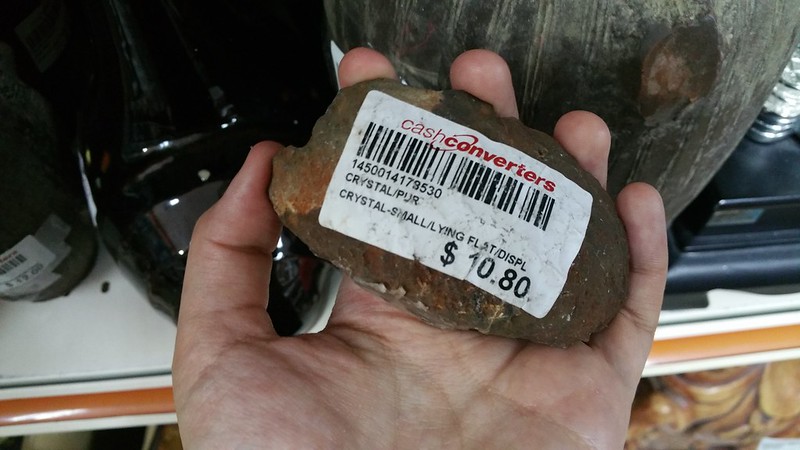
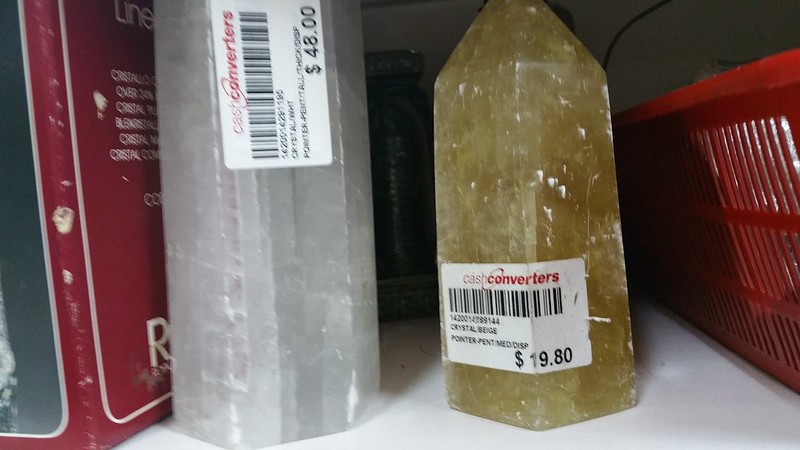
And of course, because Cash Converters has made the re-selling of seemingly unwanted and useless objects their entire business, there is also a price tag.

Untitled

Untitled

Untitled

How does Cash Converters determine the price for rocks? From looking online, people say that Cash Converters in other places use the prices of other existing online catalogues such as ebay, argos, etc to determine an object's value (when it was new) and then quotes a fraction of that (pricing it so that CC would eventually still make a significant 60-100% profit on the sale of the object).
But... rocks? Even as ornamental fengshui rocks? Is there a special catalogue for fengshui rocks here? How does the CC staff evaluate it? Is it size, weight, appearance?

Also, seriously, what is up with the prices all being XX.80 or with the number 8 in them? Is the inclusion of 8 in the pricing a strategic tactic for pricing within chinese markets?

Untitled

Untitled

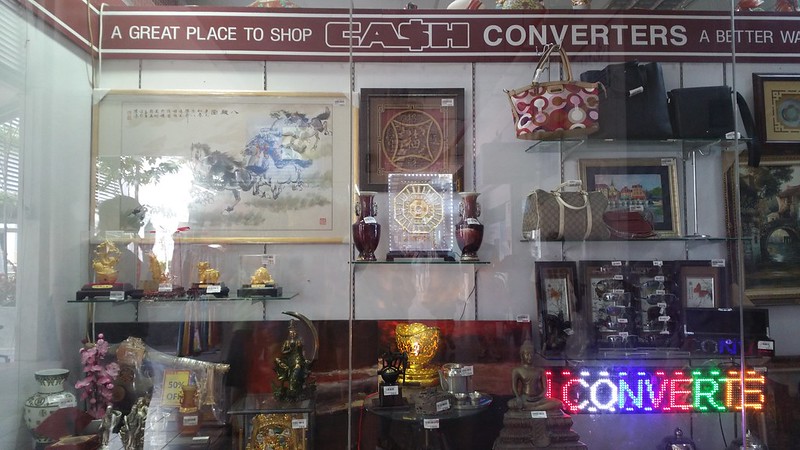
What is fascinating is that when you look at the centrepiece display within the interior of second-hand shops like Cash Converters in Singapore and the glass front of the second hand shop, it is often dominated by highly valued prosperity symbols and objects of religious syncretism, mixed up with the visual language of designed lifestyle objects, on a bed of laser-cut acrylic and LEDs.

Untitled

I also hasten to add that whilst I was at Cash Converters, no less than 4 middle-aged Chinese men shuffled through this aisle and spent a long time carefully evaluating the rocks on this shelf, so I personally I did get the impression that these rocks were definitely an object of curiosity, and perhaps by extension, even objects of desire...


Prosperity Pricing? The use of number "8" in prices of Chinese consumer products


Some googling takes me to this paper: The Use of 'Lucky' Numbers in the Pricing of Chinese A-Share Initial Public Offerings where the abstract notes that existing marketing literature shows that "the number 8 is consistently used as a price-ending in advertising for Chinese consumer products" - to capitalise on investor sentiment.

Wednesday, 9 March 2016

Public Service Notice on Geodes, and Text Complexity

The show opened to what I perceived to be a little confusion from Singaporean audiences. I couldn't understand it at first, but a quick survey amongst friends has just revealed that... geode is apparently not actually a common or well-known word amongst a public/general audience of Singaporeans! ALAMAKKK!

Geode!! A word which I assumed that everyone learnt as a child, because I had already known of geodes when I was very young. I am shocked! Stunned like vegetable! Even amongst my peers who are brilliant and intelligent in their own right and in their respective fields of practice, apparently "geode" is a specialist term that does not enter the common vernacular here!

If you're Singaporean (born and educated here) and reading this, I really want to know if you knew what the word "geode" means without googling it first.


Here is a definition of "geode":

Whilst making the work "Space Geodes", my visual reference board looked like this - a lot of geodes + bismuth ingots. Bismuth is not a geode per se, but an important visual reference for me - i wrote an entry about bismuth on this blog in 2014):


I actually thought a lot about how I wanted the form to be instantly recognisable as a "geode", and made several pencil sketch studies of the ways in which geodes are sliced and presented, especially with regards to specimens from mineral shops that circulate in the hands of amateur collectors. And actually, I called it a "space geode" because I wanted to be cheeky about how it was also about turning a human space into something almost alien or from outer space - for things like fossils and ruins become interesting to us because of a perceived break in human understanding that we need to bridge. However, I hadn't realised that the very concept of "geode" might be TRULY ALIEN and unknown to some!??


As a young child I remember being given a purple coloured booklet about rocks which came with a bubble pack of different semi-precious rocks, which made me aware of the different names of rocks. I remember there being a tiger's eye, banded agate, red jasper, rose quartz, turquoise, hematite, sodalite, and amethyst. Also, this must have been an American book because it also talked a lot about spelunking (cave exploring). (As an adult I learnt that the term "spelunking" was only used in the US, whereas it was called "potholing" in the UK).

UPDATE!!!: My mother found the book in the house! I wrote the paragraph above before I went to bed, and in the morning my mother fished the book out and I was vindicated to find that my memory did not fail me with regards to the rock names! The DingParents bought it from Toys R Us and gave it to me when I was 6, meaning this book is over 25 years old! It also contains a little section about GEODES, so I'm guessing this is where I first learnt the word "geode".


However... despite giving me such amazing access to books and information from an early stage of my life (yay to the Parents on their excellent strategy!), my parents did not actually read this book themselves, and therefore they themselves did not know what a geode is...

I showed them these following pictures which I took last week at Fu Lu Shou Complex, home of mystical antiquities, mysterious amulets, and religious relics (a shopping centre tellingly named 福禄寿 after the Daoist idea of fu/fortune - lu/status - shou/prosperity), but my parents looked at my pictures and identified these as "fengshui stones". I wonder what others call these? I'm guessing other people might also just identify them as "fengshui objects" or "crystals"?


Thinking about how one learns about geological terms in one's life - I also learnt words like magma and pyroclastic cloud from simply watching movies like "Dante's Peak", which I probably first saw aged 13 in 1997. I remember that I liked the movie so much that I even printed out random film reviews of the movie which I had found from the internet and kept it in a file, as a weird way of preserving a memento from the film! (Because I felt at the time that it would be unlikely for me to encounter a volcano or a geological feature like that) Please don't tell me I was the only weird geeky child here who learnt all these terms by accident??

I was told that some people also know of the word "geodes" via POKEMON because of Geodude (geode+dude?), a boulder pokemon who... erm.... rolls around. So people know geode might be a stone. But then, in Pokemon, the Geodude is never really officially pictured cracked open to show his presumably crystalline insides...


Geodude (pokemon)

I suppose there have been very few opportunities or means for people to learn about geology or geosciences in Singapore - it is something I've talked about for some time. I mean, I was very surprised to learn that in the UK some schools offered Geology as an A level subject, because it does not seem to figure in our curriculum. (Can any teachers confirm this?) Geology is part of Earth Sciences, but I'm guessing that the closest you might get to learning about geology in schools might be via geography. But Geography in Singapore is classed as a humanities subject, and not the most popular one at that, as I remember an article very recently about it:

Straits Times 22Feb 2016 - Updated JC geography curriculum worries some:


Google Trends on the interest in the word "Geode" shows a declining number of people searching for the word in the last few years:


But this is people "searching" for the word. It may mean that either (1) they don't know it and are searching, or that (2) they knew it but wanted to look for more information about geodes. The "trend" numbers do not make this distinction, of there being possible different intentions behind the search for information.

So, how do we determine text complexity? Whilst writing this I realised that a function that used to be in Google search last year has disappeared! To be honest, I never really used it much whilst it was available, but for some time there used to be a reading level function for Google search, and it used to be listed on this official google search filter list. Now the reading level filter is gone from the list as well. A quick look online reveals some discussion about how it was quietly removed in May 2015 without any announcement on any google blog.

See:
Google Drops Another Search Filter: Reading Level
Google Removes Reading Level Filter

Reading Level allowed users to search for texts which were in one of 3 levels - basic, intermediate, and advanced. This allowed children or readers with difficulties to look for basic texts which would be more suitable for their reading level, and on the other end of the spectrum it allowed advanced users to look for more complex, or technically-oriented articles.

In principle I don't really like the idea of dividing knowledge up into levels because I think that my current knowledge about the world was gained by ignoring what constitutes "specialist" knowledge vs what is "amateur knowledge". I just read everything and I think it would be great if more people were unafraid of complexity. But this is just my individual view. And on the negative side, it may also explain why some of my work and the mode in which I present my own work so far may seem a little too complex/wordy for many people.

But still, I think it would be interesting to try to see how one might develop one's own metric for what constitutes "text simplicity" or "text complexity". Current tests for it (eg: Flesch–Kincaid readability tests, Coleman-Liau Index, Gunning fog index, SMOG index, and Automated Readability Index) appear to use word length, sentence length and syllable count, and sometimes checks a text against a list of difficult words.

I really have to get on with other urgent work now so I must end here for now, but the text complexity issue seems worth further investigation when I have more time to sit down and experiment with it....


Space Geodes is currently being shown at SingaPlural 2016, on the second floor of block C where it will be on show until 13 March 2016.

99 Beach Road
7-13 March 2016
11am-10pm daily


More about SingaPlural 2016: http://singaplural.com
More info on "Space Geodes": http://openurbanism.blogspot.sg/2016/03/space-geodes-digital-archaeology-and-3d.html

Sunday, 6 March 2016

Space Geodes: Digital Archaeology and 3D prototyping, from Fossils to Plastic

From 7 March until 13 March 2016, I'll have a new work showing at Singaplural, a design festival which is the anchor event of Singapore Design Week. (Or rather, shall we say, it is a prototype for a new work...)


Space Geodes imagines the 3D printed prototype as a fossil in reverse and explores one possible way of materialising this notion of digital archaeology. The project originally began from a thought that it was funny that gcode looks so much like the word geode - g-code being the numerical control programming language used in most computer-aided manufacturing, and the name for the format for files which are used to give instructions to 3D printers and CNC mills.

As 3d scanners and 3d scanning apps become more easily accessible to consumers and amateurs, I noticed that one of the common types of scans that is always being shared by users online is that of the room they happen to be in - a living room, a bedroom, a working room, etc. But as with the uptake of any new technology, human error, technical problems and misuse of tool comes into play, compromising the quality of the scans.


Hundreds of poorly scanned domestic interiors have been semi-anonymously converted into incomplete surfaces, afflicted with too little information or impossible geometries that prevent them from being properly understood by machines and rendered into real objects that can exist and be manufactured into the physical world.


Unable to dig for material remains for clues of the recent human past in my highly urbanised environment, as digital archaeologist I have instead remixed the 3D models of rooms found on creative commons with an icosahedron and then plane-cut them into new forms, like how a lapidarist might cut open a geode.

The "geodes" are produced using a Selective Laser Sintering (SLS) process, which involves using a high powered laser to fuse plastic powders - synthetic polymers of petrochemical origin, which completes its process of becoming a digital fossil in reverse.


I excavate the remains of these human spaces, fix the holes in the models, and prepare the 3D data to be sliced for 3D printing. The precisely structured layers within the resulting gcode/geode reveal the split-second shifts in perspective within the domestic space; the fluctuations in data capture which resulted in the imperfect transfer of physical reality into machine-readable 3D data.

This digital fossil forms an inversion of interior into exterior, fossilising a moment in space and time.

Notes on MeshMixer / Process


Meshmixer is undoubtedly one of the easiest and most handy application for fixing 3d models (plus it is free!). There's probably no easier or more dummyproof way to hollow out an object, add escape holes for draining excess material, and fixing/filling holes in models.

Meshmixer utilises a contextual menu - that means that you must have selected a specific type of part in order to see the available options for it. Therefore if you only select one mesh, you will not see the join/boolean menu. That different kind of editing menu is only available once you select two meshes or more.


To some extent, you can use Inspector to fill most holes. But it can't do all the guesswork for you if the file is too convoluted. Sometimes you'll need to use a combination of Fill (F to fill - A to accept, Esc to cancel) and Bridges (⌘B). I found that if you have learnt the shortcuts you can just open a file and type all the shortcuts in order and then leave it to run that sequence of edits that you want (it might take a while). It is useful to clean up the file by pressing S and selecting on the main object (in orange) and then pressing EIX - E to expand selection to anything connected to the same mesh, I to invert selection to select stray bits and pieces in the file which are not connected to the main mesh model, and X to delete those tiny glitches.

"Reduce" function: Reducing the complexity of the models at every stage really brings the STL file size down drastically, which helps as many commercial printing services have a file size limit. You can reduce the total number of vertices without losing too much quality, but like with any kind of compression, if you just wildly press the reduce button then some details may get unexpectedly smoothed out, so you need to do a visual check from time to time.

"Plane cut": you literally just "cut" with your mouse by drawing a line which indicates the angle and location of the plane on which the model should be sliced up. So natural.

As for improvements I wish it would have are - firstly, I think Meshmixer would benefit from having some sort of timer which indicates how much time will be required for each process. Most 3d software gives some sort of indication of how long each process takes (eg: Blender also will create an alert to tell you when it has finished sampling whilst you are in another window). Sometimes Meshmixer takes so long and my computer sounds like an aeroplane and I worry it will simply crash because I've made the mistake of running a process on a mesh with too many vertices. If I see that the estimated processing time is too long, it indicates that perhaps there are problems with my model that I should be fixing before making it more complex. Being able to see the process time and then abort a time-wasting process accordingly would be useful...

Secondly, Meshmixer does crash a whole lot and at least it does restore my work most of the time, but it can be quite temperamental... I really wish Meshmixer didn't crash on my mac so often. Perhaps my 4 year old Macbook does not have the power to do the job. But I guess Meshmixer does the job!

Responding to the site


When I saw the site at 99 Beach Road for the first time on Friday, I saw that the window opened up to a view of the Rochor Flyover, which slopes downwards. There is the constant movement of cars at an angle, which contrasts curiously with the hard straight lines of the Gateway Towers in the background - two perfectly trapezoidal shaped knives of steel and glass.


View from the Window

I wanted to introduce a gridded pattern to the space which would play on the view from the window and also suggest a confusion of depth, which is the error which the machine introduces into the 3d scan of domestic interiors. A few years ago I worked on a installation with Jeong Hee Woo which involved making a live-sized outline of a HDB flat and South Korean flat in black tape. So I thought of introducing a warped grid into this space using black tape again - ah! The good old fashioned all-synthetic polyester+acetate+nylon tape.


Exhibition Design which I drew up whilst sitting at the coffeeshop (VIRTUAL IMAGE)


Exhibition on site (ACTUAL REALITY)


See also:
The Library of Pulau Saigon

Wednesday, 2 March 2016

Yangtze Strangers

Untitled

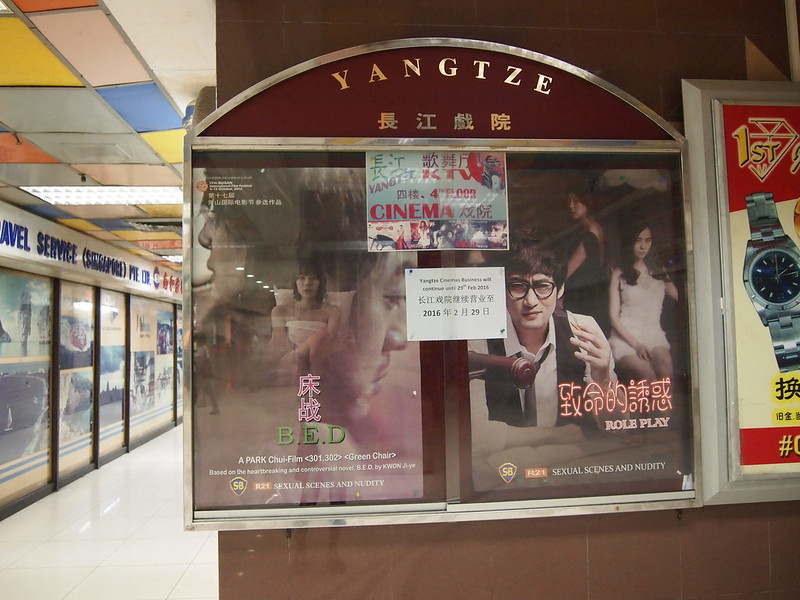
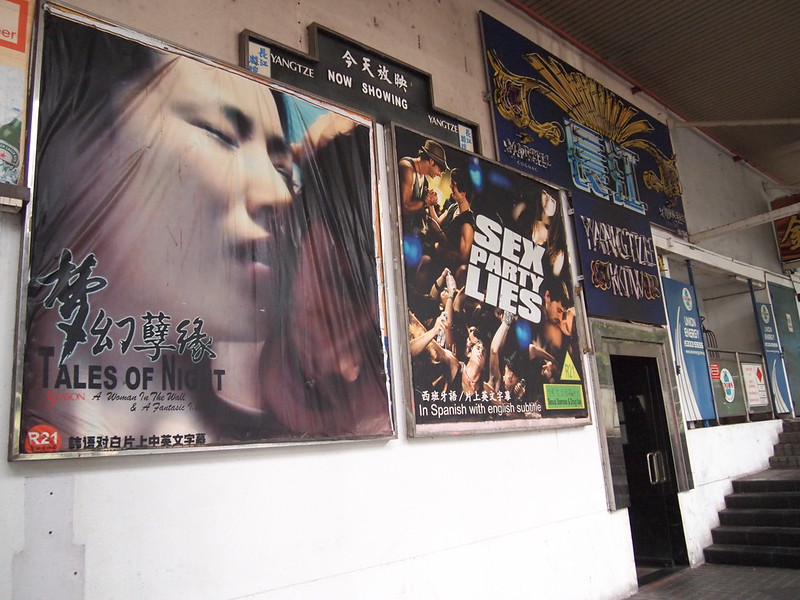
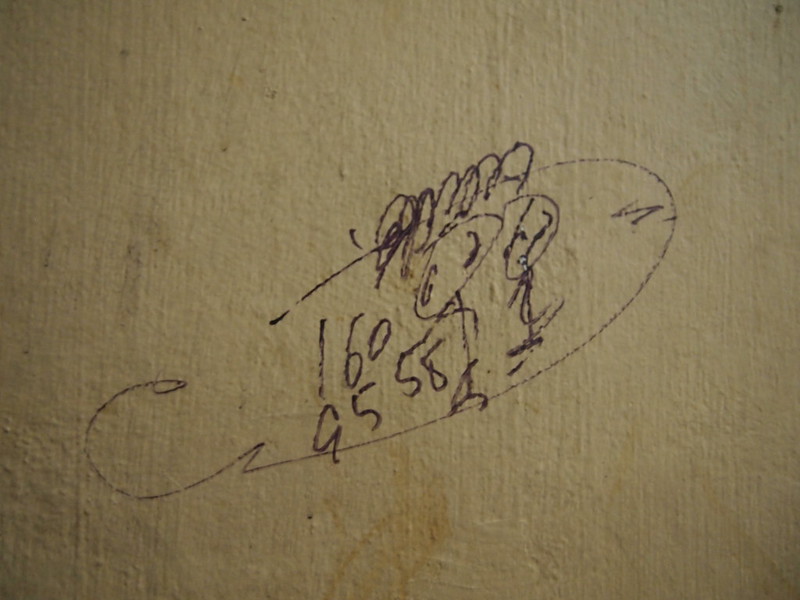
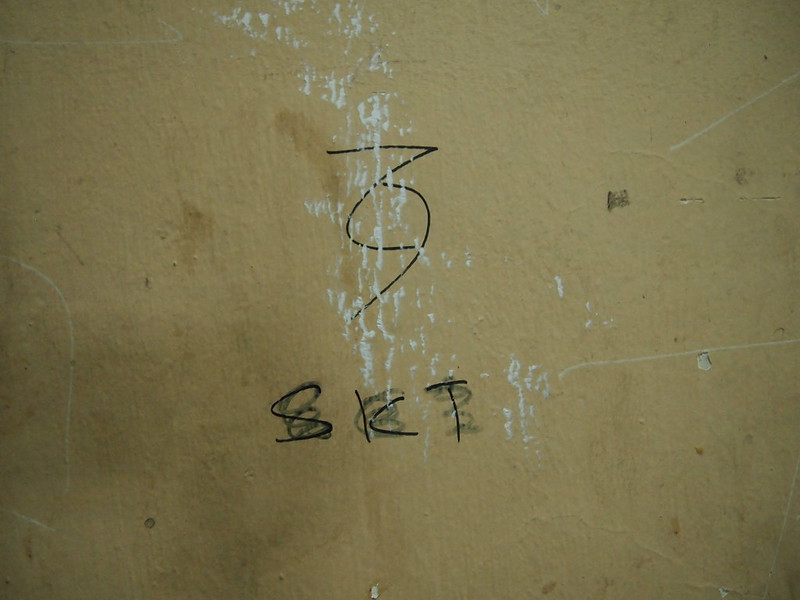
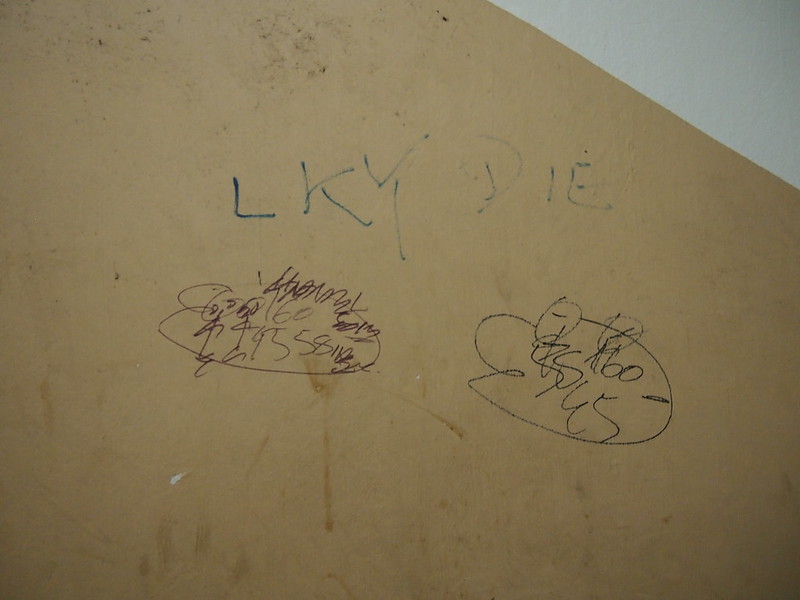
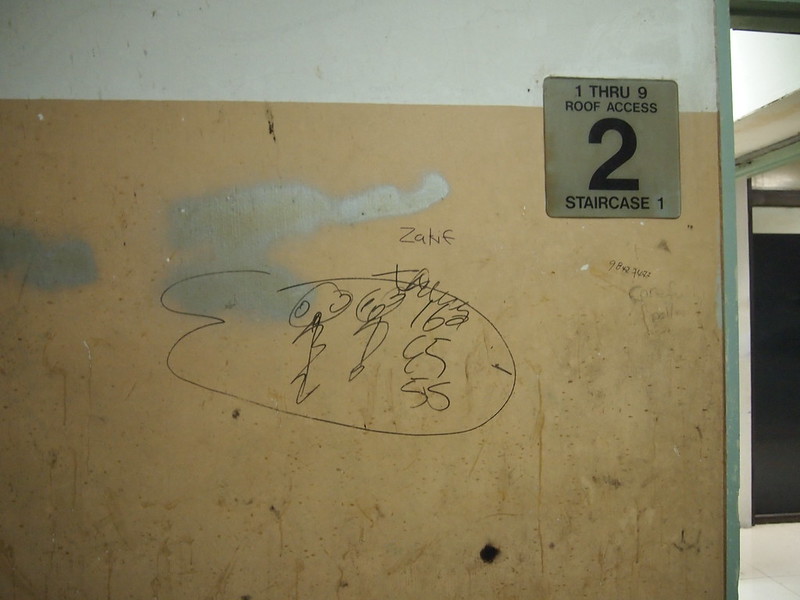
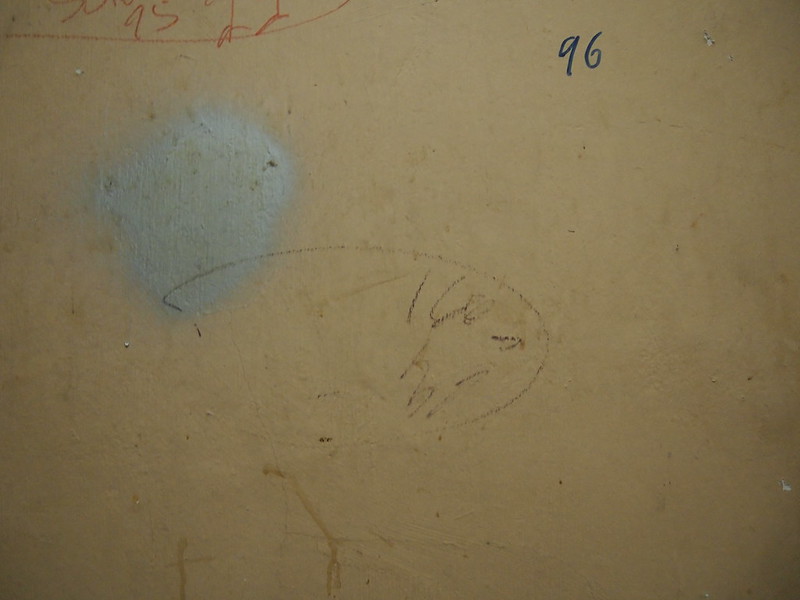
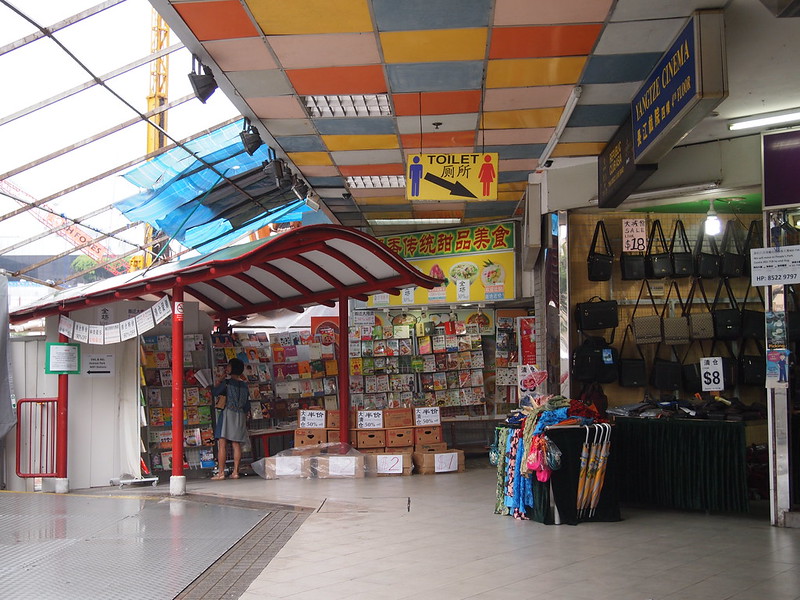
Yangtze Scribbler, I still haven't found you! Soon there won't even be a reason to call you the "Yangtze Scribbler", once the Yangtze Cinema is gone from memory. The reference that I used to refer you by will have ceased to exist.

Untitled

Untitled

Yesterday my mother and I saw the Yangtze Cinema appear on the 6.30PM Chinese news in Singapore. We only saw the second half of the report, but due to the stunted state of our Chinese we couldn't agree on whether they were reporting that it was about to reopen, or about to close for good, my mother was unfoundedly optimistic that she had heard that it would be reopening, but I knew that even if the dilapidated Yangtze suddenly rose from the ashes, it wasn't quite something that would be celebrated with a spot on the prime time news.

Untitled

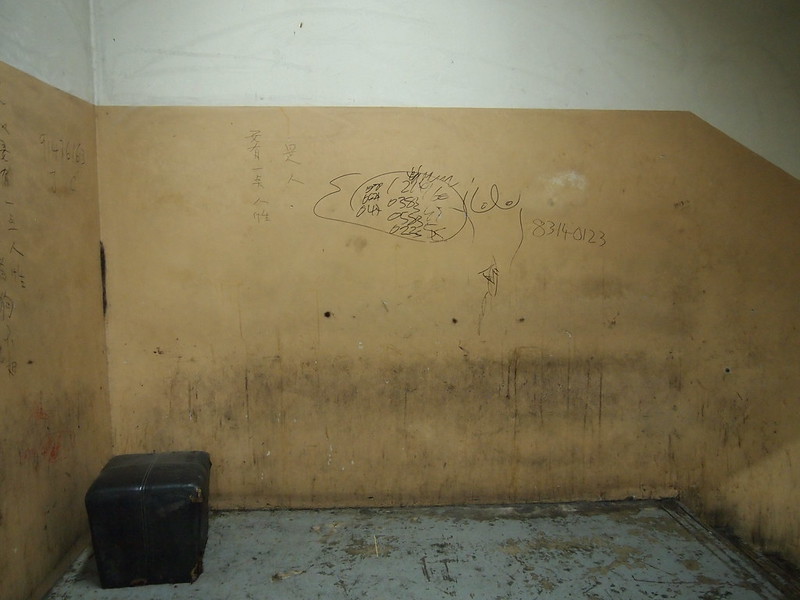
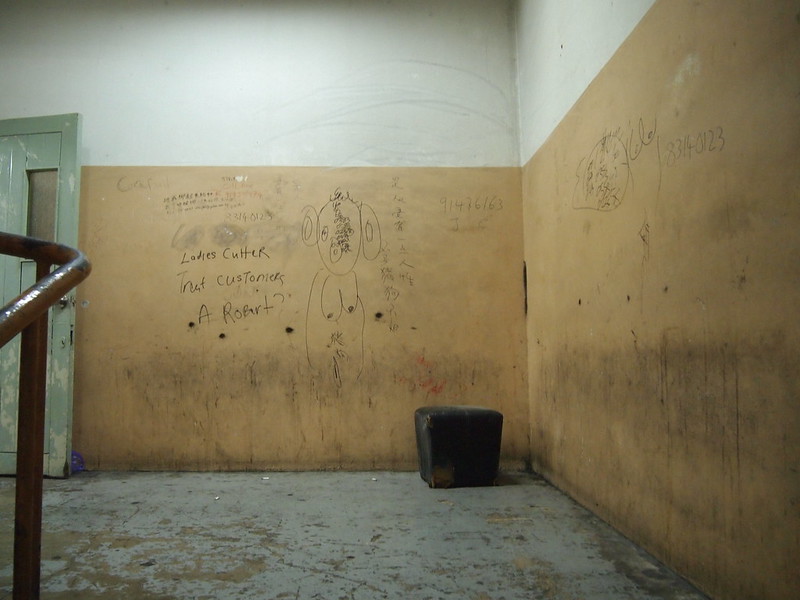
And so indeed, the Yangtze finally closed its doors on 29 Feb 2016. For me, the search for the "scribbler" started from nothing more than a chance discovery of the strange scribbles on the stairwell of the Yangtze - that somehow continued for years like a game or hide and seek in other parts of Singapore, when the same scribbles started appearing on the routes I frequented near Queen Street and the Muslim Cemetery where I would catch the bus. I have always been terribly grateful for Pin Pin's foresight for documenting the story of my search for the mysterious writer of symbols which I had childishly named the "scribbler" at the time...

See: Tan Pin Pin's film for the Singapore Memory Project - Yangtze Scribbler (2012)

I'm not always in Singapore these days. Sometimes I am, and sometimes I'm not. But last August, whilst walking from Outram to Chinatown, I ended up being trapped in Pearl Centre during an extremely heavy downpour, the relentless tropical kind of rain which demolishes umbrellas and forces you to wade through ankle deep water in order to get to your next appointment. So I soon realised that the rain meant that I would be stuck at Pearl Centre for quite some time...

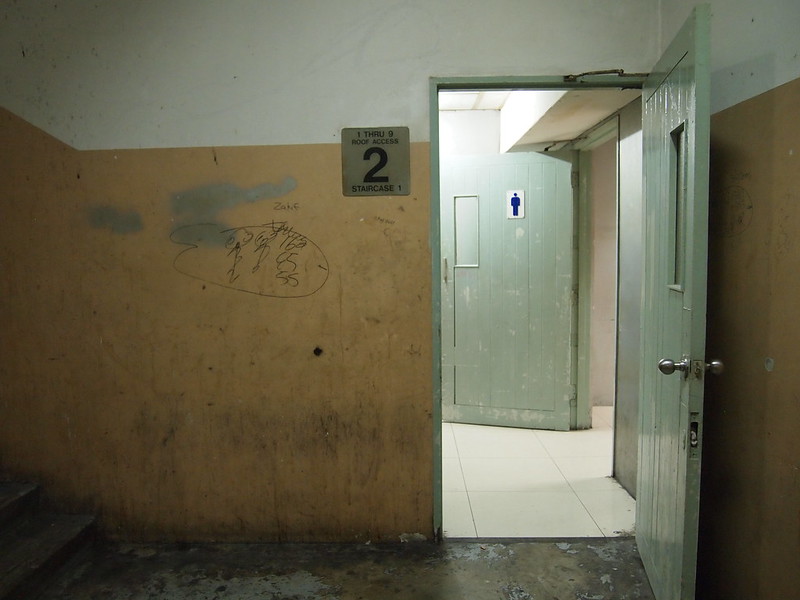
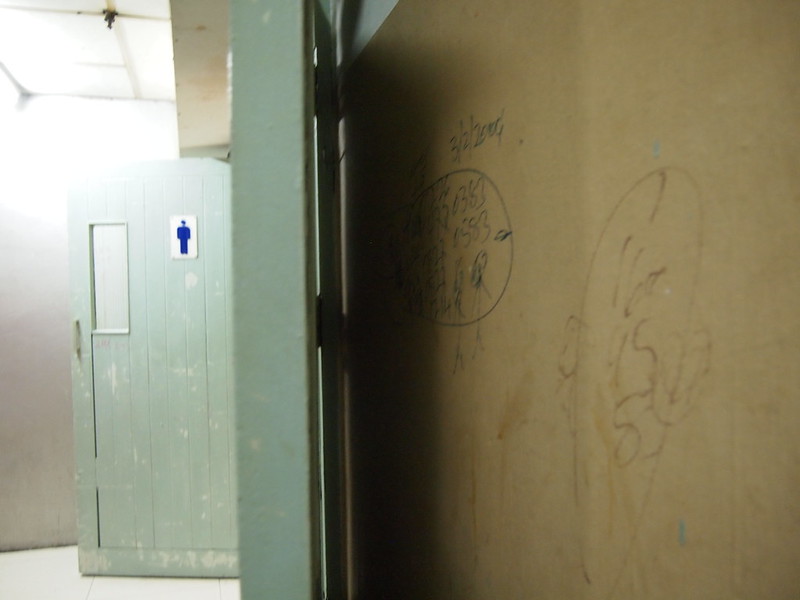
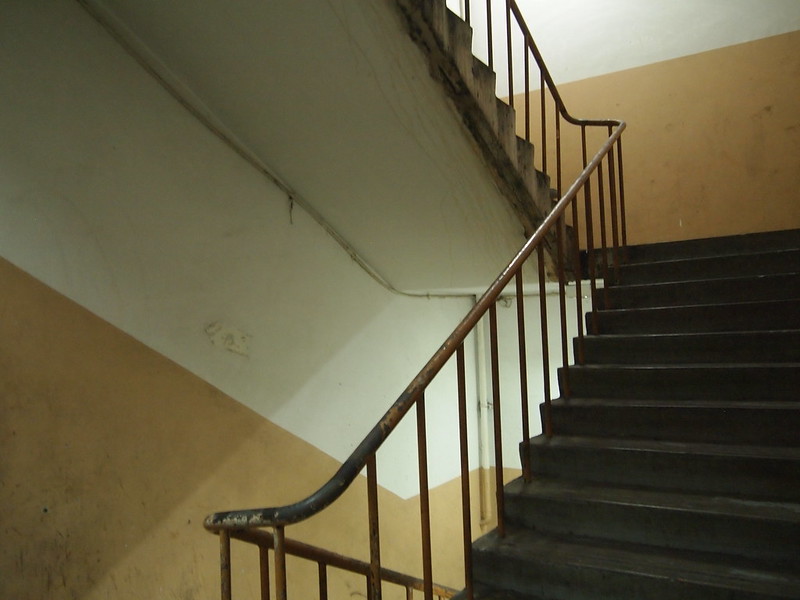
If we talk about ambiances, there are actually very few places in Singapore where I feel a sense of being physically repelled. The stairwell leading up to the Yangtze Cinema is certainly one of those places. I have always supposed it is because in real life I am awkward and have been thoroughly socialised by society's norms to respect people's "private space". I don't like accidentally brushing against strangers on public transport and I would never really feel totally at ease in someone else's house. The stairwell makes me feel like I am intruding into a space which someone has already claimed as their own; the walls engraved with scribbles, handprints and furniture for one to sit on.

Paradoxically, like the extreme vertigo I often experience when walking on large rocks or steep natural terrains, this inexplicable sensation of being physically repelled is what excites me and attracts me to return to and look closer at the place.

Untitled

Untitled

Untitled

Untitled

Untitled

Untitled

Untitled

Untitled

Could it have always just been a product of the hypnotic flicker of artificial light, or the effect of some low-frequency extractor fan infrasound that induces a vertiginous sensation of there being some other presence within the enclosed space? And what of the other doors with the MALE TOILET signs next to it? Is there something significant about how all the Male toilets are next to this passageway that is trying to send me some subliminal messages about how this is some Male space that I'm not supposed to be intruding on?

Untitled

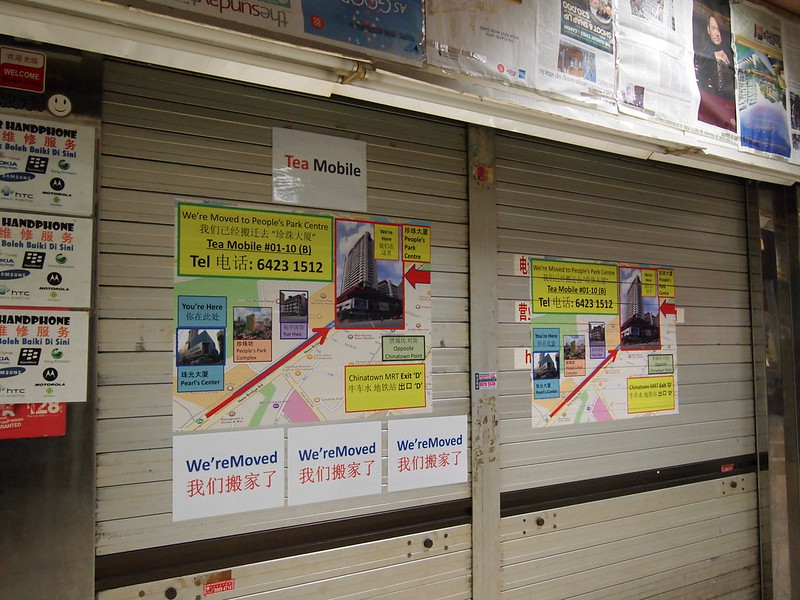
On that afternoon in 2015, the sense of having intruded was also quite frankly literal. Poking around the stairwell on one of the higher floors, I set off some kind of alarm within the building (that I had never encountered or triggered on previous trips here). So I bumbled through one of the other doors on the stairwell, and was surprised to find a middle aged man in plain white shirt, long trousers and flipflops, sitting on the floor in the corner, reading a newspaper. Mumbling an apology for suddenly disrupting his peaceful afternoon in the corner, I walked through the corridors between closed shutters and glass windows decorated with MOVED signs - only to accidentally disturb another man hiding in another concealed corner of this empty shopping centre. Looking through the glass of another vacated shop, I could see another man in another corner, not doing anything at all. With the shops gone, they were free to use the building in any way they pleased. And they decided it was a good place to sit. They were all seemingly waiting for something... perhaps the next showtime at the Yangtze?

Untitled

The old men sat apart and alone, occupying the unused corners in this emptied shell of an old shopping centre that still remained lit and airconditioned for nearly the last few who remained. Did they ever speak to one another, or did they know each other? I don't know. Perhaps they remained complete strangers to each other till the very end, just as I may never really know if I inadvertently crossed paths with the Yangtze Scribbler that afternoon. After I finally left Pearl Centre, I realised that somehow it hadn't occurred to me to speak to the men to ask them if they had known who had made the scribbles on the stairwell.

Somehow united by this strange space, the strangers passed the time together and waited for the last show of the day...

Untitled

Goodbye, Yangtze.


See also:

May 2013 - Yangtze Scribbler on Victoria Street
June 2012 - Yangtze Scribbler on Queen Street
April 2012 - Looking for the Yangtze Scribbler
Mar 2012 - Yangtze Scribbler on Victoria Lane
Flickr Set: More images of the Yangtze Scribbler
Singapore Memory Project Showcase - Tan Pin Pin's short on the Yangtze Scribbler