Saturday, 23 July 2016

A Chinese Gatecrasher at the Great Exhibition: A Visit to the National Art Library (Victoria & Albert Museum)


During my student days I felt too intimidated to try to access the National Art Library, despite my countless visits to the V&A on the way home via South Kensington. How foolish of me! There were no barrier to entry, but then again, there were also no clear signs on how I should have come to access and browse this library, and even with renewed purpose and confidence after the IHR course, I still felt some trepidation on going to register for a reader's ticket.

Firstly, a logistical note for the first time visitor: leave your bag at the cloakroom by the entrance. There are plastic bags available. If you haven't already registered for the NAL card, its £1 for an average sized bag. If you have the NAL card, its free to use the cloakroom, but it's that Catch-22 where if you're a first time visitor who hasn't got the card up but are going to the library to obtain one, then you'll simply have to shell out the £1. If you go to the Library doors carrying your bag, they will tell you to go back to the cloakroom. There aren't any lockers nearby, so you'll just have to go down the stairs and back through the gift shop to the cloakroom at the front entrance again.


After registering with my ID and explaining the research I wanted to do in brief, I was granted a very generous 5 year reader's ticket, and that was it. Dated 2021, an implicit assumption and reminder that the library would be here in 2021 granting me access to all of its volumes for the next 5 years when I didn't even know what I'd be doing in the next 5 years! The librarian asked me to sign my new card, and then, there it was, my ticket. I looked at him. He looked at me. I looked at him, expecting some explanation, some formal introduction, or reminders to not take in my pens and clipboards. With many other libraries and archives often giving a perfunctory explanation to first time users of their resources, I was surprised that they assumed that I knew what I was doing, or perhaps my performance of the foreign artist-designer-researcher had been too convincing. The librarian gestured to me go along, so I awkwardly slunk off to a corner of the room like a small terrified spider trying to hide itself in the corner, clinging to the open shelves at the edge of the room and going around in a few circles, keenly aware of the creaky floor amplified by the volume of the space in the library - the librarians wheeling their comically squeaky trolley across the room, the raspy breathing of researchers and their intense and very serious flipping of huge dusty books on cushioned pads. Finally, having crawled all around the edge of the library back to the front entrance in one great circle, I seized upon a map affixed to the front of the library which showed there was an open shelf for the "GREAT EXHIBITION".


No doubt much has been written on the subject of "The Great Exhibition of the Works of Industry of all Nations" in 1851, and I have since found that many extremely pertinent volumes (such as Tallis' inimitable account of the Great Exhibition) can actually be found online in digital form. But here, gathered together into a collection, the considerable size and unexpected heft of the volumes emphatically declare the existence of these records; it is so much easier to browse through it manually, to sift through and determine what material within it is truly of note.

Robert Ellis' preface to the catalogue acknowledges the 'extreme challenge' involved in contending with the vastness of the collection and the element of disorder - in trying to put together a catalogue with over 15000 contributors, manuscripts, drawings, etc, all of which required to be put into some order of composition in time for the catalogue's publication. The introduction to the section on the colonies also expresses the importance of the visit to the exhibition to handle objects in person:

There appear only two available methods by which a manufacturer can be made acquainted with the existence of foreign products likely to be useful in his business; one is, by the collection of such information as is obtainable respecting them, and arranging it according to the most prominent properties of such substances. When these are so arranged, it is comparatively easy for any one to ascertain whether India, or any other foreign country, contains any useful or ornamental product which might be employed instead of, and be cheaper than, that already in use.

But with the most simple arrangement and clearly-conveyed information, the manufacturer generally would feel little interest about unknown natural products and their strange names, unless he had an opportunity of seeing and of personally examining them. Then, a glance of his practised eye, or the slightest handling of a new substance, informs him whether it is likely to be of use for his purposes.

This wasn't some special trade fair just for the rich, or traders and manufacturers and people working in industry. This was a spectacular extravaganza for the masses. The exhibition ran for 141 days (1 May 1851 to 11 October 1851, closed on Sundays) and had been attended by very large numbers of people from all over - imagine, that 6,039,195 people visited it, of which over 4,439,419 had come in the last 80 days when the ticket prices had been very sensibly lowered over the duration of the exhibition (just a shilling). It was also abetted by railway developments - in the pre-railway age stagecoach fares were about 6d (6 pence / half a shilling) for each mile, an average labourer in London might earn 20-30 shillings a week and outside of London it was likely to be less than that, but with the railways there were "shilling days" where one could get a return ticket for a train down to London for around 4-6 shillings (3rd class). (Thomas Cook had started his company ten years prior in 1841 with similar shilling day rail excursions for all and sundry and there were many such packages to ferry anyone and everyone to London for an excursion to the Great Exhibition. King's Cross had opened in 1850, connecting London to much of the north and midlands...)


A fantastic satirical etching by George Cruikshank: originally from Henry Mayhew's 1851: or, The adventures of Mr and Mrs Sandboys and family who came up to London to "enjoy themselves", and to see the Great Exhibition. On the way to the library I had been complaining to George about the painfully slow traffic in Knightsbridge and difficulty in getting in and out of buses and trains due to the sheer number of students on excursion and tour groups becoming stuck inside stations... I guess some things haven't changed since then...

Other absolutely useless but depressing figures found in the tally books: During the exhibition, a rather frightful 1,092,337 bottles of soft drinks (supplied by a Messir Schweppe!) were consumed, 943,691 Bath buns were eaten (which forever altered people's understanding of Bath buns and ended up being known as "London Bath Buns" as these buns were more irregularly shaped, very fruited, highly sugary and generally heavier than their counterparts from Bath), and also another 870,027 plain buns were consumed.

I could go on and on about the criteria for the selection of exhibits as well as the dubious selection and Prizes given out, which resulted in some many absurdities and 'innovations' and 'offenses against good taste' (in some opinions) being put on display, but perhaps that should be for another post.

Today what I'm excited about is the story of a mysterious chinese man who basically gatecrashed the opening in grand style, captured here in Selous's official portrait for the opening.


The Opening of the Great Exhibition by Queen Victoria on 1 May 1851
Henry Courtney Selous. © Victoria and Albert Museum, London

From the V&A Website: "The identity of the man in Chinese dress who stands in the group on the right of the painting with foreign commissioners and chairmen of juries has been subject to debate, as no official Chinese delegation attended the opening of the Great Exhibition. In a printed key to Selous's painting, published in a newspaper in 1852 (V&A museum number 329:1-1889), his name is given as Hee Sing, and a note records that he 'happened to be present on the occasion', implying that he had no official position in the opening ceremony. However, it has recently been suggested that this man can be identified as Mr Xisheng (alternative spelling Hesing), who arrived in England in 1848 onboard the first Chinese ship to have entered British waters, the Keying. A medal in the collection of the Shanghai History Museum, bearing a portrait of Xisheng, records this event with the following inscription:

'MANDARIN HESING OF THE CHINESE JUNK
THIS REMARKABLE VESSEL IS A JUNK OF THE LARGEST CLASS, AND IS THE FIRST SHIP CONSTRUCTED BY THE CHINESE WHICH HAS REACHED EUROPE, OR EVEN ROUNDED THE CAPE OF GOOD HOPE. THIS JUNK WAS PURCHASED AUGUST 1846, AT CANTON, BY A FEW ENTERPRISING ENGLISHMEN. SHE SAILED FROM HONG KONG 6TH DECEMBER 1846 ROUNDED THE CAPE 31ST MARCH 1847 ARRIVED IN ENGLAND 27TH MARCH 1848'


Googling for the name HEE SING brings me to a book which notes that it was recounted by Lyon Playfair in his memoirs that "a Chinaman dressed in magnifient robes, suddenly emerged from the crowd and prostrated himself before the throne. Who he was nobody knew. He might possibly be the Emperor of China himself who had come secretly to the ceremony."

Organisers were completely fooled and taken in by his immaculate dressing and 'dignified' behaviour (executing an elaborate kowtow to the Queen) and thus they regarded him as someone significant and placed him between the archbishop of Canterbury and the Duke of Wellington where he was immortalised in many portraits of the opening ceremony. He is mentioned as the "bogus Chinese mandarin" in some sources...

More on the "Keying" from the Illustrated London News of 29 July 1848:

The ROYAL CHINESE JUNK "KEYING" manned by a Chinese Crew. Visitors received by a Mandarin of rank and Chinese Artist of celebrity. Grand Saloon, gorgeously furnished in the most approved style of the Celestial Empire. Collection of Chinese Curiosities, &c. The "Keying" is now open for Exhibition, from Ten to six, in the East India Docks, adjoining the Railway and Steam-boat Pier, Blackwall.—Admission, One Shilling.

ADMISSION, ONE SHILLING.—During the limited period which the ROYAL CHINESE JUNK will remain in London, the charge for admission will be reduced to One Shilling. This most interesting Exhibition, which has been justly called "the greatest novelty in Europe," has been visited by her Majesty the Queen, all the Royal Family, and an immense number of persons, including nearly all the nobility and foreigners of distinction in London. Junk Tickets, including fare and admission, are issued by the Blackwall and Eastern Counties Railways. Omnibuses direct, and conveyance also by Steam-boat from all the Piers between Westminster and Woolwich; fare 4d. Catalogues obtainable only on board, price 6d.

In short, Hesing (who acts as "Mandarin of rank" on the Keying, and is also captain of the ship) gatecrashes the opening of the Great Exhibition and convinces everyone there as well that he must be VERY IMPORTANT since he dresses like he must be important and behaves like he must be important, and strangely no one thought to ask him who he was (why???). It is not clear to me - and it seems it is also not clear to everyone else looking back on the event - on whether Hesing was an authentic mandarin official or simply performed as "Mandarin of rank". But it does sound like the Keying had been a popular and quite affordable NOVELTY (red flag) exhibition on an epic Chinese Junk brought over by some "enterprising english businessmen" (another red flag). I wonder what Hesing's account of the whole affair would have been like. Was he just acting as his 'character', as the "Mandarin of rank"? Or was he trying to assert his role as an "true Mandarin of rank" in the face of other people's doubts of his authenticity? And what happened to Hesing and the Keying after all this? So many questions and more to search for...

Sunday, 17 July 2016

"What do you mean we're in Middlesex?" and "Is it Harringay, Haringey, Haeringshege, Haurnsy, Hornsey or HRNNGGGHHH??": A Visit to the London Metropolitan Archives


The first time I've ever seen an 18th century feoffment document!
E/MW/C/0218 / A transaction in 1707 for Tower Place and the Warren in Woolwich

The London Metropolitan Archive is hidden away in a large nondescript building down in Clerkenwell. As an archive of local records for the London area, it combines the collections of the London County Council (LCC), Middlesex County Council (MCC), Greater London Council (GLC), pan-London charities, organisations, businesses, and records from the Diocese of London (all of the parishes that donated their records – most have, and these are quite useful for those researching family history within the area).


Useful and sometimes curiously specific research guides


"IS YOUR ANCESTOR A CONVICT?"


Index files for Parish Records at LMA


Parish Registers: useful for historical records of births, names of parents, baptisms, marriages, and burials, etc.

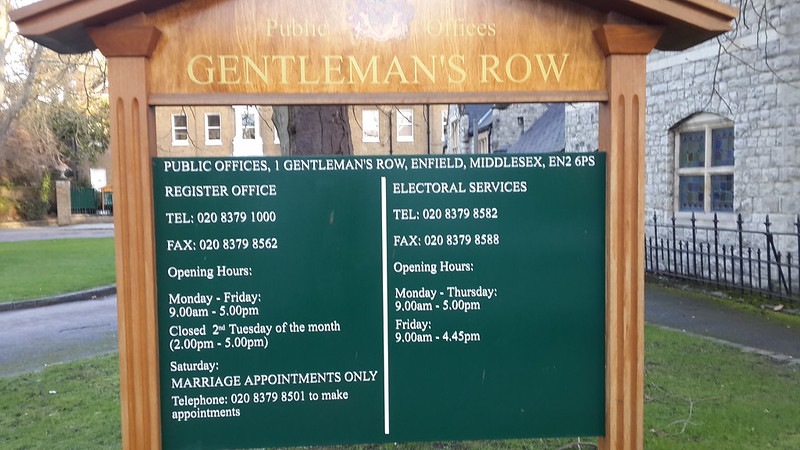
Mind you, I've noticed that archivists and government administrators seem to love acronyms, so the terms do take getting used to, but the most exciting thing I've been induced to think about is the concept of the place called MIDDLESEX. Perhaps this is something all you people brought up in the UK already know in great detail or learnt in school, but my understanding of Middlesex has always been fuzzy. To be honest I simply thought that was where Enfield is (aka Quite Far Away Place), because I saw a Public Office noticeboard in Enfield in 2014 that wrote MIDDLESEX on it. Back when we were living in Stamford Hill, I could hop on the National Rail service directly to Enfield Town in about 20 minutes, so it’s clearly a very reasonable commutable distance to the city.

20140207_154837
In Enfield (February 7, 2014)

It might sound like a useless distinction to talk of, but people, you don't understand: I'm still easily excited by the frisson of crossing invisible county lines! We haven’t got other historical counties or towns to travel to in Singapore, everything is just paddling about in the same pond there. Here I can go to a DIFFERENT county or city in under half an hour? OMG I'll do it, it's cheap thrills for me!

But non-londoners may not be aware of the boundaries of the historic county of Middlesex prior to the 18th and 19th urbanisation which rendered areas such as Tottenham and Enfield more as residential suburbs for the city of London.


Map by the Institute of Heraldic and Genealogical Studies, 1997

In simple terms, historically Middlesex had its own thing going on (and it even appears in the Domesday Book) - Middlesex, Middleseaxon, Land of the Middle Saxons! But then as the city of London expanded, more and more of what would be considered Middlesex in the past was effectively changing into the “suburbs of London”...

Starting with the Local Government Act of 1888, administrative counties were formally established. So in 1888, a small part of what was considered part of Middlesex County was then transferred to the new County of London, and the rest then came under Middlesex County Council. Over the years, a series of local government acts established, merged, or dissolved various counties. The MCC (Middlesex county council) was dissolved in 1965 as the area had become urbanised together as the Greater London area, and then became under the GLC (Greater London council) from 1965 onwards [London Government Act 1963] – until the GLC itself was dissolved in 1986 and its powers distributed to the various London Boroughs [Local Government Act 1985].

So the question is, does Middlesex still exist or does it cease to exist if the administrative region of Middlesex no longer exists? (I suppose I'd say that Middlesex ceases to exist once people no longer actively refer to it as Middlesex).

This reminds me of the equally confusing question of “Is it Harringay or Haringey?” A victim of multiple spelling variations, when you walk around the neighbourhood around my house, you’ll see this:


A walk around on 17 July 2016

A h2g2 article notes that the spelling Haringey was recorded in 1387, whereas Harringay was recorded in 1569. A large Tudor house built in 1792 was named by its owner Edward Gray as “Harringay House” and it formerly stood at the top of the hill (on what is the present-day Ladder, at the top end closest to present-day Wightman Road between Allison Road and Hewitt Road and over the tunnel through which the New River runs underground) - thus the usage of Harringay took common precedence in the neighbourhood. OS Maps in 1894 record the area where our flat is as Harringay Park Estate (Note: this means that our house was originally built somewhere between 1880-1894).

The name “Harringay” was preferred by the people who lived there and attempts by the Municipal Borough of Hornsey to standardize the spelling as “Haringey” were stymied by locals who insisted on using “Harringay”. Today, the administrative name for the borough is Haringey, but the place is known as Harringay. In any case the names Harringay/Haringey and also Hornsey are both actually derived from the mangling of the name of Harenhg or Heringes or Haering’s Hege. Haringey Borough website says that a local historian established that there are a staggering “162 variants of the spelling of the name in surviving historical documents from the medieval period onwards”, so at that rate, people may as well have been muttering HRHRHRHGHRGGG to each other... "Oh righto, see you tonight in Herrggnhgghhhhh...."


IN THE NEXT EPISODES: WE VISIT THE NATIONAL ARCHIVES, WHERE IF YOU SIT FACING THE WATER FEATURE TO WATCH THE FAMILY OF GEESE WHILST EATING YOUR SANDWICH AT LUNCHTIME, ALL OF THE GEESE WILL ROTATE THEIR BODIES TO FACE YOU, SUCH THAT YOU WILL REALISE, CHILLINGLY, THAT NO LONGER ARE YOU THE ONE WHO IS WATCHING THE GEESE - BUT RATHER, THAT THE GEESE ARE WATCHING YOU.

General Colonial History, Explorations and Voyages, and Richard Hakluyt: A Visit to the Institute of Historical Research Library


This week I’ve been at a course at the Institute of Historical Research, and I wish I had done something like earlier – because prior to this, it was as if I had been hitting a nail into a plank with a smartphone and going about the historical portion of my research quite randomly and inefficiently. So I have decided that for documentation purposes (as a process blog!), I shall make short summaries of the trips to each of the the library/archive that I've visited this week (and separately on my own), including:

  • Institute of Historical Research Library
  • London Metropolitan Archives
  • Bishopsgate's Institute
  • The National Archive
  • Clothworkers' Company Archive
  • House of Lords Archive
  • Lambeth Palace Archive
  • London Archaeological Archive and Resource Centre
  • British Library
  • Wellcome Trust Library
  • …and more to come!

Beginning with... the IHR library itself!


Institute of Historical Research Library


Excuse me, for the massive gaps in my historical/geographical knowledge shall soon be showing! Is there a term for this kind of bias where you end up mainly reading first about the things which are seemingly more closely related to yourself, rather than reading EVERYTHING ELSE IN THE WORLD indiscriminately? I rather like the free-associating browsing of a physical library rather than a direct automatic search of a digital catalogue, but one does tend to gravitate to familiar territory for starters. And actually, I really shouldn't apologise for not knowing every single thing, but maybe this is some weird workaholic guilt at work here... but then, perhaps it would be great to exercise my right to have incomplete knowledge if I should want to, perhaps.. even as a political statement or as affirmation of one's position? Right! SORRY BUT NOT SORRY! (Sorry)
At junior college, which was the last time I actually studied history in school - what we were taught in schools in Singapore was local and regional history (Singapore History and Southeast Asian History) and as for that extra something to give us a bigger picture of historical context, the 'earliest' era we would have looked in the syllabus was Cold War, ie: 1945 onwards. ie: what I would call Modern History. I regret to say that I never took a History module in my undergrad years either. So... basically in all my life I've never attended a medieval history class.

An ex from many many years ago had specialised in Middle English poetry and once painstakingly wrote out a poem for me in Middle English. The unappreciative early-20something-year-old me at the time looked at it as some oddity but never tried to read it. I didn't quite concern myself about historical variations of Englishes since the main remit of my studies seemed to have nothing to do with it. Simply thought of the translation process as an fruitless endeavour to which there would be no point, just wanted to read the version I could read. And so the poem just went out of mind, undeciphered. I never really knew what the poem meant because I didn't read it. In fact, I don't even have the foggiest idea what it was about now! I guess I failed to appreciate the amount of hard work and scholarship that goes into studying MIDDLE ENGLISH - and the value of being able to personally read it! To be able to access the original text before translation!


At the end of the first day of the course I had time to explore the IHR's Wohl Library. Having no prior experience of studying European History, one might even ask - what is an uneducated philistine like me doing at the Institute of Historical Research then? Greeted by tall shelves of "Low Countries" (apparently one of the central collection priorities of the IHR!) I belatedly realised that all I knew of the “Low Countries” was that it was some kind of archaic term for some bits of Western Europe which were lower-lying but my spatial knowledge of European geography and topography was too embarrassingly fuzzy to be able to pinpoint or recall the countries encompassed by this term! [I went home in shame to read up about it properly and now know that the Low Countries refers to the coastal reason of western Europe including Belgium, the Netherlands, and Luxembourg. Ironically I also found out that I had indeed written this down in my wiki/notebook several years ago but clean forgotten it since. Oh forgive me Benelux, I have entirely failed at historical geographing!]

Grasping at straws for something I would be a bit more familiar with, I blithely went to investigate the COLONIES: GENERAL area.


Oh no! Dialed too far back on the time machine!!

Apparently the IHR’s collection of sources on British North America is “one of the best in the UK”. (And I’ve definitely never encountered a physical collection of books on British North America until this point in my life... so having the chance to grab random books off the shelf to read was a delightful first)

And actually, I realise I've never really read up about East India Company’s earlier history; certainly my (generalised) knowledge of its ministrations is largely from the period after the expansion of the opium trade and establishment of Straits Settlements.


Here, I found a copy of Hakluyt’s well-known The Principall Navigations Voyages and Discoveries of the English Nation. Famous early chronicler of maritime adventures! Early colonial ideologue, economic opportunist and promoter of proselytising... [Also the adopted namesake (no direct but only symbolic links) of the rather secretive business intelligence company “Hakluyt & Company” (which incidentally also has a base in Singapore)]


And there were entire shelves of the Hakluyt Society’s publications – who have been printing editions of first hand accounts of historic voyages and travels.


Anyway, so here this is the massive volume that constitutes The Principall Navigations Voyages and Discoveries of the English Nation - such an historic piece of English travel-writing! - and I can’t believe I can walk up to it and just pick this massive copy off a shelf!


....And naturally, it is either in Latin or Middle English. Its like a TRIAL BY FIRE WAIT THIS IS NOT EVEN CALLED "MEDIEVAL" IS IT? IS THIS WHAT YOU CALL EARLY MODERN TYPOGRAPHY? HELP! WHAT AM I DOING? WHAT DO I DO?


Yeah this is more like the level I'm at:
"What do you mean Lorem Ipsum is not Latin, but just Latin gibberish...??"

It must have been a translation into English I had seen in the past, or maybe was it secondary material through which I had first encountered Hakluyt? I don’t even know! Up to this point everything I’ve touched has arguably been secondary source material. Contemporary books, journals, newspapers mediated through the eyes of the reporter and the witnesses, government reports arguably evaluated through the viewpoint of the administrator… all of these facsimiles! Reproductions! Digital surrogates!

If there's one thing I’m comforted by is in this tale is that – actually, despite Hakluyt being known for his publications on voyages – actually he himself was not actually an explorer. Instead, he had begun as a university scholar who set out to read about all the voyages he could - and then specialised in writing, translating, contextualising them. And yet the writer wields such powers in the process of writing or record of the journey. How else would I know of these journeys today?


On an aside, here are two mad bookbinding covers for speeches/addresses of the Hakluyt Society, one of which is for the tercentenary or 300-year anniversary of Hakluyt's death in 1916. (This means that this year will be the 400-year anniversary, or quatercentenary... Yes I had to google for the right word for it... it is not a common term which is quite rolling off the tip of my tongue)


IN THE NEXT EPISODES: WE VISIT MORE ARCHIVES INCLUDING THAT OF HAKLUYT'S BENEFACTOR THE WORSHIPFUL CLOTHWORKERS' COMPANY (WHO GAVE HAKLUYT A PENSION), WHICH BY THEIR ADMISSION HAD BEEN ESTABLISHED "PRETTY LATE" IN 1528. COS YEAH... YOU KNOW... SOME OF THE OTHER LIVERY COMPANIES EVEN STARTED A FEW HUNDRED YEARS BEFORE THAT IN THE... ELEVENTIES #backtothe1100s #nobigdeal

Friday, 10 June 2016

Searching for British Library Manuscripts, Trying to understand 19th Century Palaeography through Calligraphy practice, and Iron Gall Ink!

The amazing treasure trove that is the British Library! Despite the wealth of resources available there, I always feel like its catalogues are so arcane and confusing that I think it is worth making a list of things I wish they told me from the start, if it will save someone else from the confusion I had in the reading rooms - with embarrassingly noisy book stand apparatus that no one tells you how to use, and thousand paged manuscripts wrapped in very complicated cake boxes with string!...

Untitled

THINGS I WISH SOMEONE TOLD ME EARLIER ABOUT USING THE BRITISH LIBRARY


  • Archives are in a separate catalogue. On the BL page and dropdown menu: Catalogues > MANUSCRIPTS > Archives and Manuscripts.
  • There may be a "handlist" on open shelves for reference. The handlist is a list of items which are on display or which are available for requesting within a specific collection.
  • Ordering Microfilm: There is a microfilm option hidden at bottom of Request Other Items. So even if the item is technically a copy of something from Private Papers, you should order it under Microfilm. Again, I wish this was explained clearly from the very beginning.
  • Before leaving the counter, check that the item you have received is actually the actual item you have ordered. Yes, I have had the unusual fortune of receiving the wrong item after patiently waiting well over an hour for it!
  • Although the rooms close at 5, it seems that by 4.30 they'll start to ask for the special materials to be returned.
  • You have to leave most things outside and you have to use a plastic bag to bring things in
  • You cannot bring pens in. You can only bring pencils.
  • You cannot take photos of some historical material. But if you have retrieved it in microfilm form, you can take as many pictures as you want for free on your mobile phone camera. (I'd really like to find out what is the rationale for this rule?...)
  • You need a pound coin to use the lockers downstairs. (Interestingly, people also regularly forget to take their £1 coin deposit from their lockers at the basement. Just sayin...!)

Recently I wanted to look for some historical documents which were held under the India Office Records. It was then that I realised that I have never handled primary historical material before, so when the librarian asked me if I wanted original or microfilm I was confused. ORIGINAL OR MICROFILM? No one had ever asked me to choose between the two! Should I want to see the microfilm instead of the original? Is the copy truly identical to the original? I suppose I am not a historian, and I'm not usually doing such research involving very old materials, hence most of the records I have sought out in the past were all microfilm. How did this happen???

Aaaaaaaand that was how I ended up handling some original copies of Sir Stamford Raffles' letters to his sister. I became intensely afraid of suddenly developing a explosive nosebleed whilst hovering close to the thin slips of paper, almost translucent in the light. And tragically, it was then that I also realised... I COULD NOT READ THE HANDWRITING. It was almost a flat line! And what is going on the letter r and ff? And had all these weird squiggles about it! And why did people use only a perplexingly small portion of the entire paper???

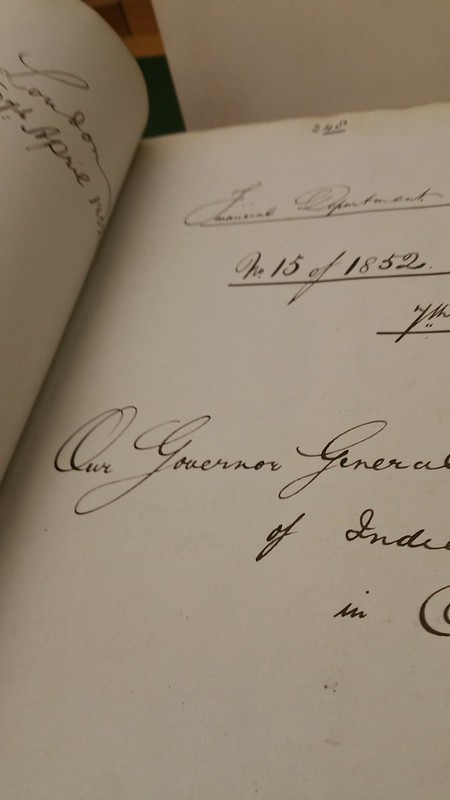
Furthermore, whilst looking through other EIC documents, I realised that I had extreme difficulty with copperplate, even though it represented the standardisation of administrative script! Doom! I imagined the eagle eyes of the librarians boring into the back of my skull as I opened up the paper and could do nothing more than attempt to decode it letter by letter... I took so long that it was closing time. The librarian then told me, "You know, you should get the microfilm next time, then you can take photos and read it off the photograph more slowly." MORE SLOWLY? HOW MUCH MORE SLOWER CAN I DO THIS?

A few days later, I decided to should try to get to grips with things by learning calligraphy or copperplate. Again, this turned out to be another first for me, and I realised I had never used an ink pen. Oddly enough, I had used a lot of digital "grunge" or ink effects in photoshop when I was a teenager, because it was all the rage at the time. But ink splotches were nothing more than things people made as packs of images and shared online, or digitally mimicked with photoshop brushes! Ink wells? Actual ink? Who used ink? Unbelievable that my life has been dominated by the digital ways! Well, never too late I guess...

PROGRESSION: TWO WEEKS OF CALLIGRAPHIC MESSING ABOUT


On 27 May I decided to get a calligraphy pen set. These nibs were wack and not bendy in the least. The result was boring. And I had no idea what I was doing.


On 1 June I got some interesting nibs in the mail - the Brause Rose, Leonardt Hiro, and a few others. The results began to improve.


1 June 2016


6 June 2016


8 June 2016


Sumi Ink. I have learnt the hard way that you should not turn the bottle upside down....


The ink that came with this beginner's set of inks was Indian Ink, but apparently Indian Ink was invented in CHINA, but the carbon materials for Indian Ink come from India. At first I thought this carbon ink must be the ink that everyone had used for all the documents that I could expect to see in the British Library collections (originating from the UK). It sounded logical on the surface and it is an old ink with some history....

But as I looked into historical inks, I found out that the standard ink that was used in medieval europe (5th - 19th c) was actually an iron gall ink? Made specifically from.... OAK GALLS! Gallotannic acids were extracted from galls in trees (how did they find all these galls? Does it mean it would have been widely celebrated, to find these galls? Were there gall hunters??)

How on earth did they discover that these galls were useful for making ink??? The earliest mention appears to have been by Pliny the Elder (23AD - 75AD) who noted that verdigris (iron) + an infusion of nut galls equals BLACK ON PAPYRUS. A brief search online of the history of iron gall ink brings up many pages suggesting that it is not really known when people transitioned from carbon inks to iron gall ink, but for the most part by the medieval times people were mainly using iron gall ink due to its permanence, non-clogging action (compared to carbon-based ink like indian ink), and "relative ease of production" (WHERE WERE ALL THE GALLS COMING FROM? DOES THAT MEAN THERE WAS A WHOLE MARKET FOR TRADING GALLS?)

I guess galls are easier to find than carbon if that material had to come from overseas! And today it seems more likely for me to be able to buy a whole load of... carbon on ebay as opposed to locating elusive plant galls in nature!

Oak galls have been used in the production of ink since at least the time of the Roman Empire. From the Middle Ages to the early twentieth century, iron gall ink was the main medium used for writing in the Western world

Why did I not know this when I last did research about galls??? Apparently many significant manuscripts were written using iron oak gall ink, including one of the oldest Bibles, the Codex Sinaticus (around 4C). Also, despite not being used widely today, in the UK, registrars today still are required to use a special blue-black archival quality ink which apparently has ferro gallic compounds - used to sign official documents such as birth certificates, marriage certificates, death certificates and on clergy rolls and ships' logbooks!

Now.... I finally have a functional reason to go out and hunt for more oak galls!...

...SO I CAN EXECUTE ONE OF THESE RECIPES FOR IRON GALL INK!
http://www.instructables.com/id/Making-Iron-Gall-Ink/
http://www.transitionblackisle.org/oak-gall-ink
https://www.westdean.org.uk/study/school-of-conservation/blog/books-and-library-materials/making-testing-iron-gall-ink

The Life and Death of Snail: How to keep snails and preserve their shells

Untitled

Untitled

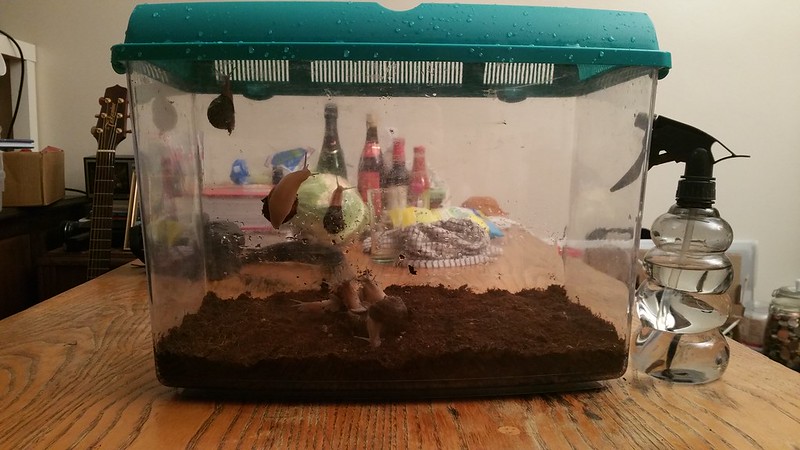
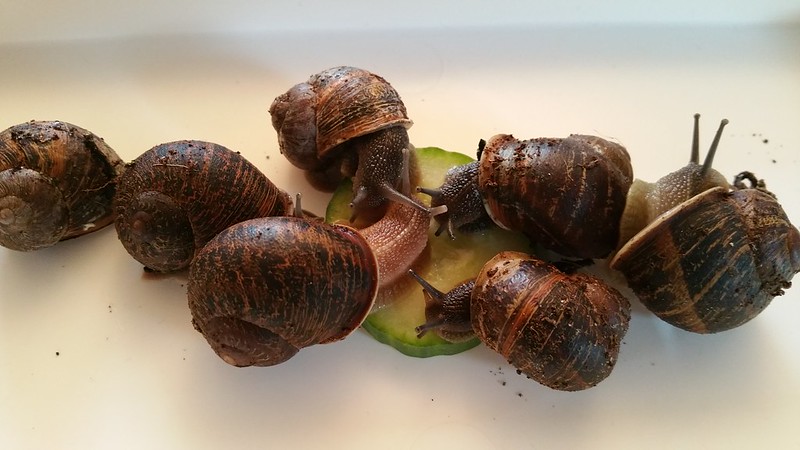
I don't know why I haven't made a more lengthy post about snails until now! Hello world and horrified neighbours, I've been rearing terrestrial mollusks of the English Garden persuasion for over a year now! (I like to call my tank "Snail TV" - its pretty soothing to watch them slide around like bizarre alien marzipan swans). George thinks I'm obsessed about them because they're a bit like rocks with faces on them, and I think there is some truth to that. They are so strange! But reactive and very very curious!

20150529_155904_Burgoyne Rd

HELLO? DO YOU WANT TO COME IN?

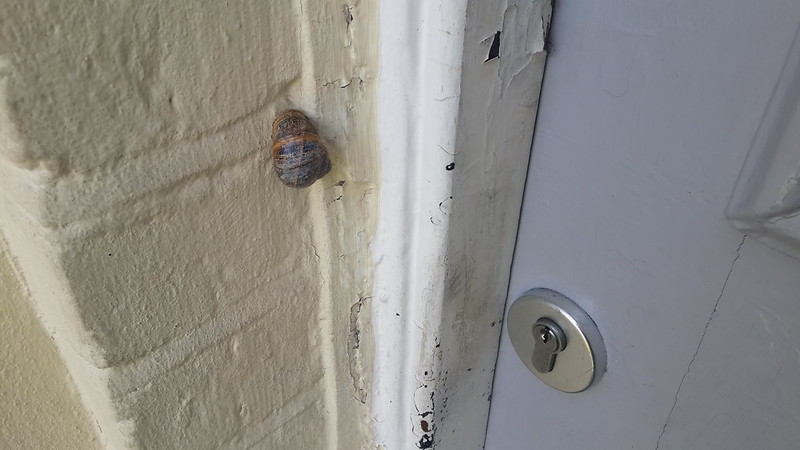
It first began because I found all these snails outside, and then I got very excited about observing their behaviour, and how they ate, but George said I could only have as many "pet snails" as I could identify by name. So we began with five little snails - Robinson Crusoe (a very adventurous but not very hungry snail), Wetherspoons (a very hungry snail), Harvester (an even more hungry snail), Prince of Wales (a yellow grove snail) and Shakespeare (a late comer who appeared to be shunned by the others).

For a period I also almost kept slugs but I discovered that the slugs were aggressively invasive SPANISH SLUGS which I felt bad about returning to the wild after I had discovered what they were. So I put the slugs on our roof. I have to admit I am not sure if this has contributed to the increase in the sound of flapping wings of birds from on top of our roof. But I figured it was a kind of tactical course for the slugs where they have to try to survive on top of our mossy roof. I don't want to kill them but by putting them on the roof, I am lowering their chances of out-eating the local snails and slugs on the ground.

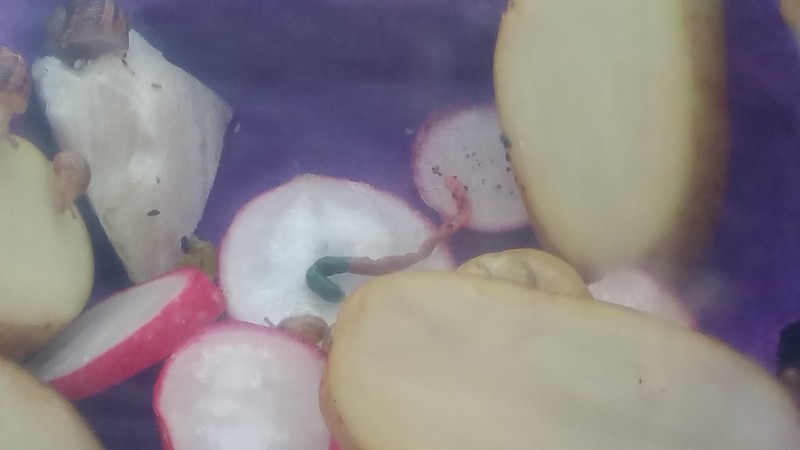
Best part is that snails are like some kind of natural 3D extruder. For example, they love to eat paper and cardboard. I was giving them a habitat made of coloured egg boxes, but they like to eat the boxes and now all their poop (and habitat) is purple, orange, and green.

Untitled

TRI-COLOURED POOP

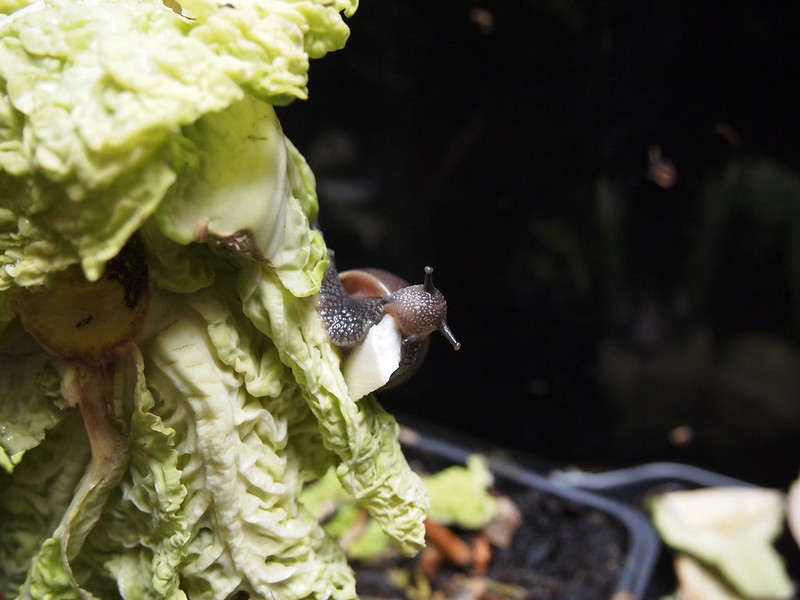
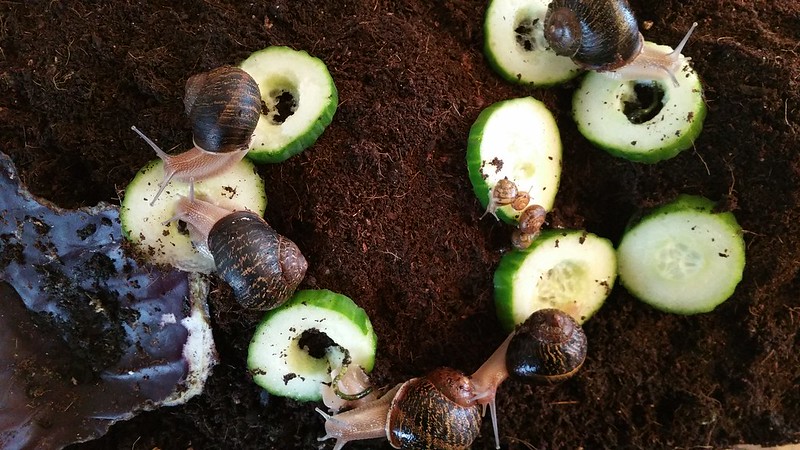
To be honest I think of them as simple machines, they slide around and they swivel their food detecting feelers around until BEEP! FOOD DETECTED! And the snail deploys its nommmmming action. (Although I HATE the word nom in most cases, it seems appropriate for snails as their mouth does indeed look a lot like "nommmmm" from afar.

P5255567

NOMMMMMMMMMM

Now it is about a dozen generations on and we have re-wilded many snails since and kept as many as we think we can comfortably keep.

Untitled

LIFE OF SNAIL


Untitled

Untitled

A picture from December 2015, before population explosion

Untitled

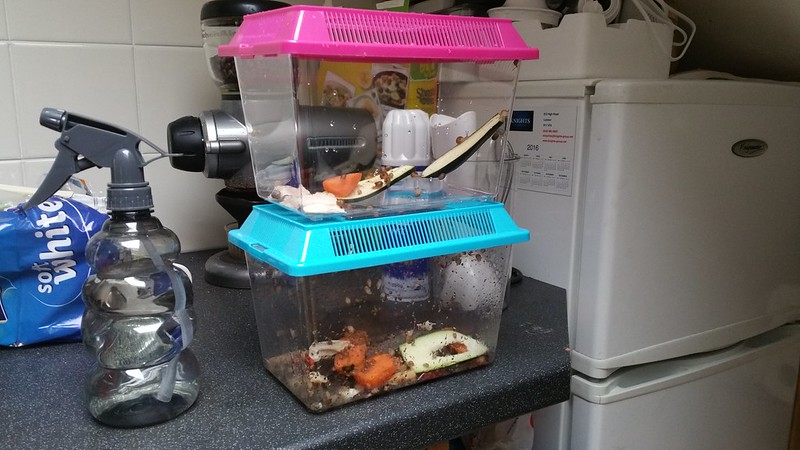
The "Nursery": I isolated batches of babies into smaller tanks at one point, because the babies were occupying the corners where the adults seem to like to sit.

Untitled

This was a short-lived experiment in which I tried to grow food for snails - to make a closed cycle of feeding and growing. We need something fast growing because they eat very very fast. I used mung bean sprouts for the first experiment. The sprouts became uncontrollable after a few days and then about two weeks later all the stupid sprouts died suddenly! With that, some sort of change in the air caused all the snails to estivate. So they were moved back to boring old "feeding" tanks.

Some notes from my first year of snailkeeping:

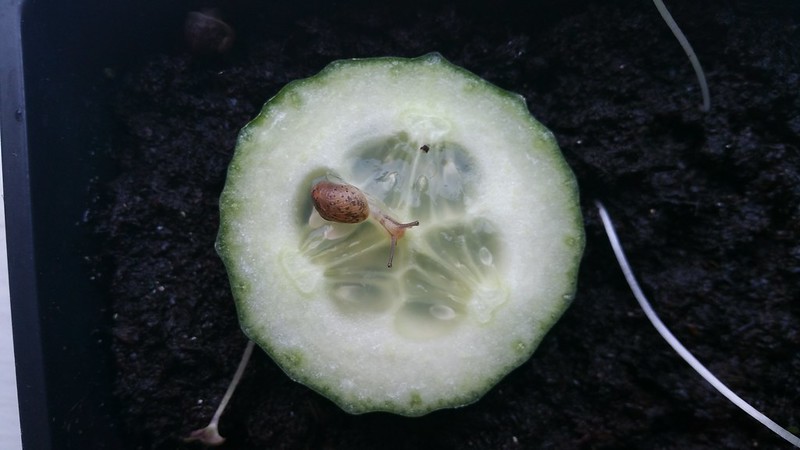
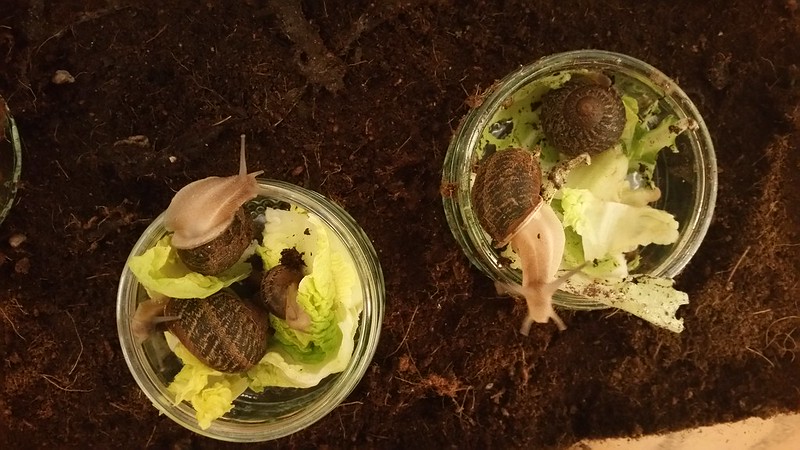
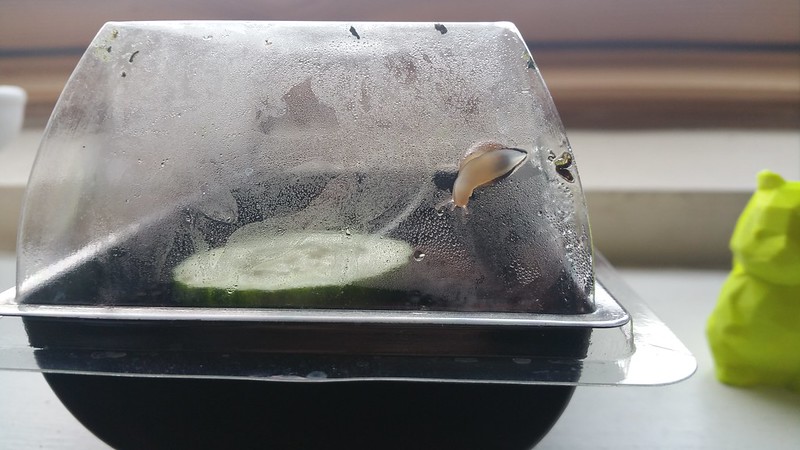
  • Snails eat most vegetables except for leek/onion/garlic type vegetables. They don't seem to like very acidic fruits like sweet berries and bananas. They may become picky if given too much choice, such as ONLY EATING THE SOFT CENTRES OF CUCUMBERS AND THEN NOT EATING THE REST, or ONLY EATING THE SOFT CENTRE OF A CARROT.
  • Snails must be fed cuttlefish bone or some other source of calcium. We went with cuttlefish bone which contrary to what one might imagine, is not harvested from live cuttlefishes. People scavenge for the bones on the seaside and then sell it for money so that pets with shells/beaks can eat these supplements. Oh and what happens in the wild? I suppose the snail will lick your walls then...
  • COVER SNAIL TANK WITH ORGANZA FABRIC (OR SOME OTHER BREATHABLE FABRIC) - IF NOT ROTTING VEGETABLES WILL ATTRACT FLIES AND CAUSE HORRIFYING MAGGOTY MOMENTS IN THE SNAIL TANK!
  • Snails will climb upwards if it is wet
  • Cocopeat is a great and clean snail tank bedding material
  • Do not allow snails to crawl on to a laptop which is metallic including macbook pros - a current passes through them when they crawl on metal and the snail will froth up
  • Do not allow snails to crawl on exposed metal, foil, copper, they will froth up
  • Do not give beautiful fruit and vegetable without washing thoroughly - sometimes pretty fruit has more pesticides, snails won't eat them (it was designed to stop them anyway)
  • When garden snails develop a white lip at the end of their shells, they have become adults
  • Do not give pasta or rice, they may overfeed and explode.
  • If you wiggle a string in front of them, they will crawl up the string
  • If you wiggle your finger just in front of their faces, they will crawl up onto your finger, unless they aren't in the mood to slither about.
  • When they have detected edible surfaces, their mouthfeelers and seeingfeelers will droop downwards, almost becoming fat and stout at the same time. If their seeingfeelers are fat and droopy, you can bet that they are probably chewing on something at the moment.
  • Some snails like eating a lot more than others. Some like digging themselves a hole and hiding all the time.

DEATH OF SNAIL


The lifespan of these garden snails is about 3 years apparently. And snails lay dozens and dozens of eggs in each clutch. And amongst those baby snails, some will die for seemingly no reason at all. It is almost as if some snails just lose the will to live.

A while back, an adult snail passed away whilst I was away. It was the first young adult snail (white lip already grown) to die like this so I had to figure out what to do. I wanted to keep his shell as well, but I needed to clean it somehow. The problem was that it was not easy to remove the body from the shell. George was not keen that I boil the snail in one of our pots. And I don't have a garden, otherwise I could have buried the shell and allowed nature's little workers (ants, etc) to eat and clean out the shell. (In professional forensics/museum situations, a dermestarium with lots of Dermestid beetles (carrion beetles) is used as they are more meticulous than humans and it puts less stress on the bone/shell)

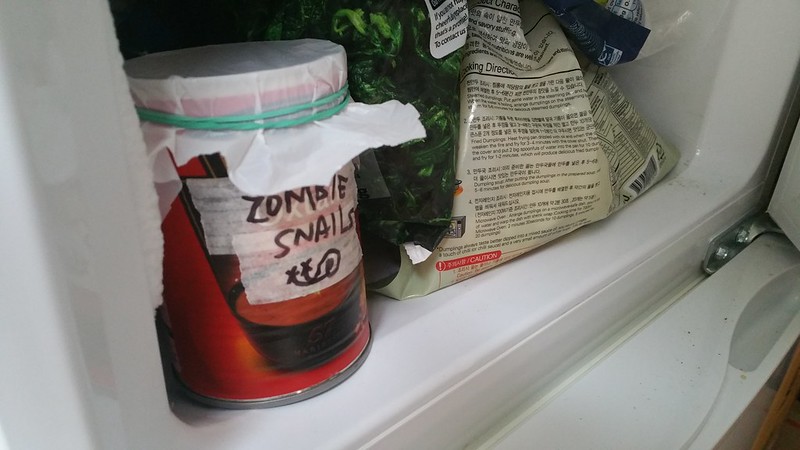
Although I had concerns that freezing the shell might cause it to crack when the water expands inside it, this method I found to have worked perfectly without damaging the shell. This also works for tinier shells.

Untitled

  1. Place snail in a plastic bag
  2. Fill plastic bag with some water so the shell is submerged, and place bag into a container
  3. Place in fridge with label so no one gets a shock when they look into container in the freezer
  4. Let it freeze overnight
  5. Thaw it the next day
  6. Dead snail will have detached from shell so you can clean the shell in water without doing some horrifying digging
  7. Dry and polish with mineral oil so the shell won't dry out and the layered patterns on the shell won't crack up and peel off.
'