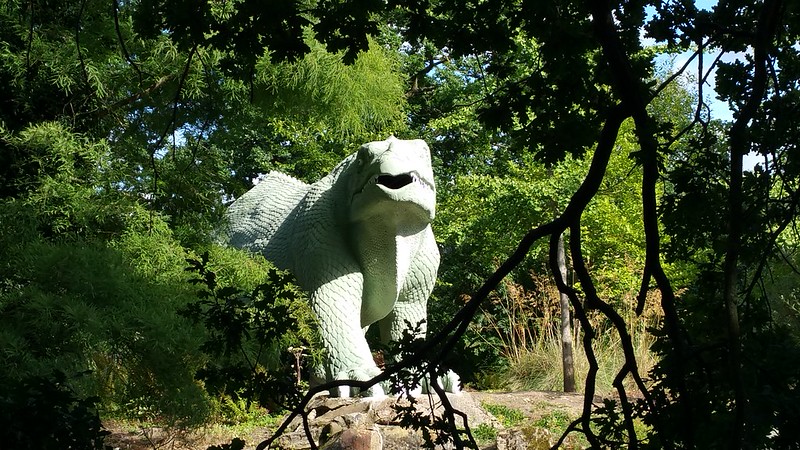
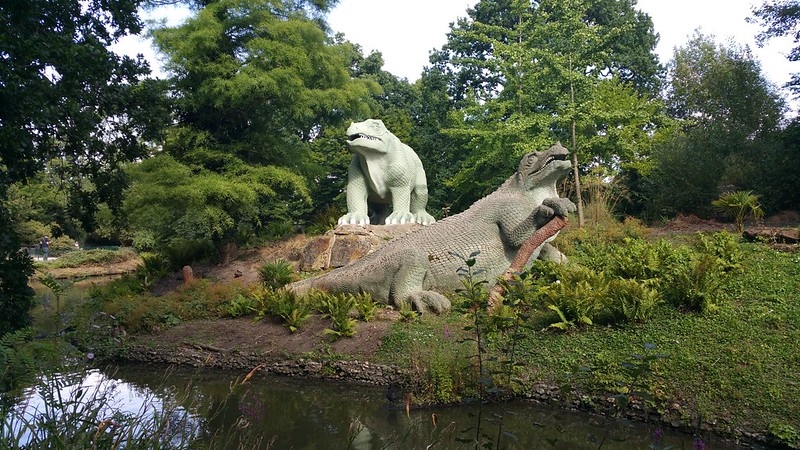
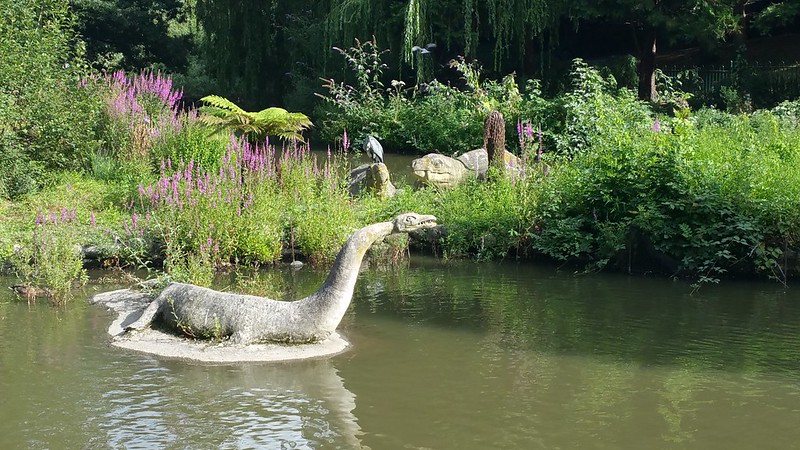
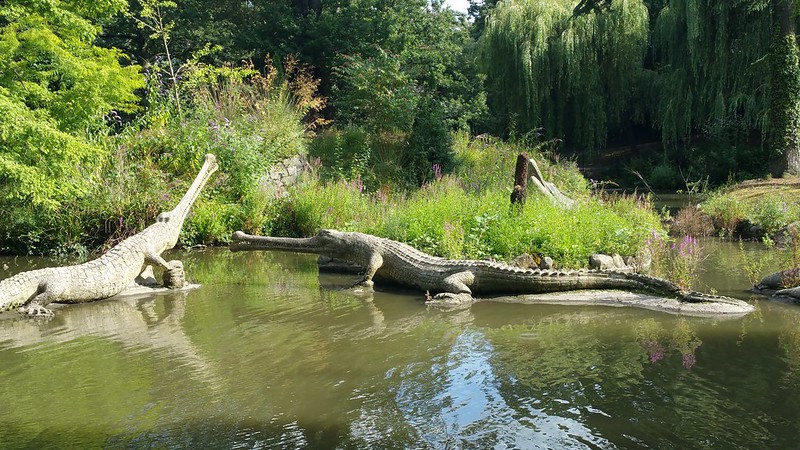
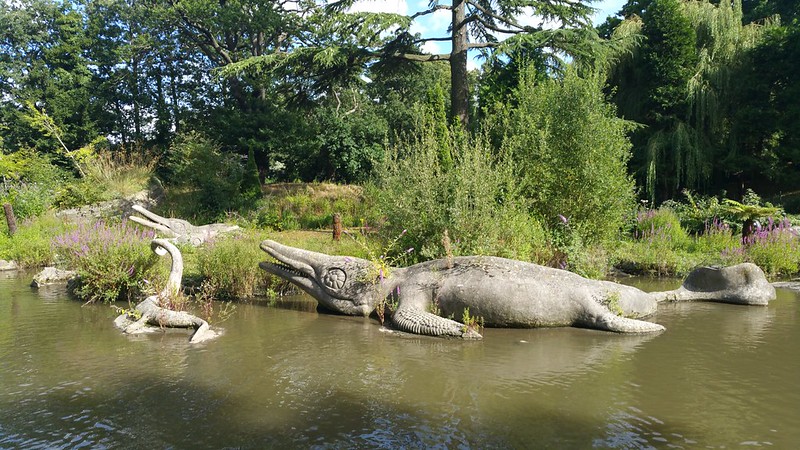
Ever since I saw that famous engraving of a dinner held inside the mould of the Iguanadon, I've wanted to see the Crystal Palace Dinosaurs in person. And so I went to see them some months ago! (Cripes, how time flies...)
Dinner in the Iguanadon on New Year's Eve 1853
Illustrated London News, 7 January 1854
Today the Crystal Palace may no longer be standing on the top of the hill, but its dinosaurs still survive on!
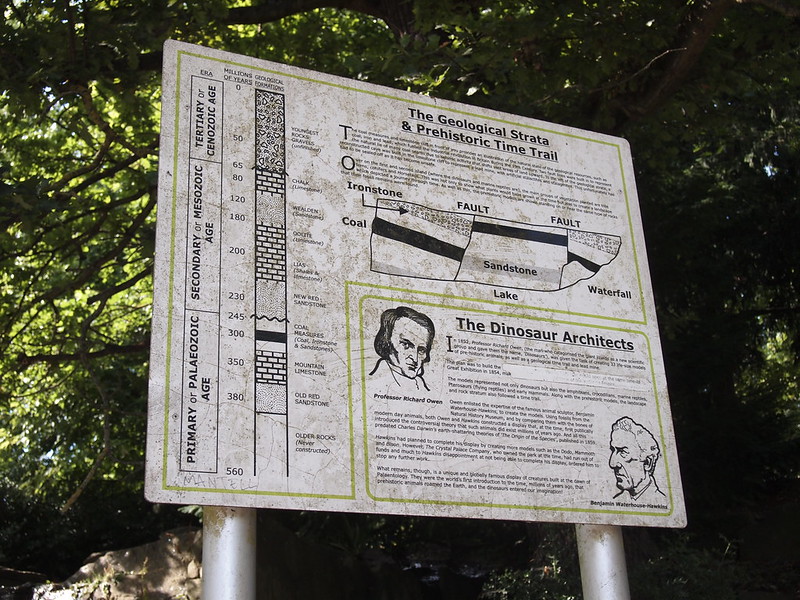
Directed by Richard Owen using the very latest scientific knowledge of the Victorian era, sculpted by Benjamin Waterhouse Hawkins and set in a rocky landscape designed by Joseph Paxton, the entire theme park was built between 1853 and 1855 (when Hawkins was told to stop work) and apparently looks more or less like it did back then, although I followed the audiotrail which takes you on a route in the opposite direction from which most Victorian visitors would have come by. These creatures underwent restoration between 2000-2003 and were upgraded from Grade II to Grade I listed after the restoration work.
Obviously over 150 years have passed since that day and our understanding and speculation on dinosaurs has changed a lot since then. It is also obvious that rivalries between scientists also added to their misshapen-ness. But their persisting interest to us today comes from them being one of the earliest known attempts to depict dinosaurs and other extinct animals - presenting these huge concrete reconstructions to the public in the form of this terrifying theme park and shaping early notions of dinosaurs in the collective imagination. Considering their size, the fact that these huge sculptures even managed to be completed was also quite a feat at that time.
Whilst walking around the park I could not help but overhear many curious statements uttered by visitors which made me worry that perhaps the people visiting the park were somehow too busy focusing on trying to get suntans or taking pictures and selfies with their handphones and not at all reading the many detailed informational signs around the park.
It is possible that some of them had even failed to understand the premise or context of these sculptures. Alas, I suppose the practical fact of the matter is that reading dusty noticeboards about prehistoric life and making educated speculations does not necessarily rank high on the priorities of everyone on a summer's day out. Which brings us to...
MISUNDERSTANDINGS IN THE MODEL DINOSAUR PARK!
Actual statements overheard on a trip to Crystal Palace on August 13, 2016
"Ooh! Look at the snake! See that snake? Can you see the snake? Snake?"
said a grown woman to her pre-language stage toddler.
"Why is the crocodile's beak so long?"
asked a genuinely puzzled adult woman to her male companion.
"Say what you like about these reptiles, they're the only ones still going!"
confidently said a grown man, to his young child and elderly father.
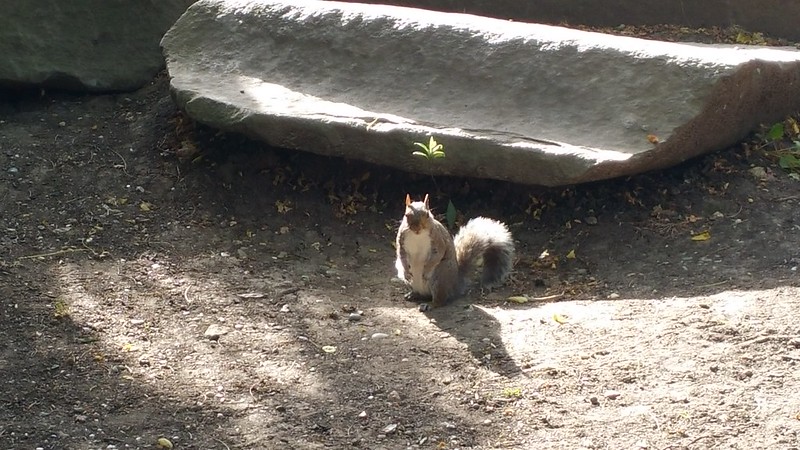
So... I'm going to end this with a picture of an angry squirrel that I also saw in the park. (It wanted nuts. I ran out of nuts.)
PEDANTIC SQUIRREL: "IT'S A PARK OF SCULPTURES DEPICTING VICTORIAN MISUNDERSTANDINGS OF EXTINCT ANIMALS U DUM DUMS. EXTINCT!
HELLO WORLD! I've actually got several important announcements to make and projects to document here, but before I do that, FIRST OFF, today I am going to try to push online my entire backlog of half-written posts piled up from the last few months of my semi-digital-hermitage... all of my half-baked notes on various things of interest such as Funtasy Island, the Clothworkers Company, Crystal Palace Dinosaurs, Royal College of Art's Darwin Building, Boukaloids, etc... WILL I BE ABLE TO GET IT DONE? STAY TUNED!
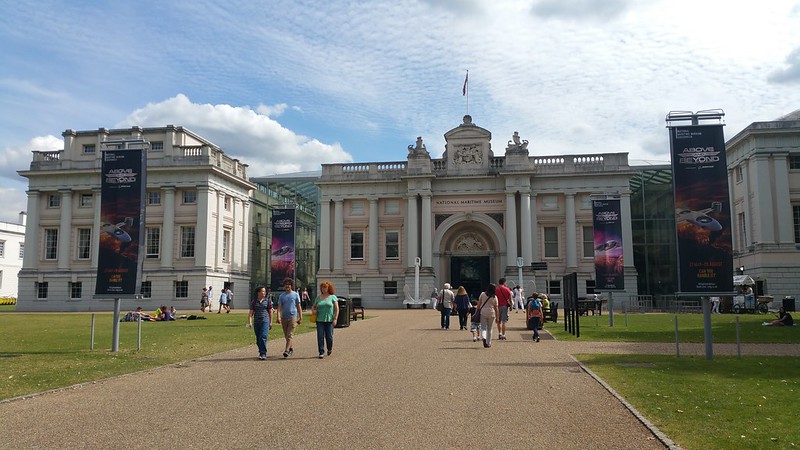
Caird Library, National Maritime Museum, London
The Caird Library is located inside the National Maritime Museum. After being to many old libraries in London it was a little surprising to see the contemporary and modestly-sized Caird - despite being housed within a rather historic building. However, what's on shelf is only a small fraction of its collections - and the staff there are also incredibly helpful if you need help in locating resources!
I was admittedly being unrealistic about what information I could actually find there - as ship logs and documents that survived long sea journeys were often only kept out of particular necessity. Furthermore the conditions at sea are in fact particularly unconducive to the preservation of information about cargo (esp since commanders and sailors often supplemented their paltry emoluments with smuggling and privateering). So instead I spent a fruitful afternoon (but quite different to how I imagined) reading up on the history of maritime insurance...
At the time the name 'Lloyd' was neutral - very ordinary but not too commonplace and held no other associations or particular connotations of class, making it suitable as the name for a coffee house which turned into a business centre; information about the progress or fate of merchant ships and other maritime intelligence were ultimately obtained by overhearing the conversations and gossip of sailors who had returned. Early underwriters would have done their underwriting at the Exchange but then the merchants and underwriters alike would seek out news through the coffee houses where people gathered.
As Charles Wright and C. Ernest Fayle's "A History of Lloyds: 1689-1713" noted: "At no time, so far as we are aware, did any group of men say to each other, "Go to; let us make the greatest centre of insurance in the world!".
There were ample opportunities where fraud could be committed where the information upon which people made business decisions was entirely hearsay, and it is also written in 1728's The Case of the Coffeemen of London and Westminster (Or An Account of the Impositions and Abuses, Put Upon Them By the Present Set of News-writers), that the coffee men complained that the news-men would come to their coffee shops where "all sorts of rousing falsehoods" were uttered until they became news, and that the coffee shops effectively played a similar role in distributing news for free, whereas the news-writers were raking in money from advertisements.
The earliest surviving copy today is from Friday Jan 3 1740 (#560)
In response to the haphazard state of the news, the coffee men decided to utilise their position as the centre of shipping intelligence of the day and make their own news. This was years after the titular Lloyd (Edward Lloyd) had passed but the name Lloyd had already become . Lloyd's List - a public report published every friday and tuesday, gathering up all the scattered pieces of shipping intelligence - covering a gamut of events such as sinkings, disasters, abandonments, vessels spoken with, ships saved, damaged, fate of crews, lost cargo, mysterious floating objects, and from time to time, occasional extraordinary occurrences.
Example: random fragments from the year of 1834...
Brest 7 Jan 1834
A quantity of Canadian timber marked M.B & SW has been driven on shore on this coast.
Neath 12 Jan 1834
A considerable quantity of palm oil and a great number of hides have been washed on show at Newton with two lower masts and several other articles
Liverpool 31 Jan 1834
Charles Joseph saw a vessel bottom up, nearly new, bottom painted green.
Liverpool 31st March
Articles picked up: segarbox, dealboxes marked D545 & a quantity of segar washing about the rocks...
From May 2 1834
Singapore, 19th Dec
"The Baltic" sailed from Marietta for this port and has not since been heard of...
If this were to be a story about the changing modes of transmissions of shipping knowledge and intelligences, then one would also imagine that by today most of the above records (even historical records of shipping information) would all have been digitised; and this should not have required my pilgrimage all the way down to these physical repositories to read them...
Digital Sheds
Source: Wikipedia (Screenshot retrieved 02 Oct 2016)
And indeed I've also noticed that Wikipedia actually has an extremely detailed list of shipwrecks - even if you wanted to search about something as specific as 1834, there is a list of shipwrecks in 1834 which from a quick glance seems to be largely written by a very prolific wikipedia editor'Mjroots' (who describes himself as someone with a hobby/interest in "molinology, deltiology, civil aircraft, railways and Dutch").
I've been fascinated by Mjroots' general sandbox - which is truly an amazing digital "junk shed-cum-workshop" of snippets. As so much of the text within seems to have been written to be the very example of a well-written wikipedia page, the Sandbox where the user Mjroots has collected all his half-written draft pages reads like a techno-poetic dream; an Infobox which tries to define all the possible parameters that might need to be known about a windmill; a Human-Markovian-wikipedia-daydream of lost ships, steam trains, windmills, tramway track maps and aircraft crash investigations...
We further interrupt this already un-routine blog for another digression into a mysterious plant insect investigation. But, this story actually begins with a consideration of air quality in space station and how I acquired these specific houseplants in the first place. If you're interested in the problem of volatile solvents in household air sprays, and the afflictions suffered by tropical houseplants, read on...
We live in a top floor flat which has its windows on its roof. Air doesn't really "blow" through the house so much as it kinda randomly pours in, and this flat definitely has got some humidity and ventilation issues. I used to combat this with air sprays, but then I became curious about how air sprays work, and ended up finding out that a lot of air perfumes including my sprays of dubious provenance (thanks TK Maxx) actually may contradictorily deprove air quality in enclosed household spaces. Furthermore, many household cleaners and pre-made wipes were likely to release more volatile organic compounds into the trapped air.
So I got George to carry home three pots of Dracaena Marginatas (Red edged Dracaena), which were one of the plants studied in the NASA clean air study. The study was trying to determine which household plants would be potentially effective in cleaning the air in space stations, but obviously it also has very useful applications in indoor earth habitats.
This particular type of Dragon Tree was found to reduce the levels of benzene, formaldehyde, trichloroethylene, xylene and toluene in the air by just living in the room. They are very low maintenance and rather importantly, they were also on SALE at the Homebase closest to us...
I also tried to switch to more basic methods of doing the household cleaning and descaling with combinations of citric acid, sodium carbonate, and Dr Bronner's castile soap. Say what you will about the crazy text all over the Dr Bronner soap bottles (bringing new meaning to soapbox - its certainly Dr Bronner's soapbox for his unusual moral philosophy), but the soaps work excellently and definitely do the job of keeping 'Spaceship Earth' clean.
Dr Bronner
Gaze upon this amazing picture of Dr Bronner from the 2015 ALL ONE REPORT, which begins with these words: "In all we do, let us be generous, fair & loving to Spaceship Earth and all its inhabitants."
This morning whilst cleaning the bathroom in anticipation of first ever visit of my parents to London (and visit to our flat here) - I discovered that the Madagascar Dragon Tree living in the bathroom was covered in tiny white ovals! It was so horrifying I didn't take a picture of it. It wasn't mould, I could see that this was a bug problem, but these tiny stationary bugs were too tiny for me to perceive any detail with the naked eye (under 1mm big, but terrifyingly numerous). The infestation looked quite severe, and it seemed to have come on overnight. Some parts which were covered by dots had even turned a bit more yellow. I initially thought it must be mealybugs, but weird ones considering that they didn't have the usual furry fingery parts of the mealybug showing - but I supposed that perhaps there were weird strains of mealybugs in Britain - I mean, I'm not a mealybug expert! Who knows what the british mealybugs might be up to!
Most normal humans might consider throwing out their shockingly diseased-looking potted plant at this stage, but I decided that I was not going to do the normal thing. NO! I decided that I couldn't allow this plant to be eaten by mysterious white dots without trying to understand what was going on, so I googled for the instructions on how to eradicate mealybugs from a plant.
Techniques recommended included controlling the infestation using the mealybug's natural predators such as ladybirds or green lacewing. I considered going to the park and picking up as many ladybirds as I could, but I don't think George would want our bathroom to become a flying ladybird habitat (furthermore, we don't have the pleasure of having the time to breed flightless ladybirds which need to be bred by selective breeding like the Japanese have done).
Ladybird Transportation
To be fair, I'm quite sure if I needed to, I could actually find a handful of ladybirds and bring them home. Some are flighty, but some are quite tame and patient and will allow you to carry them for unreasonably long periods of time. This was a ladybird which I recently carried from a hot, uninteresting concrete pavement near Forest Hill - all the way to the very top of Crystal Palace Park...
Anyway, I had to go with a rescue method which involved MANUALLY CLEANING THE PLANT, LEAF BY LEAF WITH A COTTON SWAB DIPPED IN 70% ISOPROPYL ALCOHOL.
If I could give everyone a strangely philosophical warning on the sheer tedium of houseplant treatment, it would be this:
EVERY LEAF HAS TWO SIDES!
CONSIDER THIS BEFORE STARTING ON THE UTTERLY FOOLHARDY QUEST
OF CLEANING EACH LEAF OF YOUR POTTED PLANT WITH A COTTON SWAB!!!
After I spent ages cleaning each side of each leaf of the Dragon Tree, it looked much better. I was convinced it would survive this infestation of mysterious white dots.
Crucially, I also took a leaf from the bin and examined it with my USB microscope.
WHAT IS THIS??? THESE AREN'T EVEN MEALYBUGS!!!
For comparison:
MEALYBUG PICTURES
SCALE PICTURES
Looks like it is actually a kind of scale insect, a limpet-like creature which sits on plants and sucks the sap out of your poor juicy houseplants. How on earth did it get into our bathroom? The bathroom with its window mostly closed? I don't even know...
On an aside, I also wonder how many other people were induced to purchase plants on the NASA Clean Air Study list like me. Did the release of the list increase the sales of those specific plants, or are people not logical like that when it comes to their choice of houseplants?...
I've been labouring over my remaining documentation of archives and libraries in London, but right now we interrupt my series of posts on Serious Things with a rather frivolous digression about various creatures of London, including the show-stopping Parakeets! Miraculously fluffy Caterpillars! And Giant Medicinal Leeches!
South London's Parakeet Invasion
"ARKKKK!!!!"
A few weeks ago we made a merry afternoon's excursion to walk around Richmond (meandering somewhere around the rather posh residential neighbourhoods of Sheen or Mortlake), and we reached the Thames and were sitting by a tree when a rather insistent squawking began issuing forth. There weren't any birds visibly sitting in plain sight, but all of a sudden I spotted a small green face popping in and out of a small hole in the tree! It seemed both excited but also scared of us, and George took the very excellent picture you see above.
Yesterday in Lewisham (around Ladywell) whilst visiting a friend, I saw a family of about 5 green parrots flying past, squawking merrily overhead as they passed a beatific garden scene replete with summer's blooms at their peak, gentle wind chimes, and an inexplicably affectionate black cat which decided to make my lap its bed for half an hour.
After some googling it appears that wild parakeets in South London are A Thing, and no less there are several juicy theories as to why they are so plentiful in South London!
BBC2 - The Great Parakeet Invasion
The Bogart Theory is that parrots imported from Africa to be used in scenes in the Humphrey Bogart & Katharine Hepburn movie "The African Queen" (shot at Isleworth Studios in 1951) somehow escaped and began breeding in the area. The Hendrix Theory is that Jimi Hendrix released two parakeets in the 60s on Carnaby Street, but its unlikely that two birds did this all. Finally the Escape Theory is that the noisy parakeets perhaps escaped from the homes of pet owners fed up with their voiciferous nature, or maybe that they escaped from some cargo at Heathrow Customs...
In any case, apparently these birds do not go very far from where they were born so whatever the case it was humans who were responsible for letting them loose in this part of South London.
Hairy Caterpillar Season
It seems to be the peak of caterpillar and moth season around here lately. I have learnt the hard way that one must keep the shutters down at night or else the moths will roost - or should I say, roast - in your high power halogen lamps!
Here are two very hairy caterpillars I found in the neighbourhood. Both were probably soon to become moths and seeking a location suitable for its merry business of pupating, as they were found rather inadvisably crossing the pavement - so I picked them up and put them in the bushes. I also used this visual chart to identify these caterpillars...
Sycamore moth caterpillar
Buff Ermine caterpillar
I was so amused by this little fellow that I took it home whilst I googled about what type of caterpillar it was. But George said I could not have a caterpillar as a pet and I couldn't determine instantly what kind of host plant this type of caterpillar would eat, so I returned it to the bush nearest to the part of pavement I found it.
"Meat only, please" - apparently this caterpillar won't eat its vegetables even when its starving...
Oh, the very very hungry caterpillar... they seem so misunderstood. Yet, just to be sure, lets not tempt fate by picking up hairy caterpillars with my bare hands and putting them in my snail tanks...
Whilst strictly speaking I haven't had the pleasure of personally making the acquaintance of any delightful medicinal leeches recently, I encountered the story of the rather curious Tempest Prognosticator / Leech Barometer (aka AWARD-WINNING CUTTING EDGE VICTORIAN WEATHER PREDICTING TECHNOLOGY!) whilst looking through the Great Exhibition catalogue. Furthermore it has also occurred to me that the motion of leeches resembled that of caterpillars and snails, and I am somehow drawn towards these creatures...
So what is the leech barometer, you might ask? It consists of 12 leeches were placed individually in 12 bottles, arranged in a circle "in order that the leeches might see one another and not endure the affliction of solitary confinement". (Aw bless...) Barometerworld.co.uk (FOR ALL YOUR BAROMETER RESTORATION NEEDS!) has an excellent doc on CARING FOR YOUR LEECHES which extols the virtues of the medicinal leech as the ideal pet. I urge you to read it if you have ever wondered to yourself "Should I acquire some medicinal leeches to be my next housepet?", or want to read of the 9 rules for reading the behaviours of leeches in bottles:
1 If the leech take up a position in the bottle’s neck, rain is at hand.
2 If he form a half-moon, when he is out of the water and sticking to the glass, sure sign of a tempest.
3 If he is continual movement, thunder and lightning soon.
4 If he seem as if trying to raise himself from the surface of the water, a change in the weather.
5 If he move slowly close to one spot, cold weather.
6 If he move rapidly about, expect strong wind when he stops.
7 If he lie coiled up on the bottom, fine, clear weather.
8 If forming a hook, clear and cold weather.
9 If in a fixed position, very cold weather is certain to follow.
I wish my snails were useful for weather prediction, for I often wonder and observe them, hoping they might be useful in divining something other than the presence of sliced cucumber in the vicinity.
Anyway, I soon became convinced that a leech might be a more suitable pet than a caterpillar, as it is apparently "low" in maintenance and reports are that a leech reportedly survived being in a cupboard for TWO YEARS. Not that I am advocating putting leeches in a jar in a dark cupboard for two years without food, but just acknowledging the extreme hardiness of the creature. I began to look for leech videos online, and promptly came across this excellent channel in which a Japanese youtuber seems to have bred some impressively gigantic medicinal leeches...
However, it soon became clear the level of total madness or sheer masochism involved in GIANT LEECH REARING. The youtuber who made these videos also notes that these gorgeous leeches got so big because they've been fed on his blood only - a touching or even charming prospect, until you read this knowledgeable commenter who bravely attempts to quantify the blood required in this procedure of keeping your bloodsucking pet alive on your blood alone:
A very good point, as shit is about to get real in the other videos...
Noooooooooooooooo I don't want to be eaten by my pet...
You will be glad to know that for the time being I have decided against having a pet leech...
Also I was worried about spider huntsman so I went to his twitter to check that he is still alive. He is still active on twitter and feeding more leeches with his arm which has healed and is not scarred or bloodied or ravaged by his army of pet leeches. He also seems to be selling a whole range of colourful and extremely beautiful horse leeches... which eat SNAILS... Noooooooooooooooo I don't want a pet which will eat my other pets...
Located in a prime spot opposite Liverpool Street and on the A10, I have walked past this place countless times, with its beautiful entrance sign. Paradoxically repelled by its grand entrance (designed by late Victorian architect Charles Harrison Townsend who also famously designed the Horniman Museum and Whitechapel Gallery), I never once stepped in, having previously simply assumed it must be one of those private workingmen's clubs to which I had no business barging into.
No doubt today I only have my own ignorance to blame for my failure to investigate further into the Bishopsgate Institute earlier, but in a document about the history of the institute released on its centenary, it seems that I am not the only confused person - "It appears that the Institute had something of an identity problem in its early years; when the caretaker was interviewed in 1899, he noted that "One ingenious person entered with a pair of roller-skates in one hand and asked to be directed to the rink. On Saturday a gentleman, carrying a Gladstone bag, and with a travelling rug thrown over his arm, rushed up and asked when the train left. But the most disconcerting experience was when a young woman entered and demurely asked 'Is this a matrimonial agency?" Her disappointment was quite saddening when informed that marriages were not performed there..."
(I was so excited about being inside this place that I forgot to take interior pictures of the main reading room. It is oddly almost exactly the stereotype of the grand old public library I had in my head when I say "I'm going to the library". And in the past, so many a time have I languished around the Brick Lane area, eventually sitting in the Old Spitalfields Market wishing there was somewhere to sit and read or do something other than jostle with rushing business people in suits and angsty travellers speeding past with their angrily overweight luggages. If only someone had told me about this back then!)
Unlike many other libraries in London, no registration or proof of identity is required to come to peruse the library's books (or make use of its fine reading tables). Besides the reference library, on request it has an amazing collection of books, maps and other materials on London, the East End, labour, and activism/protests. A very enthusiastic archivist/librarian whose name I sadly didn't manage to catch showed us around and told us briefly about the history of the collection. First established as a workingmen's library for the working class in London's East End, many of the books in the collection today were the result of one librarian - Charles Goss. His unbridled collecting was not so much celebrated during his time, but he was responsible for building up the significant collections on London history, labour history, freethought and humanism whilst going on his extremely long lunch breaks and buying insane amounts of books by the wheelbarrow. (While he was with the library, he also campaigned to raise the status and pay of library staff. Also the man had a magnificent moustache...)
In the main reading room, there's a magnificent skylight which has survived the Blitz (and people throwing small rocks at it), and the original bookshelves have also survived till today - they have got little handles on the side which people could use to climb up and access books on the higher shelves by themselves. However, this useful design addition proved to be divisive for the sexes - victorian notions of women's ankles being "indecent" resulted in women asking for a separate reading room so that men would not glimpse their ankles as they climbed up using the handles and reached up for the books in a flash of prudish ankle absurdity. (I'm curious how the books were separated then between the rooms...)
The Minute Book of the First International Working Men's Association, 1866-69
Apparently the library had been consciously painted in a neutral calm colour as in the past there were concerns that the books alone being read in an excitable environment might spark some sort of mad revolt. In fact, the single most famous manuscript in the collection is the Minute Book of the First International Working Men's Association, 1866-69. The book was allegedly hailed by some as the moment of the birth of socialism, although disputably being just an ordinary meeting which just happened to be followed by an argument between George Howell and Karl Marx. (It's also got squiggles on the back, speculated to have been made by a bored notetaker). Due to the book's popularity status (even Stalin wrote to the Institute to ask to see the book!), the book was eventually deposited at the bank across the road for safe-keeping for over 20 years...
I was very fortunate to have had the chance to visit the Parliamentary Archives, which holds the official records of the UK Parliament including acts, acts, journals, appeals, peerage claims, architectural plans, sessional papers, hansard (debates), various personal papers, etc.
The earliest document they hold is from 1497 for the House of Lords, and as for House of Commons the earliest they have is from 1547, but it would have been much earlier if not for the 'tally sticks' fire of 1834 and the small, unassuming "Jewel tower" standing across the road...
Apparently in 1834 the Exchequer/National Treasury had to dispose of a bunch of tally sticks, which were a physical form of accounting system that was becoming obsolete at the time. A primitive form of accounting which could be used even if you were totally illiterate, they were basically sticks marked with notches that were split lengthwise. These sticks were used to keep track of taxes that had been paid and an example of them can be seen here at the National Archives. Unfortunately the obsoleted sticks had their revenge just as they were being disposed of by being burnt in the basement of the House of Lords, resulting in a fire that consumed many records, except the ones in the Jewel Tower and ones that were furiously pushed to safety out of the window by a clerk...
We entered the grounds via Black Rod's Garden Entrance, and having never come explicitly to see Big Ben and the other the "touristic" sights of London before, I was shocked at the extreme numbers of people walking all around in all directions. People of every size, colour, and age, milling about on the greens and all over the roads, in every direction! "Is there a protest? Is something special going on today?" "Are these people coming to a festival? Is this place like this because Theresa May was just appointed as PM? Or is it because of Brexit??" No. Just another day at Westminster, inundated with an endless stream of flashing cameras and transient sightseers who have come to see the spectacle of parliament...
The persistence of the monarchy in the UK is a curious anachronism. From the perspective of a visitor coming from a foreign republic, the notion of it doesn't really bother me, but up close it is truly a very strange vestigial limb, wrapped up in a bizarre spectacle and ritual that I half-expect to be parody or a satire of itself.
We went up on an old lift and found ourselves in a maze of tiny passageways. The funny thing about very old and important buildings is that sometimes they seem to have been built for people who were much smaller, perhaps harking back to a time when the world's population was also smaller. You couldn't really expect to bring a big group through these tiny corridors, there just wouldn't be any space!
For those uninitiated with televised broadcasts of the State opening of the UK Parliament at the start of each new parliamentary session, Black Rod (whose Garden Entrance we used) has a very visible role in the ceremony of the opening of Parliament and the Queen's speech, where Black Rod (as representative of the Queen) summons the Commons to come to the Queen's speech. As he approaches the door of the House of Commons the door is slammed in his face, symbolising the independence that the Commons have from the queen. He then uses his black rod to knock on the door 3 times and then is admitted in to summon the Commons to attend the Queen's speech. (The short explanation of why this ritual exists is that in 1642 Charles I attempted to arrest 5 MPs which constituted a breach of the constitution, so the monarch's representative has to ask to be let into the Chamber of the house of commons, symbolising the right of the commons to question the right of the monarch's representative to enter the Chamber...)
We were shown the spot from which some strategic camera angles of the Queen are had... as the opening of this former ventilation chimney lies directly above the Sovereign’s Entrance.
"Hmm... did you say this entrance is only for the Queen? But the inside of this chamber is covered in pencils and small bits of stationery carelessly dropped in by other butterfingered visitors and researchers passing through! What will happen during the next opening?..."
Here is the famous room where all of the UK's parliamentary acts are stored - a controlled climate room to keep over 60 thousand vellum scrolls in the best condition possible.
These are actually the first scrolls I've ever seen in my life in person (I'm definitely no medievalist!). All written in iron gall ink apparently. I've never had occasion to request for a document in scroll form from any archive or library in the past. In fact I've never had to think about real scrolls in this way before, or to have to use the word Codex to distinguish it from the Scroll. [Codex being individual sheets of vellum which are then bound along one side.
I think of the Page/Codex as the "older" format from which tyrannous Infinite Scroll has emerged out of. But historically, the scroll came first. To see the scrolls as retired format for the archive is vindication that the infinite scroll is indeed a regression in terms of design - an abomination of both readability and function. I hate the infinite scroll with no end in sight, which overwhelms with too much information and takes control away from the reader who may have wished to index, bookmark or access the text with more precision. Often it is sometimes difficult to pinpoint the location of the data that one wishes to find back later, especially if you have pressed the back button on an Ajax loaded infinite scroll. As for a page/codex format, even though one can only read one page at any one time, it is also easier to make a decision on whether any material of interest will be present in a document by reading one highly specific page, as opposed to skimming through a potentially infinite chunk.
Strangely when I look at these very old scrolls, I think of them almost as a painted landscape, of them painting an infinite, continuous history. (Also: I suppose that if the scrolls consisted of only visual material and formed a continuous narrative, perhaps I'd be less prejudiced against the infinite scroll itself...)
Another significant change has recently happened, or rather, NOT HAPPENED. Although legislation has been printed and paginated for quite some time, this year there was a big decision on the material to be used. Vellum which is made out of calfskin (actually sheep and goat too) has been the traditional material used to inscribe or print upon because of its longevity - it survives thousands of years and has enabled the persistence of documents in the parliamentary archives for a thousand years! (except for humidity and fire! it can't do fire!) But earlier this year, the House of Lords debated that legislation should be printed on archival paper in order to save tens of thousands of pounds a year. The use of vellum was argued as being "vanity printing" and "frivolous flummery" in an age where efficient digital alternatives seem exist)... But of course this begs the question, how much trust can we put in digital alternatives? Can there really be any digital media storage solution which isn't inherently unreliable or under the physical threat of becoming obsolete as a format further down the line, when we are talking about 500, 1000, 5000 year time scales?
Paper lasts around 200-500 years (probably more in the range of 200), but vellum purportedly can last 5000 years. The Domesday Book was written on vellum in 1086. The Magna Carta was put on vellum in 1215. Unbelievably we can still see those very documents today. Vellum from 600 can be found in excellent condition today. There is no telling how paper will survive beyond 200 years. So, although the material change would result in some savings for parliament, it might mean jeopardise the accessibility of historical documents in the long term future - assuming that we also believe that time will go on and switching to paper might even result in costly preservation issues in 200 years time!
At the time, Paul Wright, William Cowley's general manager and Britain's remaining maker of vellum was quoted in The Telegraph as saying: "What they have decided is that future generations will be denied the privilege of touching history and no man has the right to make that decision."
Fortunately, after protests from MPs and many other supporters, it was decided that they would continue using vellum. The ability of people in over 500 years time to touch legislation made today may seem rather inconsequential in the short term, and obviously a vellum maker also has vested interests in the matter, but it touches on something quite important: indeed one may argue that we can let go of things, and sometimes we may even be forced to let go of things, but I think the desire to touch and hold these historic things in our own hands will continue to persist. A primal desire to prove its existence by squeezing it in our own hands, to have that personal tactile connection with something that we believe is real and authentic...
Here is the original FOI act printed on Vellum.
Thank you to archivist Mari Takayanagi for showing our group around the archives.
Update: On more recent attempts to gather galls to make Iron Gall Ink!
So all the acts were written in Iron Gall ink on Vellum. We know where the Vellum came from, but where does the iron gall ink come from? Where did it come from in the past? Was this ink imported, and where from?
At first, I began by doing the obvious - trying to find oak marble galls myself. Whenever I read online that galls are "widespread" around the world, I weep because for some reason, I must be living in an area of London that is somehow devoid of the specific wasps which are responsible for causing those characteristic oak marble galls.
After hours in my nearest park, Finsbury Park, I determined that there are probably only just 3 large English oak trees of note. You'd have thought there'd be more Kings of the Forest in there, but noooo, it is mainly populated with London Plane trees and a smattering of other trees including cedar, horse chestnut, holly, willow, lombardy poplar, beech, and a fair number of hornbeam trees. (NOTE: not an exhaustive list!)
English Oak
Baby Acorn (English Oak aka pedunculate oak has acorns with stalks, sessile oaks which are also known sometimes as irish oaks have stalkless acorns. These have got stalks)
Spangle Galls
Knopper Galls
Every acorn, a knopper gall!
Out of these three English Oak trees in Finsbury Park, two have a lot of galls on them, but only spangle galls and knopper galls. Funny enough, as I was searching for galls under the oak trees, I found myself being bizarrely hit on the head by a constant rain of knopper galls (the very things I came for!) as it turns out that there was a small squirrel very very high up in the tree trying to eat the baby acorns but it was discarding all the excrescences and throwing the gnarly bits down on to the ground!
Half eaten acorn, only excrescence is left!
The miscreant who is pelting me with galls
Anyway with my handful of knopper galls, I went home to read up more about galls, and on closer reading I realised that the Andricus kollari wasp itself responsible for galls was not introduced to the UK until the 1800s!!! In any case it is reported that galls on English Oak trees are ascertained to contain little tannic acid, and are of little value. I haven't verified this properly but it seems Aleppo galls from Syria and Asia Minor are said to have been shipped over in boatloads to Europe for the production of iron gall ink???