Monday, 16 December 2013

Facial Reconstruction / Anatomy for Artists

Recently I attended a brilliant two day workshop on skull-based facial reconstruction conducted by forensic artist Richard Neave. Here is a documentation of the process...

PB268057

Making the eyes and the nose...

PB268060

Added Buccinator muscles on the cheek area.

PB268062

Added lips.

PB268066

Adding the Temporalis muscle - note how it continues under the zygomatic arch. These are all muscles which are responsible for mastication (chewing) and facial expressions.

PB268072

Building up the muscles on the face - added the masseter muscles on top of buccinator muscles, added forehead muscles and muscles around orbital area.

PB268074

Adding some fat in the cheeks.

PB268076

Adding the zygomaticus major and minor muscles. I was quite confused with the names by this point so if there are inaccuracies you should let me know. I think there was also a levator muscle along with the parotid gland which looks like a tiny squiggle in there.

PB278079

Added the ears.

PB278091

End of Day 1 - Looking quite like a face now

PB278094

Nose underside closeup

PB278097

PB278098

Other people in the class and their work

PB278108

Day 2 - we add more fat

PB278112

More fat

PB278128

Suddenly after lunchtime I've suddenly decided to use reference pictures to make it look more like a certain (ahem!) face. I am told this is not necessarily the right way to go as the bone structure should be the thing which brings out the face (hence, reconstruction from skull and building up layer by layer). But I've decided to try to sculpt a replica of George's face since this is an artificial plaster casting of a skull I'm working on anyway so there is no real specific bone structure to reveal here (and we haven't really been properly calculating how much fat and muscle is to be on this face...)

PB278127

Our tutor Richard was quite helpful nonetheless in giving some tips on which prominent features I should try to bring out more in the face to make it look more like this.

PB278129

Fattening up the chinpad!

PB288163

Completed work!

PB288164

PB288167

PB288177

Some more pictures of the work of other classmates:

PB278145

PB278146

PB288170

PB288171

Anatomy of the Spine

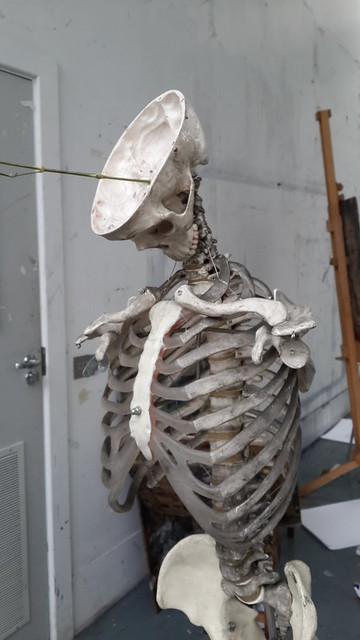
On a previous occasion I also attended the first day of an anatomy class conducted by Eleanor Crook (anatomical waxwork and effigy maker, artist in residence at Guy's Hospital Gordon Museum of Pathology). We studied the structure of the human spinal column and counted each vertebrae off as we drew them.
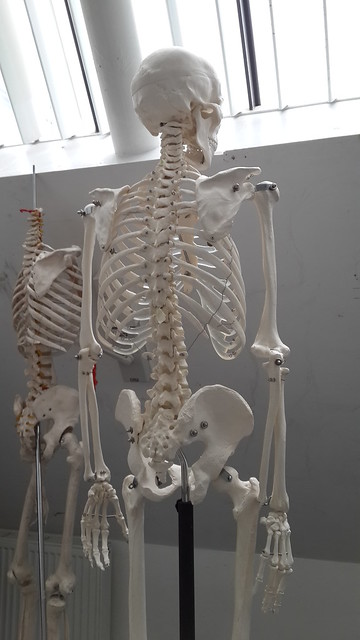
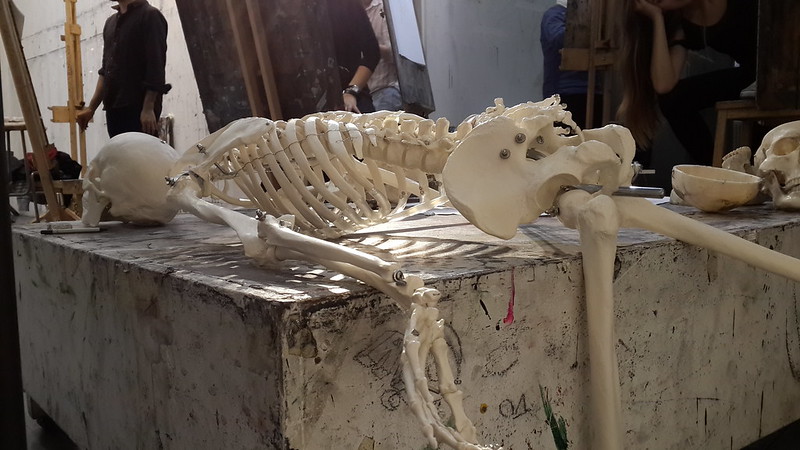
2013-11-12 13 2013-11-12 13

2013-11-12 16

Humans have 33 vertebrae in total - 7 cervical vertebrae, 12 thoracic vertebrae, 5 lumbar vertebrae, 5 sacral vertebrae which are fused together to form the sacrum, and 4 caudal vertebrae which are fused together to form the coccyx (tailbone).
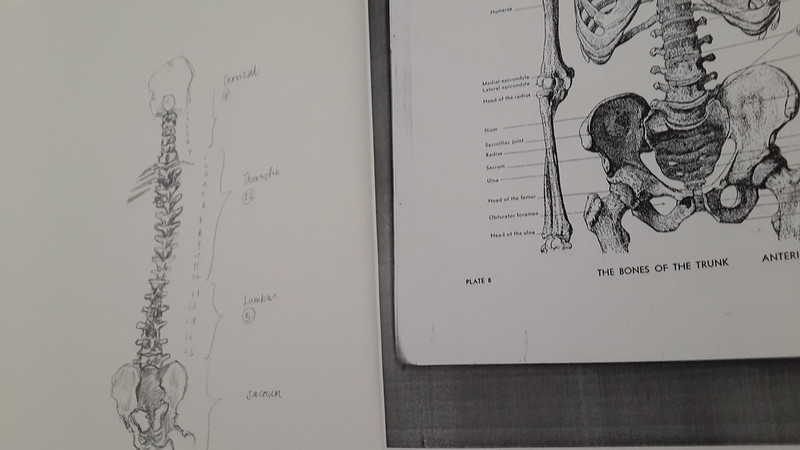
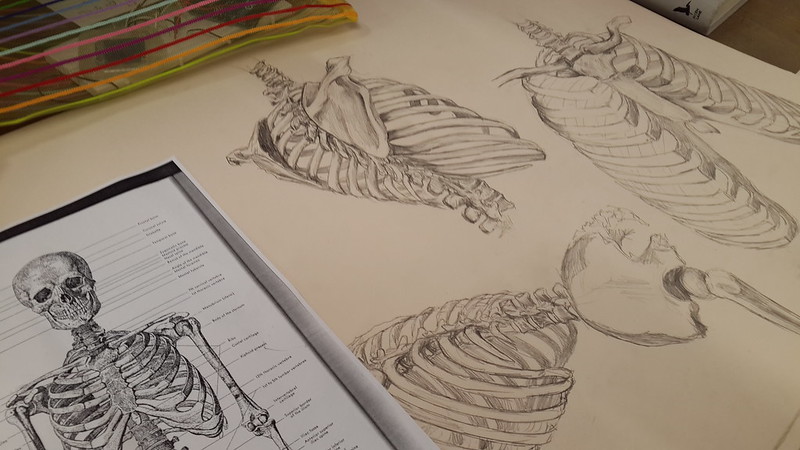
2013-11-12 12

2013-11-12 19


It's been really nice attending the various anatomy classes at the Drawing Studio - I haven't attended a drawing or sculpture class since I was a kid so it's been quite exciting - and sometimes baffling - so many things that they assume all students at the Royal College of Art must already know! - yes I know its an art school but I've never attended a drawing studio class before! What are all these strange sculpting tools? How do I use the easel without accidentally turning it into a murder weapon by having it dramatically fall apart in 3 pieces in the middle of class? How do i even affix the paper to easel...?

Tiny confusions aside, I was quite surprised how easy it was to sculpt a face which does look like a face. However, if you ask me, my objective for attending such classes is not because I want to produce my own artistic rendition of a human face, but more because I just want to understand the bone structure and musculature inside the face which contribute to the overall appearance of a human face. (I suspect that the interest of most students was to produce a face which displays specific emotions or age, or to iterate on the shape of the human face to see what alien-looking variations could be produced - a process that might be useful to an animator or a filmmaker or sculptor...)

But for me, I suppose I would like to know how one would compute a face. Could we reverse-guessstimate the shape of a person's skull based on photographs of a person's face (and information on the person's gender and age)? And if a face does indeed exude some sense of heightened emotion, what are the specific muscles or bones contributing to such an appearance? For example, I've noticed that I have never been able to look convincingly angry. Could it be that being asian in descent I simply lack a specific angry-face muscle that causes me to be unable to look more than slightly annoyed even if I am very angry?...

Building a simple two servo walker

School's out! Its been an extremely crazy few weeks at school so I'm falling behind in all the documentation of the random tiny experiments and projects I've been working on lately.

This morning I tried to make a two servo walker for fun. Something relatively uncomplicated. There are many tutorials online for one servo walkers (eg: B.E.A.M walkers) with something called a bi-core, which is a simple oscillator that allows it to produce more complex behaviours, and which also involves some gears (which I do not have). So I decided to try to build a simpler two servo walker.

PC168287

This was my simple design for the walker's feet. The script I used was a very basic edit to the default servo "sweep" script which probably needs no elaboration on how to use... because it just works.

PC168284

Assembling it together - I used an Arduino Uno, two mini servos, a small breadboard, some garden wire, mounting board and electrical tape. In my mind, having the front legs go in a different rotational axis seems to make sense so that the feet will lift off the ground. [Later I did try making them on the same plane (but opposite directions) and it did not work as well... but this is a design that can certainly be improved on...]

PC168285

One hour later and we're already done!

PC168286

Not terribly complex but it does walk about slowly...

Friday, 29 November 2013

Peltier Tiles and Toroid Beads

Producing a small current from a Peltier Tile


Recently I purchased some Peltier tiles from ebay. A Peltier device is something which is able to change a temperature differential into voltage (Seebeck Effect) and when a current is run through it, opposite sides of the tile have a temperature difference (one side will be hot and the other side will be cold - and in some cases will require a heatsink to prevent it from damaging the unit).

Screen Shot 2013-11-29 at 2.21.33 PM.png
Image Source: http://www.tellurex.com/technology/peltier-faq.php

The Peltier tile itself is a ceramic coated tile with tiny n-type and p-type semiconductors coupled together with a junction of copper between each pellet of semiconductor. Like the potato battery, the current is generated when electrons flow from the side absorbing the heat to the side that is releasing the heat.

Both n-type semiconductors and p-type semiconductors are extrinsic semiconductors which means they are "doped" or mixed with specific amounts of impurity. In a n-type semiconductor, each impurity atom produces a free electron which can drift to produce an electrical current. It is called n-type because most of the electrons carrying the charge are negatively charged free electrons produced by the doping process. In a p-type semiconductor, each impurity atom has a hole in the valence band. It is doped with a different element such as which has not enough electrons to form covalent bonds with all of the semiconductor's atoms, thus leaving a hole in the covalent bond structure. Electrons from the n-type semiconductor flow through to the holes of the p-type semiconductor, but because of the arrangement the charge and the heat are all flowing in the same direction...

Screen Shot 2013-11-29 at 2.21.42 PM.png
Image Source: http://www.tellurex.com/technology/peltier-faq.php

Initial results with the tile were as follows:

PB298192

Hand and cold air - 0.04v

PB298190

Hand and cup of ice - 0.23v

PB298194

Top of a Bowl of Soup (55ºC) and Cup of ice (11-15ºC) - 0.58v

More experiments may or may not ensue as the main motivation for this experiment was just that I just wanted to see and feel for myself how peltier tiles actually work...


Where to find a toroid bead (ferrite core) in your house


PB288184

I wanted to find a toroid bead to build a joule thief. I eventually found one inside a used fluorescent lightbulb. I've been hoarding some broken lightbulbs in the studio - finally they are of some use! My classmate Frank helped me crack up the casing with a pair of pliers. I found this broken bulb in September so the capacitor has had sufficient time to discharge - but apparently you will need to make sure that the capacitor has really discharged if the bulb was recently used.

It was interesting to see what was inside the lightbulb. It was a bit like discovering the existence of a new fruit or something; cutting it open to see what this strange fruit looked like from the inside and only eating the tasty bits. Note that it has to be a fluorescent lightbulb because a glass lightbulb obviously would not have the circuitry or the ferrite core for us to take out.

PB288186

Toroid bead

When I hear the word toroid I think of of torus prims in Second Life. I imagine big inflatable torus shapes floating about. WHICH IT IS. And speaking of donut shaped things...

20131127_235617_Clapton Common

DONUTS! INFLATABLE MENORAH! DREIDEL!

It is Hanukkah in Stamford Hill and we noticed this because there were suddenly a lot of exciting donut flavours being displayed at Grodzinskis. Happy Hanukkah!

Monday, 25 November 2013

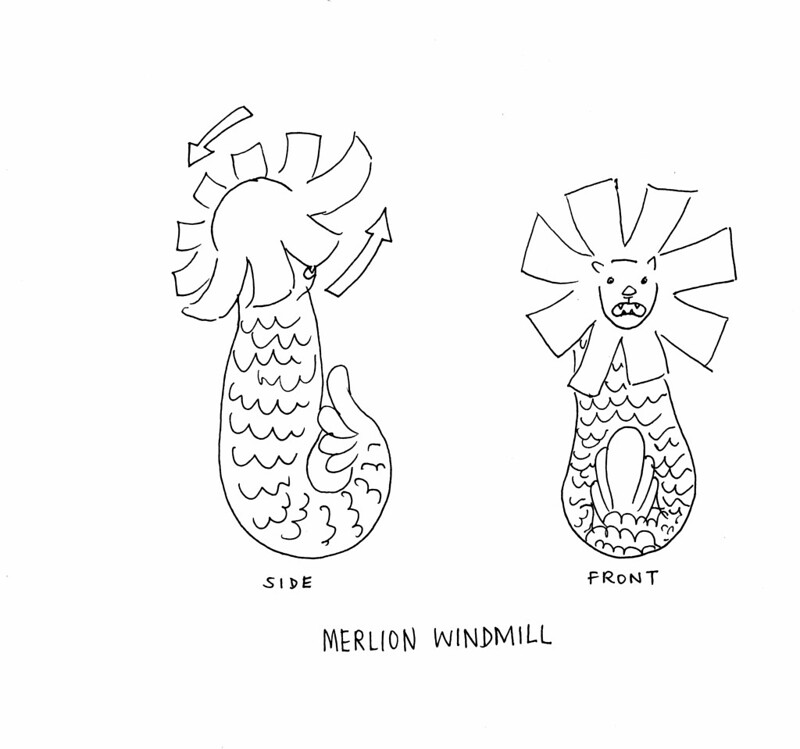
Merlion Windmill

img003

Last night I dreamt that I had found a Merlion Windmill along Changi Road in Singapore, and I was trying to find out who was the mad and elusive millionaire who had ordered the construction of this giant 12-storey-high monster. Standing at the foot of the Merlion Windmill, I started googling for it on my phone and then I discovered that there was also another replica of this Merlion Windmill in Mexico and also a 24-hr convenience store in Western Australia that had also been named "Merlion Windmill". I was surprised that I had not yet encountered the Merlion Windmill before, considering I had always been living in the east side.

1. Does this mean I should build a new type of novelty merlion hand fan?
2. Is this my brain's way of telling me not to reinvent the windmill?
3. Am I thinking too much about my alternative energy school project?


A text on merlions I wrote a few years ago:

The Merlion was first sighted in 1843, shortly after a large sandstone slab (also known as the Singapore Stone) was blown up by the mouth of the harbour of Singapore. Eyewitnesses record having seen the half-fish, half-lion creature crawl out of the fragments and into the waters of the Singapore River. It is unclear whether the creature had been living underneath the rock, or whether it had been living within the stone. The origins of the Stone from which the merlion came from are also mysterious, and there were rampant rumours that the stone had come from outerspace as it had been present long before there was human habitation in the area, and was covered in a mysterious script that was never deciphered by mankind.

Since the introduction of the first merlion into Singapore waters, more merlions have been sighted around Singapore, although most Merlions no longer live under or inside rocks, but are more commonly sighted perched on top of "waves of rock" which are made of a substance secreted by the animal, which hardens into a rock.

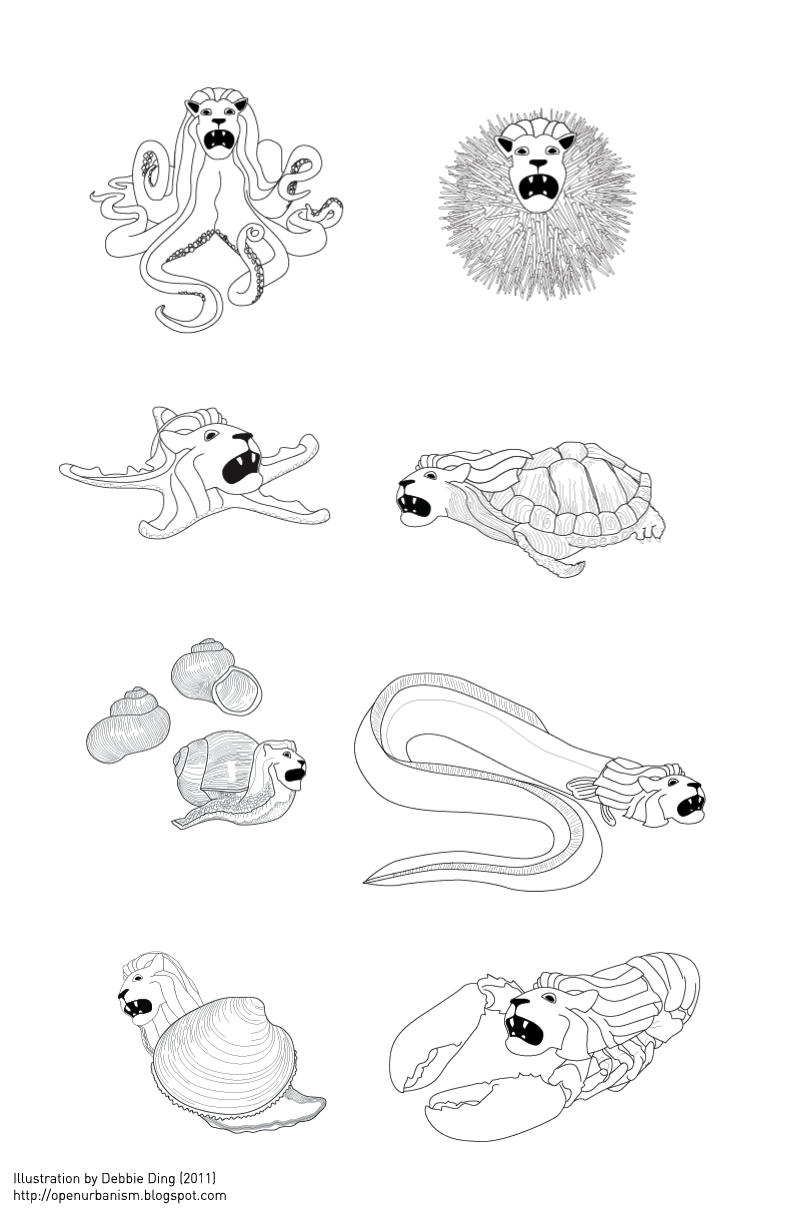
Merlions (binomial name Singapura singalaut) are predominantly marine animals which have a body composed of three distinct parts.

1. Lion head: Many merlions show cephalisation and have a head region with eyes and other sense organs.
2. Scaly Torso: the soft-bodied portion with internal organs, covered with a mantle of decorative, interlocking "scales" which are actually a cuticle secreted by the merlion.
3. Fish foot: the strong muscular fish-finned portion sometimes used for swimming (and capable of limited locomotion). The terminal segments are modified into a tail fan, a region with high surface area that acts as the blade of a paddle in the escape response.

The division of the body into distinct areas seems to have allowed diversification to occur because there can be different types of Merlions adapted to various ways of life, distinguished by modifications to the thoractic area or the tail...

merlion

(To be continued)

Sunday, 24 November 2013

Growing Mushrooms, Moss and Lavender - Part I

Growing Mushrooms


PB248050

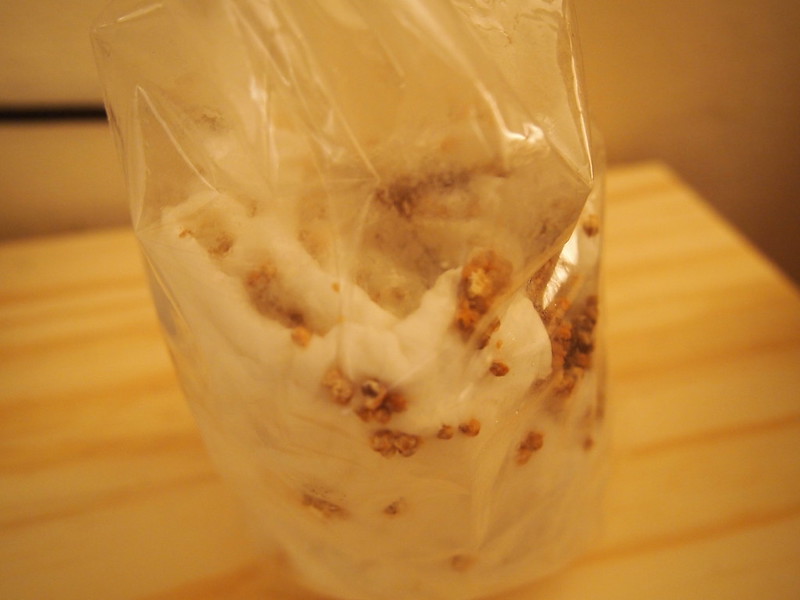
I'm currently trying to grow Oyster Mushrooms. I bought a small quantity of oyster mushroom spawn on ebay recently - the substrate used appears to be millet. After that, I boiled a bog roll (white, no inks, no fragrance) in a pot of water and then when the bog roll had cooled down, I scattered some mushroom spawn on it and inbetween its layers. To be honest I'm not sure if I'm doing it the right way, but we'll check back on these babies in a week's time. Right now they are hiding underneath a box in our rather warm room...

I have wondered about this but I do not think the mushroom spores pose any direct risk to humans - or do they? I mean, we are not going to have an outbreak of mushrooms everywhere in this room, right? Surely it can't be that easy to cultivate mushrooms. I mean, if it were so simple to have an outbreak of mushroom then wouldn't everyone with a slightly damp and dark house have mushrooms growing right out of everything, and wouldn't then people capitalise on that and eat home-cultivated mushrooms all day long?

Growing Moss


2013-11-10 16

2013-11-10 15

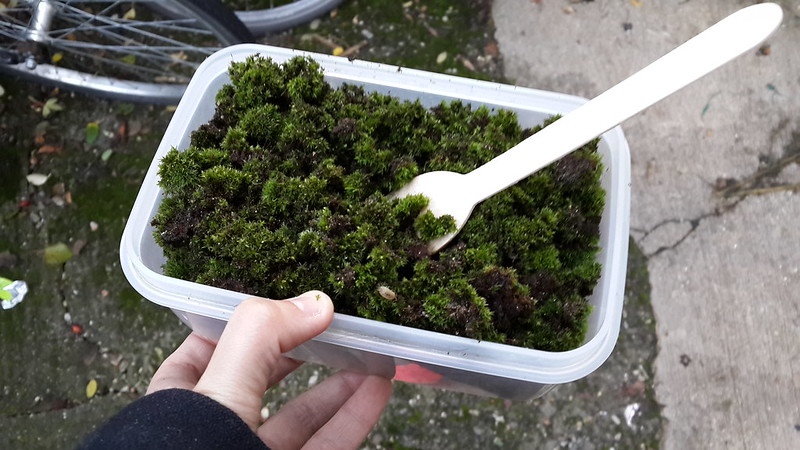
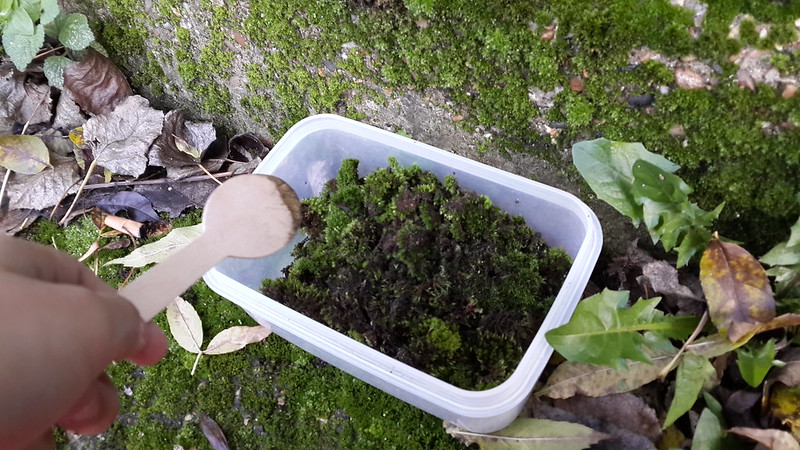
Another thing I've been doing is attempting to grow Moss. MOSS! It is very plentiful on the walls and pavements of West Bank. One day I went out and scraped a container's worth of moss from one of the front walls of our house, after which I broke the moss down into little bits and mixed it down with some Sainsbury's Basics Yoghurt and leftover beer. The yoghurt and beer serve as food for the moss bits, I was actually going to do a comparison of which works better (beer or yoghurt) but I realised that the yoghurt actually acts as a glue, hence the prevalence of people using buttermilk or yoghurt as without this ingredient it will not stick to surfaces. So I just mixed in some yoghurt with all of the moss. I applied this strange smelling moss sludge to the balconey. It hasn't turned mouldy yet which is great, but it probably will take a few weeks to reconstitute together...

Growing Lavender


2013-11-10 14

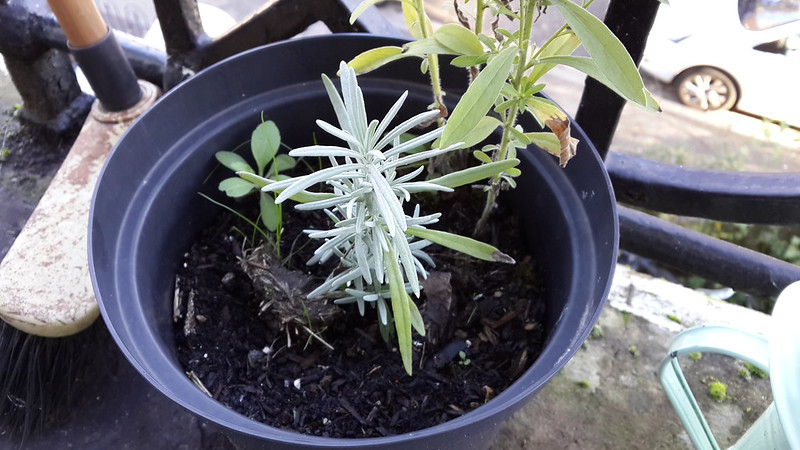
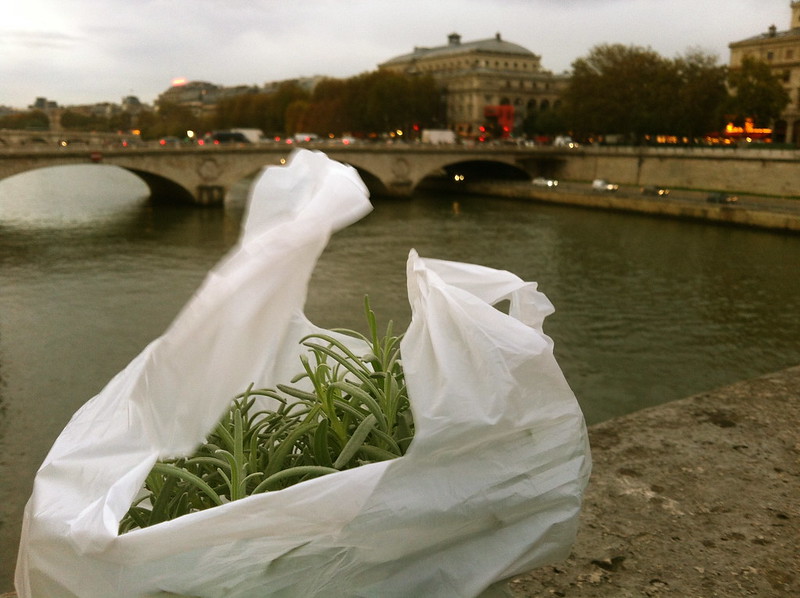
Finally, this is a picture of Georges II the Lavender Plant, who has grown from a cutting from a pot of Lavender I bought in Paris last year. Last year around this time, George the human brought a small cutting back from my pot in Paris and stuck this bit of lavender into a pot of soil. Unexpectedly, the clipping of lavender now known as Georges II did not die from the trauma of being suddenly cut and rudely stuffed in a pocket and carried to London, but actually has continued to grow and thrive to this day. I hope that Georges II will have many more happy years on the West Bank Balcony....

IMG_7754

The plant formerly known as Georges I (RIP 2012, due to overzealous watering on my part)

See also: A Mini Tour-de-Paris for a Pot of Lavender

Crossing the English Channel / French Girolles

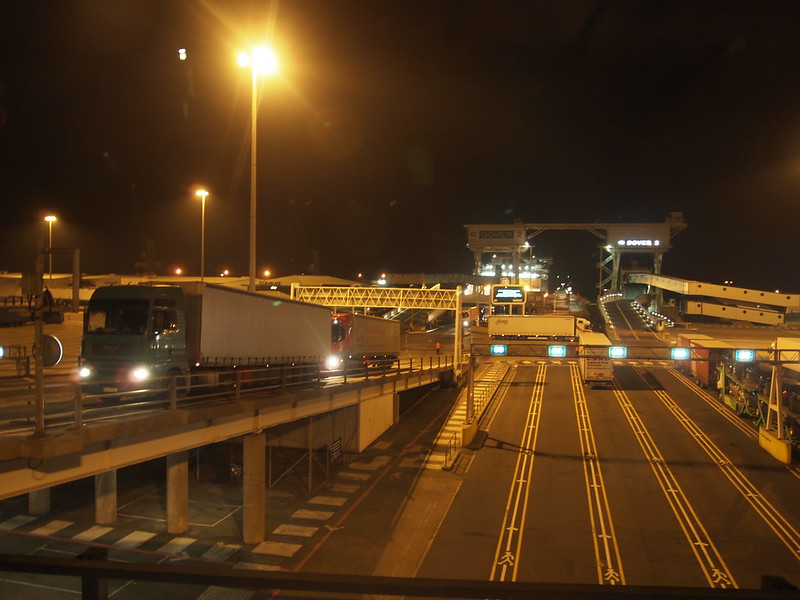
PB188014

Calais

PB188017

P&O Ferry

PB188020

Dover

I've taken the Eurostar quite a few times but tickets were really costly this time of year, so I decided to try to take the bus instead on my most recent trip to Paris. I got a National Express ticket, but the actual bus I took to and from France was devoid of any of the usual National Express livery. Instead we were in a strangely bright coloured bus with a drawing of a coconut tree on it. It was otherwise very fine and clean and lovely on the inside, except that on my outward journey there seemed to be someone onboard who was transporting a lot of potatoes or yams along with them, so it seemed a bit... um... earthy?


Eurotunnel Route - View Larger Map

The journey from London to Paris is very straightforward without any passport checks - only spot checks. We went via the Eurotunnel and there was no need to disembark from the bus at all. But the journey from Paris to London is more complicated as entering the UK requires one to go through a number of checkpoints. There is a checkpoint in France where you get off the bus and go through two posts (French Border Exit and UK Border Entry) with only your passport in hand. Following that, when you get to the Calais-Dover ferry crossing, you will be required to disembark from your vehicle for the full 1.5 hours of the ferry ride. Finally, our bus was picked out for an additional passport check at Dover; we were all asked to disembark with all luggage (handcarry and stowed luggage). They did a cursory check of people's nationalities and waved almost all of us along without much checking, but they took aside two people for questioning. To be honest it seemed like it had been some sort of pre-planned "sting" operation targeting some individuals which the authorities in Kent must already have known would be on this bus (it is after all the cheapest route and also involves a seemingly less stringently monitored border crossing compared to the planes or intercity trains). Consequently this entire episode caused an immense delay to our journey as our bus was delayed to the point that we met with London's peak hour london traffic all the way back to Victoria... Grr!

The lady bus driver on both my journeys was quite a character: she was quite old but still wore her hair in two blonde pigtails and wore ridiculously bright red blush on her cheeks despite being desperately pale. She also used the talking sat-nav for the ENTIRE EIGHT HOUR BUS JOURNEY FROM LONDON-PARIS, and on the way back from Paris to London. All whilst listening to ABBA. 8 HOURS OF A VERY-POLITELY-LOW-VOLUME PLAYBACK OF SEE THAT GIRL! WATCH THAT SCENE! DIGGING THE DANCING QUEEEEEEEEN! It was so soft and timid, you could not complain. She was a sweetheart. But some of the passengers were quite rude to her because of the delays which were out of her control.

In conclusion: I cannot in good faith recommend the eurolines bus as a means to getting from London to Paris the next time around. It is simply fraught with too many unpredictable factors and the land journey is really very very long and tiring, and on top of that prone to more delays. However, if you are on a severe budget and willing to lower your expectations, then it will be the lowest budget method of getting to and from Paris from London. Eurostar is usually in the £70 range and upwards, and a flight to Charles de Gaulle might be around £60+. A Friday Night bus on Eurolines/National Express booked only one week in advance will cost just £35. Apparently if you book well in advance it might be as low as £9... but who manages to do that?


Girolles / Chanterelles


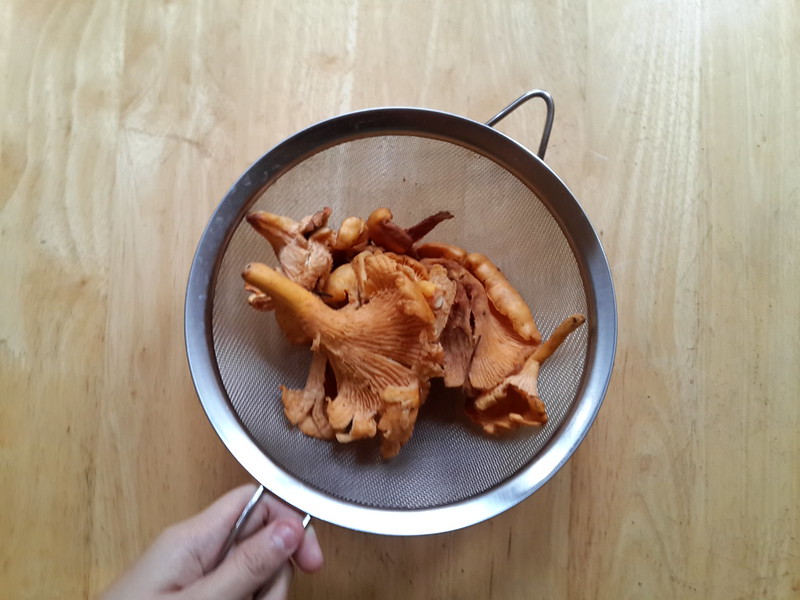
Whilst visiting Paris, I brought back home a small bag of Golden Chanterelles, aka Girolles (if you're in France) or Pfifferlinge (if you're in Germany). They seem to be much more common on the continent and I don't see them around very often in shops in London unless I've gone to the wild mushroom corner of some farmer's market. They are quite delightful (although not cheap) and I find that these chanterelles have a lot more texture to them and a more 'meaty' taste - perhaps in some ways a little bit similar to an oyster mushroom, but very yellow and much more dense and intense in flavour.

20131120_102312_Amhurst Park

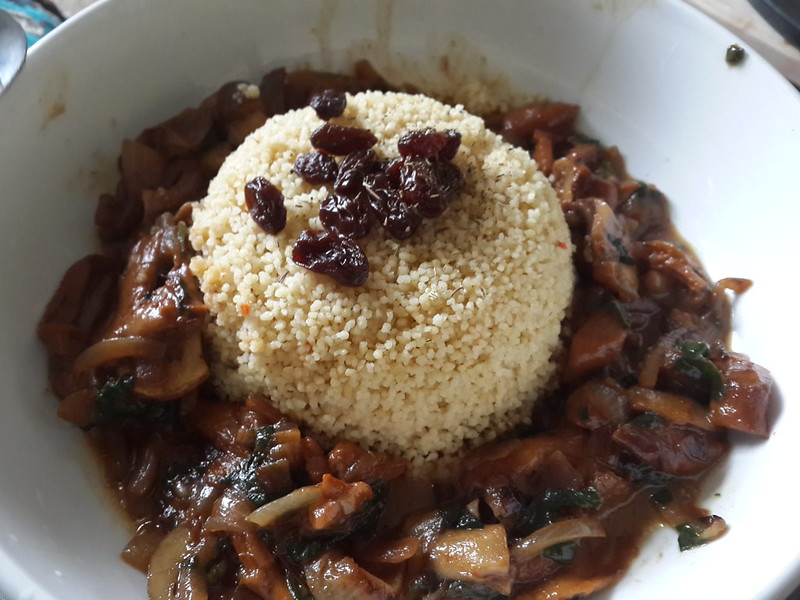
One morning I made a simple dish of girolle accompanied by couscous with raisins. FOR BREAKFAST! Because breakfast can be epic too. The chanterelles were cooked in a pan with some butter, onion and spinach, a splash of rice dream and a few shavings of parmigiano. This was really fast to prepare. It was kind of madeup but I think I like making up recipes as I go along. Couscous was also really simpler to prepare than I recalled; it is similar to the technique of preparing bulgur wheat, you just boil the same amount of water per ml for each gram of couscous, season the water with salt or a stock cube, and then throw the couscous in the boiling water. Take off the heat and cover with a cloth or a plate for 5 minutes. After which the couscous is done and you can fluff it with a fork. I've often seen couscous paired with sultanas or currents so I threw some on top...

20131120_110424_W Bank