Thursday, 31 July 2014

The Palazzo F.- : lost in time and space? (Venice Architecture Biennale, Swiss Pavilion, 2014)

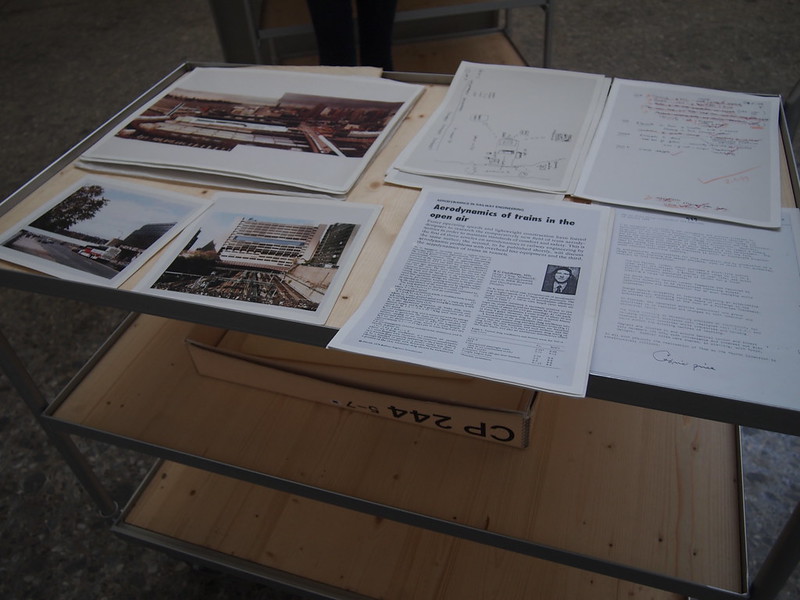
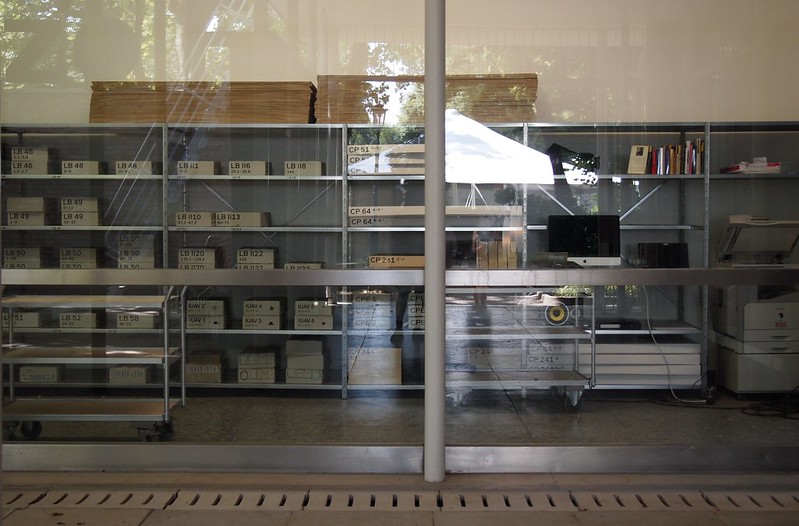
Recently I went to work at the Venice Architecture Biennale along with a dozen other Design Interactions students from the Royal College of Art. We were there to produce a project on the future of labour at the “summer school” as part of the larger Swiss Pavilion. At the end of our week at the Swiss Pavilion, our projects went into a small grey box which went into a larger archive.

“Following Burckhardt’s and Price’s critique of the traditional university system, Lucius Burckhardt and Cedric Price – A stroll through a fun palace will function as an architectural school under the leadership of Italian architect Stefano Boeri with Lorenza Baroncelli. It will welcome and connect students in a worldwide network of thinkers, schools and researchers, enabling them to reflect on how the contemporary landscape is changing.”

P7220596

Hans Ulrich Obrist, February 2014: “At the centre of the project will be the archives of drawings of Cedric and Lucius, of which different aspects will be revealed throughout the Biennale. ‘A stroll through a fun palace’ in collaboration with architects and artists will present a laboratory where the ideas of Cedric and Lucius can be toolboxes to invent the future.’

P7220595

As an “archive”, the materials in the Swiss Pavilion meant to be “programmed according to a time-based dramaturgy, creating a changing mise-en-scène and an exhibition in constant motion.” Models, materials and other archival objects were wheeled out periodically, moved around, shifted on to chairs, taken out at different intervals. The projector came on, songs were sung, sounds were sometimes played, boxes rearranged by curators. And in the middle of the open space, the slightly confused visitors on a mild summer’s day in Venice wandered through these fragments and tentatively, hesitantly sifted through a few at random.

Whilst I was extremely grateful to have had the opportunity to spend a week inside the Biennale, “absorbing” the Biennale, as it were - I had some issues with the actual execution of the pavilion itself, perhaps because I had imagined something quite different from having read the texts which described it.

While you can indeed aim to curate an exhibition which consists of multiple points of view where it is forever impossible for the viewer to have a complete overview or to see the entire story in full, whether by physically or by time durations, the question for me is whether such an approach can be aesthetically compelling, or able to hold together when executed? Will it show enough of the narrative to pique the interest, to encourage one to open up this “toolbox” and to unpack its ideas and engage with it, especially for one who might be encountering all of this for the first time? Or will the toolbox remain nothing more than a conceptual toolbox out of reach, a pretty idea without immediate action or application?

This is not to say that I don’t think that there are many useful lessons to be learnt from Cedric Price and Lucius Burckhardt; the Fun Palace is indeed a great if unfinished idea - a place where the building remains flexible and changing with its users having to complete it by making use of it. But in its execution, the exhibition seemed to induce or reinforce the audience’s meandering behaviour of floating around like a confused, constantly distracted, itinerant museum goer, “sampling” archive materials at random like how a shopper might taste a few proffered food samples at a supermarket - but so noncommittally. In my opinion, the Swiss Pavilion turned out to be a space in which I saw the spectacle of the “confused and lost gallery-goer” - the everyday camera/smartphone-clutching mobile spectator, instagramming the scene before understanding it, itching to flick to the next page, unable to focus on something with any concerted engagement - lost and floating in space. I began to wonder, with my limited understanding of the forces that had produced this situation, how I came to be sitting here in the pavilion - who was the intended audience at an architecture biennale? A random venice traveler? Architects or architecture students working on some other portion of the biennale? Seriously, who were all these people? What force had produced this massive architectural extravaganza, and for whom? And who were we really hoping to engage with this "toolbox of ideas"?

So often “participatory” shows which involve introducing people to the ideas of “great visionaries” approach it from the viewpoint of somewhat didactically showing the audience how their lives could potentially be enriched through these great amazing ideas. I have no issue with something educational, but I think that if it is done without truly getting people to go through it thoroughly - and without demanding that they should fully give these ideas completely new forms on their own at the end of these interactions - then it is clearly more a pedagogic exercise rather than a true reciprocal exchange of ideas. I suppose my problem with it is mainly that I find that the moments at which true interaction can occur here seem so facile and fleeting.

The archive trolleys used to move and rearrange materials reminded me of the gravestone trolleys I saw in the Cimetere in Venice’s Isola di San Michele - inert gravestones inscribed with distant names, shuttled from place to place by its caretakers - large mute memorials exiled to a floating isle that was to be their grand funerary palace... I guess it is another kind of Palazzo F.- ...?

Maybe I say this because I am now beyond "toolboxes". They are useful, and even a review of the "fundamentals" of architecture like the bigger Giardini show is also worth going through, but I no longer want to play with toolboxes and dictionaries, its almost like just stalling time; I think we ought to be spending that the time writing and making completely wild and new things.

Sunday, 27 July 2014

Second Life Adventures: A Lonely Dinosaur on the Dancefloor, Deconstructed Architecture in the Metaverse, and Hopper's Diner in Space

I've been having internet issues the last few weeks - being in a flat in Venice with no internet and no mobile data, having intermittently poor internet here in Berlin. Once every few months I recall that I have a Second Life account. Last few nights I found that - shock! surprise! - I could actually clamber online after hours late at night, and what do I do online? The really important work I need to do online?... No, instead, I found myself wasting time on Second Life once again.

People unfamiliar with Second Life often ask me, "What can you do in Second Life?", "Aren't all these virtual worlds dead already?". So here is a list of things you can do right now in SL - or rather some of things I've done this week:

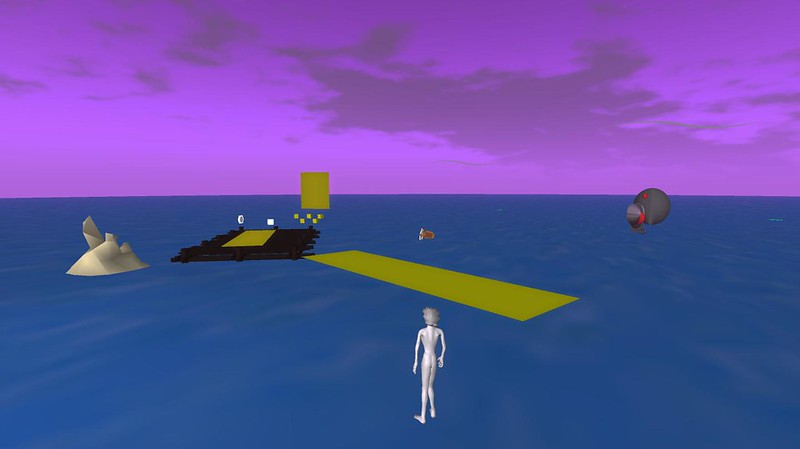
1. Walk through some abstract wastelands

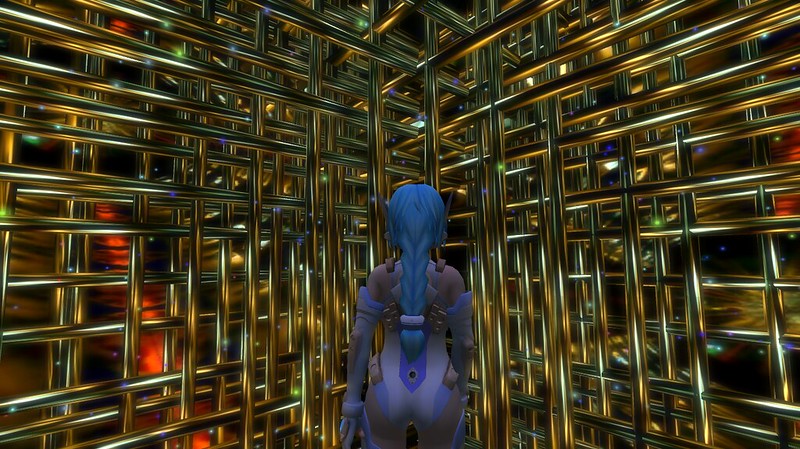
Snapshot_015

Lots of half-built places with strange lighting that look like a cross between a glitchy p-model music video from the 80s, a seapunk animated gif, and someone's incomplete rhino 3d project. But don't get me wrong, most of them are less interesting than what I've just described. A lot of them are very mundane as well, like reproductions of grassy hills and boring houses with boring normal furniture inside them.

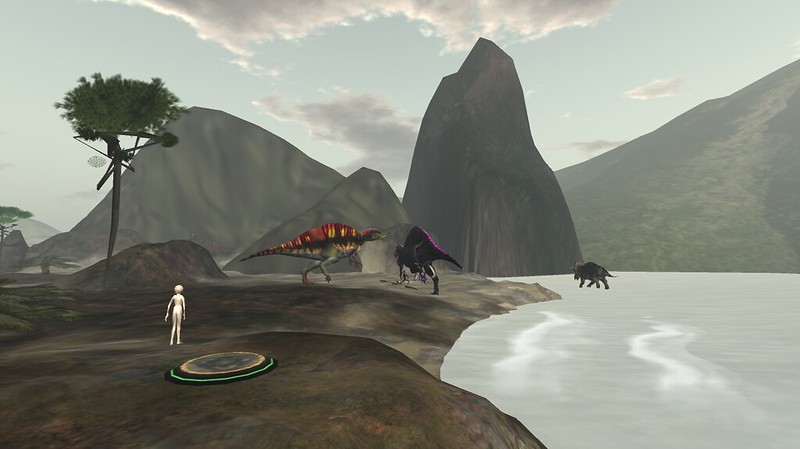
2. Walk around in the prehistoric world of dinosaurs

Snapshot_002

Went to Prehistorica, the Dawn Kingdoms, where they also have a collection of very convincing dinosaur avatars for sale!

3. Become a dinosaur

I decided to become an apatosaurus (also known as brontosaurus), largely because it was just about the BIGGEST.

Screen Shot 2014-07-25 at 9.43.30 pm

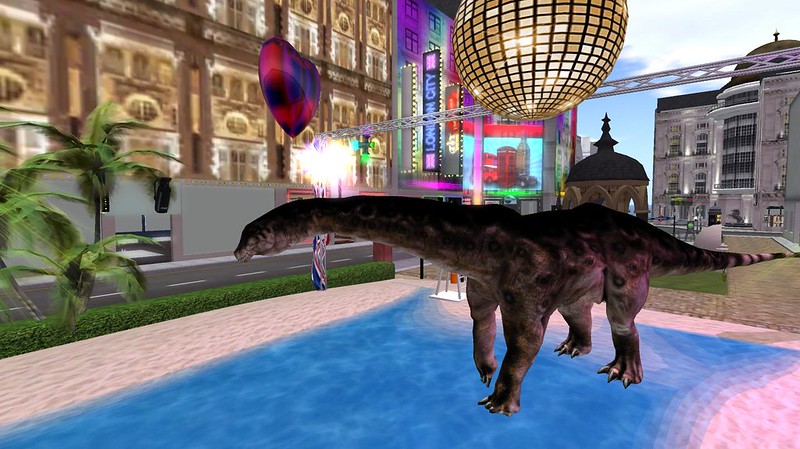
4. Become a Dinosaur and and walk around "London City"

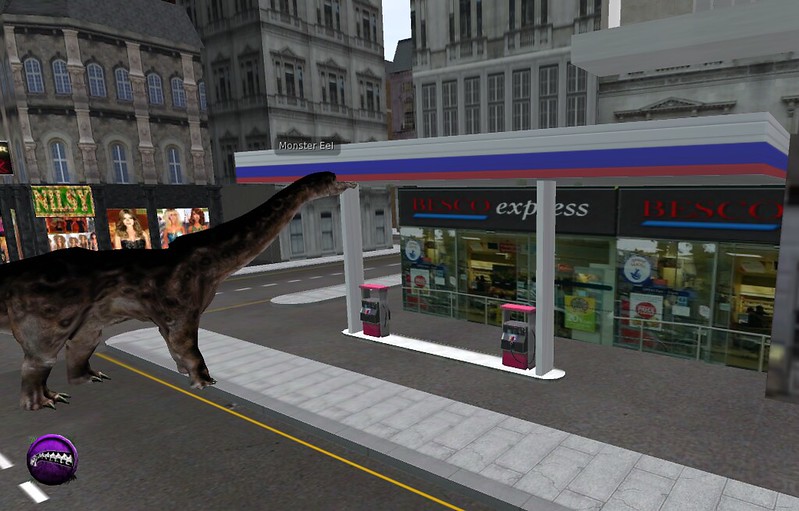
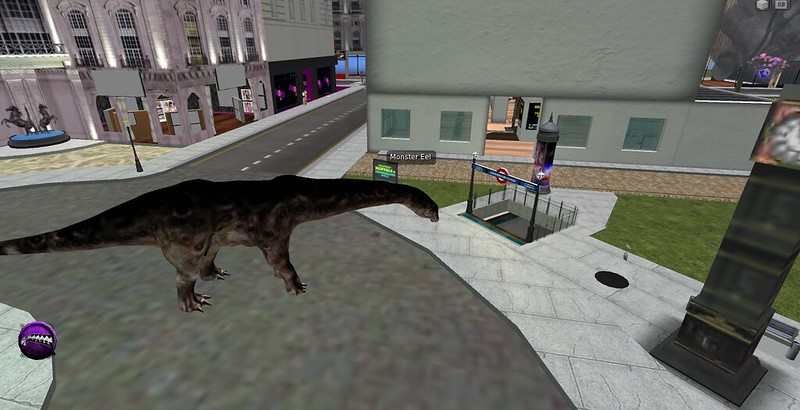
"London City" is a sim which looks like London but is set by the seaside, merging some of the elements from London with a seaside town. I tried walking around making loud roaring noises and growls and stamping sounds but no one seemed to take notice. Some other avatars skittered around underfoot, trying to figure out how to operate the free go-karts in this parcel...

Screen Shot 2014-07-25 at 11.00.43 pm

Snapshot_011

Screen Shot 2014-07-25 at 11.02.08 pm

Screen Shot 2014-07-25 at 11.04.39 pm

Sadly, as I was still a gigantic Dinosaur, I was too big to go inside the Tesco and Tube equivalents in "London City Pier". Its hard being a dinosaur.

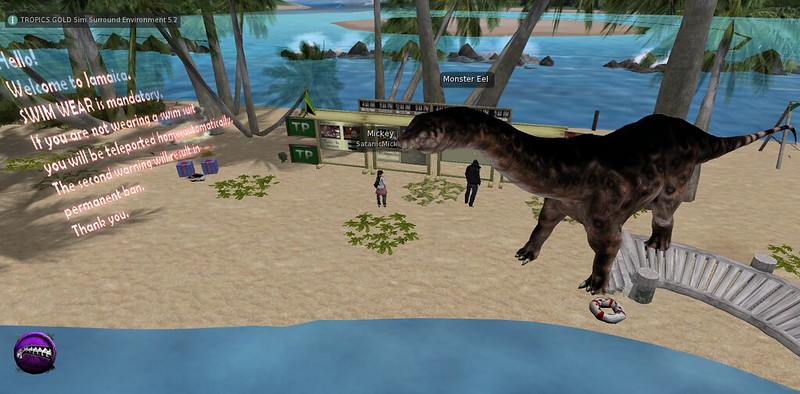
5. Become a Dinosaur and walk around a beach - almost

Screen Shot 2014-07-25 at 10.44.01 pm

I also wanted to go to the beach in Jamaica but they had a compulsory swimsuit policy. That meant that I couldn't go to the beach because I didn't have any dinosaur-sized swimsuits to wear there. Again, its hard being a dinosaur.

6. Go to a party as a Dinosaur

Screen Shot 2014-07-25 at 10.57.13 pm

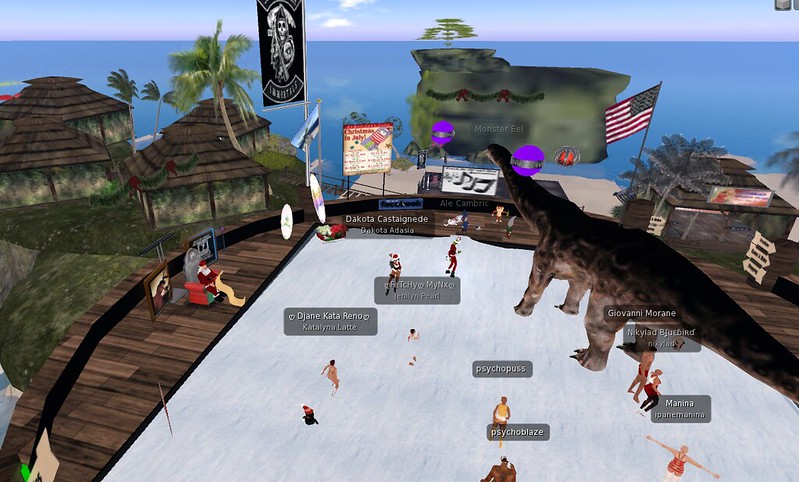
It's lonely up there, being a big dinosaur, and dinosaurs can't dance because all the other people are too tiny and its impolite to step on them...

7. Become an Android and do taiji in a japanese pavilion by the seaside

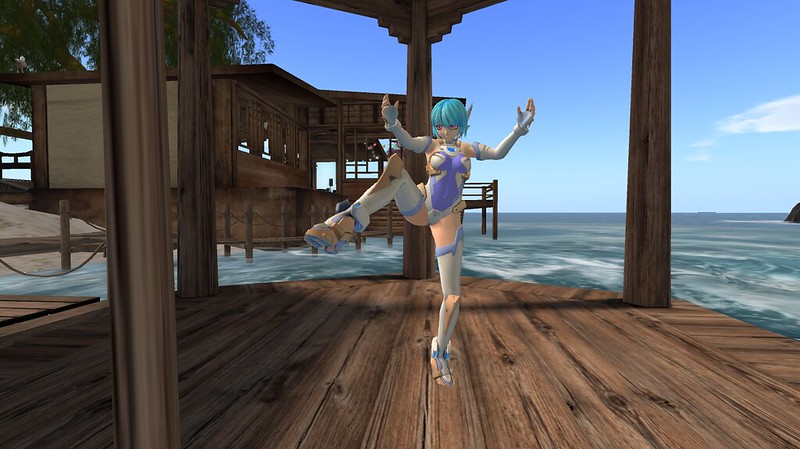
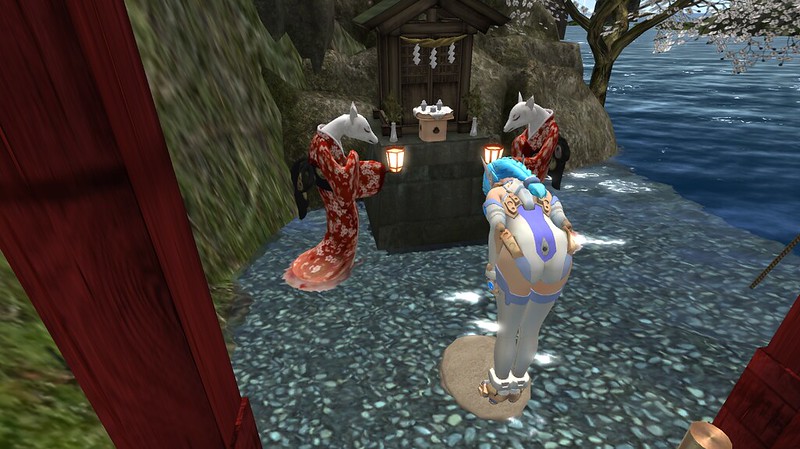
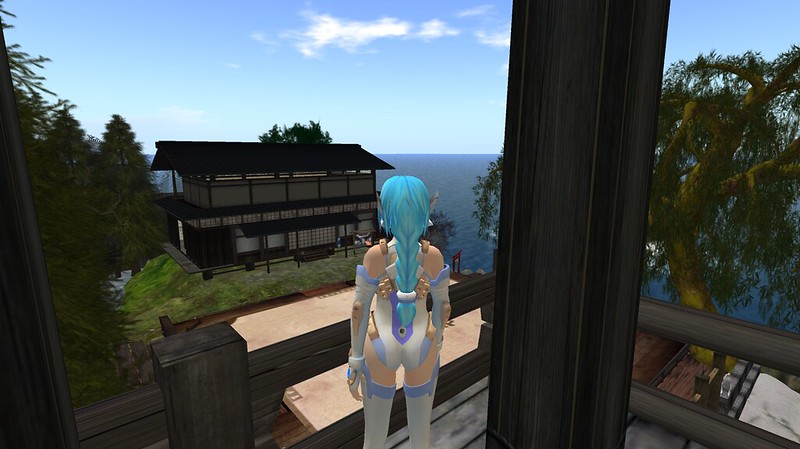
I was bored of being a dinosaur by this point, so I switched to being an anime style android. Utilizator makes really excellent full mesh avatars. This is the Rikugou A; Utilizator also makes the popular Kemono avatar, of which there are endless mods it seems, all very professionally constructed (except that I don't really want to be a furry...)

Snapshot2_004

Snapshot2_006

Snapshot2_005

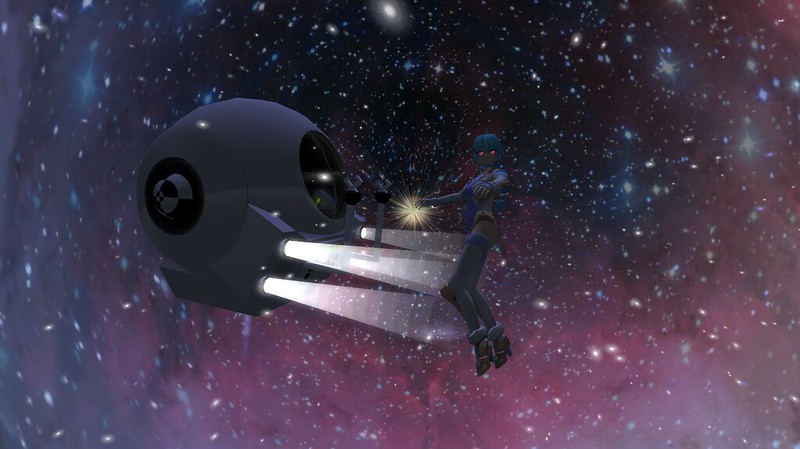
8. Fly through outer space

I visited Ars Simulacra: NMC's SL Artist Showcase Island, which can always be counted on for a good experience. All of the following images are from Ars Simulacra's MediaMorphosis.

Snapshot3_002

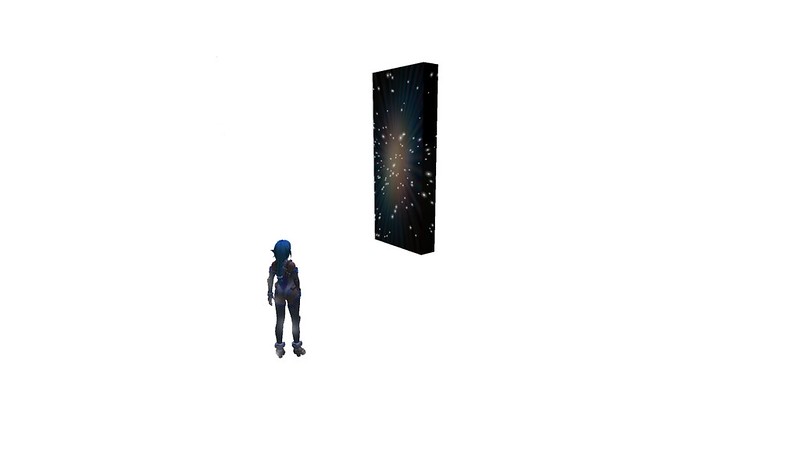
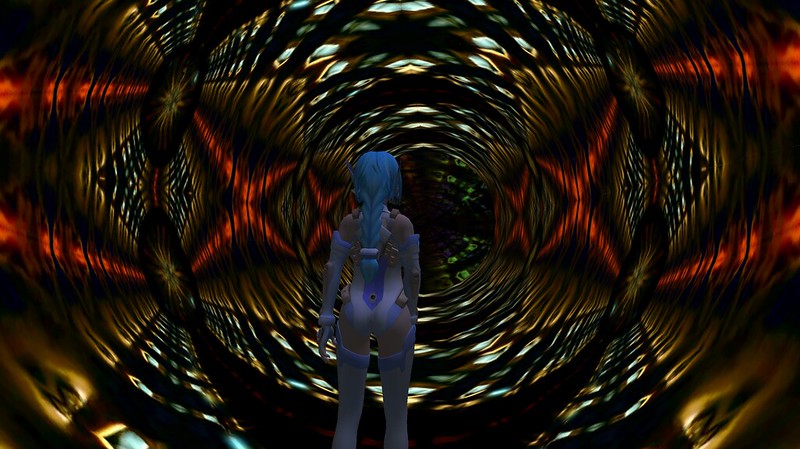
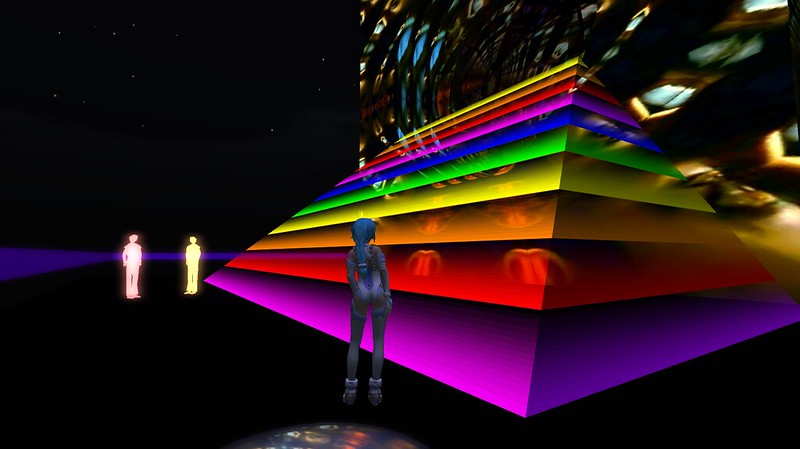
9. Wander around immersive landscapes

Snapshot3_001

Snapshot4_002

Snapshot4_010

Snapshot3_004

I should like to rent a large plot to build something on this scale one day just so I can experiment with it slowly! How much of these effects are "accidental" or intentional designs? I believe that a lot of what looks impressive is sometimes very simple in its underlying construction. And looking back, I'm surprised to realise so much time has passed since I first saw these kind of spaces. I've already been on SL as nothing more than a casual user for over 7 years now. It has almost been 3 years since I stepped into Kuru Kuru World. This type of floating, deconstructed space has been in the metaverse for so long; its nothing new but I still wonder if we can learn anything from it and apply it back to architecture in the real world.

These sort of spaces still remain as some of my favourite kinds of spaces in SL to walk around in. I realised the image I had in my head for a proposal I had written recently (to be built in real life) comes a lot from my fondness for such spaces in SL.

What's interesting for me is the use of video on the 2d planes which are used to create structures. In such a world, "light" or more correctly "colour" also operates completely differently. A media "texture" with glowing white elements appears as a bright light that reflects off the faces of the avatars, and the shifting transparency in these moving image layers also produces unexpected diaphanous and complex-looking waves, especially when you cam around them. Much of these are housed inside huge megaprim domes with "infinite" seamless interior textures, which only reveal their underlying structure when you fly about and cam out as far as you can.

10. Visit a replica of Hopper's Diner

Snapshot4_017

Snapshot4_014

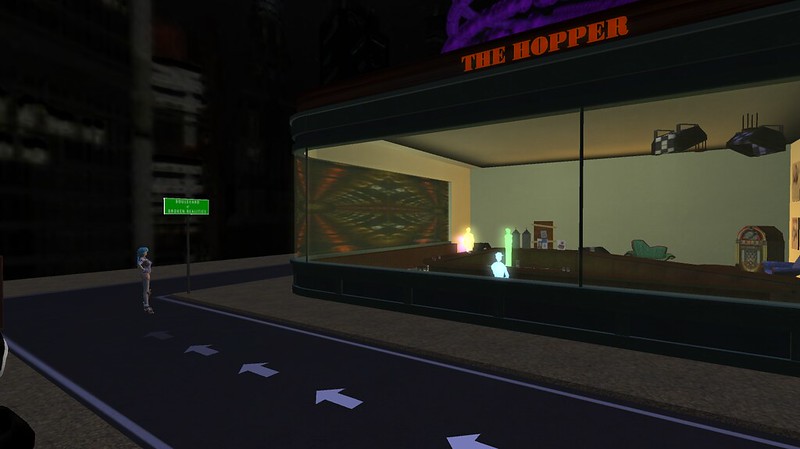
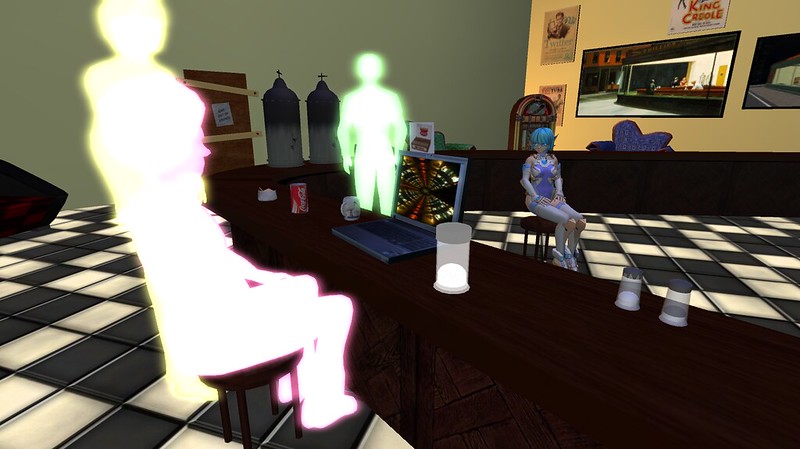
An obvious landmark to reconstruct in a virtual world, and famous for having been used as a visual reference for the "future noir" style of Ridley Scott's Blade Runner. Where Blade Runner faithfully reproduces the colour tones of Edward Hopper's "Nighthawks", here the lonely diner itself is faithfully reproduced as a physical 3D space to wander in and around. I feel a bit strange walking around it, standing outside looking in, sitting inside looking out - I wonder, by spending more time in the virtual Hopper diner, will the diner eventually appear in the maps of my dreams...?

Friday, 11 July 2014

The Act of Rationalising the Destruction of Books: Singapore's National Library Board pulps books!

P7110131

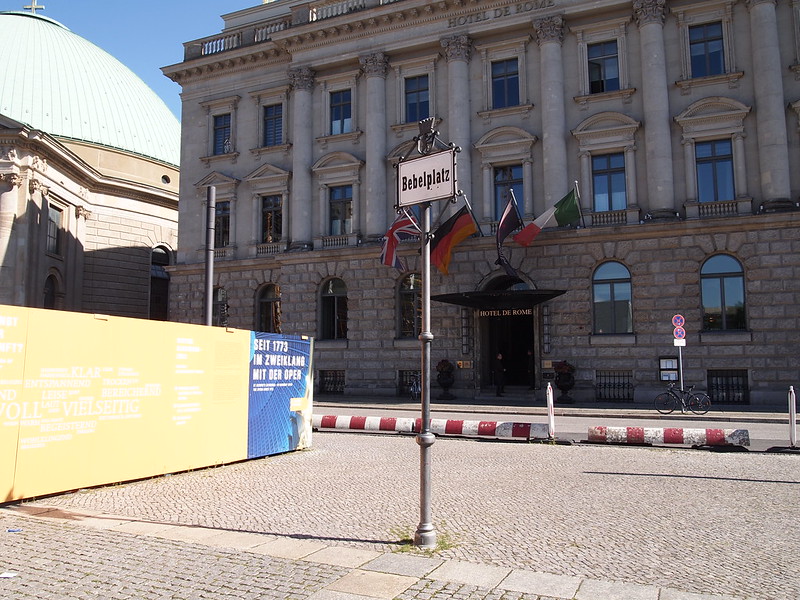
Today I had a walk around Mitte in Berlin, and I went past Bebelplatz.

P7110142

On 10 May 1933, in this open square next to the opera house and Humboldt University, over 20,000 books were burnt in the square after Joseph Goebbels gave an incendiary speech to a crowd of 40,000 people and students. The entire library of the Institut für Sexualwissenschaft (Institute of Sex Research) was first to go; dragged out on the streets and burnt to ashes. Books by numerous Jewish writers and pacifists were also pulled out from nearby public libraries and burnt. These included works by Heinrich Mann, Heinrich Heine, Stefan Zweig, Karl Marx, Albert Einstein, Kurt Tucholsky, and Erich Maria Remarque.

The Institut für Sexualwissenschaft was a non-profit foundation which conducted research on sexuality with regards to medicine, psychology, and ethnography. The Institute also had been an early advocate of sex education, contraception, and had been campaigning for the civil rights and acceptance of homosexual and transgender people.
P7110137

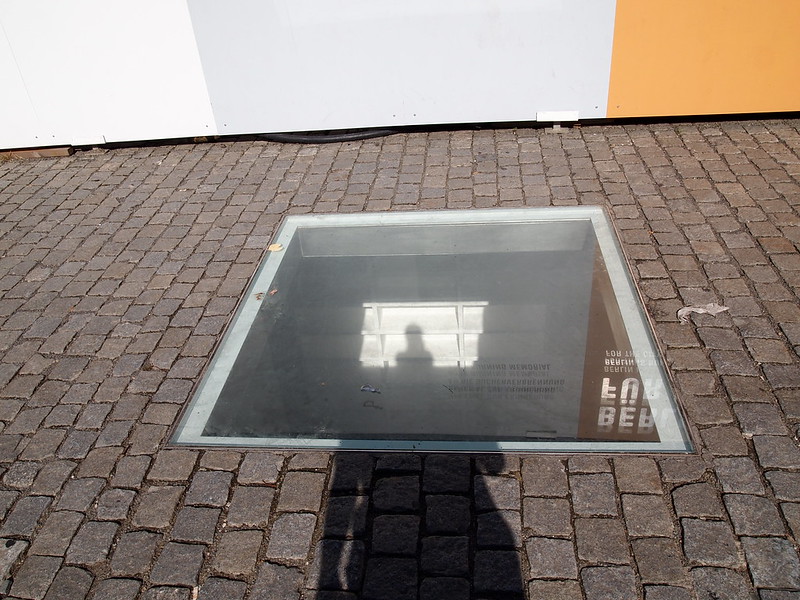
The Book-burning Memorial by Israeli artist Micha Ullman - consisting of an empty subterranean library that could have held 20,000 books

10 JULY 2014, STRAITS TIMES, SINGAPORE: Three children's titles recently removed by the National Library Board (NLB) as they were deemed not "pro-family" will not be put back on the public libraries' shelves. The three titles are: And Tango Makes Three, The White Swan Express: A Story About Adoption, and Who's In My Family: All About Our Families.

In a press conference held at the children's section of the Toa Payoh Public Library, Ms Jasna Dhansukhlal, assistant director of NLB's public library services, said the books will go through a "discarding process" where they will be pulped...

Pulped! One would reasonably expect that a library is a place where books will be kept safe, and where they would be a champion of freedom of information and speech. Yet this is not the case at the National Library Board; who after receiving a petition requesting for the books to be reinstated, instead announced that they decided that they would stick with their "pro-family" stand, and would be in fact pulping the books!

The pulping and destruction of literature because it isn't aligned with a particular set of values is something that a library should never be engaged in. Even with the way Singapore is generally thought of to be conservative, never did I expect that they would say that they would pulp the books to be withdrawn. Were we even talking about the same place where I spent hours and hours reading in the reference section as a young teenager? With one fell swoop they were going to stain all my happy hours there with the horror of imagining all the unknown books they may have withdrawn and destroyed over the years due to some conservative and religious complainants. At some point I had outgrown the National Library and had wondered why its collections in its public sections were so sparse and unrepresentative of the vast literature out there, and I thought it was likelier to be from a failure to acquire the books, rather than the possibility of there having been a slow but systematic culling of books along the way. But now even we cannot be sure, because we do not have the numbers.

There are also a few separate issues at stake here: (1) BIGOTRY: Can our national library be allowed to be openly anti-LGBTQ? should the library be allowed to impose a moralistic "pro-family" (anti-LGBTQ) policy over its public access collections and withdraw those books which do not reflect those so-called "community norms"? (2) CENSORSHIP: Can our national library be allowed to play moral watchdog and censor materials at will? Why should they be allowed to define what is an acceptable family structure, and why is it defined in such a narrow way? and (3) ACCOUNTABILITY & TRANSPARENCY: Can the library can be trusted to make the right decisions when it has shown that it is not accountable and transparent in its actions? Should a library be empowered to quietly withdraw books from their collection at will if a single individual with his or her personal moralistic/religious agenda complains about a book?

We do not have a Freedom of Information act in Singapore, therefore there is no official instrument with which to request for NLB to make the list of books which they have withdrawn public, unless they decide on their own to make this information public. The government-citizen relationship in Singapore is still largely a nanny-state in which the government exerts power over the people by withholding data and information, and by doing so restricting people from making autonomous decisions. For example, the belief that the government controls everything continues to influences people's behaviour, as evidenced from how opposition parties still have to reassure some voters that nothing bad will happen to them if they vote for the opposition.

A few days ago the government also announced that they would not be bringing Article 5(2A) of the Constitution into force, which means that it can make amendments to our Constitution without having a vote. The reason they cited was that they might want to make refinements to our tax system and the basis on which the Government can draw on net investment returns for current spending, so being able to amend the Constitution would save Singaporeans from the process of a potentially lengthy and protracted national referendum.

The issue then, is whether you trust the government to do exactly as they say, and whether you trust that the Government will truly be able to do everything in the people's interests.

Unfortunately, this is not a perfect world that we live in. I am always suspicious if I hear someone tell me that they know what's best for me - assuming that they must know better than I know it myself. As a logical and thinking individual, I would like to be able to make the decision for myself, instead of letting someone else summarily make the decision for me. It is not that I am being contrary for the sake of being contrary, but it is simply that I would like to understand how everything works for myself before I have an opinion, and to have the autonomy of making choices for myself. For me, this autonomy of choices also forms the basis of a democratic society, in a space where we can have open and honest discourse.

It is interesting to note how the destruction of those books is often very carefully rationalised by those who are homophobic; in all the reports, the suppression of the books is always described as a kind of positive action on the part of homophobics to stem the "pollution" before it "infects children". They describe the complete eradication of books with any representations of LGBTQ people (and penguins) as a way to attain a better society with better values, with none of that terrible corrupting gay influence.

The Nazis also used a lot of propaganda aimed at educating children and students about the so-called corrupting influences of the Jewish and gay people, to the point where the burning of libraries became a way of showing support for the government. They also had a War Manual, the "Kriegsbrauch im Landkriege" (The Usages of War on Land), in which they formally justified terrorising civilians and destroying the cultural capital of their enemies as such: "War cannot be conducted merely against the combatants of an enemy state but must seek to destroy the total material and intellectual (geistig) resources of the enemy."

In "Libricide: The Regime-Sponsored Destruction of Books and Libraries in the Twentieth Century", Rebecca Knuth writes an account of how the Nazis even made a point of their tactics of cultural warfare by completely destroying the same Louvain Library in Belgium not once but twice! - during both world wars, even though they had already been rebuked and widely deplored the first time around, and the US and Britain had spent considerable effort trying to rebuild the library only for the Nazis to destroy it for a second time.

I am disappointed to see so many people who have graduated from my alma mater National University of Singapore, saying such terrible things and supporting NLB's destructive actions in the name of so-called "pro-family values". In all of my years of education in Singapore, I was never taught to hate and discriminate and to force my views on to others! What happened to make so many Singaporeans so ignorant and intolerant of differences in views?

Has there been a lack of exposure to the outside world and the realities that exist outside it? Do these people know that many countries around the world recognise the human rights of LGBTQ people and ban all anti-gay discrimination? In countries such as UK, Denmark, Norway, Sweden, and Iceland same-sex marriages and same-sex adoption have been legalised as well. Those countries are all doing pretty fine and nothing much has changed, except that more people now have their human rights recognised.

To me, it seems that Singapore's public libraries and education system have completely failed if all they have done is to produce so many ignorant and intolerant people today who cannot think for themselves - people who would rather let the state control and define what their children can or cannot read, because they are apparently afraid that their children will become corrupted by a single book - presumably because they feel incapable of thinking for themselves after years of being told what to do - by their religious leaders or by the government.

Books and the dissemination of information through printing and technology are the very things which have enabled us to create and share ideas of identity, individualism, human rights, and even the idea of a nation. These are all potentially ideas and notions which different people may have very different views about.

How can a National Library be allowed to pulp books based on a single complaint without further consideration of other people's points of view? If it can pulp few children's books like this, how can it be trusted to manage the National Archives of Singapore, which moved under the National Library Board in 2012? A library that continues to promote intolerance, bigotry and destroys books should not be managing our National Archives, or the archive of books deposited by Singaporean authors by legal deposition.

Today as I walked around Bebelplatz, I was accosted by endless streams of young American and British tourists in huge numbers, distinctly audible from their accents, which made me bristle with the annoyance I frequently get in a place overrun by tourists and generic packaged tour groups; the pre-packaged, simplified narrative that tour groups invariably assign to hot tourist destinations. There was a tour guide standing close to me giving a description of the square to a dozen teenagers, talking about the significance of books and why the burning of books was such a terrible atrocity that should never be repeated again.

To me, it sounded so obvious and logical that his statements came across almost trite. Likewise I also find that my entire article is nothing more than stating the obvious. Yet as obvious as it seems, in the end it is a lesson that many still have not learnt.
P7110128

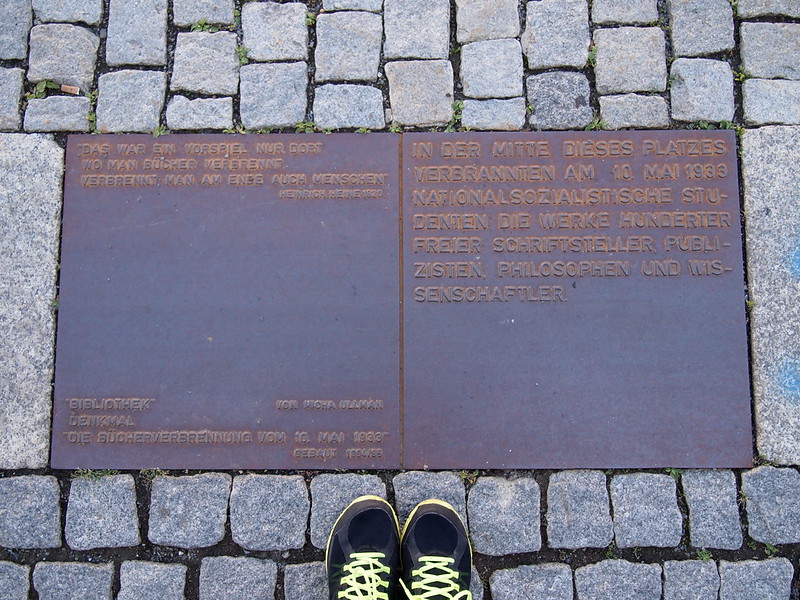
Das war ein Vorspiel nur dort
wo man Bücher verbrennt,
verbrennt man am Ende auch Menschen
- Heinrich Heine 1820
That was only a prelude, there
where they burn books,
they burn in the end people.
- Heinrich Heine 1820

Tuesday, 8 July 2014

On Censorship and the withdrawal of access to books which are not "pro-family": National Library Board needs to clarify their position on how they handle their collections!

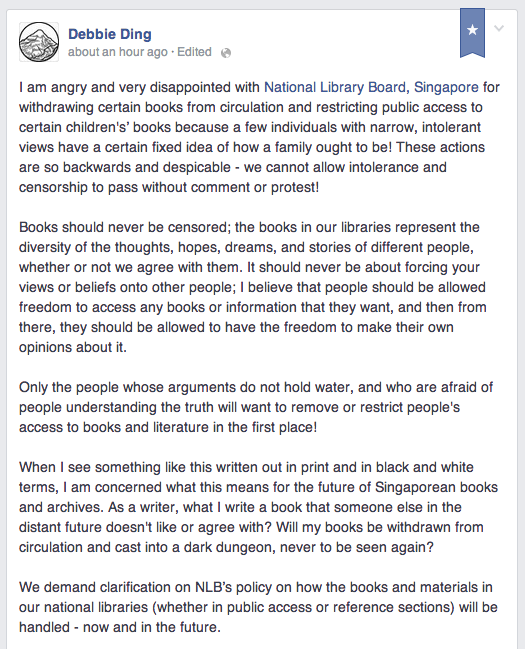
Screen Shot 2014-07-08 at 1.34.47 pm

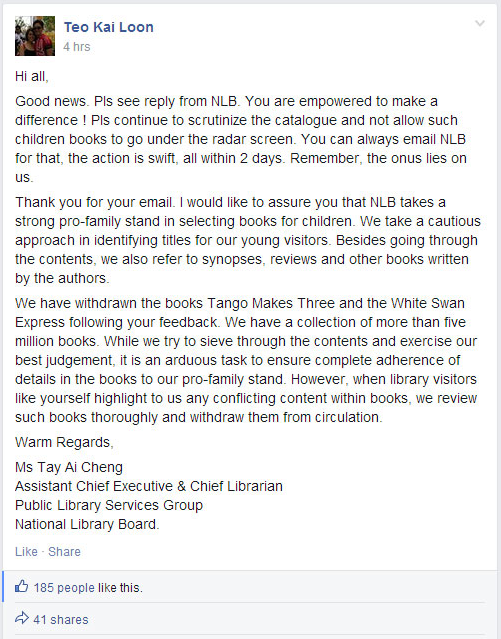
This morning a post from a "pro-family" (anti-lgbt) group “We are against Pinkdot in Singapore” by Facebook user "Teo Kai Loon" made the internet rounds. It contained the following letter from Ms Tay Ai Cheng, Assistant Chief Executive & Chief Librarian of the National Library Board in Singapore: (Original screenshot image here)

Thank you for your email. I would like to assure you that NLB takes a strong pro-family stand in selecting books for children. We take a cautious approach in identifying titles for our young visitors. Besides going through the contents, we also refer to synopses, reviews and other books written by the authors.

We have withdrawn the books Tango Makes Three and the White Swan Express following your feedback. We have a collection of more than five million books. While we try to sieve through the contents and exercise our best judgement, it is an arduous task to ensure complete adherence of details in the books to our pro-family stand. However, when library visitors like yourself highlight to us any conflicting content within books, we review such books thoroughly and withdraw them from circulation.

Warm Regards,
Ms Tay Ai Cheng
Assistant Chief Executive & Chief Librarian
Public Library Services Group
National Library Board

I was extremely disappointed to see this letter and the use of a "pro-family stand" to justify the censorship of books - a withdrawal which was only demanded for only by a few individuals with an agenda of intolerance! This is a slippery slope we are headed down and how can a nation's library policy of including or not including books be dictated by a few individuals with narrow views on what can be represented and what cannot? I wrote a response to the issue but my facebook post quickly vanished as the original post I had shared was taken down - the result is that now I am even more angry. I've rewritten it now and made a screenshot of it above just in case....

The books which were withdrawn were:

And Tango Makes Three is a children's book based on the true story of two male penguins who were observed to have formed a couple whilst they were in New York's Central Park Zoo. They were later given an egg to raise which another couple could not, and they hatched a baby penguin named Tango.

White Swan Express is a children's book about adoption, and how families can come in all forms of shapes, sizes and arrangements. It traces the journeys of four very different North American families who travel to China to adopt a child, but even though everyone is very different, they are all not so different because all the families are bound together by love.

I hate how the term "pro-family" is often used in Singapore. They aren't really "pro-family" if they do not agree that every human has the right to have a family irregardless of sexuality and gender. They are only "pro-heteronormative-family", and "pro-fixed-gender-stereotypes". In fact, "pro-family" has now become a thinly veiled way of saying that one's views are anti-LGBT without coming right out to say that you are actually homophobic / intolerant of LGBT people!

When public representative public bodies such as NLB say that they are "pro-family" what does this mean? Does it mean that the National Library of Singapore can officially refuse to allow the public access to certain books if they happen to include stories from the viewpoints of LGBT people? Really, Singapore? In this day and age? Isn't this tantamount to thought-policing? A National Library shouldn't be "pro-anything" - and if anything at all, its prerogative should be to be "pro-freedom-of-information!"

It is important that we demand a public clarification from NLB on their policy on how the books and materials in our national libraries (whether in public access or reference sections) will be handled - now and in the future.


See also:
NLB: Recommend titles to be added to the public collection: https://eservice.nlb.gov.sg/recommendatitle/recommendatitle.aspx
NLB public feedback form: http://www.nlb.gov.sg/Feedback.aspx
My Post on FB
Straits Times: NLB removes two children's titles after complaint that they are not "pro-family"
Mothership.sg: National Library Board apparently banned two children’s books as they are deemed not pro-family
Independent.sg: NLB removes two children’s books after complaint by anti-LGBT group
Yahoo News COMMENT: Kirsten Han - NLB should not define ‘family’ and censor books

Saturday, 5 July 2014

Arriving at ZK/U / Baugips Casting Experiments / Moabit and Behala Westhafen

A few days ago I got to ZK/U in Berlin (finally) where I’ll be doing a residency for the next two months. I’m also going to try to catch up on a lot of backlog on documentation and writing here.

On seeing a sink in my studio, I decided it was as good a reason as any to experiment with something horribly messy and wet, like plaster casting. So far I’ve only had one other experience trying to use plaster - earlier in the year I went to a two-day plaster casting workshop by Kevin Callagan at London Sculpture Workshop - it was great because it was more about making quick “sketches” in 3D through hand sculpted clay moulds and plaster casting - instead of drawing sketches, the idea was to produce quick 3d plaster sketches of visual ideas, which I really enjoyed doing - and which I want to do more of for “The Library of Pulau Saigon” project I’m working on.

One of my goals for the year is to improve on my model building skills - sadly I have never ever had to chance to do a proper wood/metal workshop/design & tech class, neither have I ever done a foundation art course, so I am generally very clueless (and completely lost) when it comes to what is the proper way to build something. I mean, I build things because I want to build things, but actually I don’t know what I’m doing really....

I found a bag of ‘baugips’ (building plaster) and ‘modellgips’ (modelling plaster) in the communal material shelf, and I happened to chance across some squishy ‘plaster mixing pots’ for 70 cents in a hardware shop along Turnstrasse, so...

20140705_011200

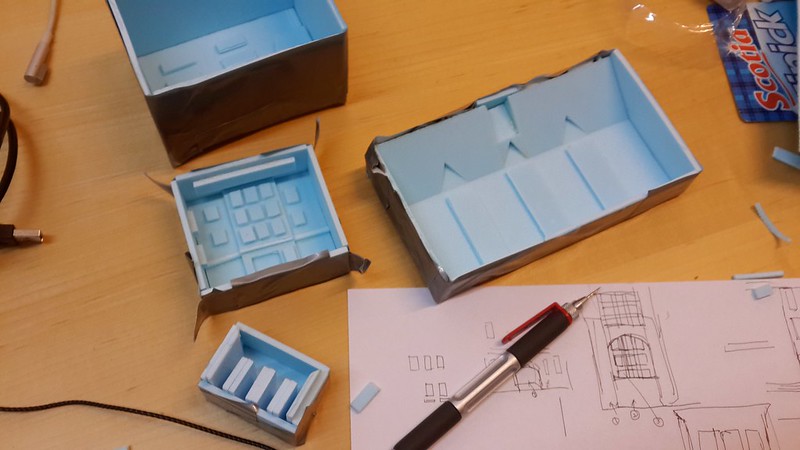
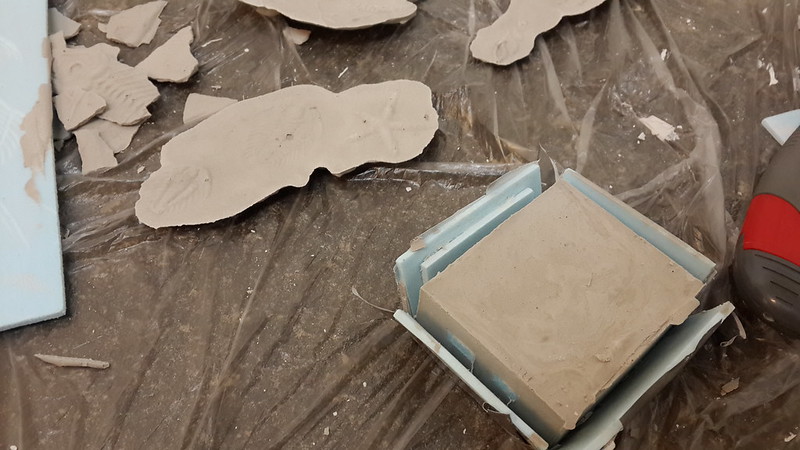
First, I made some moulds to cast the plaster in. I wanted to make some of buildings; the end result turned out to be gross renderings of what I imagine to be ‘berlinesque’ buildings and also the Behala Westhafen building which looms in the distance from my window. I found some blue foam in the communal pile - it is also so easy to work with and make into prototypes! Good thing is that blue foam is a perfect material for plaster casting, and for me it feels less wasteful than using clay, which can quickly become messily inpregnated with shards of plaster, rendering it unusable after a few uses.

20140705_164721_Siemensstraße

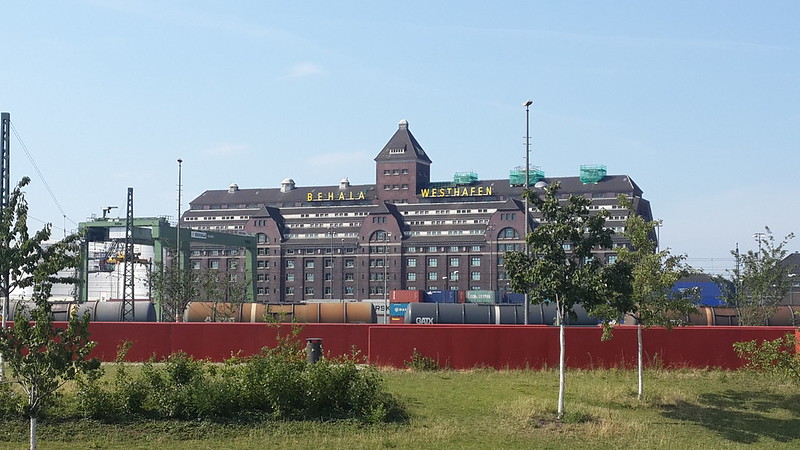
The actual view of Behala Westhafen from the terrace of ZK/U

I wanted to add a note on the Behala Westhafen - it is easy to forget that technically speaking Moabit is an island, bordered by the River Spree, the Westhafen Canal and the Berlin-Spandau Navigation Canal. Looming in front of my window view is the massive, red-bricked Behala Westhafen building, and the trains which come in ever so often, presumably hauling the cargo to be shipped to and from the Westhafen habour. Behala is the company that runs a harbour which ZK/U is right next to here in Moabit, built in 1914, forming Germany’s largest inland port. It is surprising to see the busy port in the middle of the land. You would imagine a sight like this should be at the coast or at the edge of the sea, but here the busy cranes and container port is right in the middle of Berlin!

20140705_011558

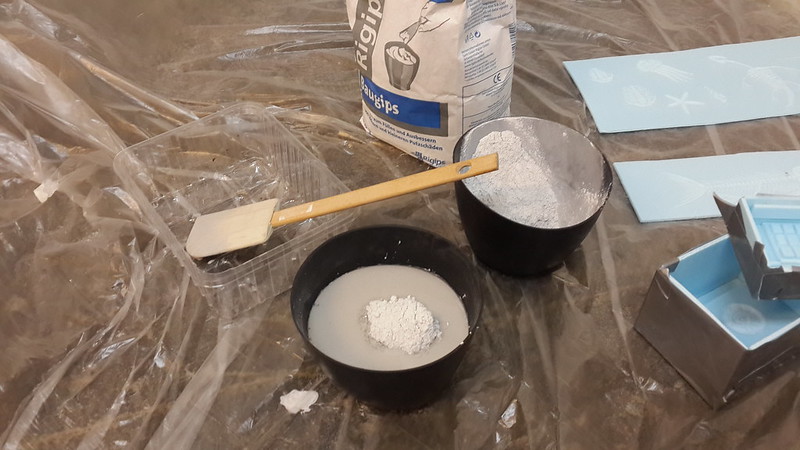
I had half of cup of water in the container and poured in the plaster slowly, allowing the plaster to ‘absorb’ the water. It will make a distinctive sound... if "the sound of water being absorbed" can actually be described as a sound? Well you’ll have to hear it to know it. When the plaster begins to stop sinking and starts forming islands that stick out on the surface of the water, you can start to mix it. I am a lazy person so I got a discount rubber spatula to mix it with instead of my hands. Of course if you are a purist you should use your hands to knead out all the lumps, but without introducing too many bubbles.

20140705_012942

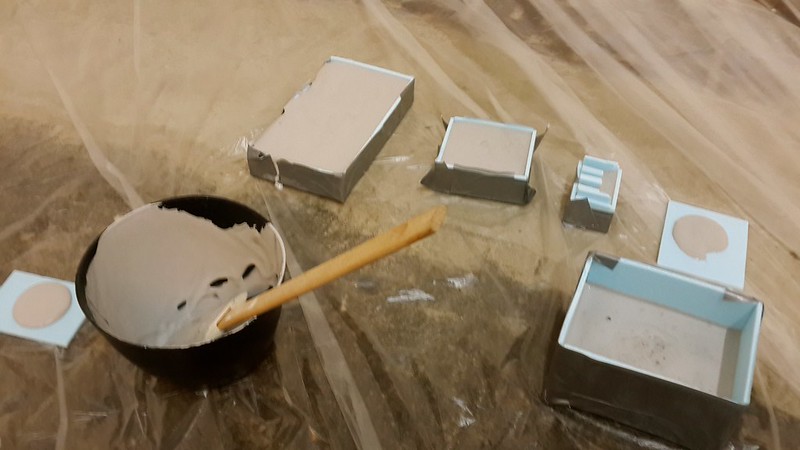
Poured into the casts and left overnight to dry.

20140705_091341_Siemensstraße(

Ready to peel away from the mould

20140705_091353_Siemensstraße

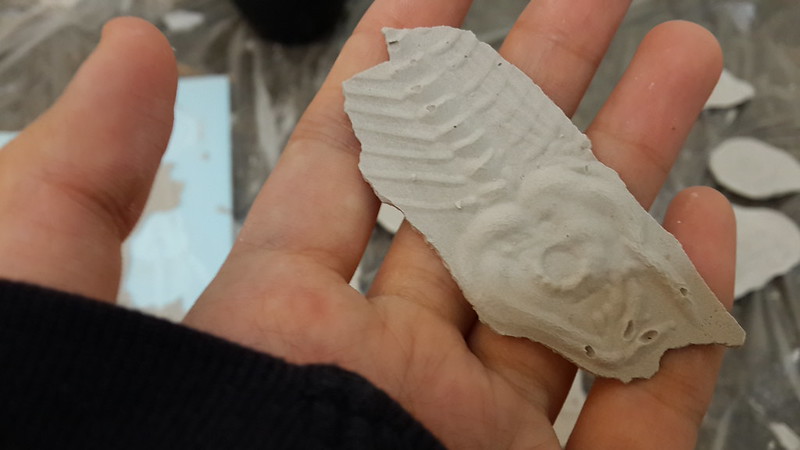
"Fish skeleton"

20140705_091406_Siemensstraße

"Trilobyte"

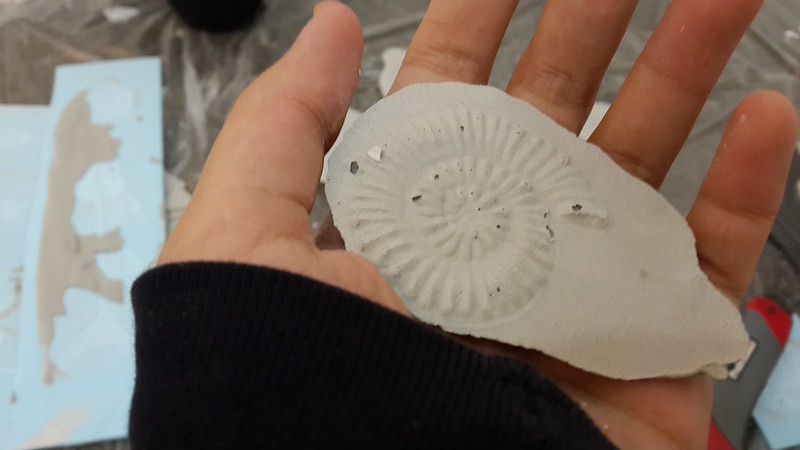
20140705_091359_Siemensstraße

"Ammonite"

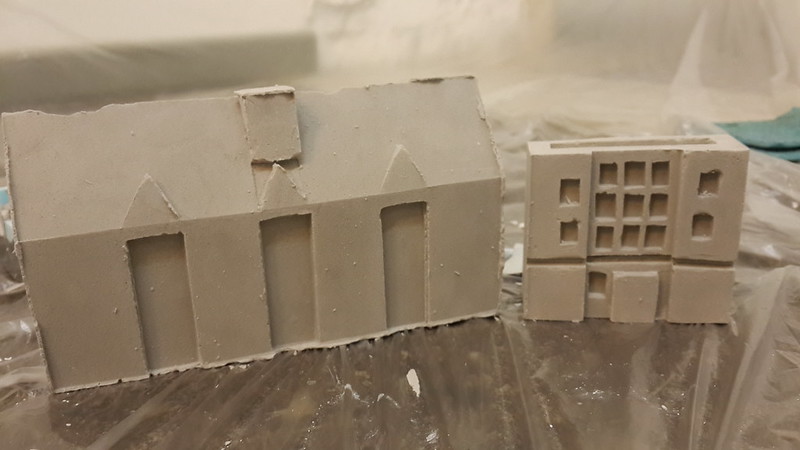
20140705_092332_Siemensstraße

Some manner of a building facade - at this point I’ve realised I’ve done it all inversely by mistake! LET THIS BE A LESSON - is the feature sticking out on the building? To make a mould you should only be cutting out shapes representing each of the recesses, NOT the protuberances on the building! The next time I make a mould of Behala Westhafen I will do the cutouts in reverse.

Sunday, 22 June 2014

Collecting Dust

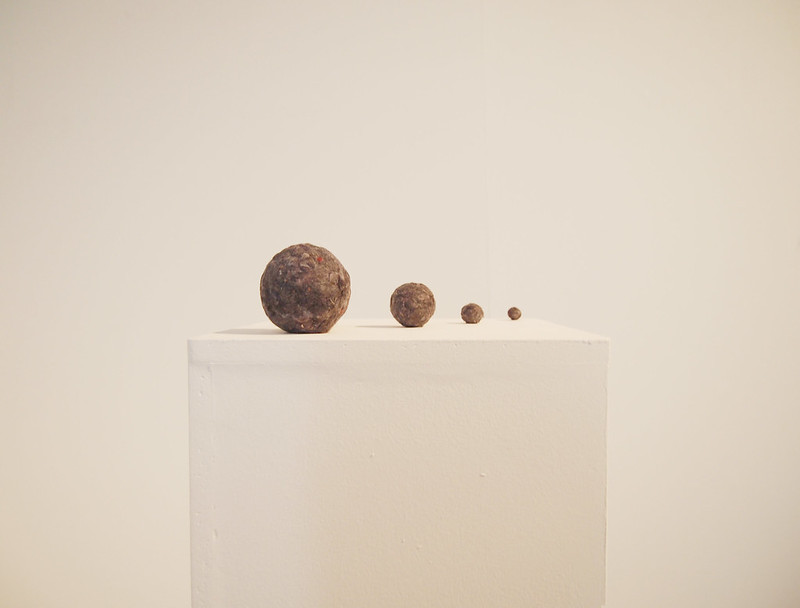
from-dust-to-dust-final-work

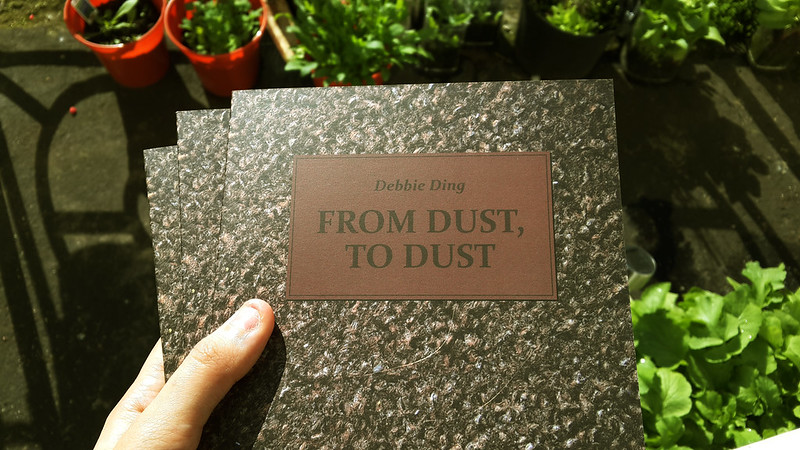
Debbie Ding, "From Dust, To Dust"
Exhibited at "Ghost on the Wire", Bermonsey Project, London, June 2014.
Curated by Gavin Maughfling & Suzanne de Emmony with support of the National Arts Council of Singapore

The above four balls of dust are the culmination of months of me and George collecting and trading dust. Firstly this couldn't have happened without George! <3 For the entire exercise began in earnest, while we were facing a yawning chasm of time and space between us (I never want us to be apart again for that long!) How surreal it is to be here, from a simple meeting and a funny conversation, to me sitting here in London on your carpet, rolling our dustballs together...


One reason why I haven't been posting on this blog recently is because I've also been working on all this writing that was to go into the book for THIS show! And that was in addition to the unreal amount of work I've had at school - helping the graduating year build their show - which by the way is unbelievably awesome! Please take a look at the works from this year's Design Interactions. I've been helping to compile everyone's work for the online DI14 documentation, and building.... ants? (More on my desultory diversions into fly tying in another post..)

20140610_082742_W Bank

To be honest, writing is a curious sport. It is nearly impossible to estimate how much time one needs to write, unlike most other tasks which can be planned for. You can only hope to produce the conditions that will allow the words to flow. Sometimes there will be inspiration and sometimes there is just none. I had a few reams of half-baked texts, but I threw out most of my drafts at the eleventh or almost the twelfth hour, and decided to rewrite most of the text in the very last weekend before I sent this off to print. I think the text turned out much better that way.

P6012764

A week before this I had attended a curious workshop at Auto Italia by Ingo Niermann, who edits the Solutions series and whose writing on Drills I had first encountered at Documenta. We had an interesting meandering dialogue, and I decided to try to write/rewrite some of the ideas I had into the form of a Drill. With a Drill, one becomes free to coerce oneself into something else, repeating an action over and over again until it becomes almost an instinct to behave as such. For a drill to work there is the necessity of repetition - and for me my feeling of a drill is that any kind of repetition also comes with resignation (assuming one is wholehearted in the execution of the drill) or, it could also come with some modicum of anxiety and futility (if one is unable to surrender oneself entirely to become the material).

I am reminded of one of my favourite films from some years ago - Brothers Quay's Institute Benjamenta, where a man who says that he has lost all hope of becoming a useful member of society applies to attend the Institute to learn how to become a total servant. In their classes, they repeat drills and certain motions endlessly, to some unknown end, which the man finds more and more oppressive over time. Even though he has given up hope on becoming an individual in his own right, he remains unwilling to follow the drills and become the material entirely because the meaning within the repetition is hidden to him. This is what we slowly realise is the nature of becoming a servant at the Institute Benjamenta. A motion repeated on cue, producing meaning and effects not seen. There is a kind of poetry within total subservience; I do think that for an artist the ultimate is to become one with the material/work, but inherently its attraction for me is not being unquestioningly willing to give up the control, but the interesting thing for me is that dissonance one feels in trying to get closer to the meaning through a systematic repetition of seemingly pointless actions.

Here follows an excerpt from the book...
(If you like it, you can also order a copy online here.)


How to Become Homeless


From the book "From Dust, To Dust" by Debbie Ding


Begin the motions of moving to another country for a short while.

Get a very large box.

Collect all of your most important and personal items and place them in a very large box in a long-term storage facility - with the absolute belief that you will be returning for them very shortly. Throw away all other items which you deem as unimportant.

Create an inventory list of each item that you have put into the box to help you remember what is inside this box. Write out long, lovingly detailed descriptions of each item you place inside.

Allow yourself only a very short time to complete this task. In the midst of your rushed packing, convieniently misplace this inventory list by also putting it in the box, and then seal the box and place it into storage.

Quickly move to another country and allow yourself to settle into this new life over time. Slowly get more and more caught up in your other life there until you end up staying there for an additional 3 years.

Allow yourself to completely forget what you left in the box in the previous country over time.

Begin to feel a sense of mystery and curiosity about the contents of the box that was left behind. The contents of this box will gain significance, just as how forgotten scribblings in small notebooks which you have lost forever will seem like they must have been significant, genius thoughts that you desperately must recapture. Tell friends about the box you left behind, and how you have to go back for it someday. Try to imagine what you might have left in the box.

Come back after 3 years to investigate the contents of this box.

Discover that the box is mostly full of heavy, inconsequential things which have lost their emotional importance, or things can be replaced, or have already been replaced since.

Give away the contents of the box to anyone who will take them.

Begin the motions of moving to another country for a short while.


For more information visit http://dreamsyntax.org/dust

Sculptures in Reverse, No. 2 (Autonomous sensory meridian response / Taste-Shape Synesthesia)

sculpturesinreverse copy


Sculpture in Reverse, No. 2 (To be listened with headphones)

“Sculptures in Reverse” is a series of binaural foley sounds designed around the idea of producing sounds which mimic the sounds that can be heard within the interior spaces of one’s head - such as the sound of cleaning one’s ears with cotton, scratching one’s scalp, or the sound when one’s hair brushes against one’s headphones. This piece must be listened to with headphones.

The neologism “ASMR” (Autonomous sensory meridian response) is popularly used to describe panning/binaural sounds which may trigger tingling, pleasurable, or relaxing sensations in the head, scalp, back, or peripheral regions of the body in response to auditory stimuli. Even the sound of someone noisily unwrapping some paper or plastic behind me (without me being directly aware or focusing on the sound) can give me an unexpected "premonitory" tingle, although I cannot explain how or why it happens in any definite terms. It is almost as if I am like a glass vessel that happens to resonate or vibrate along with other tones/vibrations.

Recently I found out that I might have some form of synesthesia - an unconscious wiring of different senses together. I have always tasted foods as "shapes", and had always assumed this was true for most people. Somehow, I suspect that many people throughout my life seem to have humoured me and my comments about the “shape” of foods as simply being part of my being "overly-imaginative" or "creative", without realising that the "shapes" of tastes are actually real to me.

It is quite bizarre if you ask me: how is it that people do not taste salty flavours as roundish, or sweet flavours as possessing of angular features? Isn't it as obvious as looking at a physical object and being able to tell its visual shape and colour immediately? I have always assumed that it would be as obvious as being able to discern colours. When people say "This taste is not rounded enough!" - obviously to be said when you want to tell someone that the taste is currently too angular! I thought that when I posted about it online that others would chime in and agree that it was patently obvious that a salty flavour would usually be rounded, but up to this point no one else that I've met has had the same perception of it! I began to question if I had made it all up. Could this all be another one of my confabulations? But... how do you explain why the perception of these "shapes" seem real to me? Is it less real just because I don't have the words to describe it yet?

I am also equally surprised when people tell me that they have experienced no interesting sensations from listening to "crispy" sounds. I wonder if my ability to appreciate “ASMR” is somehow related to my ability to taste shapes. For me, it is a matter of "red" being red, and "blue" being blue, "salty" being generally roundish, "sweet" being decidedly angular, and "bitter" like a horizontally layered slate-like shape which disintegrates around the edges (UGH!). A person whispering SKSKSK which gives me a tickle behind my right ear and anticipation of pain or touch gives a strange "leap" behind the knees. How do we describe these connections and sensations which span across more than one of the senses - connections which are indistinct and for which we have no common understanding of words to describe them? What is the connection between the consciousness and the senses?

The series “Sculpture in Reverse No. 2” is an attempt to simulate physical sensation through audio alone.

Longer half hour mix (To be listened with headphones):

Thursday, 22 May 2014

The Launch of the NewBiologist

20140521_112327_W Bank

20140520_181845

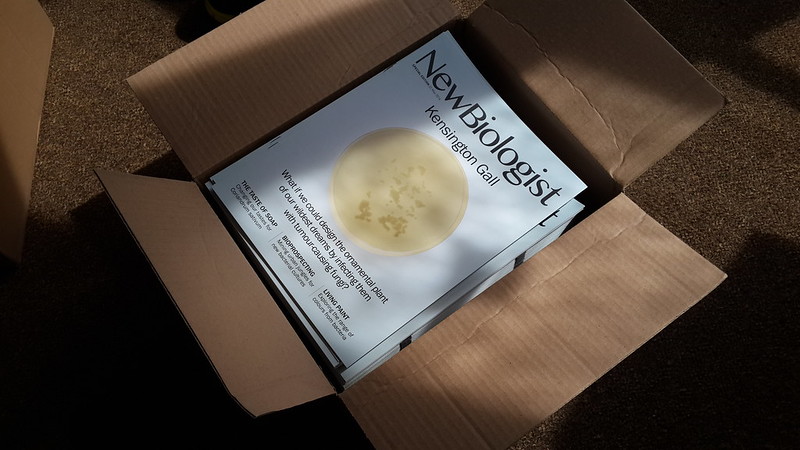
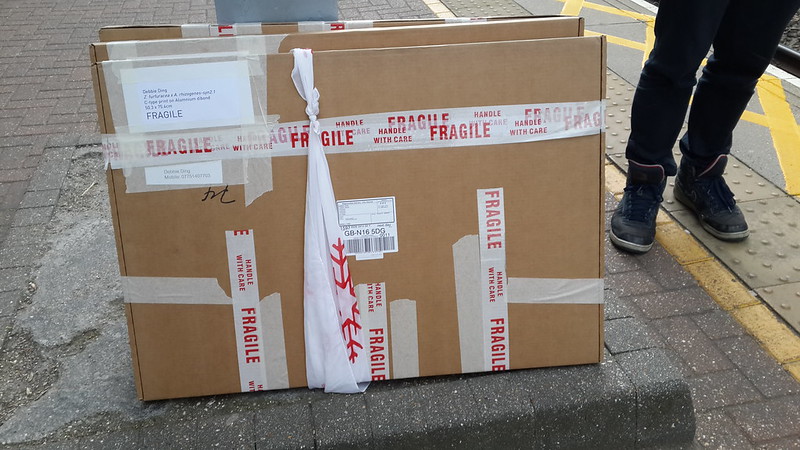
Early this year I began working on a project about the future of plant galls (plant tumours) - and I've written, edited and produced a magazine called "NewBiologist" which will be launched and shown tomorrow along with some prints from my series "Kensington Gall" - in a group show "Second Nature" at Espacio Gallery, which is at 159 Bethnal Green Road. The private view is at 6pm tomorrow. Come down if you are in London!

"Kensington Gall" is a story inspired by popular science journalism in NewScientist and creative non-fiction in the New Yorker, both of which I have been accidentally reading a lot of (because there are always new copies of it in the house thanks to George). I wrote a few other short articles, and spun these stories into a magazine I like to call the "NewBiologist". I've written all of the words and made all of the images in it, and I'd love to hear people's comments about the story. When I have more time to format it, I will release a digital copy as well, but in the meantime if you'd like to support it, please buy a copy of the magazine!

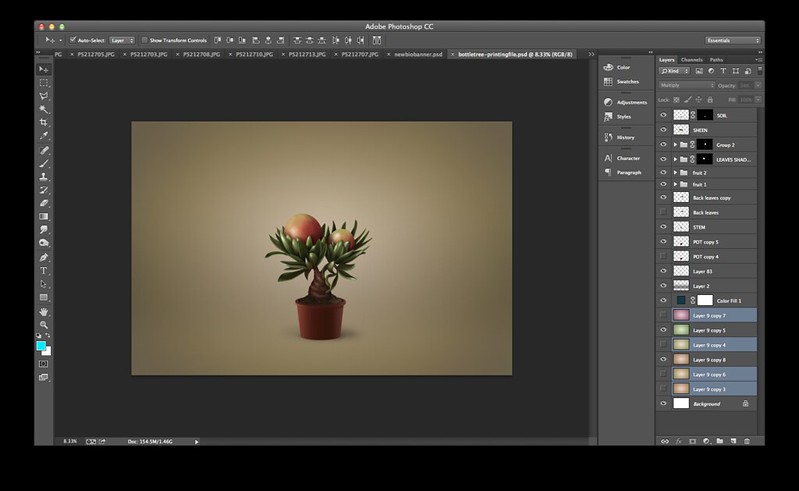
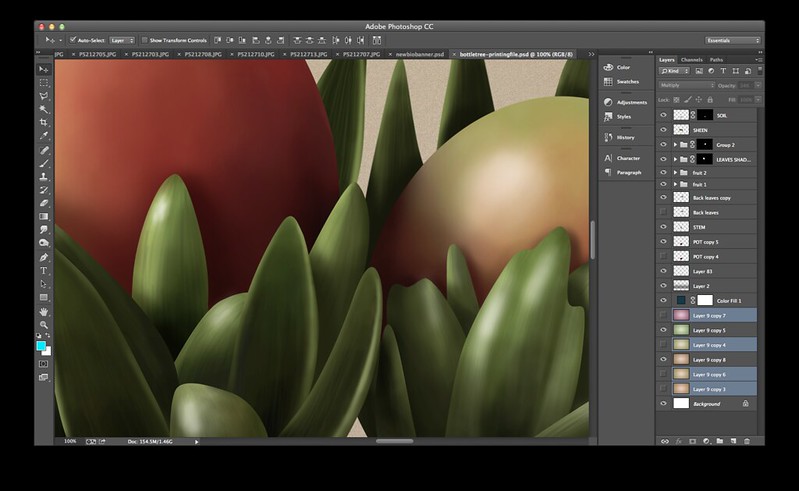
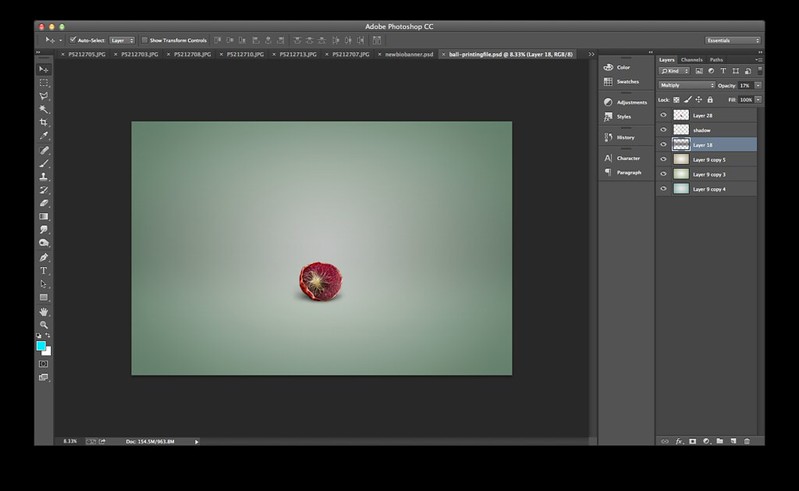
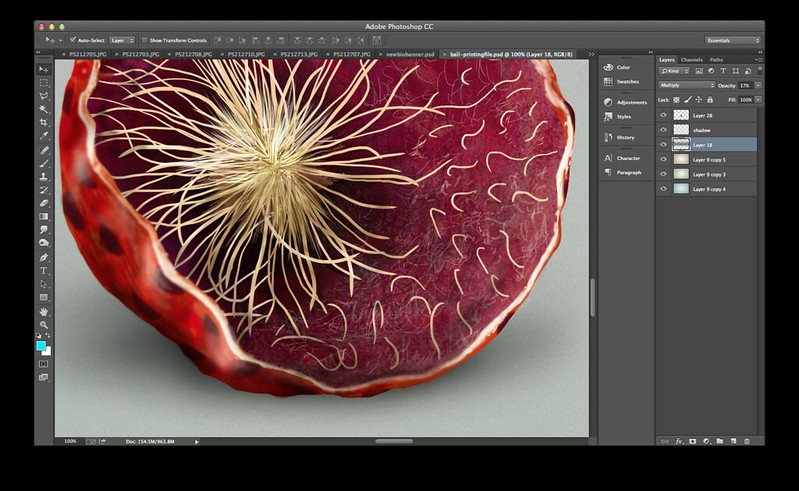
My main goal in the production of these images has been to produce something which has the unreal sheen of something computer-generated, have a high degree of photorealism, but be obviously handdrawn when observed close up. The entire image was digitally painted in Photoshop and is not a photograph.

Screen Shot 2014-05-22 at 1.13.54 AM.png

Screen Shot 2014-05-22 at 1.14.03 AM.png

Screen Shot 2014-05-22 at 1.14.53 AM.png

Screen Shot 2014-05-22 at 1.15.27 AM.png

banner

Plant pathogens such as the fungi Ustilago Maydis infect plants such as corn, by secreting enzymes which stimulate abnormal plant growth. The resultant “corn smut” tumours are considered an undesirable blight in the US, but in Mexico it is a coveted gourmet delicacy that is even sometimes intentionally cultivated, turning pathogen to cultigen.

What if plant tumours were to be intentionally bred and designed for ornamental purposes? In an exploration of long-form creative non-fiction style in popular science journalism today, Debbie Ding investigates these alternative plant futures.

Through the NewBiologist, Artist Debbie Ding interrogates the odd, secretive world of leisure gardeners who use synthetic biology to genetically engineer plant pathogens, which cause different plants to develop visually interesting tumours
- also known as ‘galls’

You can get a copy for £4 at Espacio Gallery or from me directly, or order it via the online cart at http://dbbd.bigcartel.com (£4 + Postage and Packing)


Espacio Gallery
Second Nature
May 22nd - June 3rd 2014


159 Bethnal Green Road
London E2 7DG
Preview Thursday May 22nd 6 - 9pm
Open daily 1-7pm including Weekends
Exhibition closes 5pm Tuesday June 3rd

Espacio Gallery and the Chelsea Fringe are pleased to present Second Nature, an exhibition that showcases exciting ideas from a group of national and international artists. Comprising works in a variety of media, the show provides a fresh look into some of the aspects related to the natural world.

ARTISTS
Tania Beaumont
Jennfier Bennett
Kanwal Dhaliwal
Debbie Ding
Ahmed Faroqui
Leigh Glover
Laura Gompertz
Ewa Goral
Sally Grumbridge
Russell Hall
Kate Nagle
Nicki Rolls
Clare Skill
Kirsty Stutter
Sandie Sutton
Maria Vesterinen
Jessica Ward

Facebook Event: https://www.facebook.com/events/1472083986361590/

Sunday, 18 May 2014

RCA's Department of Environmental Media, 1974-1986


Patrick Keiller - Robinson in Space

Recently I stumbled across a book version of Patrick Keiller's Robinson in Space at the RCA Library, seemingly by coincidence, but later found out that it was probably at RCA Library because Keiller was previously a student at the Department of Environmental Media, which only existed from 1974-1986. From what little I can find out about it online, it was founded by Peter Kardia who seems to have been quite a visionary educator. Prior to setting up the Department of Environmental Media at RCA, he was known for his "locked room" experiments at Saint Martins College.

From Shadowboxing: "The Environmental Media department, which existed from 1971 to 1986, was set up for ‘students requiring extended or mixed media facilities and for those whose work includes proposals for redefinition of conventional fine art boundaries’ (Annual Prospectus 1976-77). An experiment in interdisciplinary practice, the course was not well aligned with other College departments, which were defined by more traditional subject areas, such as painting and sculpture. ‘[Environmental Media] students [were] expected to create for themselves the conditions, which [would] enable them to work self-sufficiently for limited periods, isolated from criticism’ (Annual Prospectus 1974-75). Students were able to work conceptually, and with emerging media such as video, as well as embracing the more conventional means of production, seemingly free to create their own terms."

It seemed interesting to find out the origin of the Department; and where better than to have traced it to a book with a section by Peter Kardia himself. In "From Floor to Sky: The Experience of the Art School Studio" (Hester Westley, Malcolm Le Grice), in a section "Art and Art Teaching" by Peter Kardia, he writes it began with the Stained Glass Department, which initially worked within the administrative framework of School of Interior Design, but it had begun to admit students with fine-art backgrounds, students who were interested with environment and the effects on an particular environment of illumination coming in from stained-glass windows, and different types of media and technology was also introduced. So "in 1970 a Department of Light Transmission and Projection was formed, including what had hitherto been the Stained Glass Department but also a new section named Environmental Media, for which elementary equipment that was listed as being obtained included tape recorder, video camera, stills camera, and sound synthesizer." The next year Stained Glass and Acrylics moved back to School of Ceramics, and Environmental Media moved to Sculpture.

Sadly I also read in this account that it was the appointment of a new rector Jocelyn Stevens. "It was not long after [Stevens'] appointment that he proposed the closure of the Department of Design Research and the Department of Environmental Media. When this became widely known, there were many objections and the matter was even raised by the MP Tam Dalyell in Parliament. The rector however, would not go back on his decision, and the Department was finally closed in 1986."

It is fascinating to consider that alterations to, and the closure of a university department should even warrant a discussion in Parliament; education after all should be a priority. Why did Stevens want to close Design Research and Environmental Media? Was it really just because they were too politicised? How, and why? And what was it allowed to happen, even without knowing the details I question why someone should reject a way of learning and teaching or close a new and possible mode of inquiry? I should like to research and understand why this was so.

In the context of the current situation at RCA, I think we should not be complacent to think that even our department is immune to change - and immune to suddenly not existing. Seeing the situation with the large increases in intakes for the other design programmes which have caused such pressures on space and facilities for students and staff, and the introduction of seemingly commercially oriented courses which seems to be pandering to commercial interests - I worry sometimes that the direction may have been lost - I'd assume that the goal of a school like Royal College of Art would be to produce leaders who will make challenging work or experimental work. And I had specifically decided to come to RCA to study at Design Interactions precisely because I didn't want to study in a place where ideas would be dictated by money and politics... (ie. I didn't want to study in Singapore...)

As Cheo Chai Hiang puts rather eloquently in a recent article:

"Having lived and worked overseas for more than 30 years, I take it almost as a given that an artist requires freedom in order to engage in radical research and experimentation, especially when finding new ways of challenging established modes of visual arts practice. Since returning to Singapore in 2003, I have seen the cultural, social and political pressures that are exerted by the government to ensure that individuals conform to conservative and safe norms. Hence the artist is required to exercise extreme caution, which eventually stifles the will to think critically and creatively (...) Perhaps, in addition to Dr. Ellis’s question “Will the gifted blossom?” we should also be asking two further questions: Are current educational approaches really designed to nurture those destined to be our future arts practitioners? If so, how can we encourage these individuals to blossom in Singapore rather than elsewhere?..."

The Tableaux Vivants of Manchester Museum

P5142422

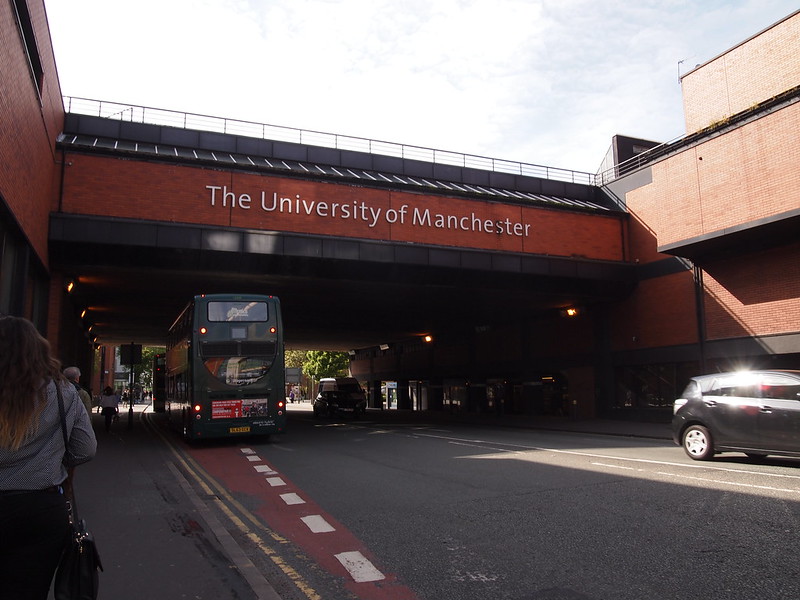
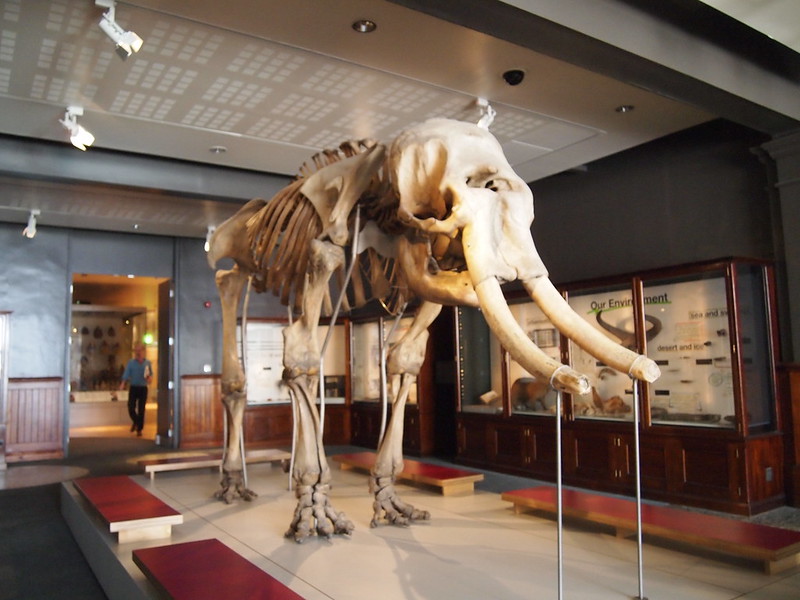
On a recent day trip to Manchester, I visited the Manchester Museum, the museum of the University of Manchester. It happened to be directly opposite the building I was in - right opposite Kilburn Building (blocky, red-bricked Computer Science building) and University Place (building which looks like a big tin can). I was unexpectedly ejected from a campus eatery at 2.30pm, and by this point I required a little break from the non-stop RUINS THEORISING going on, and how fortuitious to have a museum right there...

The ground floor has a temporary gallery space which currently has an exhibition called "From the War of Nature", which uses tableaux vivants to tell various stories of different animal communities fighting for survival in nature. This temporary show has no scientific labels and the stories were painted in broad and rather general strokes, which seemed odd to me even if the taxidermy was beautiful. I actually almost stopped at this point, but fortunately I decided I might as well continue on to the second floor...

P5142451

P5142454

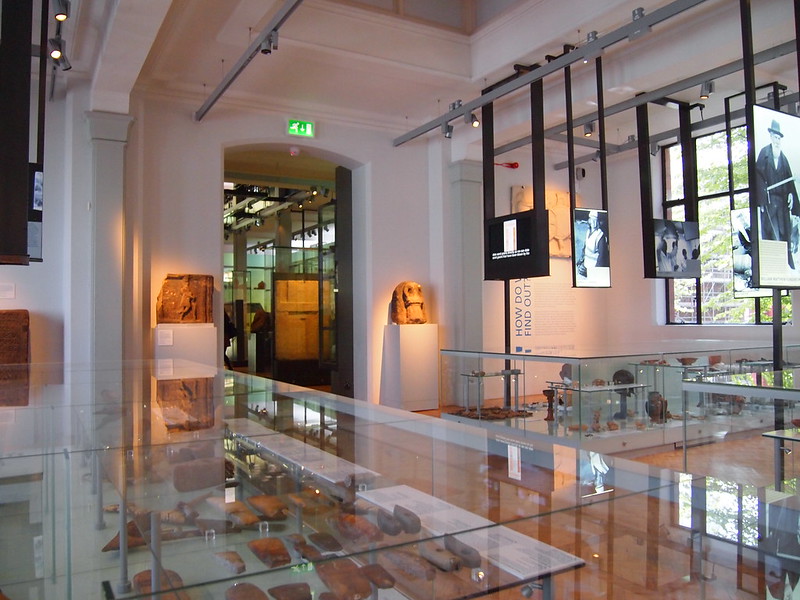
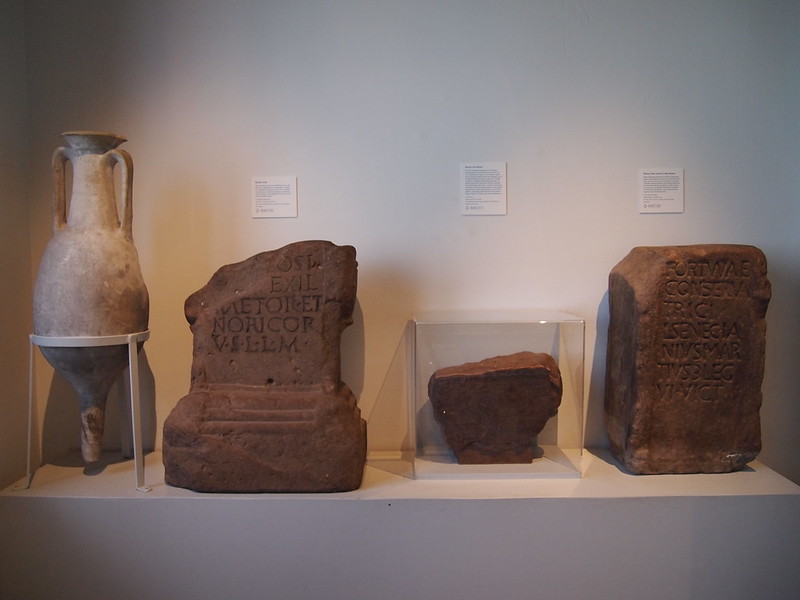
Things looked a lot more exciting upstairs, which began with some local archaeology of Manchester, including a collection of roman artefacts...

P5142455

P5142458

P5142469

P5142474

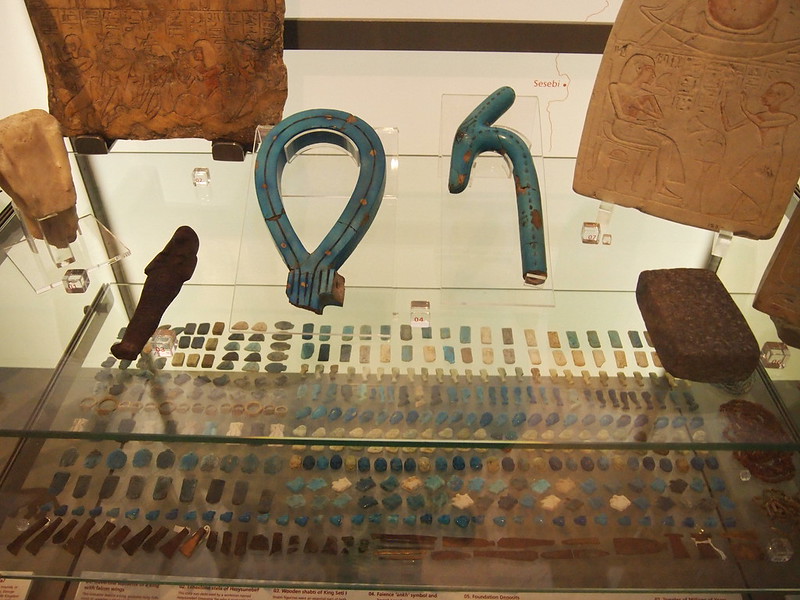
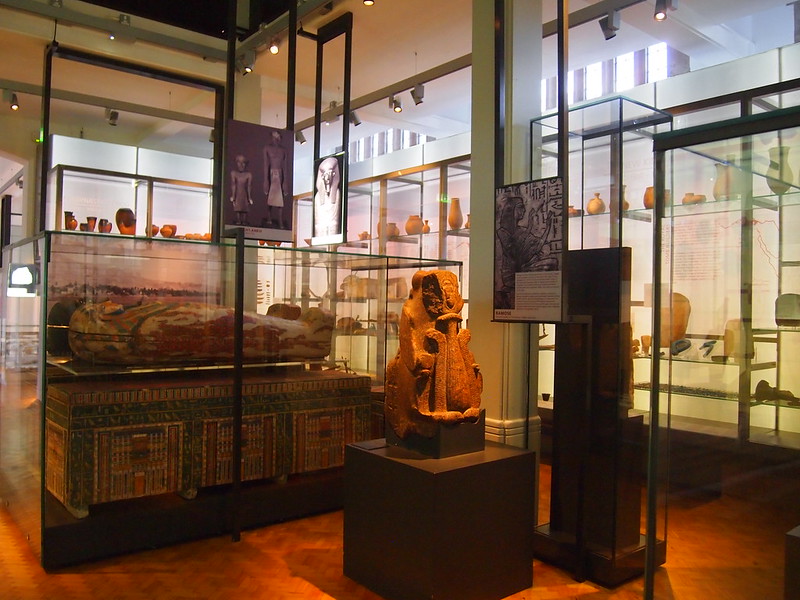
It was followed by what appears to be a rather comprehensive Ancient Egyptian collection, one of the most comprehensive in the UK - with apparently around 16000 objects in their Egyptology collection, including objects from prehistoric Egypt (c. 10,000 BC) to the Byzantine era (up to around AD 600).

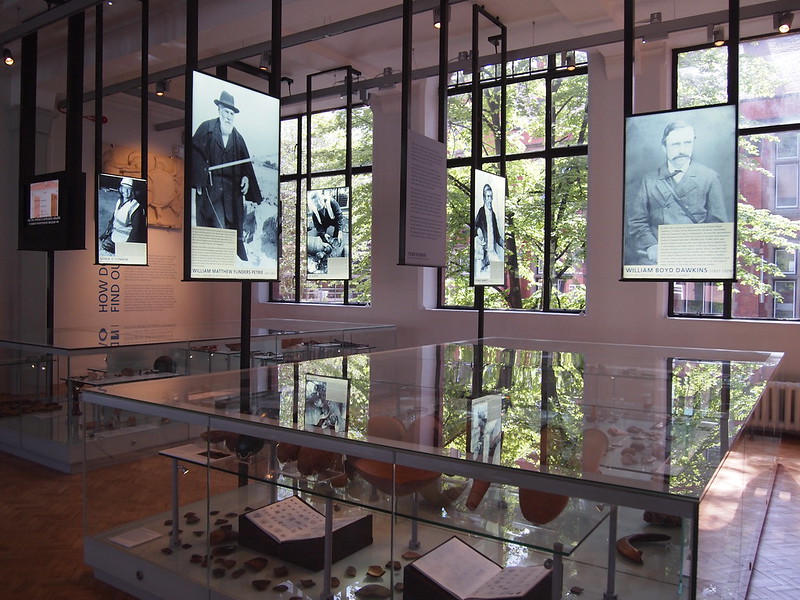
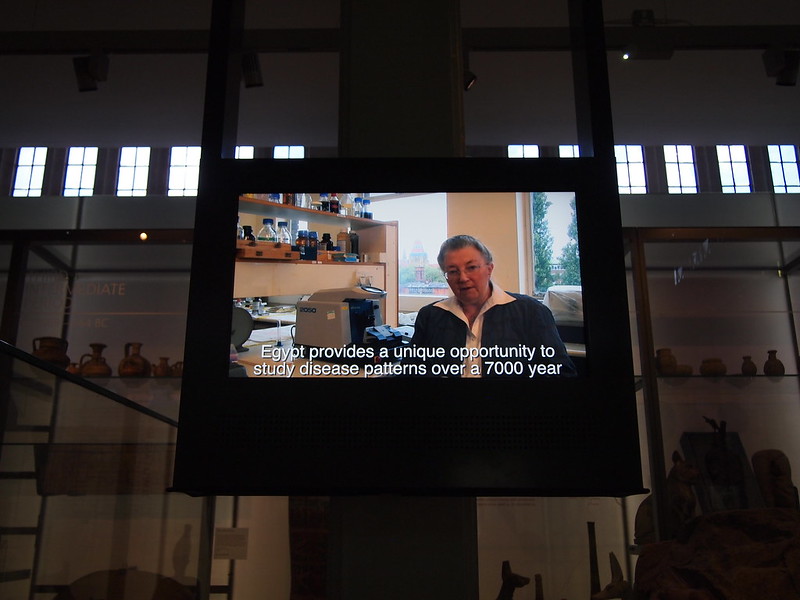
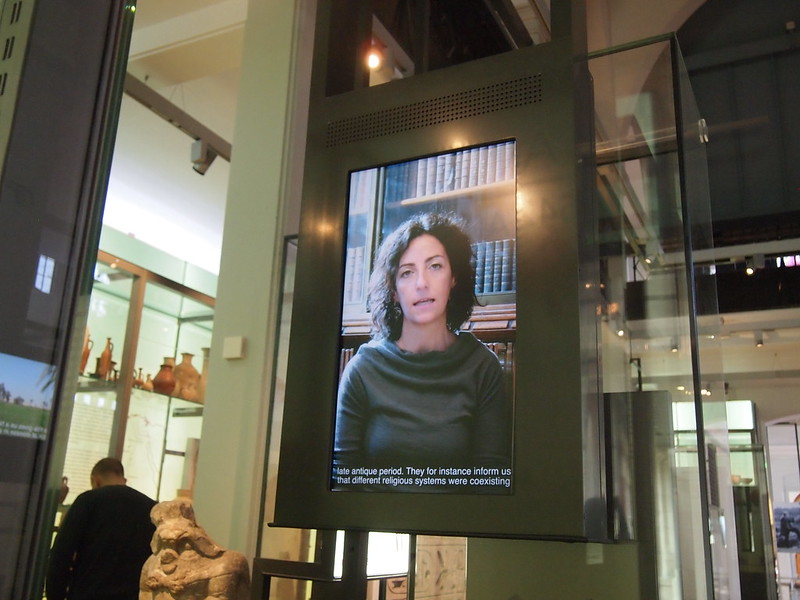
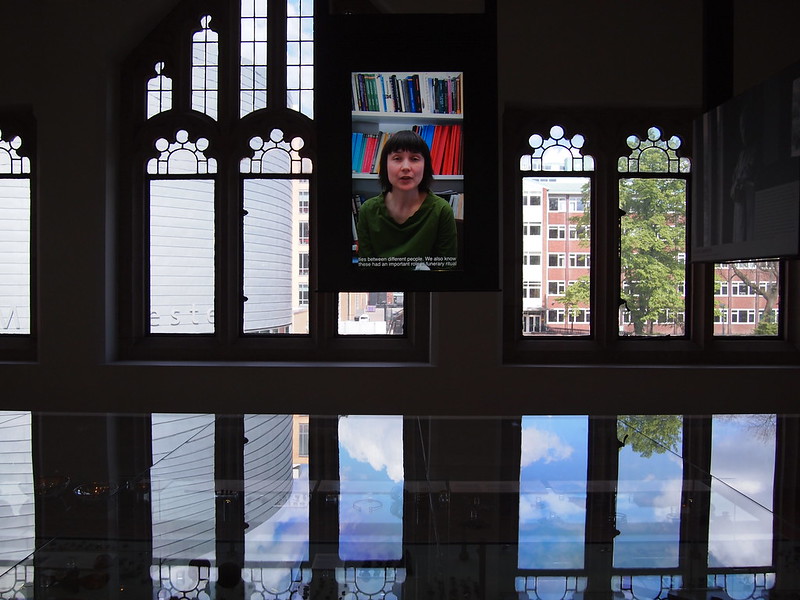
I suppose one thing that endeared me to this museum was the presence of these screens everywhere, which featured actual interviews with people working with the artefacts, and some screens featuring young visitors' reflections on the artefacts, drawing a connection between the artefacts and our daily life. This made the temporary exhibition downstairs make more sense - since I understood that the museum was designed to be as accessible as possible and more of an educational experience, a kind of space which wouldn't really portray Natural History and Science as something technical and complex, but instead as something to inspire the imagination.

P5142475

P5142476

P5142456

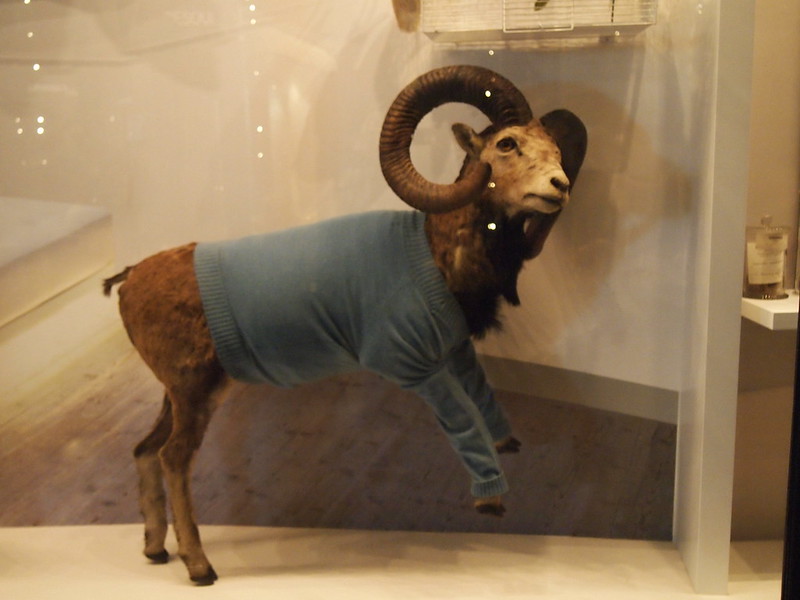
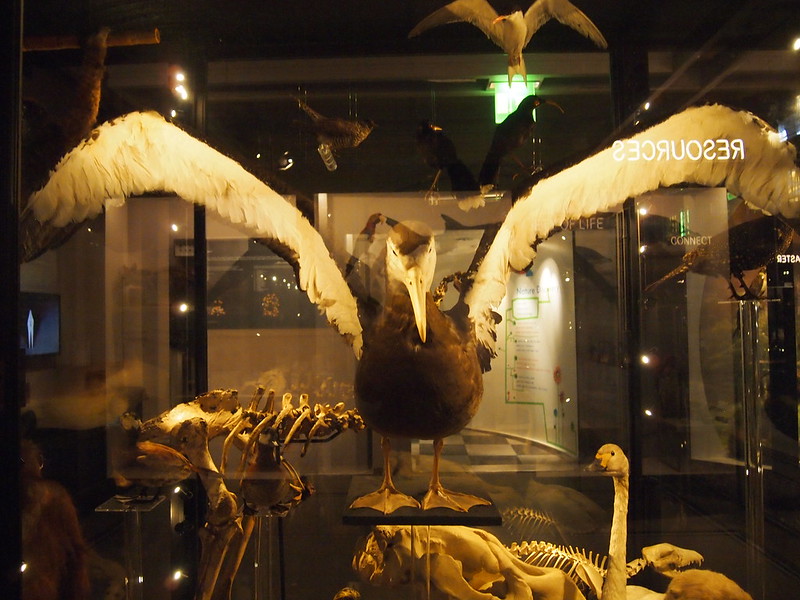
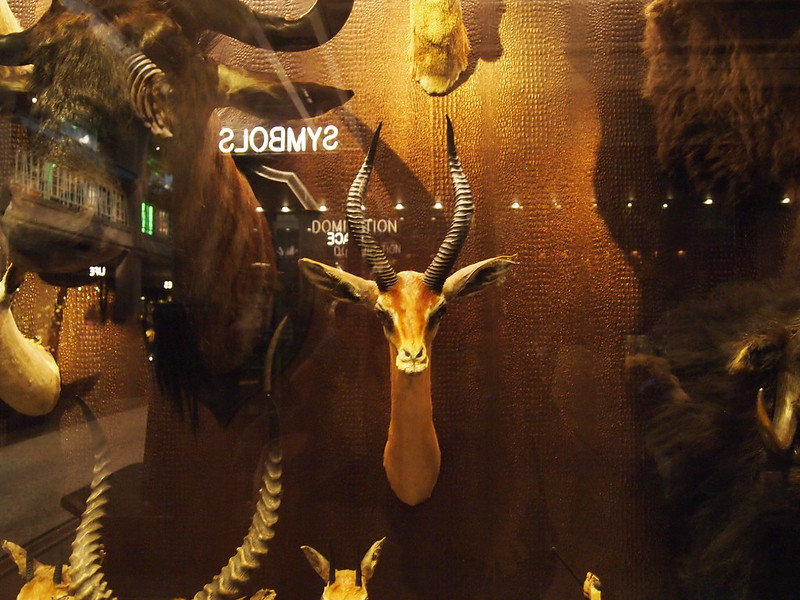
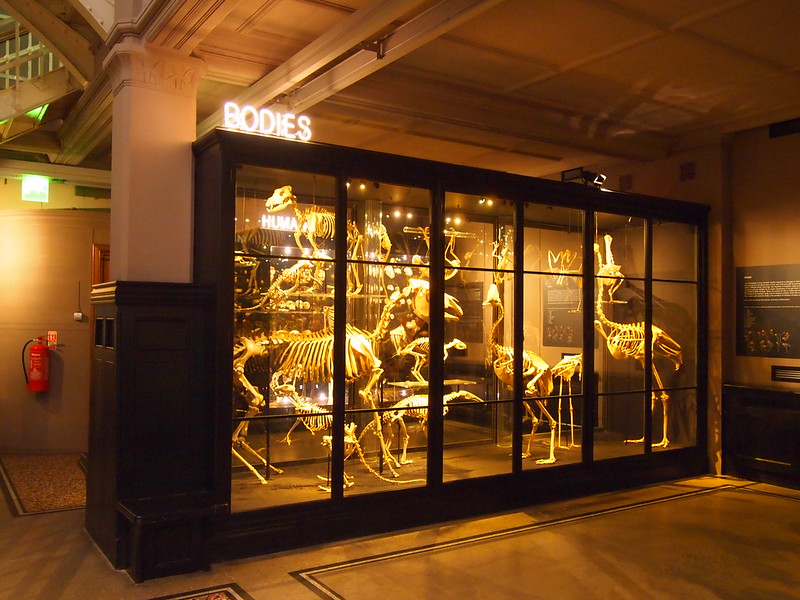
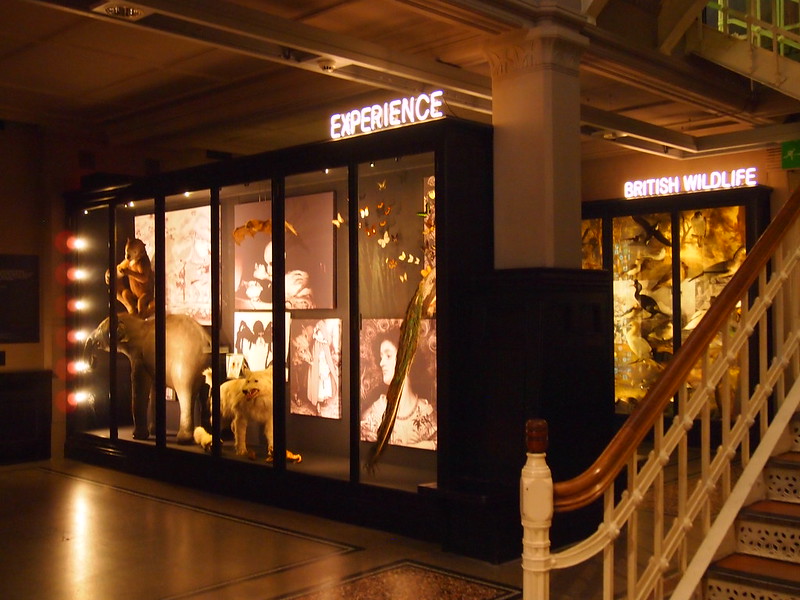
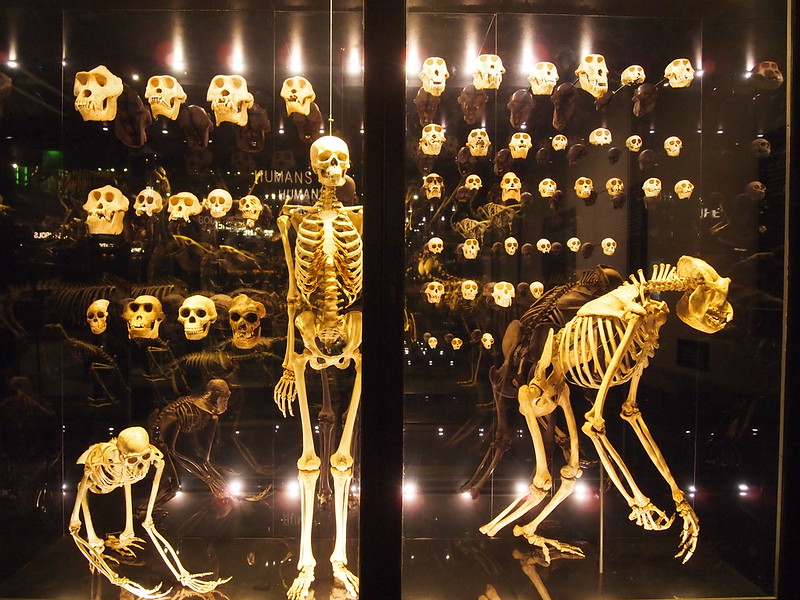
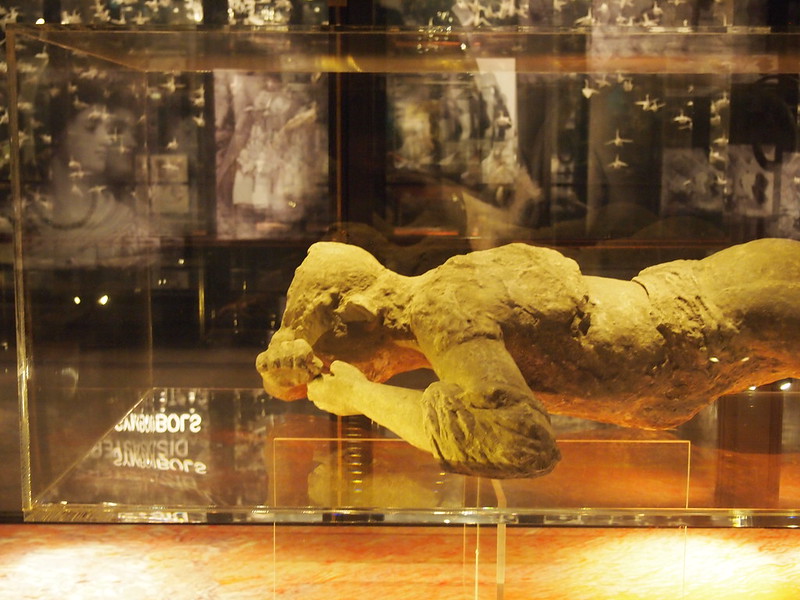
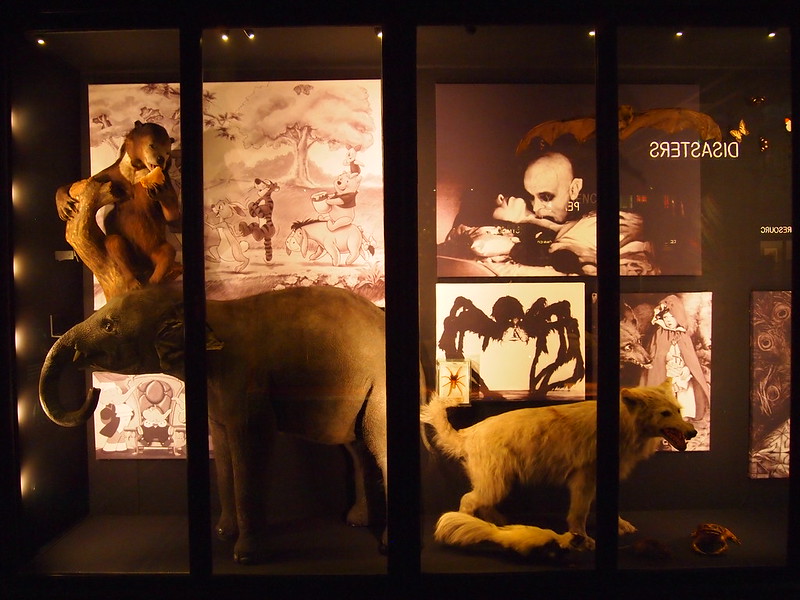
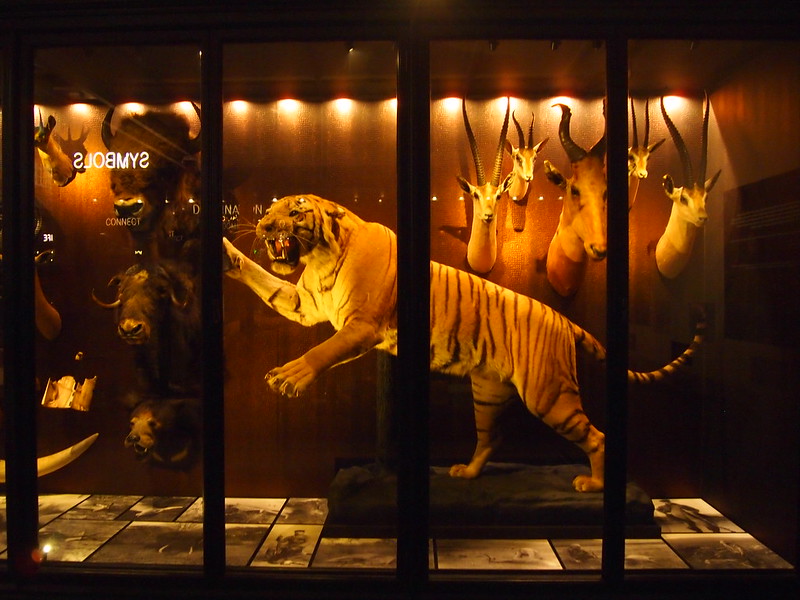
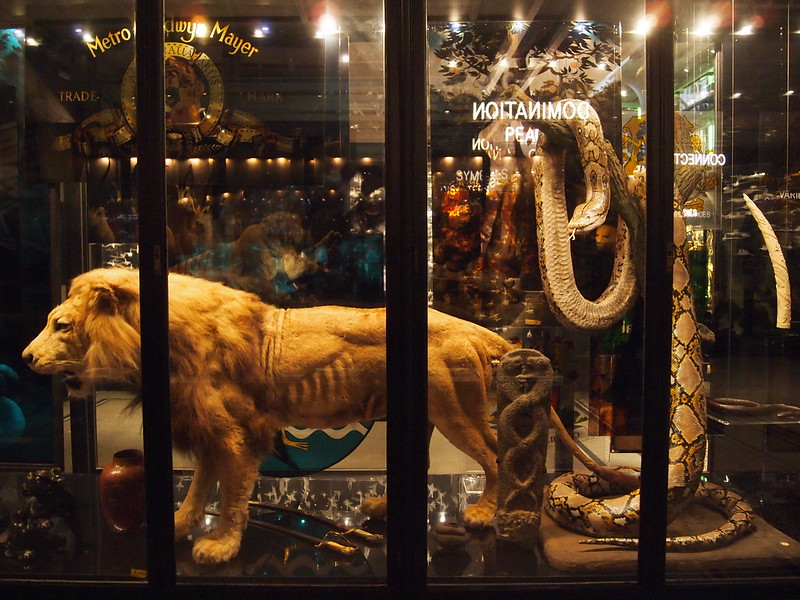
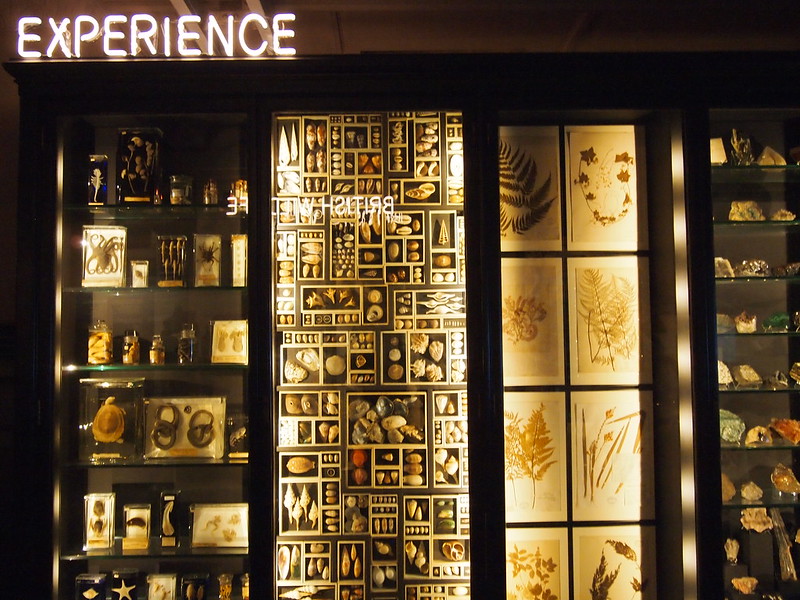
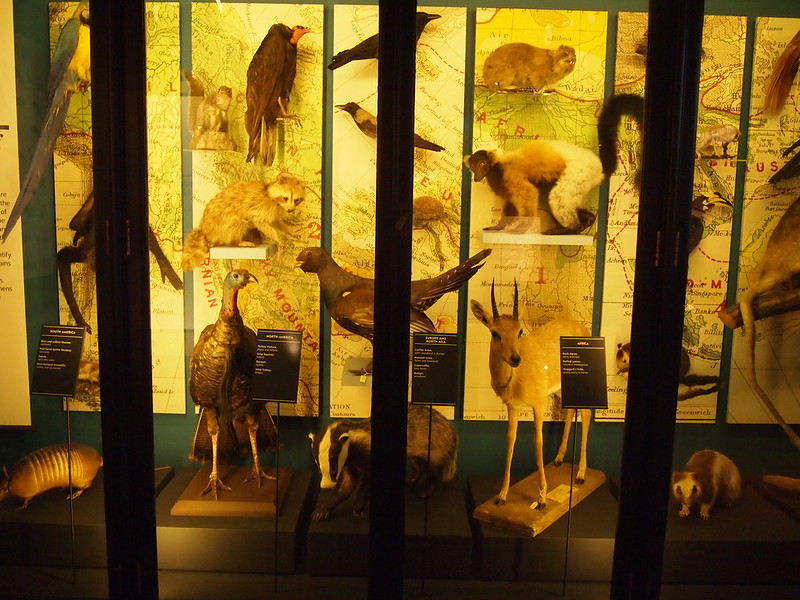
Next up was the most curious hall ever - more tableaux vivants which seemed almost like art installations, based on very broad issues and themes such as EXPERIENCE.... PEACE.... etc.

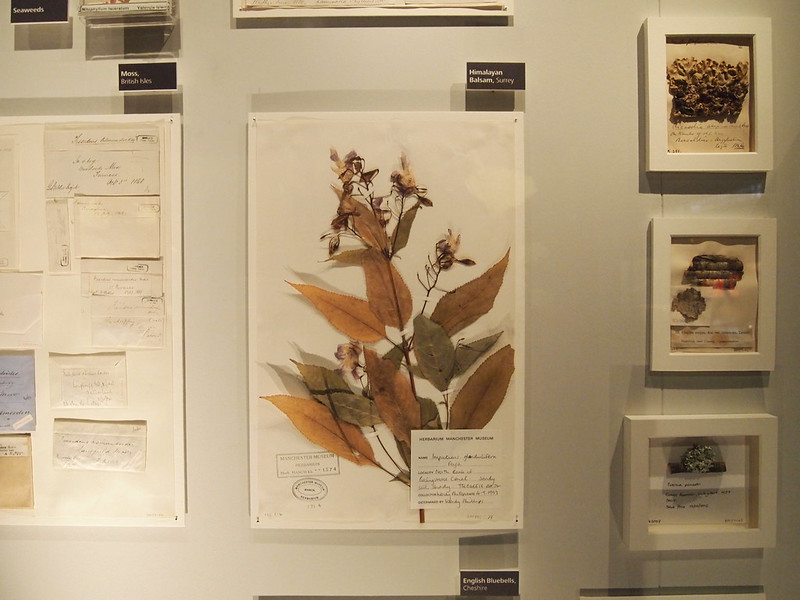
On the sides, they were flanked with thoughtful quotations by people working at University of Manchester who were deeply involved in researching those areas. For example, in a section about British Wildlife, they had an interview from a guy who worked in a wildlife protection group, and they had him telling a beatific story about how he went camping once and woke up alone in the middle of the English countryside and watched a bird flapping off into the sunrise in a sort of reverie, feeling the interconnectedness of life and the simple beauty of nature. I have to admit that this kind of naive earnestness in the video presentations veered rather dangerously on the romantic and trite - but in the end I still feel the intentions and sentiments behind it all were generally good.

P5142477

P5142478

P5142479

P5142481

P5142482

P5142483

P5142486

P5142487

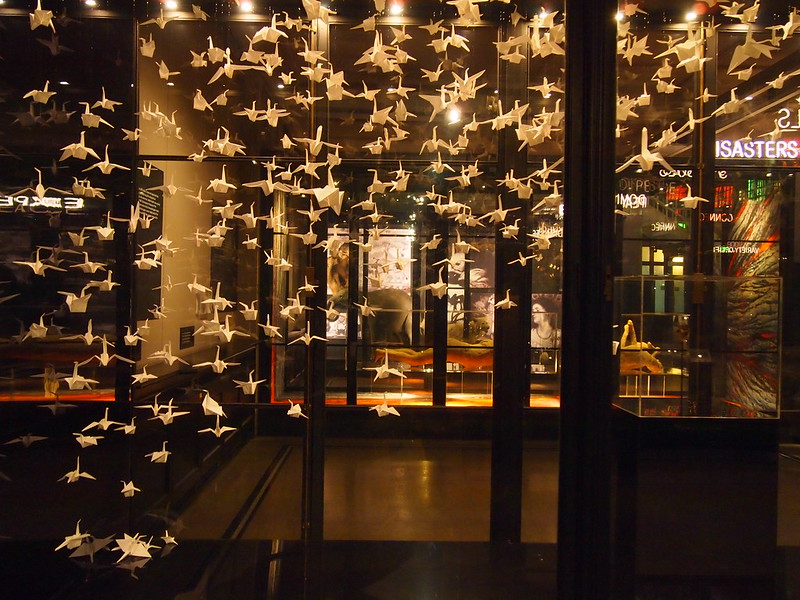
An installation of cranes???

P5142489

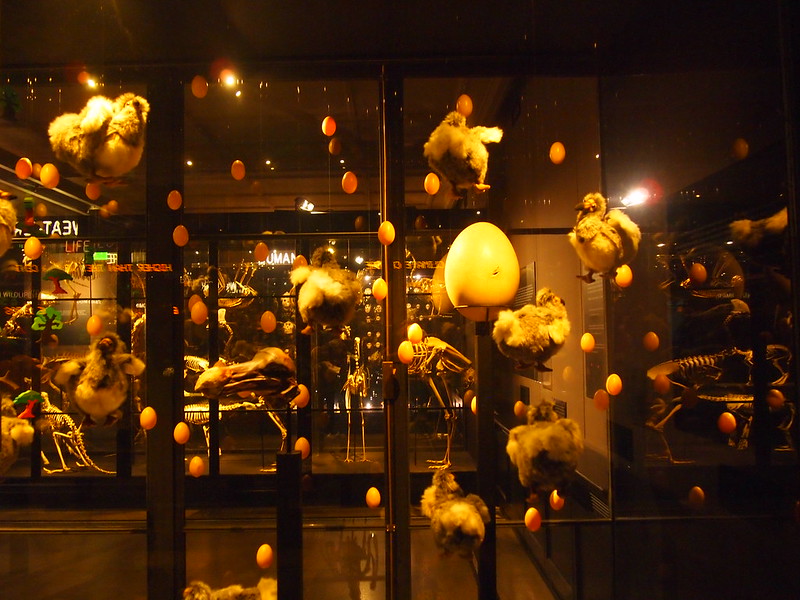
Floating stuffed dodos and eggs???

P5142491

P5142492

P5142496

P5142501

P5142502

P5142503

P5142504

P5142505

P5142513

P5142514

P5142515

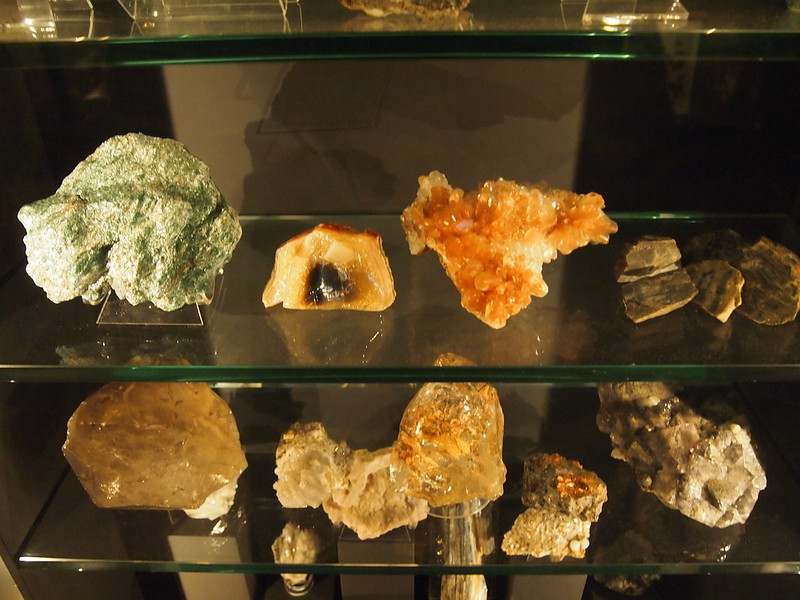
Rock

P5142516

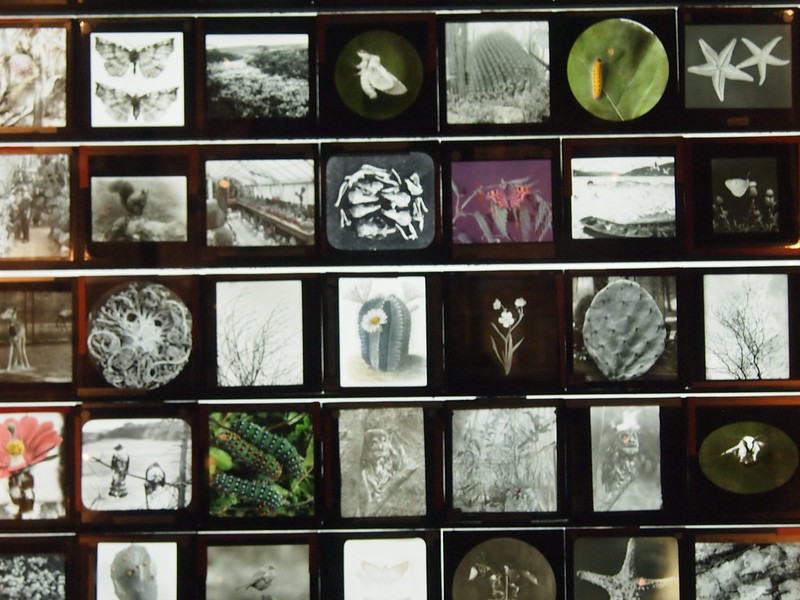
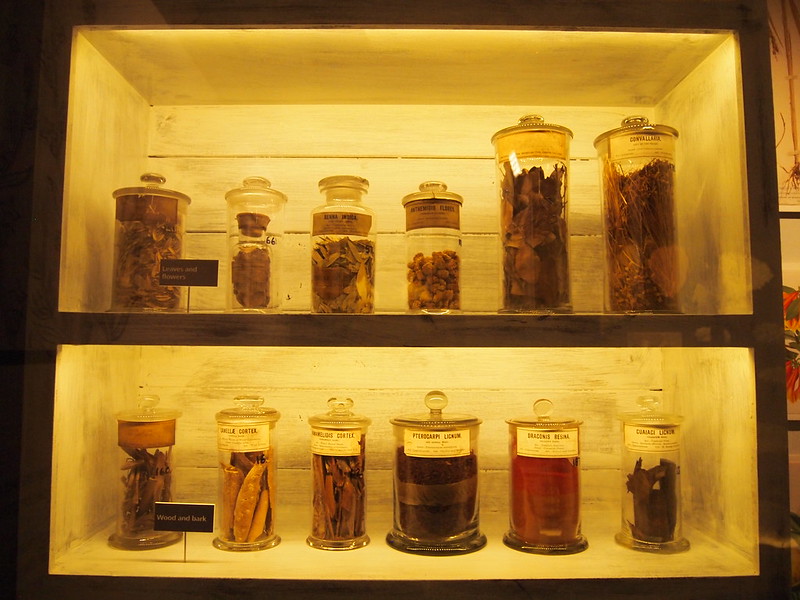
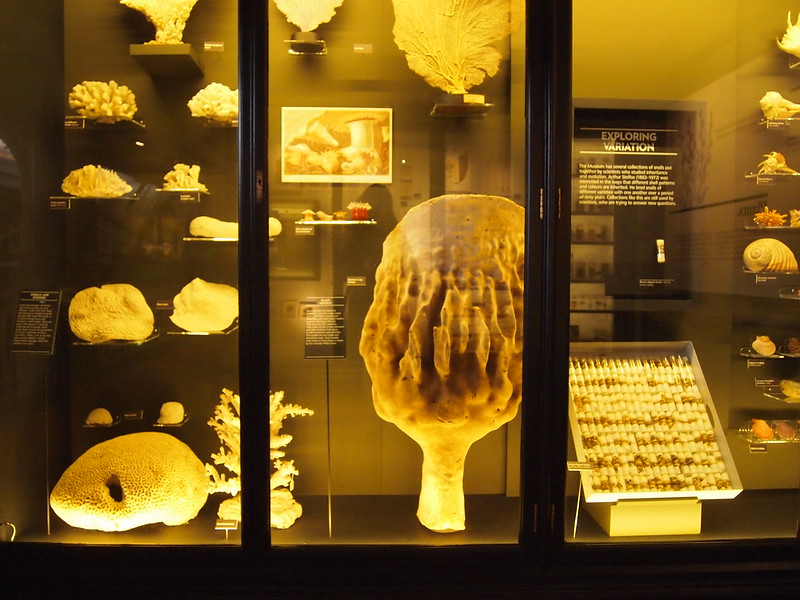
Collections

P5142522

P5142529

P5142535

P5142536

P5142540

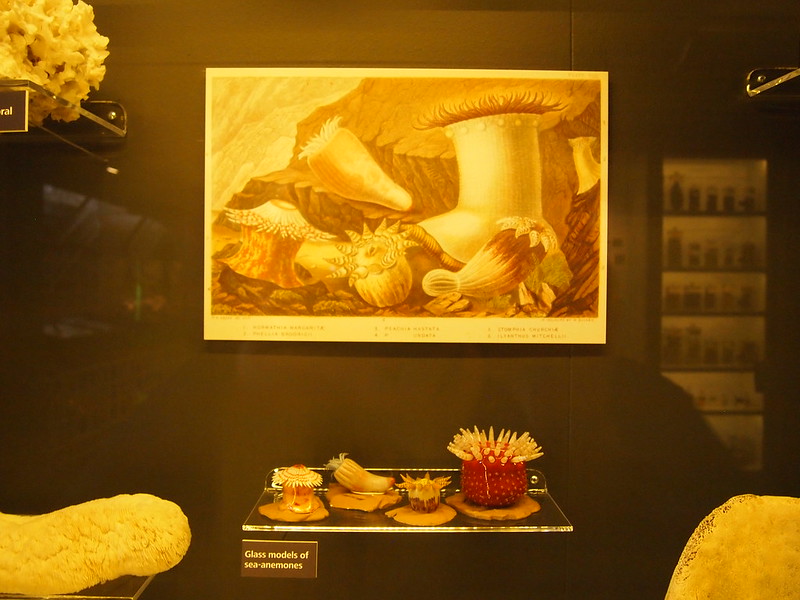
Blaschka Glass Models!

P5142547

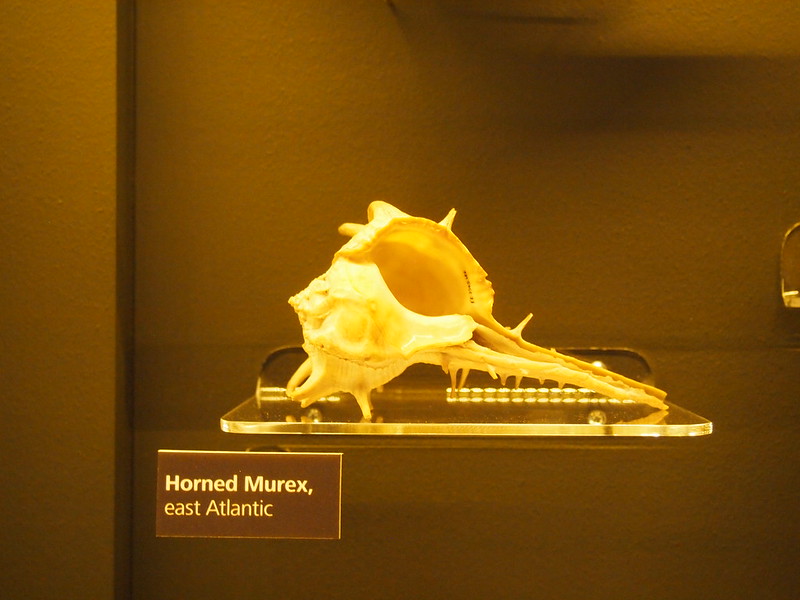
Horned Murex

P5142548

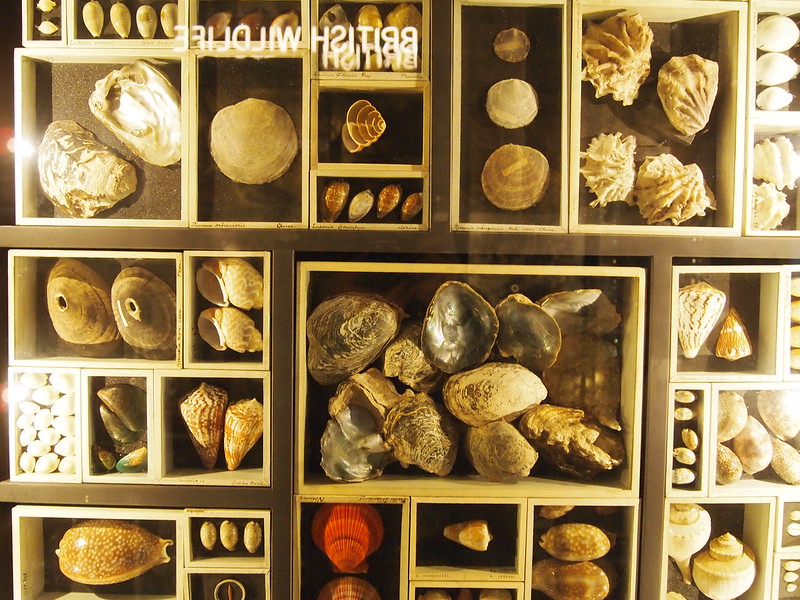
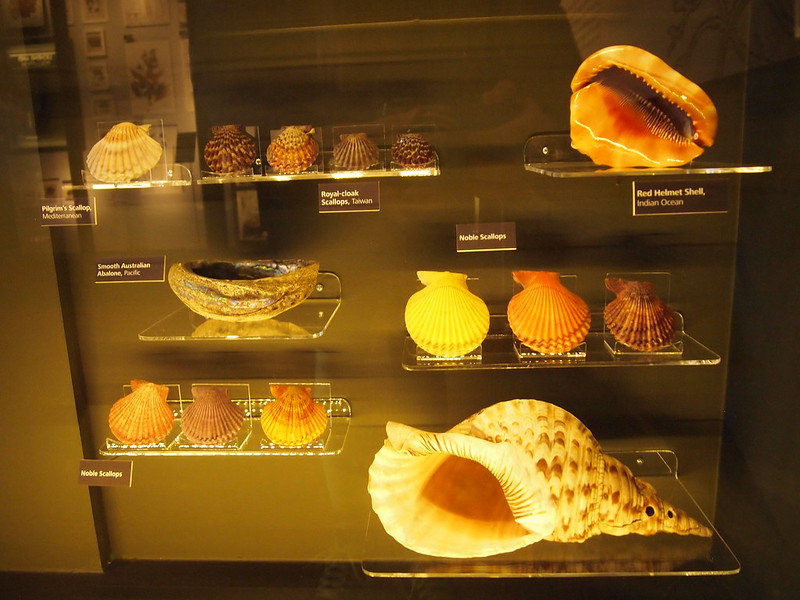
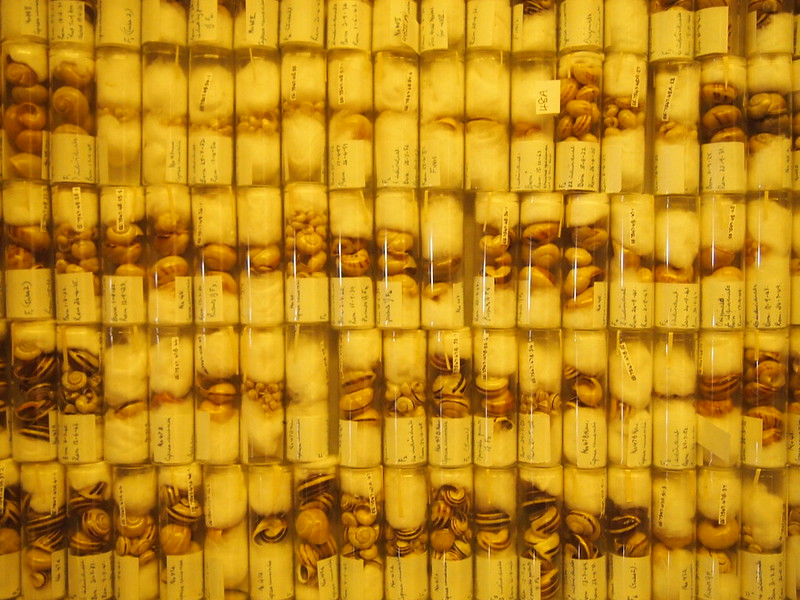
Shells

P5142544

Snails

P5142554

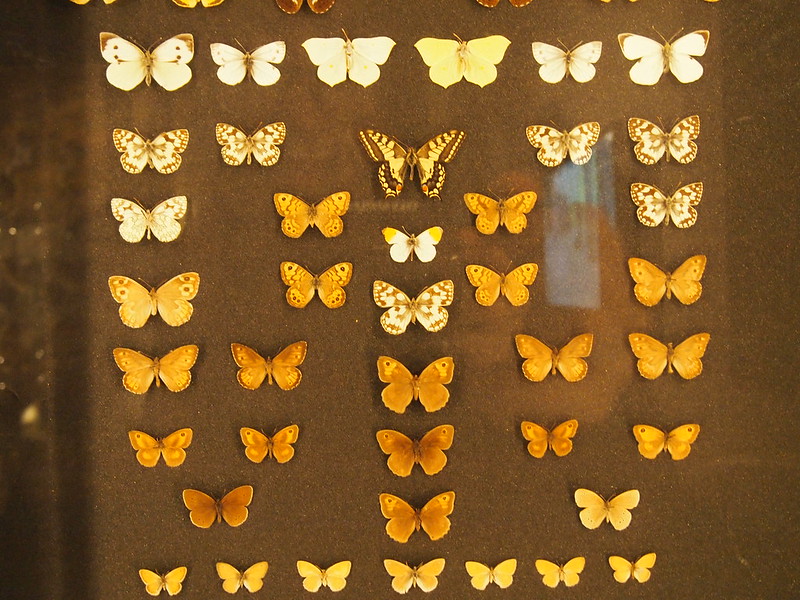
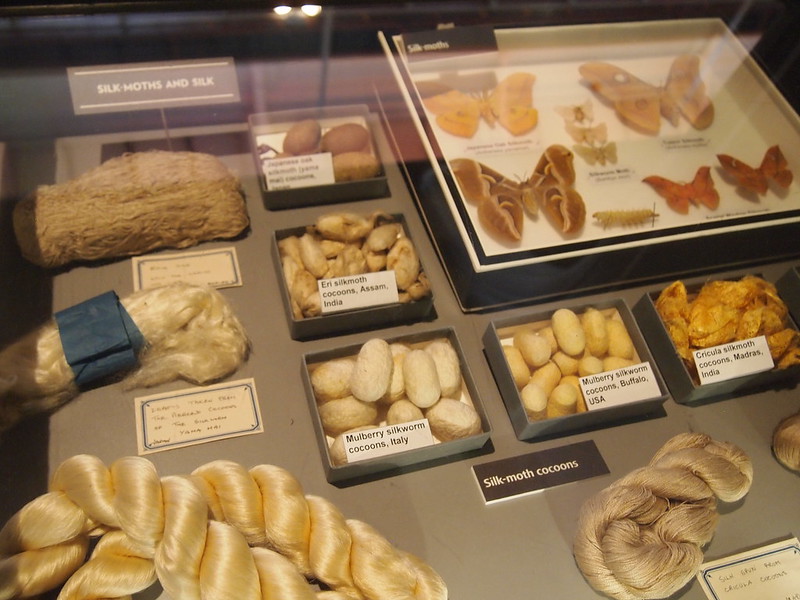
Moths

P5142564

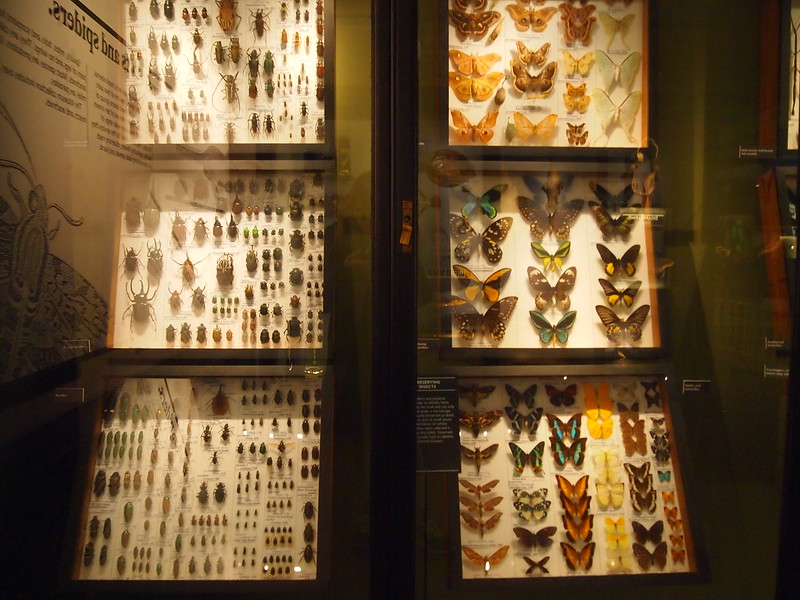
Insects

P5142560

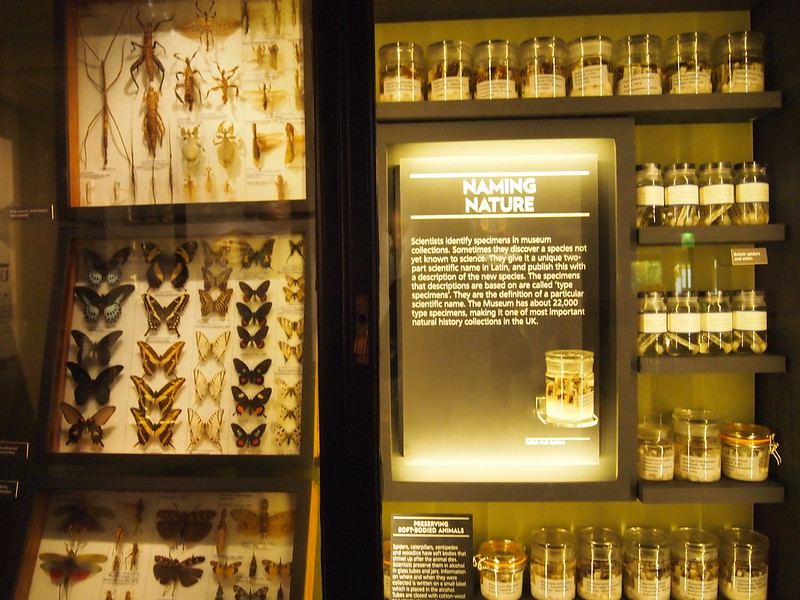
It says here that Manchester Museum has over 22000 type specimens. Also, to put things into perspective, Manchester Museum apparently has around 4 million specimens. Natural History Museum in London has over 28 million specimens. Still, these are collections that have involved the life's work of so many different individuals over the years.

P5142566

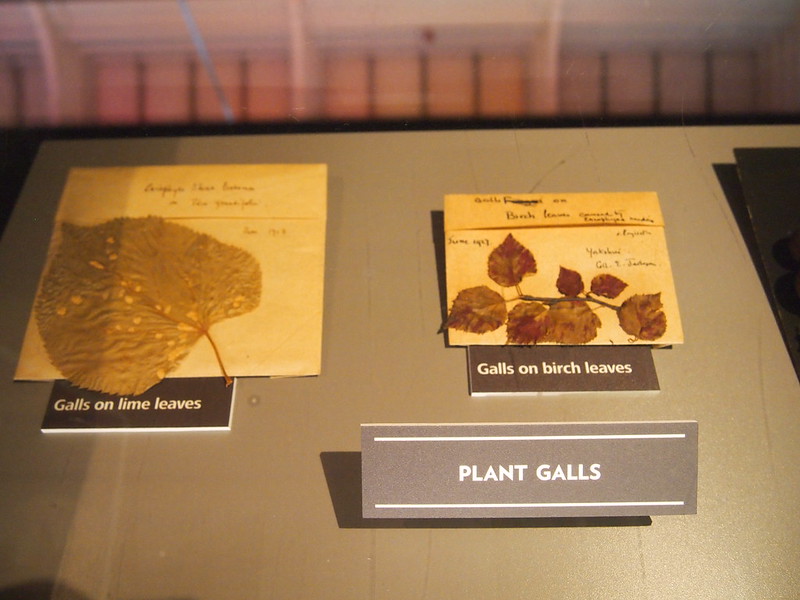
PLANT GALLS!!!

P5142568

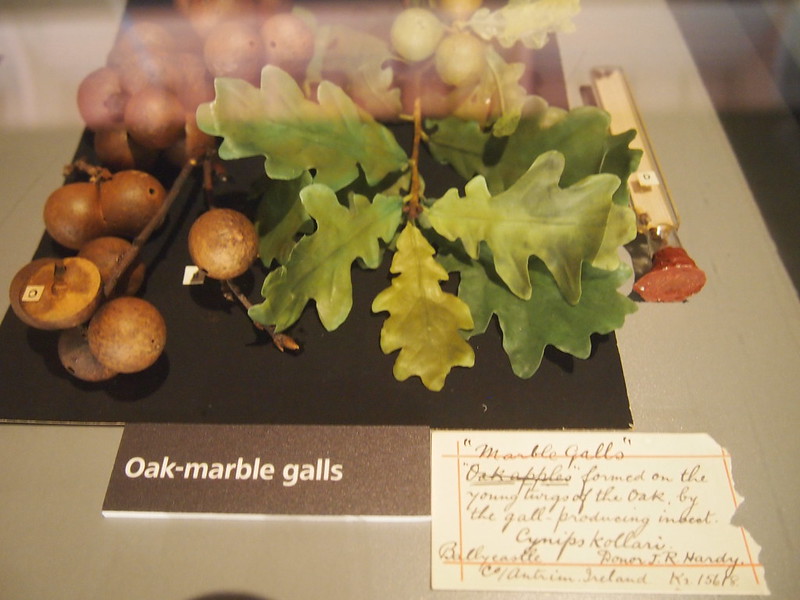
OAK MARBLE GALLS!!!

P5142572

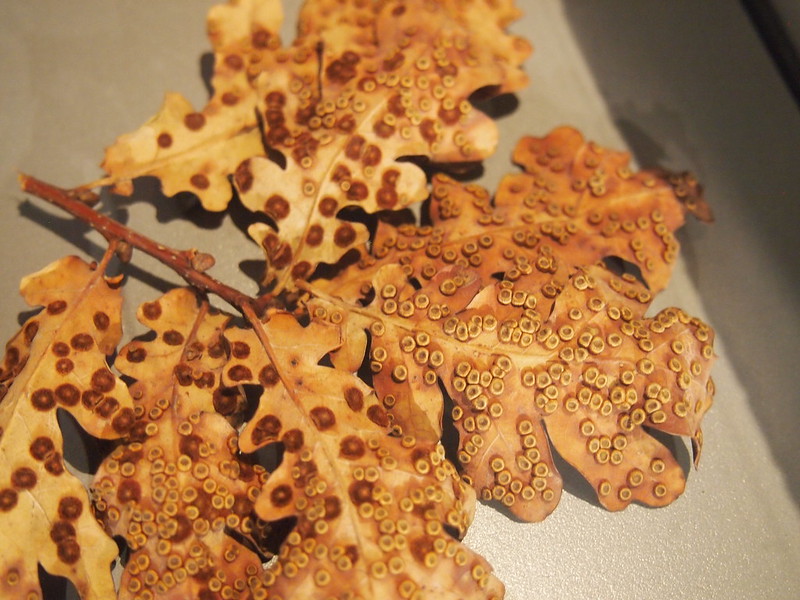
Silk-button Spangle Galls!!!
Need I explain how excited I am to see a plant gall section?

P5142586

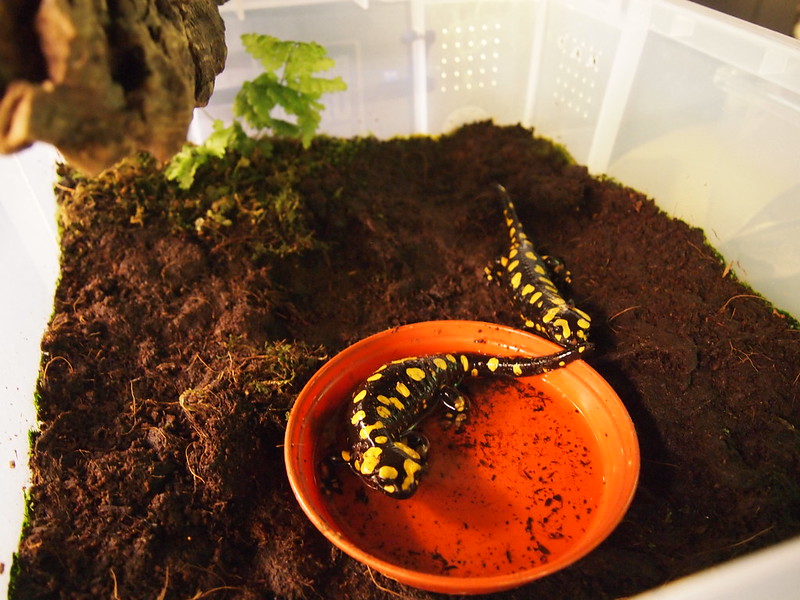
Fire Salamander in the vivarium, just arrived! (living animal section)

There are too many photos so I will end here for now. With such a vast collection including a section dedicated to "Museumology" and "collections", where I saw a section on Egyptian fakes and its no surprise that later when I checked it up, I found out that Mark Dion's "Bureau for the Centre for the Study of Surrealism and Its Legacy" was actually put together from Manchester Museum's vast collections - which, as with any huge collection, is bound to be full of eccentricities and overlooked corners full of strange items, unusable models, fakes, and other items.