Friday, 10 June 2016

Searching for British Library Manuscripts, Trying to understand 19th Century Palaeography through Calligraphy practice, and Iron Gall Ink!

The amazing treasure trove that is the British Library! Despite the wealth of resources available there, I always feel like its catalogues are so arcane and confusing that I think it is worth making a list of things I wish they told me from the start, if it will save someone else from the confusion I had in the reading rooms - with embarrassingly noisy book stand apparatus that no one tells you how to use, and thousand paged manuscripts wrapped in very complicated cake boxes with string!...

Untitled

THINGS I WISH SOMEONE TOLD ME EARLIER ABOUT USING THE BRITISH LIBRARY


  • Archives are in a separate catalogue. On the BL page and dropdown menu: Catalogues > MANUSCRIPTS > Archives and Manuscripts.
  • There may be a "handlist" on open shelves for reference. The handlist is a list of items which are on display or which are available for requesting within a specific collection.
  • Ordering Microfilm: There is a microfilm option hidden at bottom of Request Other Items. So even if the item is technically a copy of something from Private Papers, you should order it under Microfilm. Again, I wish this was explained clearly from the very beginning.
  • Before leaving the counter, check that the item you have received is actually the actual item you have ordered. Yes, I have had the unusual fortune of receiving the wrong item after patiently waiting well over an hour for it!
  • Although the rooms close at 5, it seems that by 4.30 they'll start to ask for the special materials to be returned.
  • You have to leave most things outside and you have to use a plastic bag to bring things in
  • You cannot bring pens in. You can only bring pencils.
  • You cannot take photos of some historical material. But if you have retrieved it in microfilm form, you can take as many pictures as you want for free on your mobile phone camera. (I'd really like to find out what is the rationale for this rule?...)
  • You need a pound coin to use the lockers downstairs. (Interestingly, people also regularly forget to take their £1 coin deposit from their lockers at the basement. Just sayin...!)

Recently I wanted to look for some historical documents which were held under the India Office Records. It was then that I realised that I have never handled primary historical material before, so when the librarian asked me if I wanted original or microfilm I was confused. ORIGINAL OR MICROFILM? No one had ever asked me to choose between the two! Should I want to see the microfilm instead of the original? Is the copy truly identical to the original? I suppose I am not a historian, and I'm not usually doing such research involving very old materials, hence most of the records I have sought out in the past were all microfilm. How did this happen???

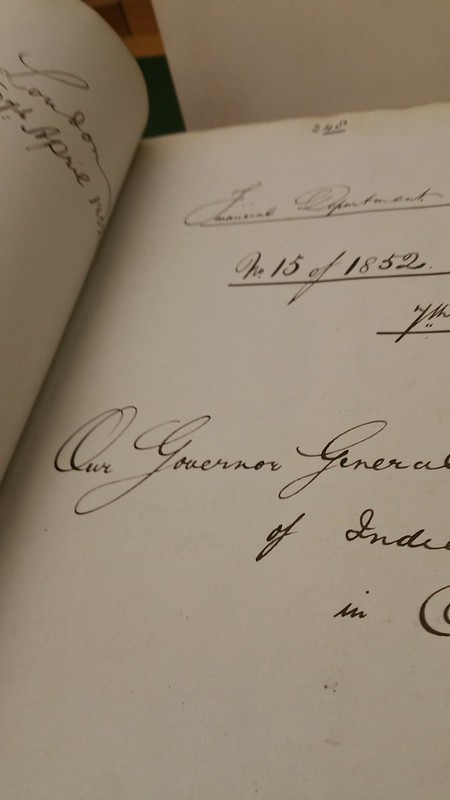
Aaaaaaaand that was how I ended up handling some original copies of Sir Stamford Raffles' letters to his sister. I became intensely afraid of suddenly developing a explosive nosebleed whilst hovering close to the thin slips of paper, almost translucent in the light. And tragically, it was then that I also realised... I COULD NOT READ THE HANDWRITING. It was almost a flat line! And what is going on the letter r and ff? And had all these weird squiggles about it! And why did people use only a perplexingly small portion of the entire paper???

Furthermore, whilst looking through other EIC documents, I realised that I had extreme difficulty with copperplate, even though it represented the standardisation of administrative script! Doom! I imagined the eagle eyes of the librarians boring into the back of my skull as I opened up the paper and could do nothing more than attempt to decode it letter by letter... I took so long that it was closing time. The librarian then told me, "You know, you should get the microfilm next time, then you can take photos and read it off the photograph more slowly." MORE SLOWLY? HOW MUCH MORE SLOWER CAN I DO THIS?

A few days later, I decided to should try to get to grips with things by learning calligraphy or copperplate. Again, this turned out to be another first for me, and I realised I had never used an ink pen. Oddly enough, I had used a lot of digital "grunge" or ink effects in photoshop when I was a teenager, because it was all the rage at the time. But ink splotches were nothing more than things people made as packs of images and shared online, or digitally mimicked with photoshop brushes! Ink wells? Actual ink? Who used ink? Unbelievable that my life has been dominated by the digital ways! Well, never too late I guess...

PROGRESSION: TWO WEEKS OF CALLIGRAPHIC MESSING ABOUT


On 27 May I decided to get a calligraphy pen set. These nibs were wack and not bendy in the least. The result was boring. And I had no idea what I was doing.


On 1 June I got some interesting nibs in the mail - the Brause Rose, Leonardt Hiro, and a few others. The results began to improve.


1 June 2016


6 June 2016


8 June 2016


Sumi Ink. I have learnt the hard way that you should not turn the bottle upside down....


The ink that came with this beginner's set of inks was Indian Ink, but apparently Indian Ink was invented in CHINA, but the carbon materials for Indian Ink come from India. At first I thought this carbon ink must be the ink that everyone had used for all the documents that I could expect to see in the British Library collections (originating from the UK). It sounded logical on the surface and it is an old ink with some history....

But as I looked into historical inks, I found out that the standard ink that was used in medieval europe (5th - 19th c) was actually an iron gall ink? Made specifically from.... OAK GALLS! Gallotannic acids were extracted from galls in trees (how did they find all these galls? Does it mean it would have been widely celebrated, to find these galls? Were there gall hunters??)

How on earth did they discover that these galls were useful for making ink??? The earliest mention appears to have been by Pliny the Elder (23AD - 75AD) who noted that verdigris (iron) + an infusion of nut galls equals BLACK ON PAPYRUS. A brief search online of the history of iron gall ink brings up many pages suggesting that it is not really known when people transitioned from carbon inks to iron gall ink, but for the most part by the medieval times people were mainly using iron gall ink due to its permanence, non-clogging action (compared to carbon-based ink like indian ink), and "relative ease of production" (WHERE WERE ALL THE GALLS COMING FROM? DOES THAT MEAN THERE WAS A WHOLE MARKET FOR TRADING GALLS?)

I guess galls are easier to find than carbon if that material had to come from overseas! And today it seems more likely for me to be able to buy a whole load of... carbon on ebay as opposed to locating elusive plant galls in nature!

Oak galls have been used in the production of ink since at least the time of the Roman Empire. From the Middle Ages to the early twentieth century, iron gall ink was the main medium used for writing in the Western world

Why did I not know this when I last did research about galls??? Apparently many significant manuscripts were written using iron oak gall ink, including one of the oldest Bibles, the Codex Sinaticus (around 4C). Also, despite not being used widely today, in the UK, registrars today still are required to use a special blue-black archival quality ink which apparently has ferro gallic compounds - used to sign official documents such as birth certificates, marriage certificates, death certificates and on clergy rolls and ships' logbooks!

Now.... I finally have a functional reason to go out and hunt for more oak galls!...

...SO I CAN EXECUTE ONE OF THESE RECIPES FOR IRON GALL INK!
http://www.instructables.com/id/Making-Iron-Gall-Ink/
http://www.transitionblackisle.org/oak-gall-ink
https://www.westdean.org.uk/study/school-of-conservation/blog/books-and-library-materials/making-testing-iron-gall-ink

The Life and Death of Snail: How to keep snails and preserve their shells

Untitled

Untitled

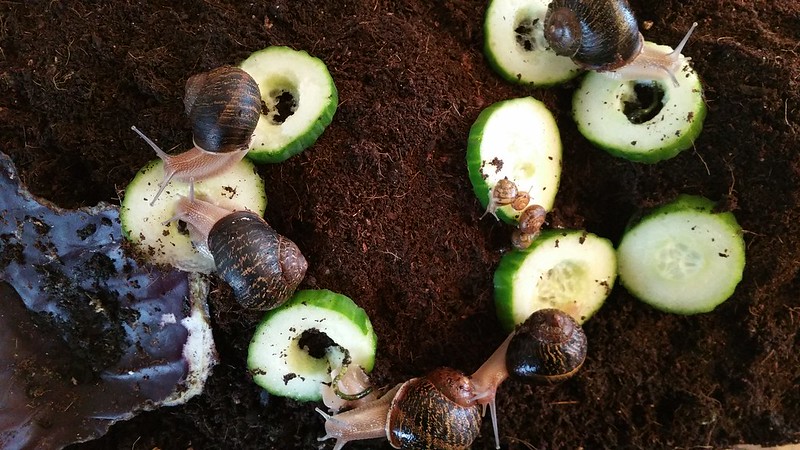
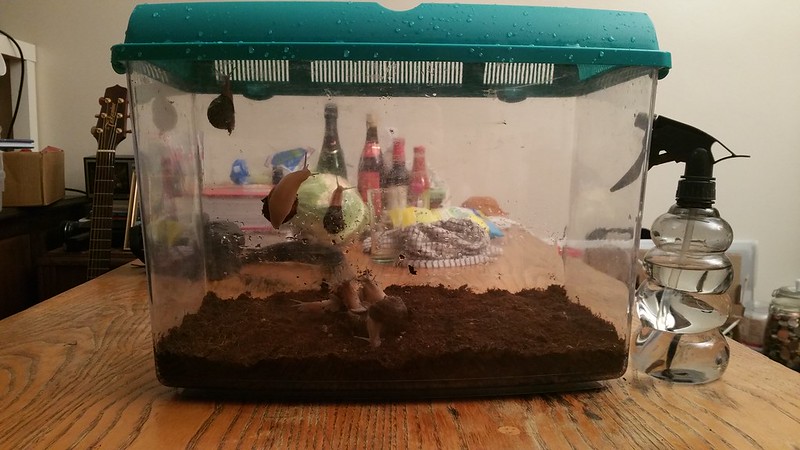
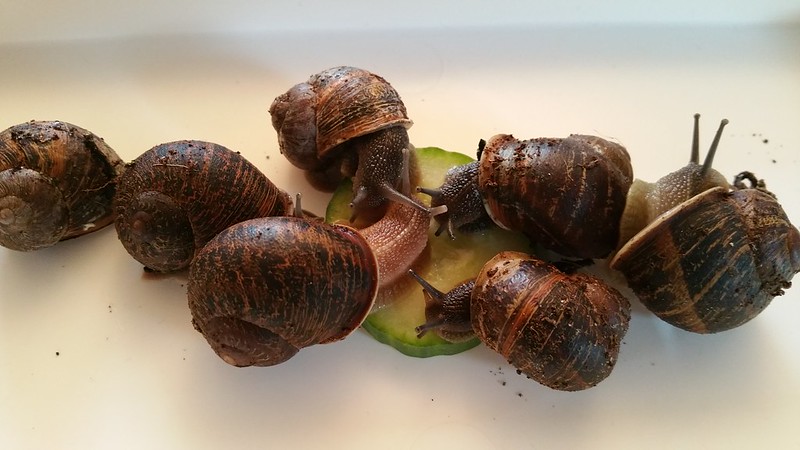
I don't know why I haven't made a more lengthy post about snails until now! Hello world and horrified neighbours, I've been rearing terrestrial mollusks of the English Garden persuasion for over a year now! (I like to call my tank "Snail TV" - its pretty soothing to watch them slide around like bizarre alien marzipan swans). George thinks I'm obsessed about them because they're a bit like rocks with faces on them, and I think there is some truth to that. They are so strange! But reactive and very very curious!

20150529_155904_Burgoyne Rd

HELLO? DO YOU WANT TO COME IN?

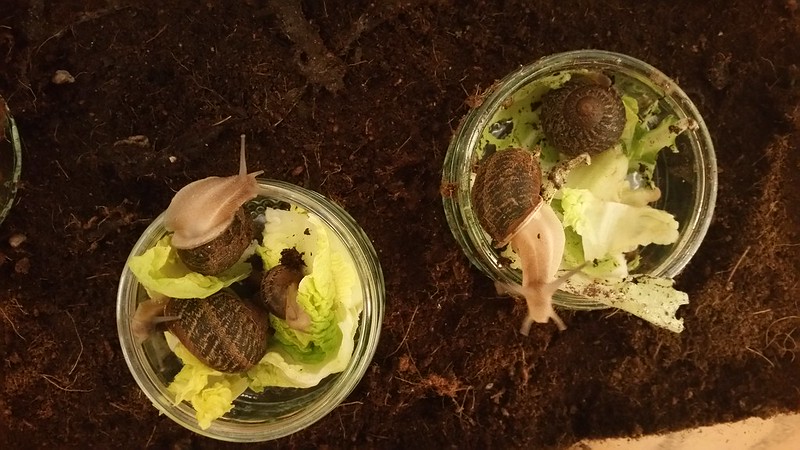
It first began because I found all these snails outside, and then I got very excited about observing their behaviour, and how they ate, but George said I could only have as many "pet snails" as I could identify by name. So we began with five little snails - Robinson Crusoe (a very adventurous but not very hungry snail), Wetherspoons (a very hungry snail), Harvester (an even more hungry snail), Prince of Wales (a yellow grove snail) and Shakespeare (a late comer who appeared to be shunned by the others).

For a period I also almost kept slugs but I discovered that the slugs were aggressively invasive SPANISH SLUGS which I felt bad about returning to the wild after I had discovered what they were. So I put the slugs on our roof. I have to admit I am not sure if this has contributed to the increase in the sound of flapping wings of birds from on top of our roof. But I figured it was a kind of tactical course for the slugs where they have to try to survive on top of our mossy roof. I don't want to kill them but by putting them on the roof, I am lowering their chances of out-eating the local snails and slugs on the ground.

Best part is that snails are like some kind of natural 3D extruder. For example, they love to eat paper and cardboard. I was giving them a habitat made of coloured egg boxes, but they like to eat the boxes and now all their poop (and habitat) is purple, orange, and green.

Untitled

TRI-COLOURED POOP

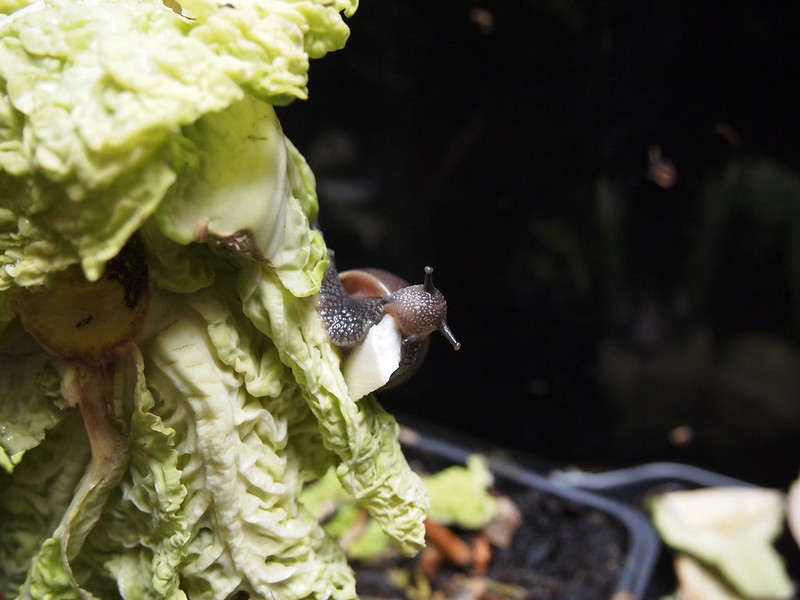
To be honest I think of them as simple machines, they slide around and they swivel their food detecting feelers around until BEEP! FOOD DETECTED! And the snail deploys its nommmmming action. (Although I HATE the word nom in most cases, it seems appropriate for snails as their mouth does indeed look a lot like "nommmmm" from afar.

P5255567

NOMMMMMMMMMM

Now it is about a dozen generations on and we have re-wilded many snails since and kept as many as we think we can comfortably keep.

Untitled

LIFE OF SNAIL


Untitled

Untitled

A picture from December 2015, before population explosion

Untitled

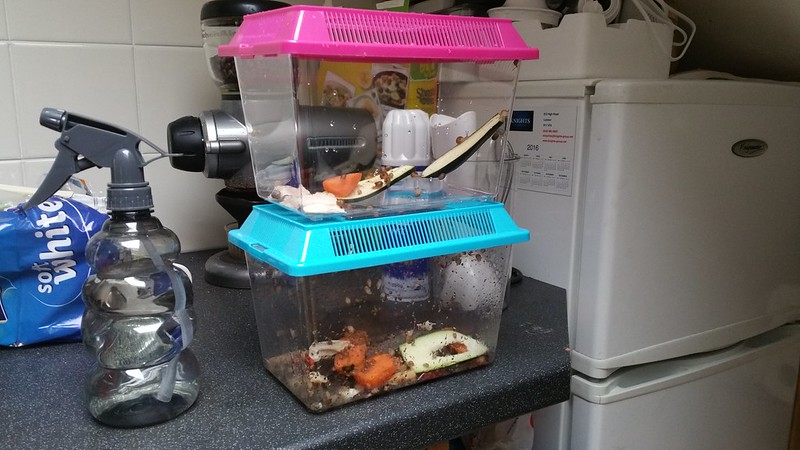
The "Nursery": I isolated batches of babies into smaller tanks at one point, because the babies were occupying the corners where the adults seem to like to sit.

Untitled

This was a short-lived experiment in which I tried to grow food for snails - to make a closed cycle of feeding and growing. We need something fast growing because they eat very very fast. I used mung bean sprouts for the first experiment. The sprouts became uncontrollable after a few days and then about two weeks later all the stupid sprouts died suddenly! With that, some sort of change in the air caused all the snails to estivate. So they were moved back to boring old "feeding" tanks.

Some notes from my first year of snailkeeping:

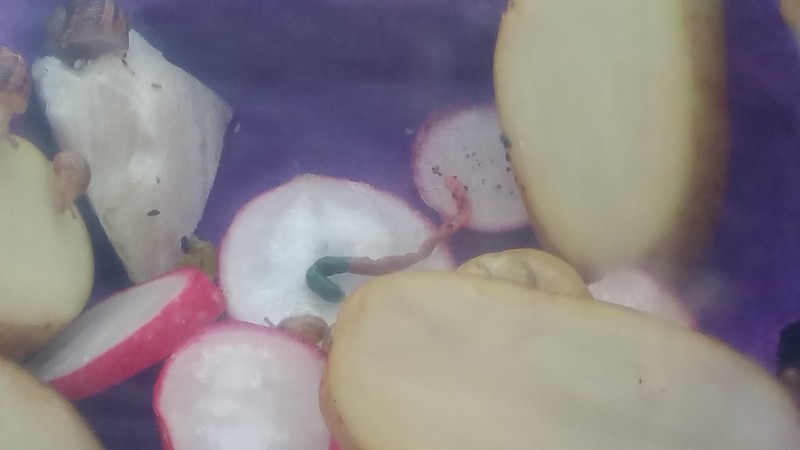
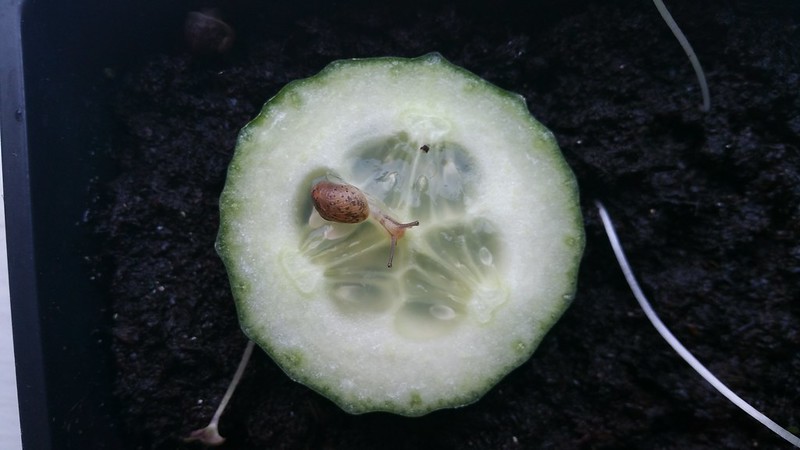
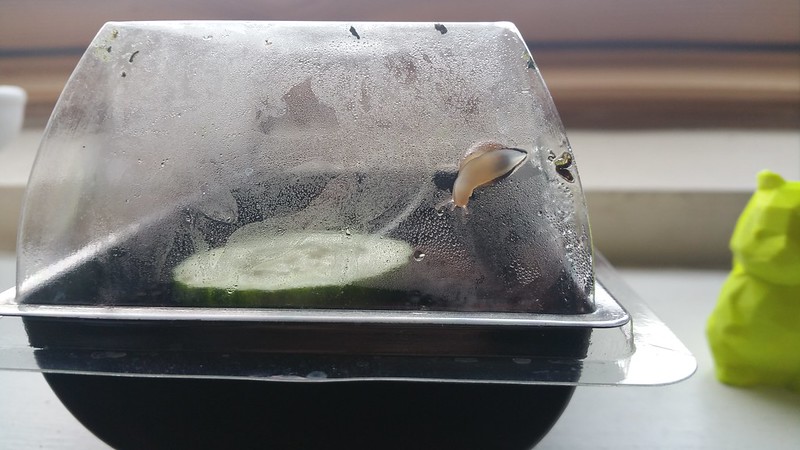
  • Snails eat most vegetables except for leek/onion/garlic type vegetables. They don't seem to like very acidic fruits like sweet berries and bananas. They may become picky if given too much choice, such as ONLY EATING THE SOFT CENTRES OF CUCUMBERS AND THEN NOT EATING THE REST, or ONLY EATING THE SOFT CENTRE OF A CARROT.
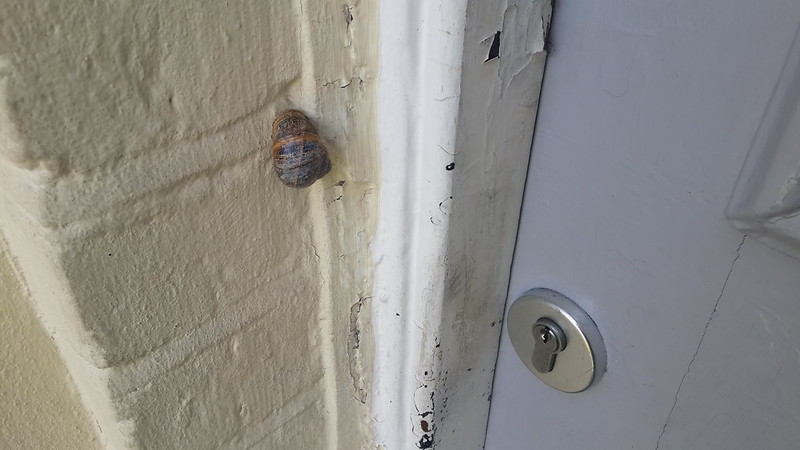
  • Snails must be fed cuttlefish bone or some other source of calcium. We went with cuttlefish bone which contrary to what one might imagine, is not harvested from live cuttlefishes. People scavenge for the bones on the seaside and then sell it for money so that pets with shells/beaks can eat these supplements. Oh and what happens in the wild? I suppose the snail will lick your walls then...
  • COVER SNAIL TANK WITH ORGANZA FABRIC (OR SOME OTHER BREATHABLE FABRIC) - IF NOT ROTTING VEGETABLES WILL ATTRACT FLIES AND CAUSE HORRIFYING MAGGOTY MOMENTS IN THE SNAIL TANK!
  • Snails will climb upwards if it is wet
  • Cocopeat is a great and clean snail tank bedding material
  • Do not allow snails to crawl on to a laptop which is metallic including macbook pros - a current passes through them when they crawl on metal and the snail will froth up
  • Do not allow snails to crawl on exposed metal, foil, copper, they will froth up
  • Do not give beautiful fruit and vegetable without washing thoroughly - sometimes pretty fruit has more pesticides, snails won't eat them (it was designed to stop them anyway)
  • When garden snails develop a white lip at the end of their shells, they have become adults
  • Do not give pasta or rice, they may overfeed and explode.
  • If you wiggle a string in front of them, they will crawl up the string
  • If you wiggle your finger just in front of their faces, they will crawl up onto your finger, unless they aren't in the mood to slither about.
  • When they have detected edible surfaces, their mouthfeelers and seeingfeelers will droop downwards, almost becoming fat and stout at the same time. If their seeingfeelers are fat and droopy, you can bet that they are probably chewing on something at the moment.
  • Some snails like eating a lot more than others. Some like digging themselves a hole and hiding all the time.

DEATH OF SNAIL


The lifespan of these garden snails is about 3 years apparently. And snails lay dozens and dozens of eggs in each clutch. And amongst those baby snails, some will die for seemingly no reason at all. It is almost as if some snails just lose the will to live.

A while back, an adult snail passed away whilst I was away. It was the first young adult snail (white lip already grown) to die like this so I had to figure out what to do. I wanted to keep his shell as well, but I needed to clean it somehow. The problem was that it was not easy to remove the body from the shell. George was not keen that I boil the snail in one of our pots. And I don't have a garden, otherwise I could have buried the shell and allowed nature's little workers (ants, etc) to eat and clean out the shell. (In professional forensics/museum situations, a dermestarium with lots of Dermestid beetles (carrion beetles) is used as they are more meticulous than humans and it puts less stress on the bone/shell)

Although I had concerns that freezing the shell might cause it to crack when the water expands inside it, this method I found to have worked perfectly without damaging the shell. This also works for tinier shells.

Untitled

  1. Place snail in a plastic bag
  2. Fill plastic bag with some water so the shell is submerged, and place bag into a container
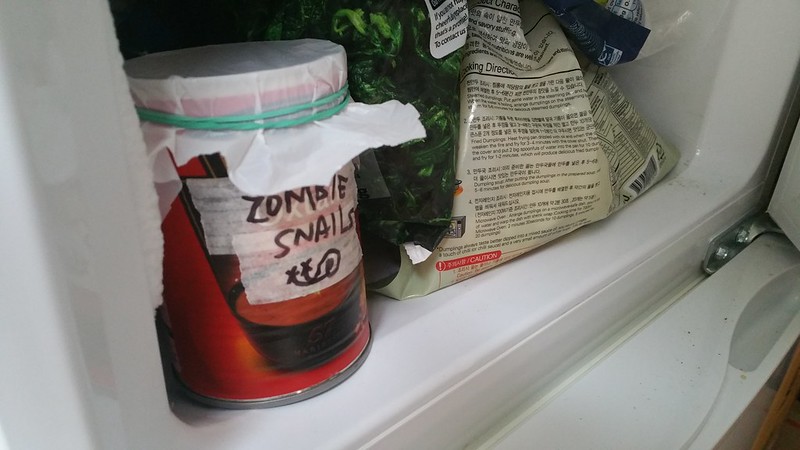
  3. Place in fridge with label so no one gets a shock when they look into container in the freezer
  4. Let it freeze overnight
  5. Thaw it the next day
  6. Dead snail will have detached from shell so you can clean the shell in water without doing some horrifying digging
  7. Dry and polish with mineral oil so the shell won't dry out and the layered patterns on the shell won't crack up and peel off.
'


Tuesday, 17 May 2016

Mysterious White Powders: Artificial Chicken Flavour

I've been thinking about writing several posts about mysterious white powders (and offwhite powders as well), such as citric acid, baking soda, kansui, and nutritional yeast, which I will do so over the next few weeks. For now I'm going to start things off with everybody's favourite.... ARTIFICIAL CHICKEN FLAVOUR!


"Artificial Chicken Flavouring"


Here is a picture of a chicken timer since its quite boring to look at a picture of white seasoning powder. A couple years ago I was taking apart a small chicken timer to send to George and I had just turned away for a moment when Kent happened to wander over and touched a spring inside the chicken. The result was that said chicken timer suddenly exploded. Oh chickens. So mysterious.

The other day we decided that we would try to "recreate a powdered Chicken seasoning". Our motivations for this were perhaps quite different: George being vegetarian perhaps wanted to find an vegetarian analogue of a seasoning that was usually paired with chicken - and he went out and got some "Jerk Chicken Seasoning" that was conveniently vegetarian. But the problem is that "Jerk Chicken Seasoning" is not really chicken seasoning. It happens to be a seasoning which is complementary with chicken, and perhaps is so very often eaten together with chicken that it has become synonymous with chicken. However, that still does not make it truly chicken flavoured. IT IS NOT EVEN CHICKEN IN FLAVOUR.

I would like to do is to reverse engineer INSTANT NOODLE CHICKEN SEASONING. What is the essence of a chicken flavour? Now at the time of writing, I don't think I'm even close to cracking it yet, but I want to find out the secret recipe for the seasoning packets in those bewitchingly addictive Mamee Noodle snacks. And I want to know the secret recipe behind the seasoning packet for the export-only Koka Stir Fried Noodles, which are very much unlike that of the emphatically health-conscious no-MSG recipes/formulations used for Koka's local markets in Singapore. The UK export version of the Singapore produced Koka noodles look different from the packaging in the Singapore and also all contain MSG. How do I recreate this "artificial chicken flavouring"? And perhaps more to the point: is "ARTIFICIAL CHICKEN FLAVOURING" already a well-known or patented formula within the food technology industry....?

Let us look a little more closely at the ingredients for both seasonins which are so bewitchingly addictive:

MAMEE CHICKEN NOODLE SNACK (FLAVOUR PACK): Salt, Contains Permitted Flavouring Substances (contains gluten,soybeans), Contains Monosodium Glutamate (E621), Disodium-Guanylate(E627) and Disodium-Inosinate (E631) As Permitted Flavour Enhancers, Spices, Sugar. Contains Permitted Food Additives of Plant, Animal (Chicken) and Synthetic Origin.

KOKA STIR FRIED NOODLE (FLAVOUR PACK)
: salt, sugar, artificial chicken flavouring [contains sesame seeds], pepper, msg, garlic powder, soya bean extract, dehydrated veg & spices.

Let's break it down a little:
Monosodium Glutamate (E621) - the sodium salt of glutamic acid (E620). gives foods an umami taste and enhance flavours. Because of its enhancing properties, it is great because it reduces the total amount of salt needed in order to make the food tasty to us. Commercially it is produced through the bacterial fermentation of molasses; glutamates are present in all proteins and can be found in many natural foods.

For starters I think MSG is an amazing invention! It is for me up there alongside the invention of instant noodles! It has been scientifically proven that glutamates (commercially synthesised or naturally occuring) have no particular adverse effect on the overwhelming majority of people. I personally enjoy food with MSG in it and all of the other naturally occurring glutamates. I usually assume that anyone or any website which denounces MSG has failed to do a basic fact check and can be dismissed as a quack (beware, for the world and internet is full of uninformed loons!)

Disodium guanylate (E627)
- the sodium salt of guanylic acid (E626), guanylates enhance other flavours but do not add any particular umami tastes. It comes from a part of RNA in cells of living organisms. Probably made from Tapioca Starch.

Disodium Inosinate (E631) - the sodium salt of inosinic acid (E630) inosinates enhance other flavours but do not add any particular umami tastes. Probably made from Tapioca Starch.

I noticed that Guanylates and Inosinates (aka the disodium ribotides) often come together. They obviously enhance savoury tastes so it is also worth noting that a lot of 'low sodium foods' may use these as a very tiny amount of them already magnifies the saltiness. I can see it as a useful way of cutting down on salt, but they can aggravate gout. But ultimately, as food additives, these ingredients might make up an exceedingly tiny portion of the ingredients of your food, so I am alright with a tiny amount of them in my food if it works so well in enhancing the taste in lieu of salt! It explains why instant noodle seasoning can taste so salty even though it amounts to little more than a tbsp of powder!

Garlic Powder - dehydrated garlic in powdered form. similarly, dehydrated onion in powdered form can also be found. these powders are not to be considered an inferior version of the fresh ingredient. It is in fact quite different from the fresh versions of itself. Both garlic and onion powders add a completely different dimension to food even if you are already using fresh garlic or onion within the food itself. However, they must be heated up in oil for best effect.

But... what is "artificial chicken flavouring"???

I'm assuming that since it is artificial, it means that it doesn't include any real chickens. Not that I care since I would eat real chickens anyway (and anything tastes better with a good homemade chicken stock mixed in), but this simply means that adding real chickens into the mix isn't the solution to this "reverse engineering" exercise...

Plus, the reason why we want to make a chicken seasoning is because WE WANT TO KNOW WHAT IS THE TASTE OF CHICKEN! I mean, have you ever eaten a chicken? I personally like chicken, although thesedays I haven't eaten as much of it as before. My mother makes an amazing steamed chicken, of which the ingredients are just chicken and salt, and it is one of the purest and most delicious chicken flavours I can imagine, if I had to describe what was chicken. I mean, what is this chicken flavour that we taste? Why do we know it is chicken flavour? How does we chicken flavour? HOW DOES WE ARTIFICAL CHICKEN???

The earliest patent I could find for a CHICKEN FLAVOUR was this from 1972, from a Marcel Andre Perret, an inventor who also devised a process for producing an artificial beef flavour in 1968. The patent application itself dithers through a few methods for producing artificial meat and poultry flavours, which Perret thoughtfully notes would be well suited for the use of a housewife who heats it and gets INSTANT CHICKEN FLAVOUR under conditions available to an ordinary kitchen:

From US 3689289 A: Chicken flavor and process for preparing the same:

Perret proposed a substitute artificial beef flavor formed by heating a hexose or pentose monosaccharide with cysteine and cystine to 90 to 100 C. for two hours in the presence of water, adding vegetable protein hydrolyzate and a 5'-ribonucleotide, and then heating again at at least 70 C. for about two hours, to develop the desired beef flavor.

Mortion et al. US. Pat. No. 2,934,437, patented Apr. 26, 1960, describe an artificial meat flavoring composition, composed of the reaction products of a pentose or hexose, cysteine or cystine, and water, reacted for at least one hour at the boiling point in the presence of water. This composition is similar to Perrets, without the ribonucleotide. Moreover, Perret requires that the mixture of hexose or pentose and cysteine or cystine be reacted at 90 to 100 C. in the presence of water, and that then the protein hydrolyzate and the ribonucleotide be added and a further reaction carried out at at least 70 C. for about two hours.

Giacino US. Pat. No. 3,394,017, patented July 23, 1968, describes a poultry flavor composition produced by reacting thiamine with a sulfur-containing polypeptide or an amino acid mixture derived therefrom, and thereafter add- United States Patent 0 ice ing an aldehyde and a ketone to the reaction product. An amino acid mixture for use in the composition includes at least one sulfur-containing amino acid such as cysteine or cystine. The mixture is heated at from 200 to 420 F. for from A minute to three hours, the shorter heating times requiring higher reaction temperatures.(...)

Belikov et al., Chemical Abstracts 62, 15339d (1965), (Z/h. Vses, K-him. Obshchestva im. D. I. Menedeleeva) 10 (1) (1065), in a study of the nature of food odors, reported that an aqueous solution of l-cysteine hydrochloride, dl-alanine, l-glutamic acid, glycine, glucose, l-arabinose and methyl arachidonate, after having been heated for two hours at to C. developed an odor resembling that of chicken soup. There was no report on the taste of the product.

In accordance with the invention, an artificial chicken flavor composition is provided which is capable of developing the flavor of chicken when heated in the presence of water for from five to ten minutes at temperatures within the range from about 60 to about 90 C. The composition can be formulated as a solid mixture, any liquids present being absorbed on the solid ingredients, and is stable indefinitely in this form, and develops a chicken flavor when heated under the stated conditions. Accordingly, this composition is Well suited for use by a housewife, who merely heats it at the time of use, and then can use it at once, without any need for storage, after the chicken flavor has been developed. This avoids the necessity of pre-heating the composition by the manufacturer, and eliminates the storage stability problems inherent in such preheated compositions. Since the composition can be heated under conditions available to the housewife in the ordinary kitchen, unlike the 125 to 135 C. temperatures of Belikov et al. (which require pressure), the compositions of the invention avoid all of the difficulties inherent in the prior flavoring compositions.

The artificial chicken flavor composition of the invention is a combination of a hexose, a bland protein hydrolysate, an arachidonic acid compound, such as arachidonic acid, or methyl and/or ethyl arachidonate, or a mixture of any thereof, and cysteine and/or cystine, or a nontoxic acid addition salt thereof.

It goes on to suggest some examples...


To be honest, it looks a lot like a recipe to me.


Oh look, not at all strange, but a patent for a TCM chicken feet recipe for tonifying qi???

Which leads on to some more "recipe" looking patents??? But can you patent a recipe? What is it under the patent classification anyway??

If you must know, the classification for Patent US3689289A is: A23L - FOODS, FOODSTUFFS, OR NON-ALCOHOLIC BEVERAGES, NOT COVERED BY SUBCLASSES A21D OR A23B-A23J; THEIR PREPARATION OR TREATMENT, e.g. COOKING, MODIFICATION OF NUTRITIVE QUALITIES, PHYSICAL TREATMENT (shaping or working, not fully covered by this subclass, A23P); PRESERVATION OF FOODS OR FOODSTUFFS, IN GENERAL (preservation of flour or dough for baking A21D) [2006.01]
1/227 · · · containing amino acids [2]
... which seems a little like a let down - what? Chicken is not its own category????


I mean like seriously this reads like a recipe for a roast duck... how do we classify patents anyway?

Which brings me to:
THE INTERNATIONAL PATENT CLASSIFICATION! classifying patents and allowing us to search for patent documents, "in order to establish the novelty and evaluate the inventive step or non-obviousness (including the assessment of technical advance and useful results or utility) of technical disclosures in patent applications.


AIEEEEE the mind boggles. All the terrifying inventions of food technology that I know so little of!
But now, it is dinnertime and I must make myself a dinner. Preferably with a chicken stock cube or something, for research purposes....

I still feel like there are insufficient pictures in this post so here is ROBOT CHICKEN...?

In the next episode, we continue to investigate: HOW DO WE ARTIFICIAL CHICKEN FLAVOUR AND WHY IS FRIED CHICKEN BATTER SO DELICIOUSLY ADDICTIVE (AND HOW DO WE RECREATE IT ALL WITH SCIENCE?)

Saturday, 19 March 2016

Second-hand Rocks and Prosperity Pricing

A long time ago, I remember reading a book which described sedimentary rocks as a kind of "second-hand" rock because they are formed from other materials - such as, from the remains of previously living organisms, or from fragments of other older rocks. But yesterday, I encountered some literal second-hand rocks!...

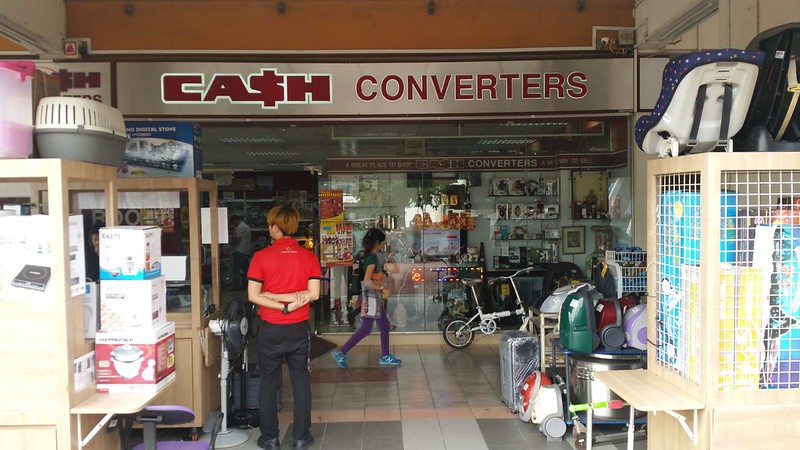
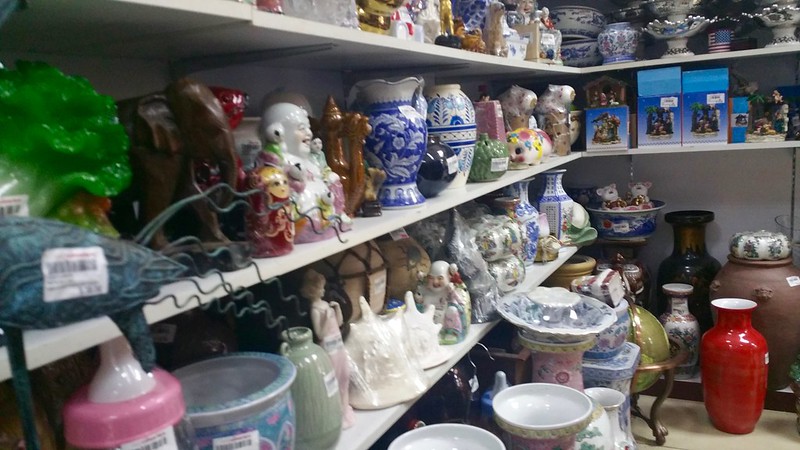
Whilst returning back to town from FOSSASIA 2016, I passed a familiar second-hand store that I used to go to whenever I was in Jurong East. CASH CONVERTERS! - that good ol brick-and-mortar franchise in the business of "buying and selling unwanted goods" - land of excess factory stock, used CDs and other outmoded forms of media entertainment, joblots of made-for-tv egg cooking devices, tennis racquets tanned yellow with age, furry massage mats, porcelain dogs, used mugs, extruded plastic god-of-fortune statuettes, bowling balls wrapped in cellophane...

Untitled

Untitled

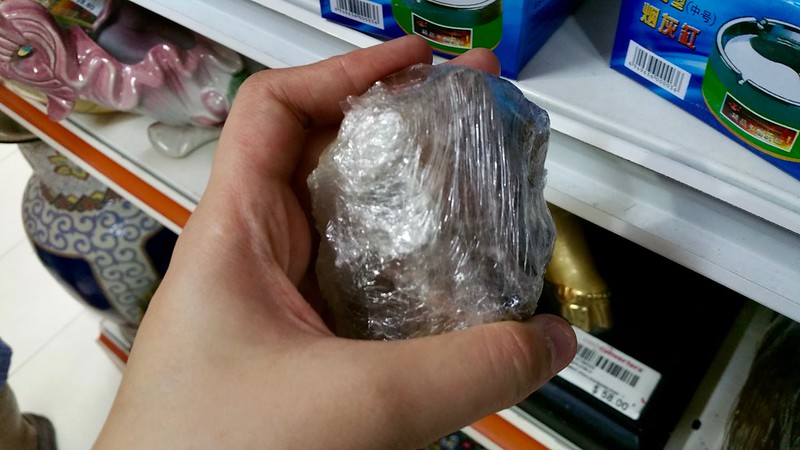
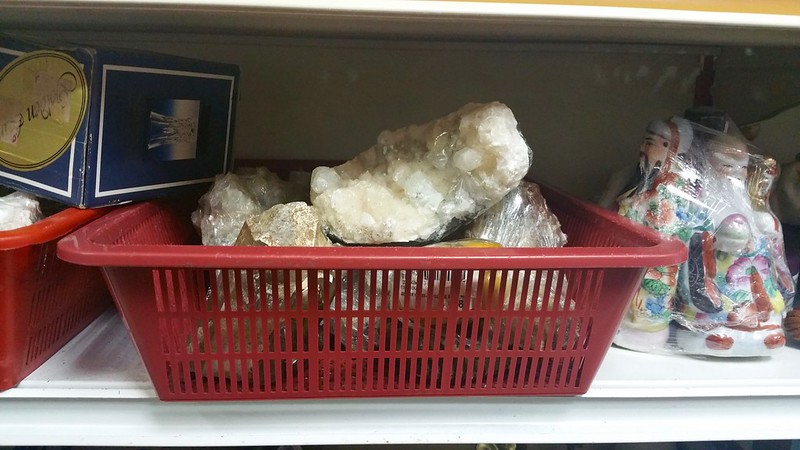
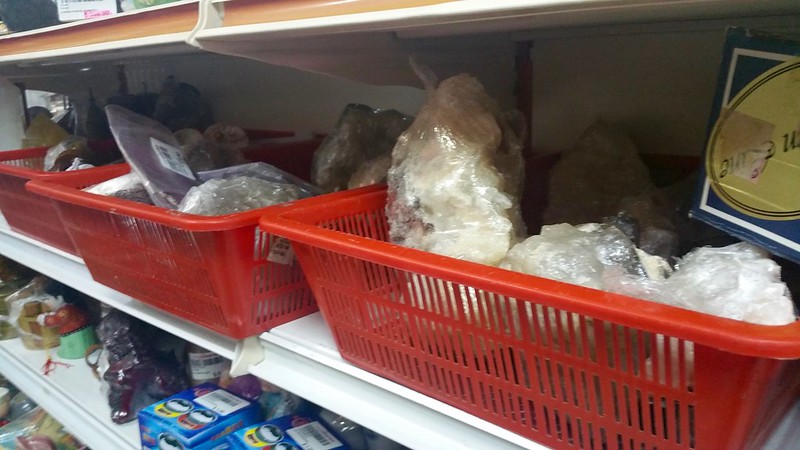
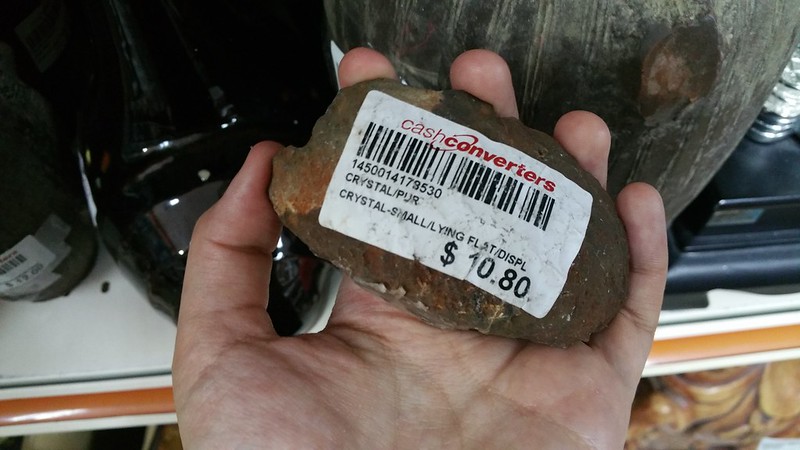
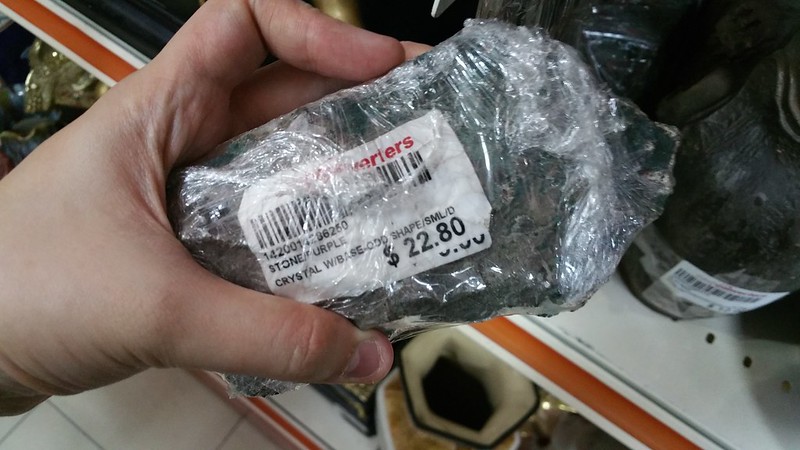
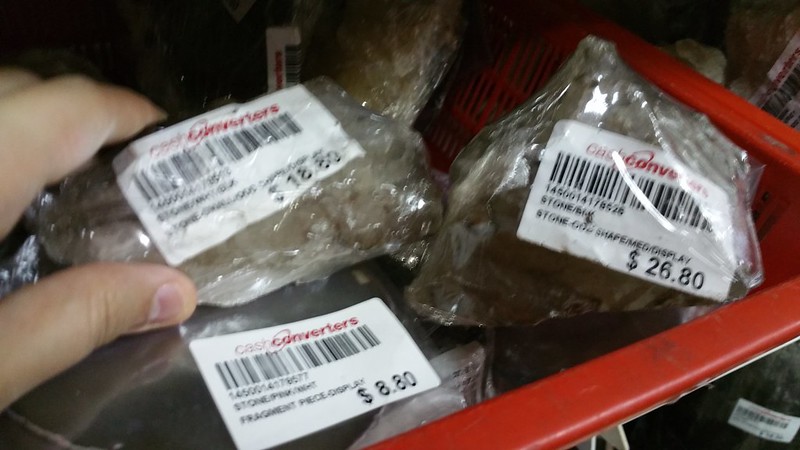
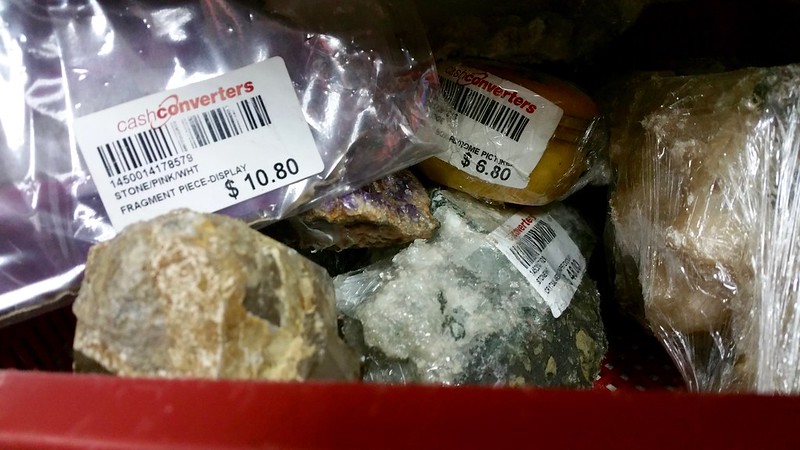
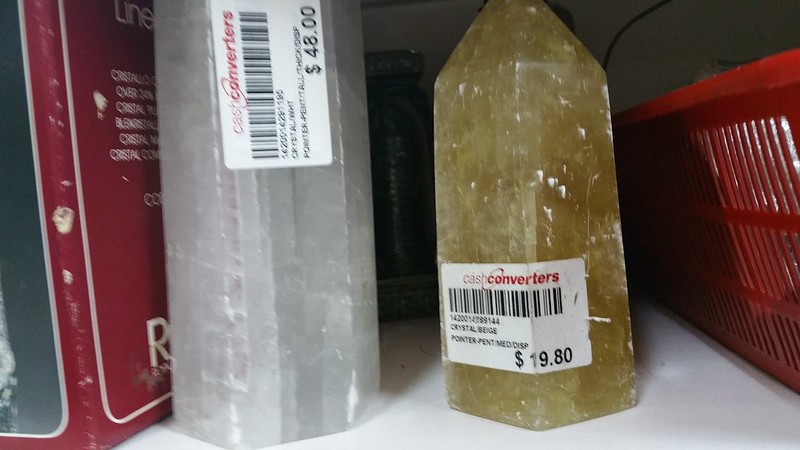
Speaking of hard objects enthusiastically wrapped in plastic, I came across a section that I hadn't quite noticed in previous visits. Lodged in a rather small shelf, in a few red plastic baskets (not dissimilar to the green plastic baskets I used for sorting my rocks in the past), I discovered that someone had secreted a whole cachet of rocks. Yes my friends. In the middle of Jurong East's Cash Converters is an entire SECOND HAND ROCK SECTION. (Maybe I should start my own rock shop like them too huh)

Untitled

Untitled

Untitled

Untitled
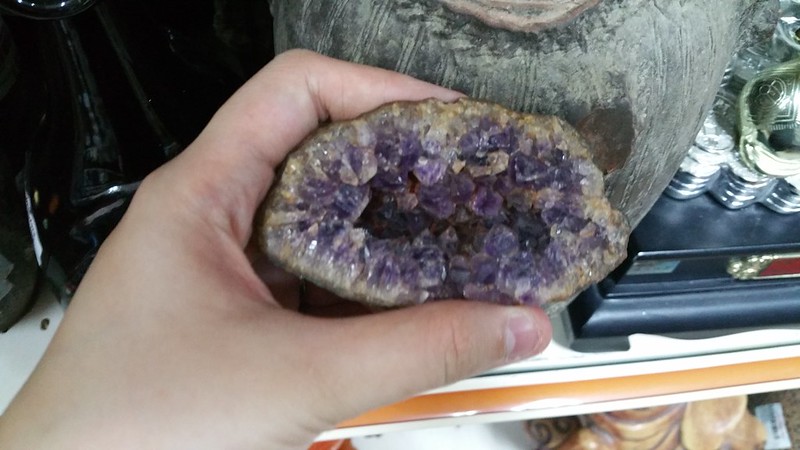
THIS IS A GEODE, BTW

No provenance. No information. Just rocks wrapped so tightly in plastic that in some cases you couldn't see them properly. Which makes it slightly alarming when a few of them are not in protective plastic shells (I worry for a moment, is the sweat on my grubby hands in danger of inflicting corrosion upon these rocks??)

And of course, because Cash Converters has made the re-selling of seemingly unwanted and useless objects their entire business, there is also a price tag.

Untitled

Untitled

Untitled

How does Cash Converters determine the price for rocks? From looking online, people say that Cash Converters in other places use the prices of other existing online catalogues such as ebay, argos, etc to determine an object's value (when it was new) and then quotes a fraction of that (pricing it so that CC would eventually still make a significant 60-100% profit on the sale of the object).

But... rocks? Even as ornamental fengshui rocks? Is there a special catalogue for fengshui rocks here? How does the CC staff evaluate it? Is it size, weight, appearance?

Also, seriously, what is up with the prices all being XX.80 or with the number 8 in them? Is the inclusion of 8 in the pricing a strategic tactic for pricing within chinese markets?

Untitled

Untitled

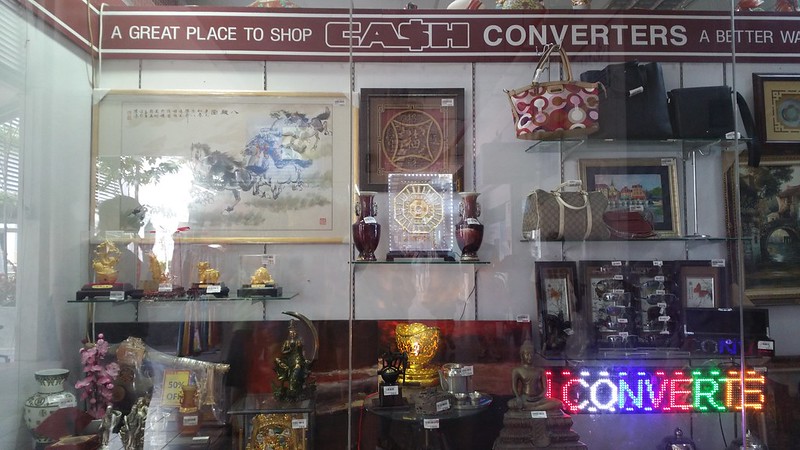
What is fascinating is that when you look at the centrepiece display within the interior of second-hand shops like Cash Converters in Singapore and the glass front of the second hand shop, it is often dominated by highly valued prosperity symbols and objects of religious syncretism, mixed up with the visual language of designed lifestyle objects, on a bed of laser-cut acrylic and LEDs.

Untitled

I also hasten to add that whilst I was at Cash Converters, no less than 4 middle-aged Chinese men shuffled through this aisle and spent a long time carefully evaluating the rocks on this shelf, so I personally I did get the impression that these rocks were definitely an object of curiosity, and perhaps by extension, even objects of desire...


Prosperity Pricing? The use of number "8" in prices of Chinese consumer products


Some googling takes me to this paper: The Use of 'Lucky' Numbers in the Pricing of Chinese A-Share Initial Public Offerings where the abstract notes that existing marketing literature shows that "the number 8 is consistently used as a price-ending in advertising for Chinese consumer products" - to capitalise on investor sentiment.

Wednesday, 9 March 2016

Public Service Notice on Geodes, and Text Complexity

The show opened to what I perceived to be a little confusion from Singaporean audiences. I couldn't understand it at first, but a quick survey amongst friends has just revealed that... geode is apparently not actually a common or well-known word amongst a public/general audience of Singaporeans! ALAMAKKK!

Geode!! A word which I assumed that everyone learnt as a child, because I had already known of geodes when I was very young. I am shocked! Stunned like vegetable! Even amongst my peers who are brilliant and intelligent in their own right and in their respective fields of practice, apparently "geode" is a specialist term that does not enter the common vernacular here!

If you're Singaporean (born and educated here) and reading this, I really want to know if you knew what the word "geode" means without googling it first.


Here is a definition of "geode":

Whilst making the work "Space Geodes", my visual reference board looked like this - a lot of geodes + bismuth ingots. Bismuth is not a geode per se, but an important visual reference for me - i wrote an entry about bismuth on this blog in 2014):


I actually thought a lot about how I wanted the form to be instantly recognisable as a "geode", and made several pencil sketch studies of the ways in which geodes are sliced and presented, especially with regards to specimens from mineral shops that circulate in the hands of amateur collectors. And actually, I called it a "space geode" because I wanted to be cheeky about how it was also about turning a human space into something almost alien or from outer space - for things like fossils and ruins become interesting to us because of a perceived break in human understanding that we need to bridge. However, I hadn't realised that the very concept of "geode" might be TRULY ALIEN and unknown to some!??


As a young child I remember being given a purple coloured booklet about rocks which came with a bubble pack of different semi-precious rocks, which made me aware of the different names of rocks. I remember there being a tiger's eye, banded agate, red jasper, rose quartz, turquoise, hematite, sodalite, and amethyst. Also, this must have been an American book because it also talked a lot about spelunking (cave exploring). (As an adult I learnt that the term "spelunking" was only used in the US, whereas it was called "potholing" in the UK).

UPDATE!!!: My mother found the book in the house! I wrote the paragraph above before I went to bed, and in the morning my mother fished the book out and I was vindicated to find that my memory did not fail me with regards to the rock names! The DingParents bought it from Toys R Us and gave it to me when I was 6, meaning this book is over 25 years old! It also contains a little section about GEODES, so I'm guessing this is where I first learnt the word "geode".


However... despite giving me such amazing access to books and information from an early stage of my life (yay to the Parents on their excellent strategy!), my parents did not actually read this book themselves, and therefore they themselves did not know what a geode is...

I showed them these following pictures which I took last week at Fu Lu Shou Complex, home of mystical antiquities, mysterious amulets, and religious relics (a shopping centre tellingly named 福禄寿 after the Daoist idea of fu/fortune - lu/status - shou/prosperity), but my parents looked at my pictures and identified these as "fengshui stones". I wonder what others call these? I'm guessing other people might also just identify them as "fengshui objects" or "crystals"?


Thinking about how one learns about geological terms in one's life - I also learnt words like magma and pyroclastic cloud from simply watching movies like "Dante's Peak", which I probably first saw aged 13 in 1997. I remember that I liked the movie so much that I even printed out random film reviews of the movie which I had found from the internet and kept it in a file, as a weird way of preserving a memento from the film! (Because I felt at the time that it would be unlikely for me to encounter a volcano or a geological feature like that) Please don't tell me I was the only weird geeky child here who learnt all these terms by accident??

I was told that some people also know of the word "geodes" via POKEMON because of Geodude (geode+dude?), a boulder pokemon who... erm.... rolls around. So people know geode might be a stone. But then, in Pokemon, the Geodude is never really officially pictured cracked open to show his presumably crystalline insides...


Geodude (pokemon)

I suppose there have been very few opportunities or means for people to learn about geology or geosciences in Singapore - it is something I've talked about for some time. I mean, I was very surprised to learn that in the UK some schools offered Geology as an A level subject, because it does not seem to figure in our curriculum. (Can any teachers confirm this?) Geology is part of Earth Sciences, but I'm guessing that the closest you might get to learning about geology in schools might be via geography. But Geography in Singapore is classed as a humanities subject, and not the most popular one at that, as I remember an article very recently about it:

Straits Times 22Feb 2016 - Updated JC geography curriculum worries some:


Google Trends on the interest in the word "Geode" shows a declining number of people searching for the word in the last few years:


But this is people "searching" for the word. It may mean that either (1) they don't know it and are searching, or that (2) they knew it but wanted to look for more information about geodes. The "trend" numbers do not make this distinction, of there being possible different intentions behind the search for information.

So, how do we determine text complexity? Whilst writing this I realised that a function that used to be in Google search last year has disappeared! To be honest, I never really used it much whilst it was available, but for some time there used to be a reading level function for Google search, and it used to be listed on this official google search filter list. Now the reading level filter is gone from the list as well. A quick look online reveals some discussion about how it was quietly removed in May 2015 without any announcement on any google blog.

See:
Google Drops Another Search Filter: Reading Level
Google Removes Reading Level Filter

Reading Level allowed users to search for texts which were in one of 3 levels - basic, intermediate, and advanced. This allowed children or readers with difficulties to look for basic texts which would be more suitable for their reading level, and on the other end of the spectrum it allowed advanced users to look for more complex, or technically-oriented articles.

In principle I don't really like the idea of dividing knowledge up into levels because I think that my current knowledge about the world was gained by ignoring what constitutes "specialist" knowledge vs what is "amateur knowledge". I just read everything and I think it would be great if more people were unafraid of complexity. But this is just my individual view. And on the negative side, it may also explain why some of my work and the mode in which I present my own work so far may seem a little too complex/wordy for many people.

But still, I think it would be interesting to try to see how one might develop one's own metric for what constitutes "text simplicity" or "text complexity". Current tests for it (eg: Flesch–Kincaid readability tests, Coleman-Liau Index, Gunning fog index, SMOG index, and Automated Readability Index) appear to use word length, sentence length and syllable count, and sometimes checks a text against a list of difficult words.

I really have to get on with other urgent work now so I must end here for now, but the text complexity issue seems worth further investigation when I have more time to sit down and experiment with it....


Space Geodes is currently being shown at SingaPlural 2016, on the second floor of block C where it will be on show until 13 March 2016.

99 Beach Road
7-13 March 2016
11am-10pm daily


More about SingaPlural 2016: http://singaplural.com
More info on "Space Geodes": http://openurbanism.blogspot.sg/2016/03/space-geodes-digital-archaeology-and-3d.html