Tuesday, 11 September 2018

Lamp Nomenclature and How to Wire a T5 Light

I may as well rename this blog as the "DebbieUniversity" or "How Debbie Did Everything The Hard Way". Well, this week I decided to teach myself about lamp nomenclature and how to wire a T5 lamp. I wanted to check the colour temperature so I had to wire it on my own to test it for the work I was building.

The term "T5" or "T8" lamp is commonly used to refer to a generic type of mass-produced lamp that always found in the same lamp format with regards to its overall shape, power requirements, and illuminating qualities.

T refers to the light's tubular shape and the number refers to the Tube's diameter.

T5 = 5/8 inch (15.9mm)
T8 = 8/8 inch = 1 inch (25.4mm)
T12 = 12/8 inch = 1.5 inch (38.1mm)

I read online that in some places people confuse the situation by calling the T5 a T16 because that's what it is in mm, and correspondingly call a T8 a T26. But in Singapore although we use the metric system and not the imperial system, we use the imperial lamp names.

How to wire a generic T5 LED lamp (3 wire to 3 pin)


Many of the T5 generics are labeled with vocabulary such as EASY TO INSTALL! SIMPLE! So this sounds just like a task for a home DIYer... right?

Firstly, read the "Operation Instruction" sheet that came with the "luminaire" which is fancy for "electrical device that provides illumination". For example, this is the sheet which came with a Philips T5-type luminaire ($14 for the light, $1.20 for the wire)


Read that the first line says it must be installed by a qualified electrician. Then throw "Operation Instruction" sheet out of window.

(Just kidding, don't killer litter, neighbours. I've already got enough old tissue on my laundry pole, thanks)

WARNING: IF YOU ARE READING THIS BECAUSE YOU ARE WIRING YOUR OWN LIGHTS AND DON'T FEEL CONFIDENT DOING IT, THEN DON'T DO IT! If you connect the wrong wires to mains power you may blow your appliance or you may accidentally electrocute yourself or someone else.

With that disclaimer out of the way.... on with the DIY!


Look at the wire that came with lamp. This is the wire for the generic T5 which came from Dama Acrylic ($12 including a free wire). 3-pin SG/UK plug head not included. You can get the 3-pin plug head separately elsewhere for between $1.00-2.50 depending on what extra features you like, such as THE PINS NOT TOTALLY FALLING OUT WHEN YOU TURN IT UPSIDE DOWN, or an extra red light that stays on when the fuse has not broken. It seems pretty standard that plugs are supplied with a 13A fuse which is there to protect the power cord and appliance should there be an power overload. (George pointed out that if I wanted to be a stickler about this then I should probably switch the fuse to a lower rated fuse such as a 3A because I'm using a much lower powered light here. But this is just a light test so...)


The stranded wire needs to be twisted together to give it some bulk that we can clamp onto later.


Next fold it on itself to give it even more heft. If its just left as strands of wire then the wires may spread out too much. If you double the twisted stranded wires on themselves it will ensure there is more wire for the screw to clamp on when it is tightened later.


Now you'll want to open up the plug head and look inside to where you'll be putting in the wires.


I try to form it into the vague shape that I need it to go into before I insert the wires and screw them in.


And then I feed the wires into the screw terminals and make sure they are fastened securely in the terminals.

WARNING: LOOSE WIRES CAN CAUSE SPARKS, ARCING, OVERHEATING AND POTENTIALLY ELECTRICAL FIRES!


Don't forget to tighten the cord grip that will help prevent the wire from slipping out and ACCIDENTALLY CAUSING A DISASTRIOUS ELECTRICAL FIRE.


Now with the wiring SAFELY done, you too can enjoy or test out your T5 luminaire!


How to wire a generic T5 LED lamp (2 wire to 3 pin)


If you have a 2 wire situation going on and one is blue and the other is brown, then this is pretty straightforward. There is no Earth and you wire the brown to L and blue to N.

Here are some other burning questions that I initially had – and the answers to them, according to the collective wisdom of the INTERNETS:

WHY IS THERE NO EARTH WIRE???

There is no ground / earth in this light because this lamp is all plastic, has no metal fittings or switches, and isn't likely to be touched by humans because it is going to be ceiling mounted for most users. The Earth wire is required when its something that has metal or electrical conductors on the outside and there may be a chance of humans touching it during an unexpected current leakage. So that is why in some simple T5 lights may not have an Earth Wire...

AND WHAT IS ALL THIS ABOUT T5 BALLASTS?

The ballast is an electronic component which regulates the electrical current in fluorescent tubes. T5 fluorescent tube lights require a ballast. T5 Integrated LED tube lights do not require a ballast.

Monday, 10 September 2018

Fancy Gems and Taoist Ancestor Worship


I don't know anything about the ancestor worship practices in Taoism. So perhaps this is already all well-known to many, but just not to me. And searching on online for answers hasn't exactly been very fruitful.


Recently it was the end of the 7th month, which was marked by rampant unattended fires on HDB grass lawns all over, red wax candles and joss sticks blazing, and a ton of food offerings left around. The most ubiquitous offering that I have seen around Ang Mo Kio have actually been these plates of gem biscuits.

The "fa gao" or steamed cupcakes with the four-way split on the top, the packet of food, the fruits... all those are familiar and recognisable enough to me but.... forgive me if this is stating something that should be plainly obvious, but since when did the Gem Biscuits become a widely accepted item of offering for the annual ghost festival ancestor worshipping??


When I started googling for Gem Biscuits I found out that they are in fact not the product of some nostalgic old local biscuit factory in Singapore or specific just to Singapore. According to NICECUPOFTEAANDSITDOWN, the gem biscuits originate from Reading from an biscuit technology accident at Huntley and Palmer, where the biscuit they were making shrunk by accident. They named them 'gems' and in 1910 went on to put hard icing on top of them. So it was a colonial import! (Along with bread and toast and kaya jams, which sound totally local but were a product of Hainanese deckhands bringing back and adapting their cooking skills from working on British ships to cooking 'traditional breakfasts' or your 'chuan tong' breakfast for the masses.


I observed in several cases that people had even scattered the fancy gems all over the ground in front of their offerings. Maybe that could be a clue...

According to NLB's Infopedia (which cites a tv documentary as reference):

"For the Teochews, an additional step of eating cockles is performed. After the cockles are eaten, their shells are thrown around the grave. In the past, cockles were used as a form of money. Hence, the throwing of cockle shells indicates a prosperous family with gold scattered all over the ground (钱满地). The strewn cockle shells also indicate to those who pass by that the family has visited the grave."

So I wonder... is this why people have taken to throwing gem biscuits all over the ground? Scattering the symbolic GEMS over the symbolic GRAVES? Or is the answer more quotidian, like, were the gem biscuits just conveniently being sold in the AMK bakery next to the AMK hell money shop?? Thus making them #1 offering of choice in AMK town? Or have wild birds taken to flinging the gem biscuits around? Cats? Someone in the block flamboyantly scattering the gems all Salt-bae-style?...

Saturday, 18 August 2018

My Mother's Sewing Machine & The Meaning of "Mahjong Paper"

Untitled

This is going to be a post about Mahjong Paper...

Untitled

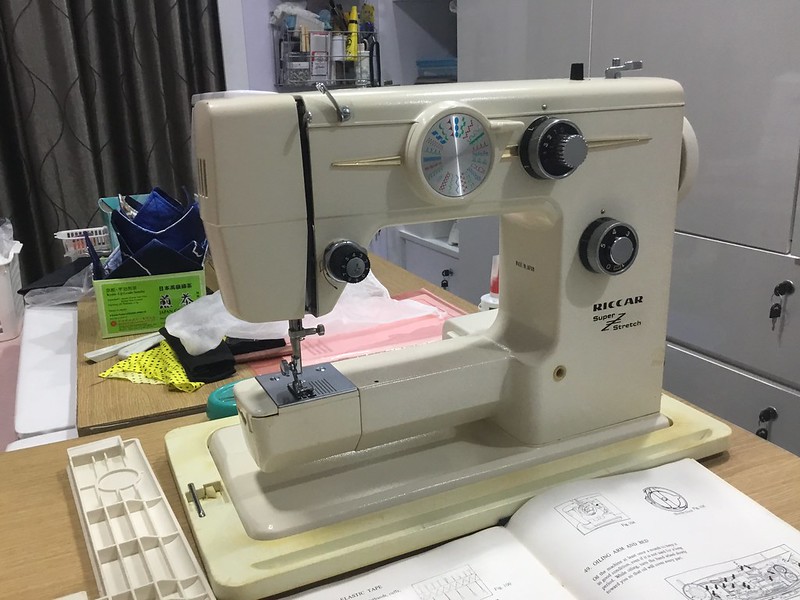
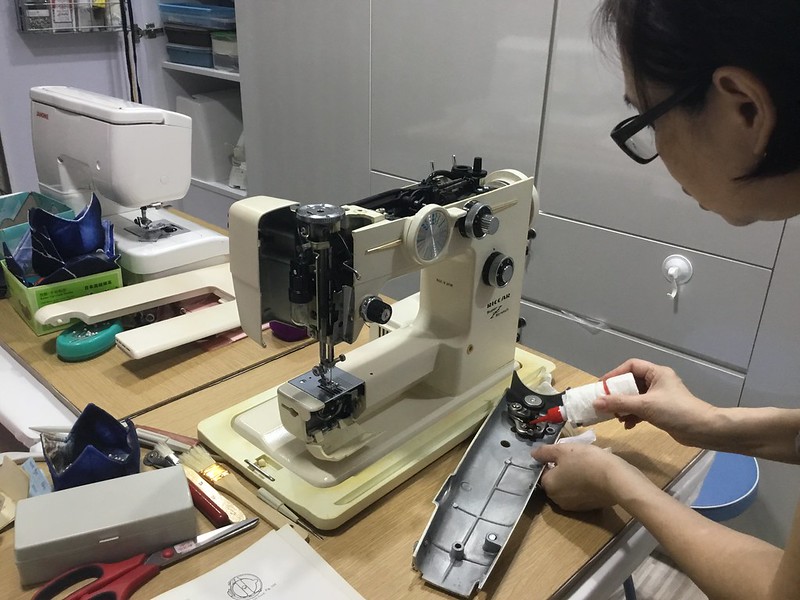
...but where the story actually begins is last weekend, when my mother handed down her old sewing machine to me!

Untitled

This was the sewing machine that my mother had used to sew everything well before I was born, and on which she had honed her amazing sewing skills to this point where she pretty much can make anything to an extremely precise, professional level. She also makes new strange mashups of things all the time. (Once, I came back home and found that she had sewn my old baybeats shirt into a crescent shaped pillow? And she made me a proper quilt from all the School CCA t-shirts I had worn in the past!) Factory-made clothing and sewn goods have got nothing on my mom's skillz! My Mom's expectations of proper standards of workmanship is so critical and precise that clothing from most 'fast fashion' shops feel like cheap bits of cloth carelessly tacked together in comparison to her workmanship.

My father said it cost a small fortune back in the day. This was years before I was even born, and my parents were very much younger, barely out of school and my father had only just begun working at that point in time so purchasing such an advanced machine at the time took years of instalment payments. But of course it proved to be a great investment towards my mother's incredible skills in sewing. If you know me in real life you will know that just about all the clothing that you see me wearing on an everyday basis was actually sewn by my mother. And all of it looks better and works better than store-bought fast fashion! She puts in huge pockets and even replicates the cuttings which I love the best.

A few of the dresses she made for me

Untitled

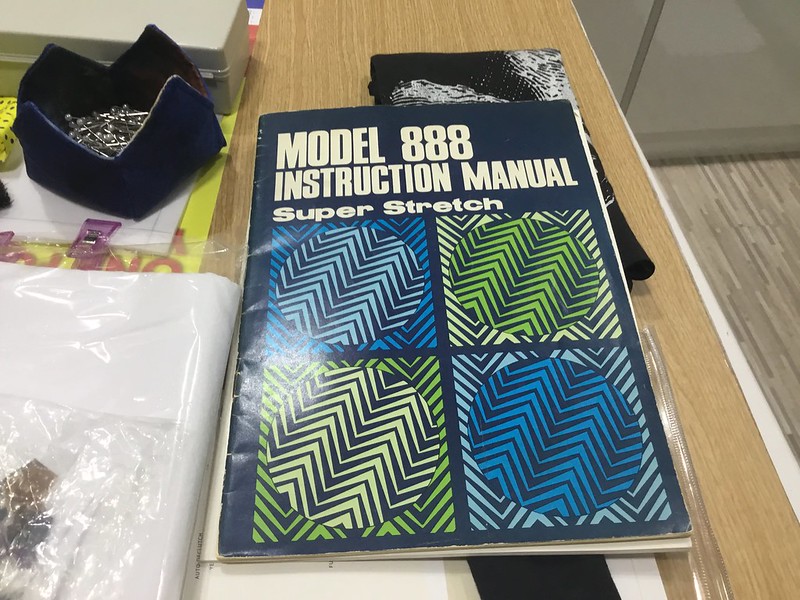
Most people are familiar with other brand names but according to the mother she had done a lot of research on the machines at the time and determined this to be the machine she really wanted. Looking it up it seems that Riccar was at one time the largest sewing machine brand in Japan and peaked in the 70s around the world, but went bankrupt in 1994 so the name is not heard so often today. Now this machine from the 70s is a VINTAGE machine.

Untitled

The entire body and all the parts are made of solid metal and it looks like a machine that could last for a lifetime if carefully maintained and oiled every year - unlike the plastic feel of many cheap sewing machines today.

Untitled

I did a bit of sewing practice with my mother's newer machine (she got a newer one with more button hole stitch functions and fancy stitches) and back at home with the Riccar I also did some sewing practice - but I soon realised I was very far off the mark and I'd need to put in a lot more practice to sew something of professional quality...

Untitled

But the thing I really wanted to write about is actually this. The mahjong paper.

It has occured to me that readers from outside of Singapore may have never heard this term "mahjong paper" which I had taken for granted was used universally to refer to a large white sheet of paper for art and craft purposes, or for wrapping books to protect their covers when you go to school.

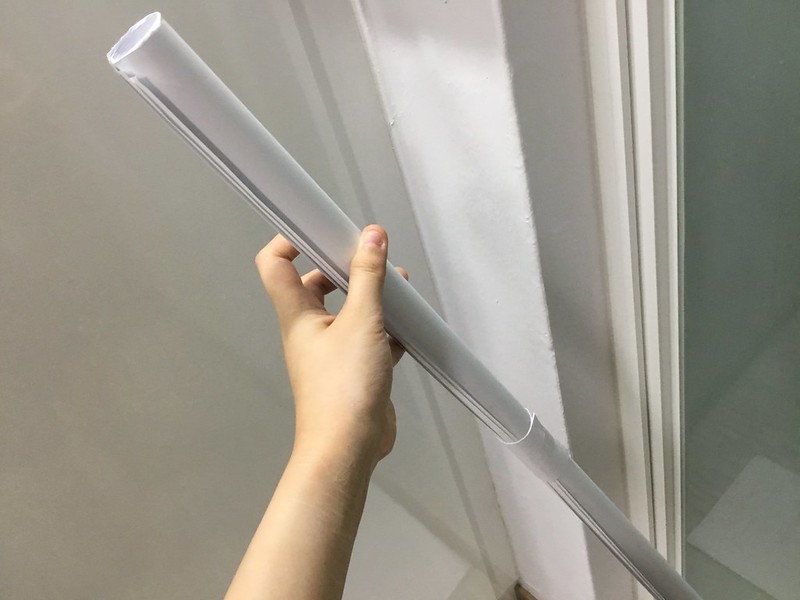
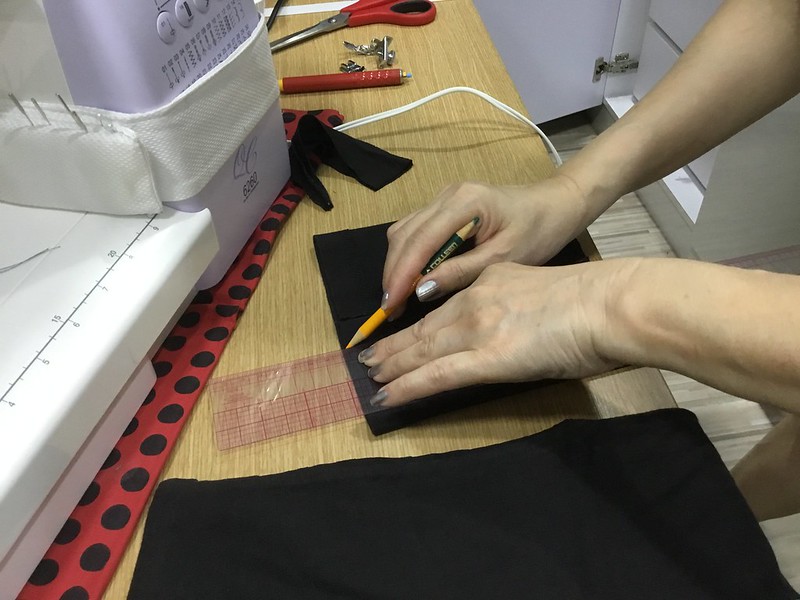
My mother bought a lot of this white paper in rolls so she could cut out patterns for the dresses and clothing she would sew.

I asked my mother if she could give me a few sheets from her extensive collection of papers - but at the same time I wanted to know what size it was.

The Ding Mother: "Its the size of the mahjong table."

DID YOU KNOW THAT MAHJONG PAPER IS THE SIZE OF A MAHJONG TABLE?


The Ding Mother: "The aunty who sold me this must have thought I'm a real big gambler buying them in rolls of 50. Little does she know I am just making clothing..."

A Totally Unrepresentative Poll of the First 10 People I Could Randomly Message on Whatsapp immediately showed that 9/10 Singaporeans I asked did not know that mahjong paper is produced, marketed, and sold named as such because of the superior tile sliding properties that the 'mahjong paper' affords the mahjong tiles!


I think I've carelessly referred to any large white sheet of paper as "mahjong paper" my entire life without knowing why "mahjong" was tacked onto the front of the word "paper" and I suspect this probably applies for many Singaporeans - that the term "mahjong paper" has come to mean "generic white paper" without any knowledge of its connection to mahjong. The 'mahjong paper' is bandied around in schools as it is cheaply used in so many art and craft purposes - and weirdly enough it is used without explaining the origin of its name.


If you google for "Mahjong Paper", you will see that all of the hits are from Singapore or Malaysian websites.
Google Trends states that a majority of searches for the phrase "Mahjong Paper" are from Singapore. (Quite a few of them must be from me)

The phrase "mahjong paper" does not appear in Google ngram searches, meaning that the term "mahjong paper" is not used in any books in the Google Books corpus.

And for all the all important question: What size is mahjong paper?

- Mahjong tables are always square, and around 81/82/86cm (playing surface).
- Most of the mahjong paper is around that size: 86cm x 86cm.

Thursday, 9 August 2018

Saigon Skydeck: Closeup from Afar

Untitled

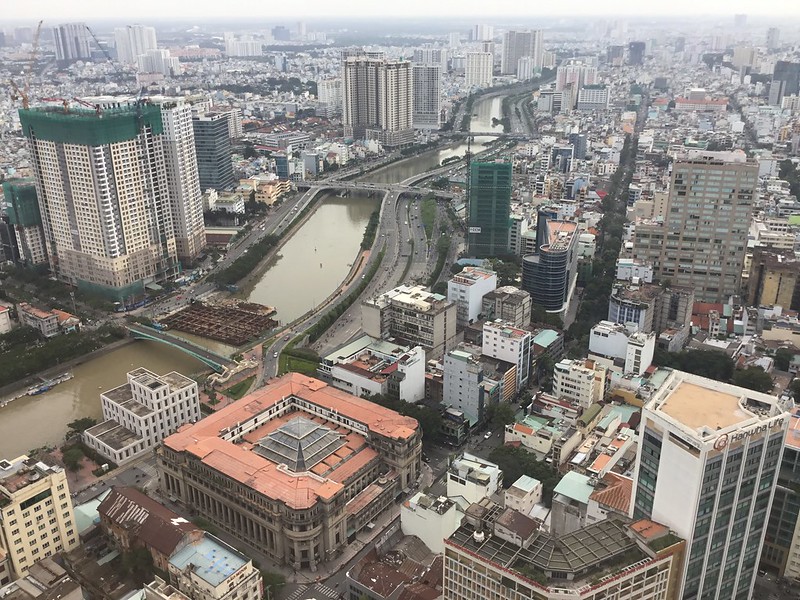
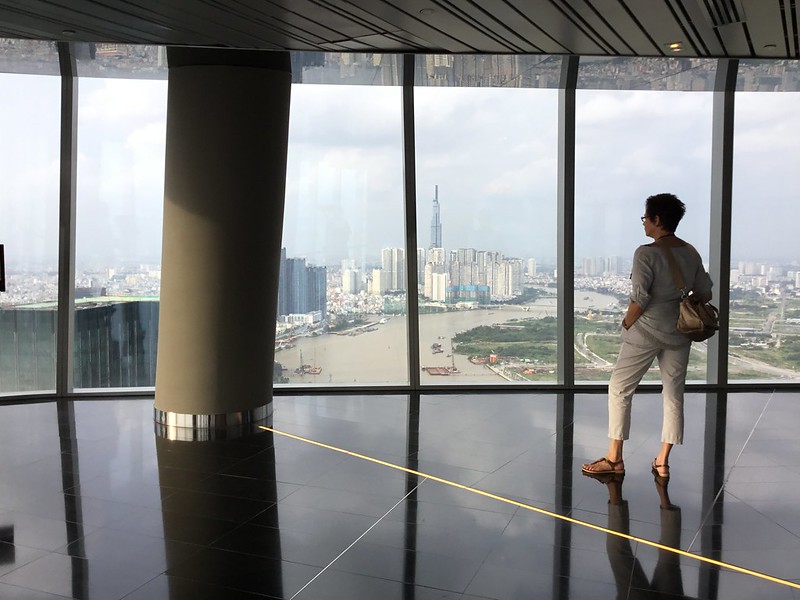
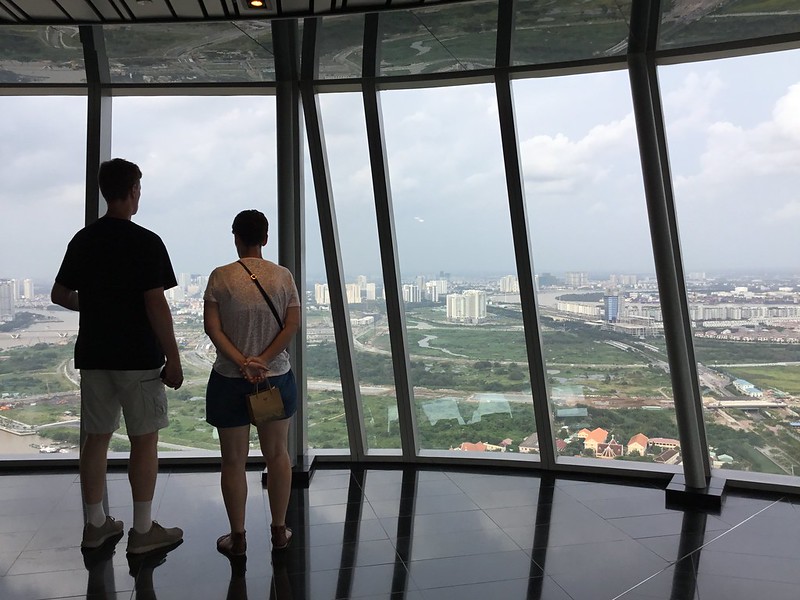
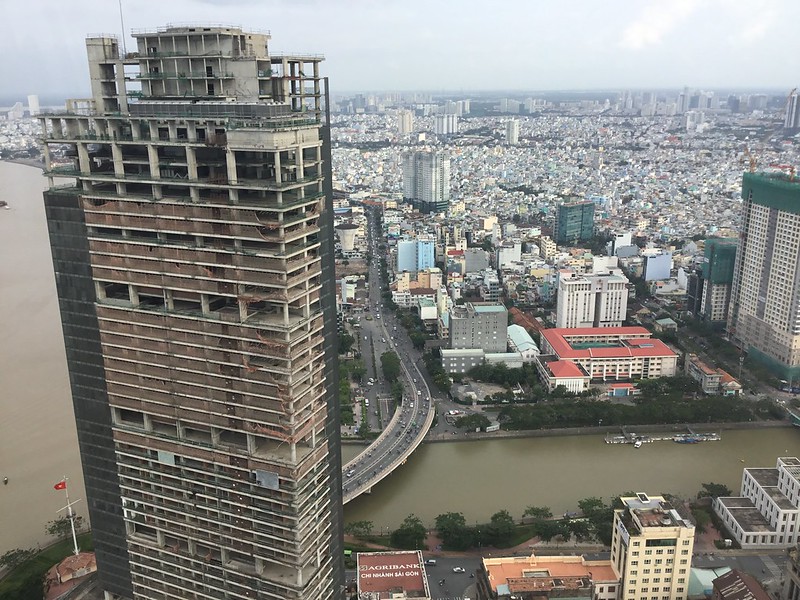
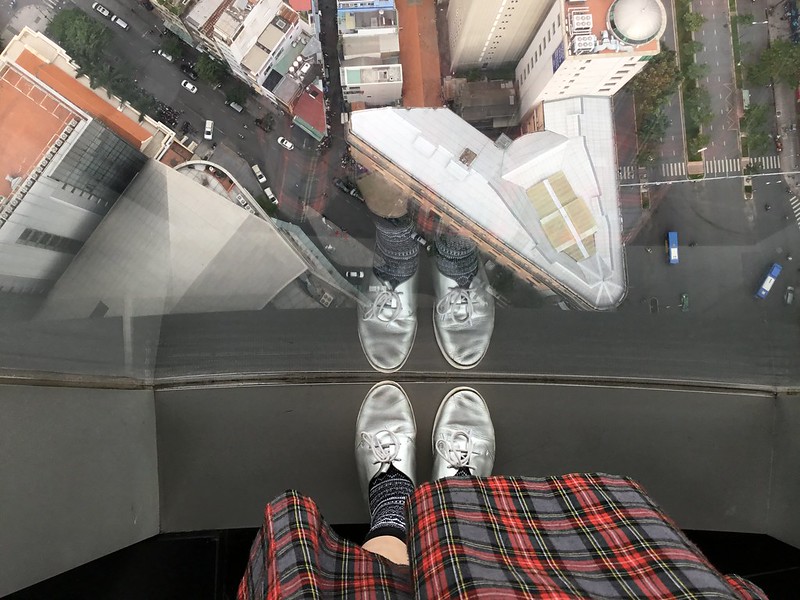
No visit to a new country for me is complete without an attempt to visit a Very High Viewpoint! Last weekend (was it only last week?) when I went to Ho Chi Minh City I went to the Saigon Skydeck where unlike many Very High Points use of the high power BINOCULARS ARE FREEE! (More on the binoculars in a bit...)

Untitled

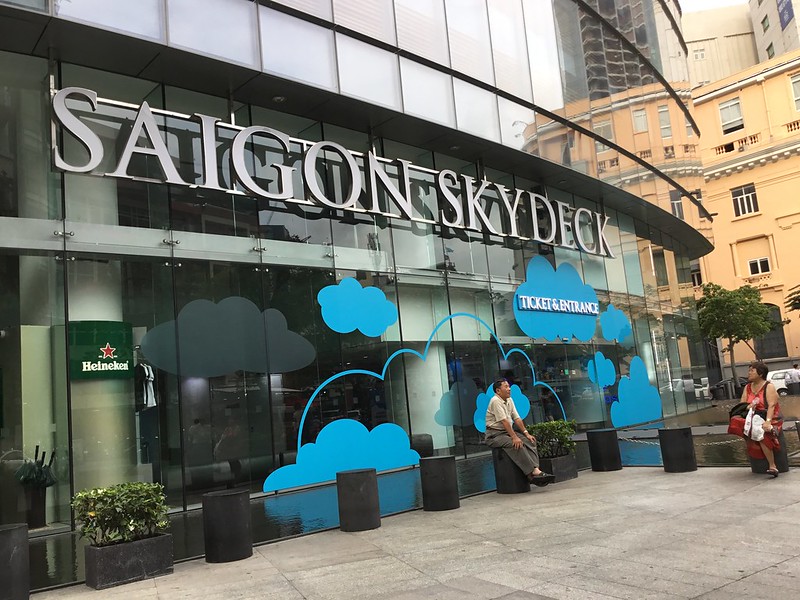
Ah! Look at these gentle carefree holidaymakers sitting outside this touristic viewpoint spot. This picture at the foot of the tower makes it look like going to this tower would be like going to visit other skydecks around the world where you're next to shopping malls and starbucks and all the other regular, humdrum accoutrements of modern life - but don't be fooled! This was nothing like the other skydecks I had visited in recent times (the walkie talkie in london, or melbourne skydeck88, or singapore's 1-altitude). Most skydecks are located in the CBD of the city, and most CBDs are full of futuristic skyscrapers which look the same whether you are in Singapore or in Europe. Ho Chi Minh is no different, but then THE ROADS; THE ROADS, THEY ARE DIFFERENT.
I'm not sure whether I am pleased to find that it wasn't like just walking through a generic urban CBD to the Skydeck. Is it good for everyday tasks like crossing the roads to feel like massive challenges? I guess this is Life for a lot of people. For me (as a visitor to Ho Chi Minh on a very short first time visit), the walk to Bitexco Financial Tower involved lots of defensive jazz-hands at the nonstop onslaught of motorbikes and a couple of near-death experiences (because if you horn at me my instinct is to stop or even walk backwards - very confusing to drivers and very bad form in Ho Chi Minh I know). And that makes going to the roof a bit different; to be gleefully plucked away from the mess and terror of the roads.

Untitled

Untitled

Untitled

Untitled

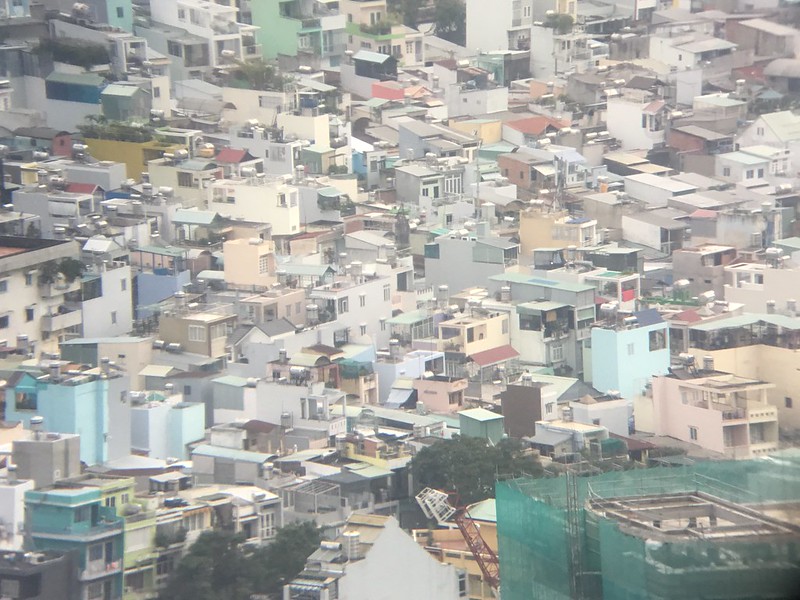
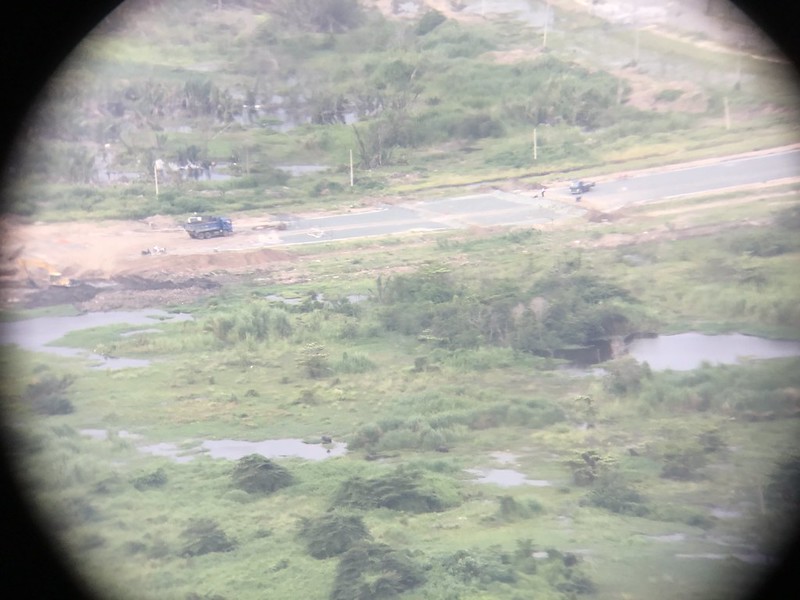
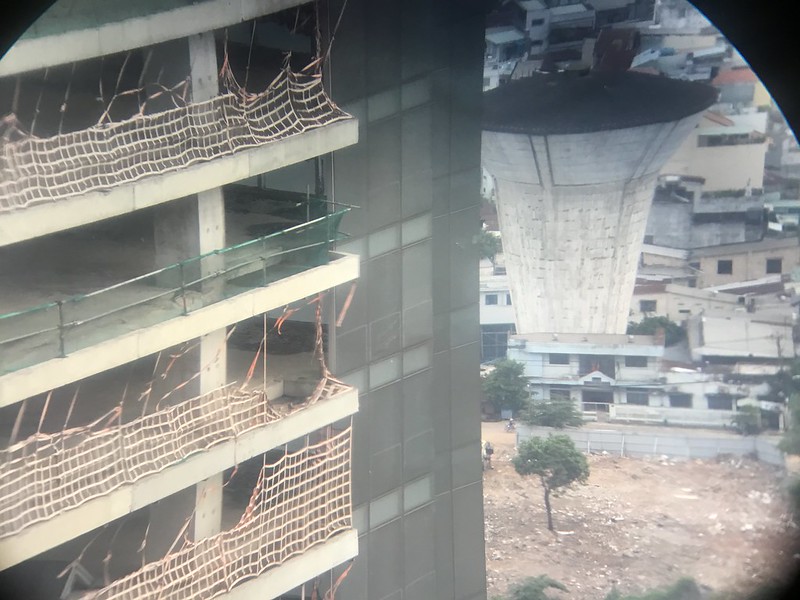
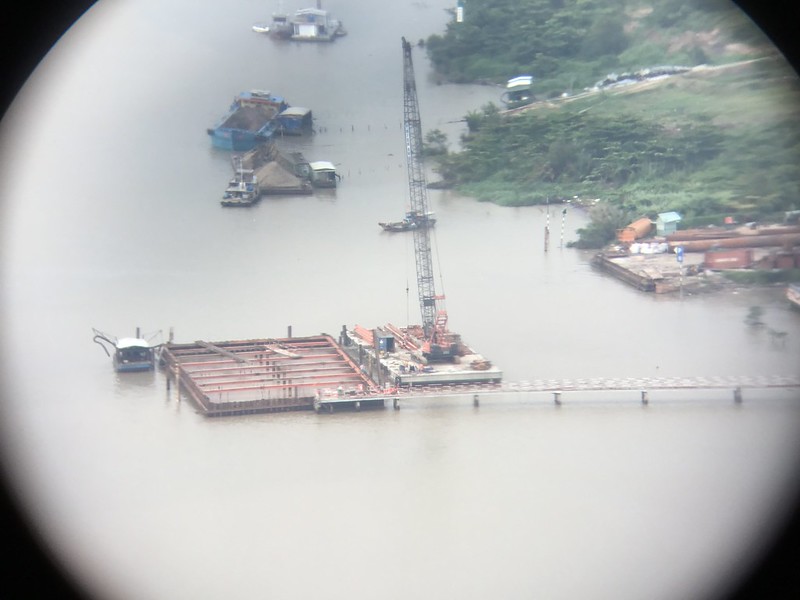
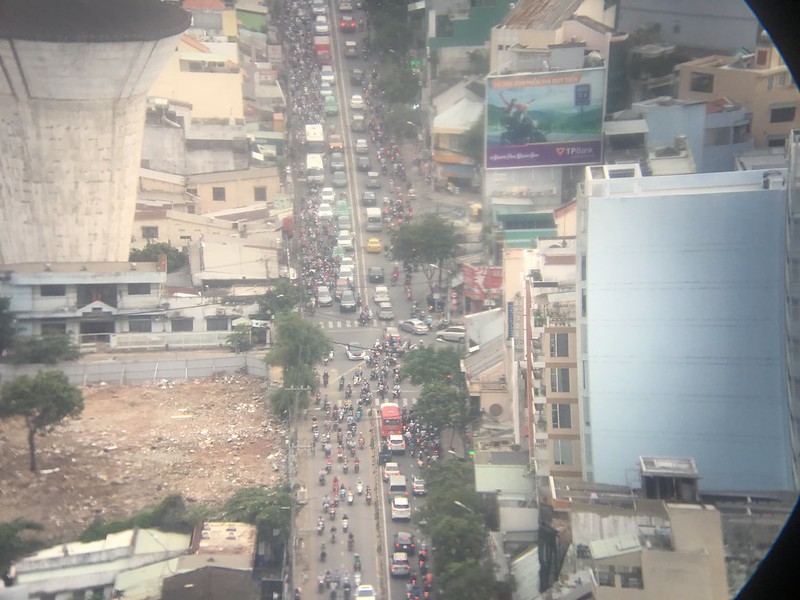
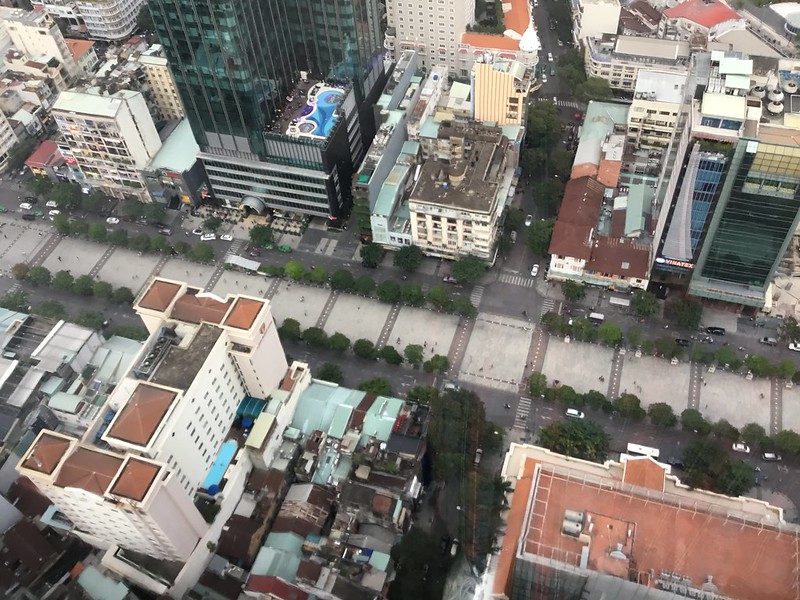
One great thing about the Saigon Skydeck is that the binoculars are FREE! I spent a very long time playing with it. Here are some of the shots taken through the viewpoint of the binoculars:

Untitled

Here you can see how all the houses in Saigon are stacked on top of one another, all higgledy-piggledy. I'm not sure if there is an explanation for this but this viewpoint gives me the impression that a lot of development here is all random piecemeal bits stuck together at different times.

Untitled

I saw two men standing in the middle of a deserted construction site. One of them crouched on the ground for a long time and I watched him eventually stand up but he did not do anything. Two men who don't know I've been staring intently at them with a giant telescope from the top of Saigon Skydeck. I must have watched them for over 5 minutes but they just didn't walk around or do anything. They were probably talking but I don't have a sonic telescope.

Untitled

Distant ribbon barriers on an incomplete high rise building, fluttering in the wind...

Untitled

Floating pontoons and machinery slowly moving in the distance...

Untitled

Nonstop traffic in the middle of busy intersection... imagining whether the people below know that someone is spying closely on them from far away...

Untitled

I'll end here with a picture of Nguyen Hue from above...

Friday, 3 August 2018

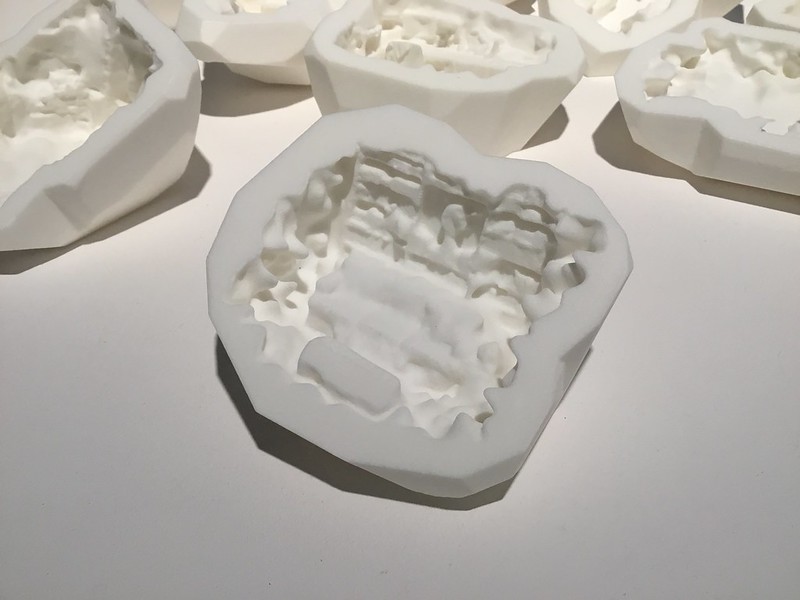
Space Geodes at Ota Fine Arts Singapore (4 August 2018 - 15 September 2018)

Untitled

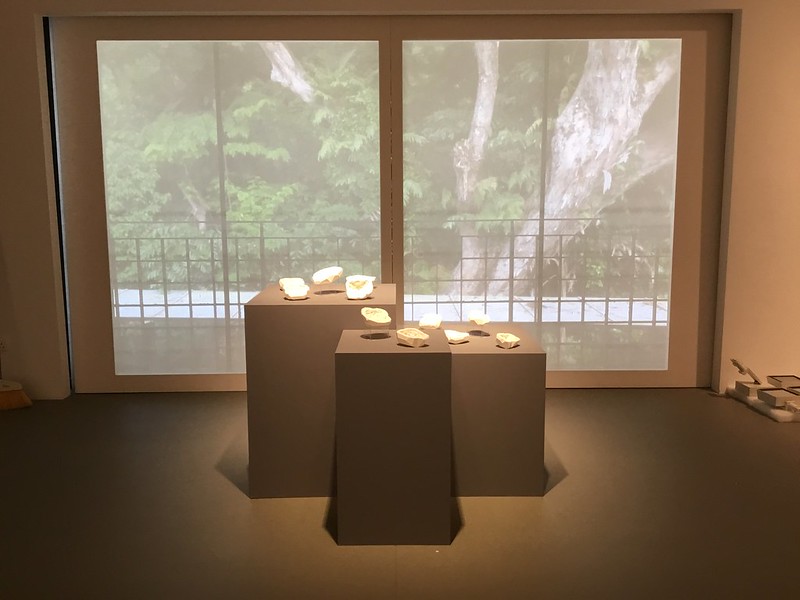
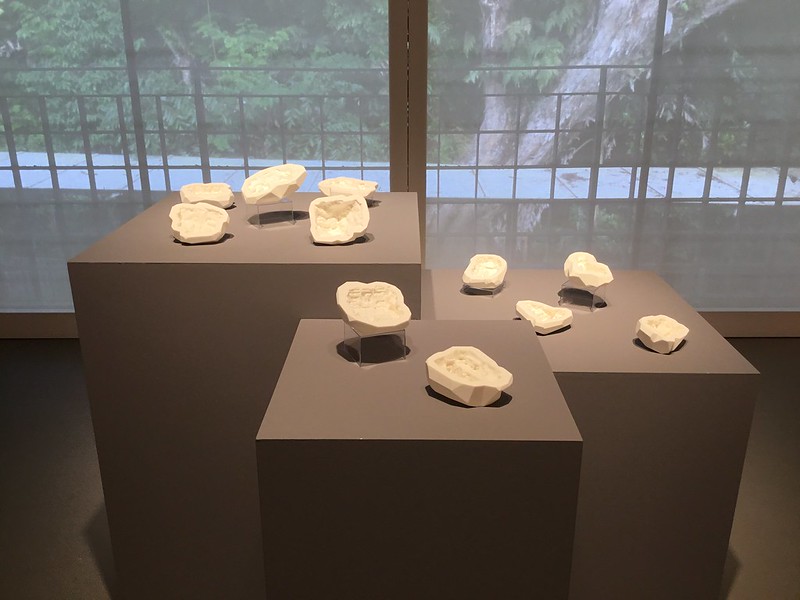
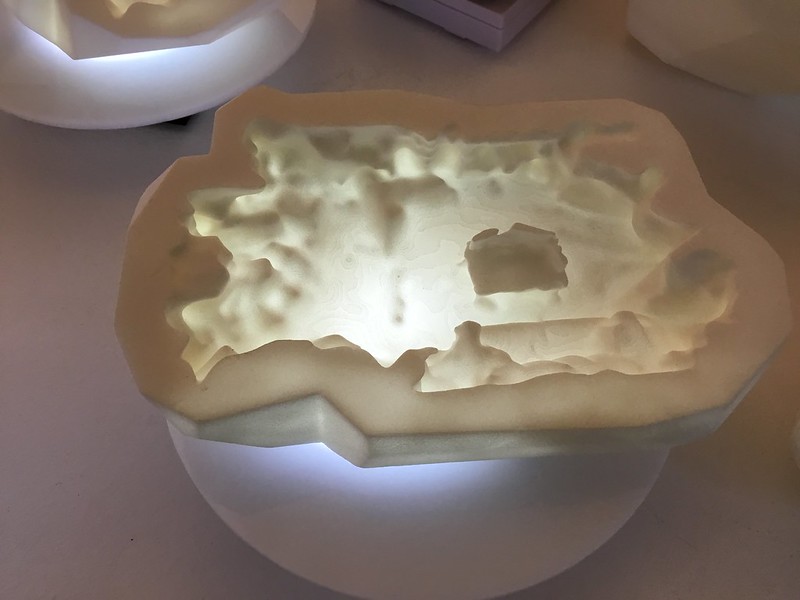
The show at Ota Fine Arts is all set up, with many thanks to Jodi for inviting me to show the work. I've shown this work two times but this is the first time I had the option of REAL PLINTHS. I previously used all acrylic casings as plinths. At the time it was a practical decision as I was using whatever unwanted 'plinth'-like items I could find and The Substation was getting rid of these old casings - but also it was a consistent material to the rest of the work. Plastic upon more plastic!

[PS you can read more of my writing about the work here as well:]
Space Geodes: On the 3D Printed prototype as Digital Fossil
Space Geodes at Singaplural 2016
Public Service Notice about Geodes

dsc0492
Left: Space Geodes at Singaplural 2016. Right: Space Geodes at Objectifs in 2017.

Untitled

Space Geodes at Ota Fine Arts in 2018

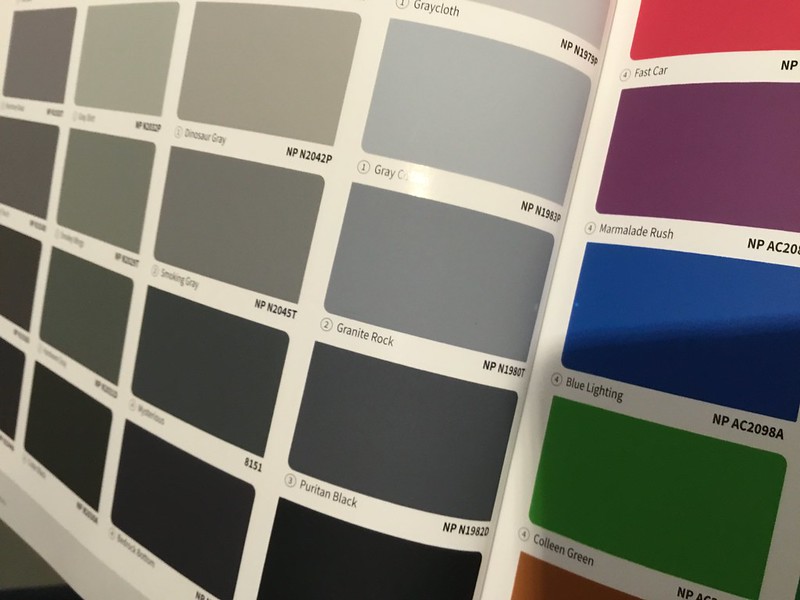
Given free choice over the colour that I would want the plinth to be, I'd always choose Grey as a neutral base over White or Black. We chuckled over the names given to the colours and I have to admit I was almost tempted to choose a colour simply because it was named "GRANITE ROCK" or "SLATE GRAY". (Ultimately if the names given to the colours by savvy paint companies were totally ignored, the choice would have been very clear to me anyway; it was always going to be a specific warm mid-range sort of grey for which I don't have a name but can always pick out of a lineup)

Untitled

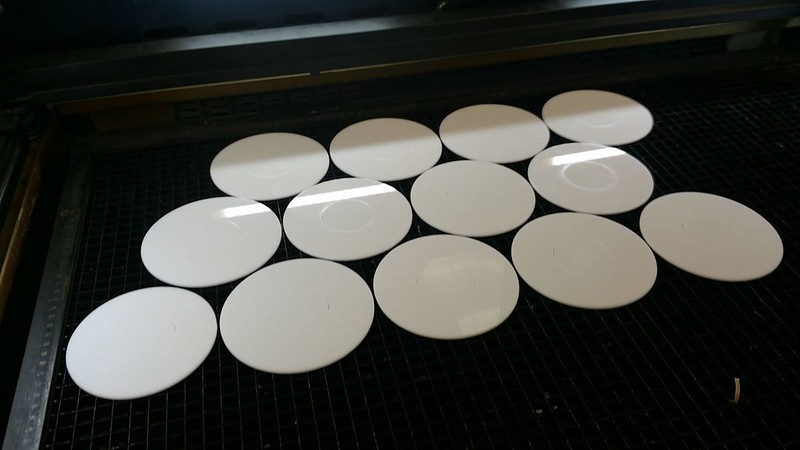
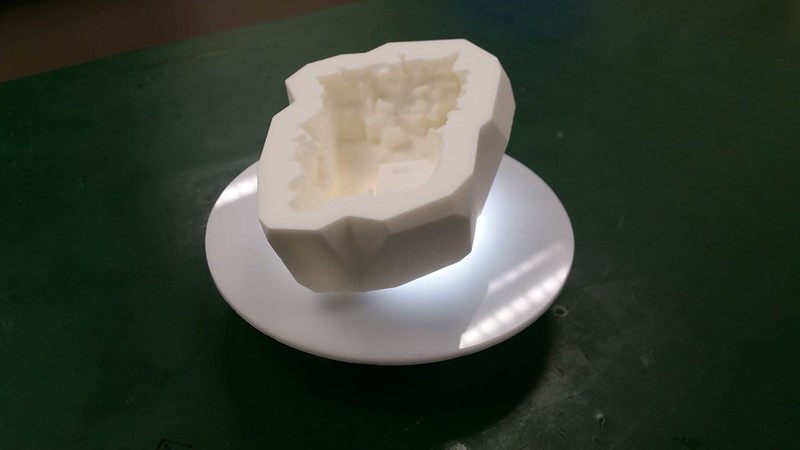
I did give the arrangement more thought this time around. Recently I've been enjoying laser cutting a lot because I now have access to a lasercutter in the NYP Makerspace which is literally a 5 minute walk from where I am staying at the moment (and its under-utilised!) so as a simple experiment I tried to make an acrylic base/riser which would also light the work from beneath.

Geode

Geode with base

The only reason I haven't gone with this lighting option is the fact that there is a little colour discrepancy in the "white" when it is lit. My lights and acrylics are too "laser white", whereas the work glows with a warm white. Weirdly enough, some of the works looked more yellow when lit, as if they differed in thickness, which I couldn't understand to be the case since they were designed as hollow shells of the same thickness for the SLS process (to save on material cost)

Untitled

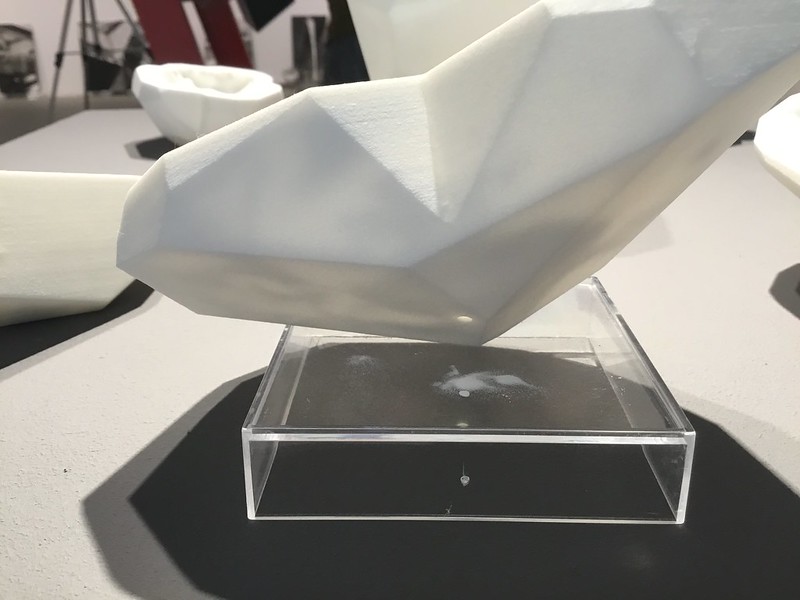
The answer as to why there was a discrepancy in thickness and lighting became clearer later. As I was arranging the works yesterday, POWDER STARTED COMING OUT OF SOME OF THE WORKS. The powder had been thicker in some portions so that was why the lighting was not consistent. Having shown the works two times before, I was surprised that powder was draining out now when I'd have expected any excess powder to come out of the work in the previous round. Perhaps it was all the transportation and vigorous moving about that dislodged the excess powder hiding inside the print, for the white nylon powder began issuing forth from the escape holes I had designed for the works.

Perhaps on previous viewings we had treated the works so very softly and cautiously as if we were handling live explosives - but this time around I put them in a basket for rocks and slung them over my shoulder as I carried them to the gallery.

Untitled

For those unfamiliar with the Selective Laser Sintering (SLS) process, it is an additive manufacturing process in which the laser sinters the powder into a solid material, but because the material itself is quite costly, designers often design the part as a hollow part with some escape holes so the excess powder can be shaken out. I would have thought that all the powder from before had been shaken out by now!

Its a bit funny as come to think of it the white powder flowing out visually resembles a weathering process in which the rocks break down into smaller particles. Earlier in the day I was also just building a prototype for a new work in which one can see material flowing in a similar way. When something breaks down into particles that small, the dust is literally blown into the wind. There's no "trying to collect it in a cup and sticking it back together". Its just gone, blown away, it ceases to be an identifiable part of the thing it was once part of.


Prototype for a new work

The private view for the group show is tonight - please come down to see if it you're in town!

Untitled

The exhibition will be on view from August 4 through September 15, 2018 at Ota Fine Arts, 7 Lock Road, #02-13 Gillman Barracks, Singapore 108935.


SPACES
Kray Chen | Sheryl Chua | Debbie Ding | Hilmi Johandi | Tristan Lim | Ian Tee
4 August – 15 September 2018

Opening Reception in the presence of the artists:
Friday, 3 Aug 2018, 6.30 – 8.30 pm

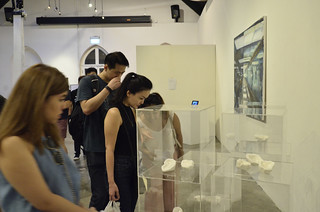
Ota Fine Arts Singapore is delighted to present SPACES, a group exhibition featuring 6 artists from Singapore: Kray Chen, Sheryl Chua, Debbie Ding, Hilmi Johandi, Tristan Lim and Ian Tee. This exhibition showcases each artist’s reaction to the spaces and structures in contemporary society, as well as a more formal focus on pictorial space. From painting to photography, video, 3D print and textile work, diverse expressions by the artists discuss relations between the virtual/imaginary and actual spaces.

Thursday, 2 August 2018

Ho Chi Minh: Dates in the Pavement

I hate crossing the road in Ho Chi Minh. Ho Chi Minh was not made for pedestrians. Turns out that when it comes to the bottom line, I am actually extremely risk-adverse as a pedestrian. Or maybe I am a soft and flabby urbanite. Or maybe I just don't have a death wish?

Perhaps it was the law-abiding Singaporean in me who was extremely averse to crossing the road if the bikes and cars did not stop first. Unfortunately, the traffic NEVER DIED DOWN, so on at least 2 occasions I was frustratingly stranded on the wrong side of the road for up to 20 minutes. (Mom, if you're reading this, you probably never want to visit HCM, because if you already hate crossing a 4 lane road in Singapore, then you're going to HATE having to cross an eight-lane road in HCM where the traffic WILL NEVER STOP. Oh my word just thinking about it...)

I don't normally talk about my neuroses and latent anxieties on this blog but that time I was in Jatinegara in Jakarta and people were sitting near a live train track and everyone seemed cool with it? NOPE.... Live train tracks and DANGER OF INSTANT DEATH are still inextricably linked in my mind. Or that other time when I was walking along the North Circular Road in London next to high speed traffic on the motorways? Yeah even though I'm safely on the pavement which is well away from the main bulk of the speeding cars, and even though London's motorways are supposed to be one of the slowest yadda yadda, if there are vehicles speeding next to me then I'm still fully at HIGH ALERT. Because speeding metal boxes whizzing past me still translate as DANGER OF INSTANT DEATH.

I mean... I'll still walk around places which feel risky (because I don't want to let fear to keep me from doing what I feel like doing) but it doesn't change the fact that its actually still anxiety-inducing for me.

I was attending a wedding in Ho Chi Minh last week and on the first day I arrived I immediately had two near-collisions. (TOP TIP: DO NOT SUDDENLY WALK BACKWARDS!!! BUT OBVIOUSLY DUH NO ONE EXPECTS PEDESTRIANS TO WALK BACKWARDS IF YOU SHOCK THEM BY BEEPING YOUR DEAFENING HORN AT THEM.) I developed a tension headache almost immediately. I even began plotting routes which would minimise my need to cross the road. I was like, Goodbye Family Mart across the road I will never know you because you are on the wrong side of the road and I will never get there. Welp, guess I won't get to the Independence Palace because I can't cross the tiny road in front of it. (Two days later I finally managed to cross that road).

I was chagrined to have been told by Rich that the street I was on (Phạm Ngọc Thạch) was in his opinion a great road to walk down with old trees lining it and the turtle roundabout at one end. YEAH I KNOW IT IS TOTALLY LEAFY AND NICE BUT I STILL CAN'T CROSS THE ROAD!

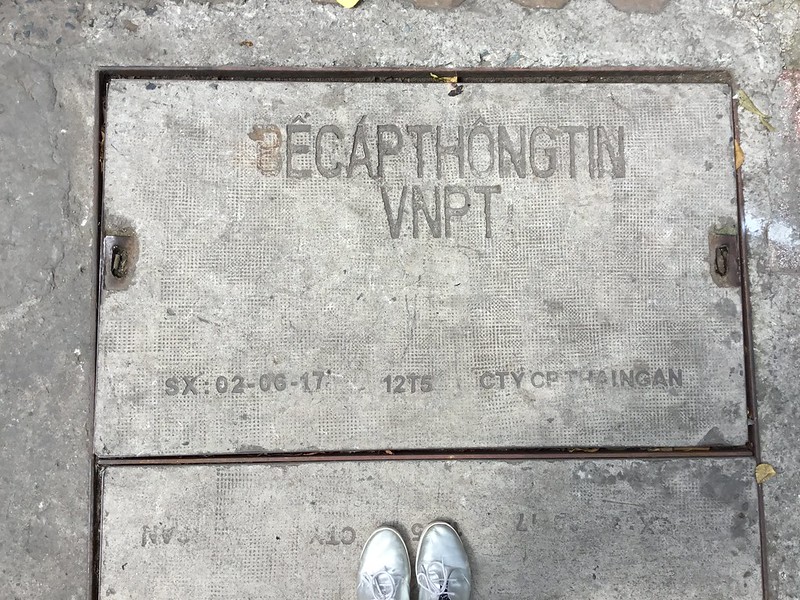
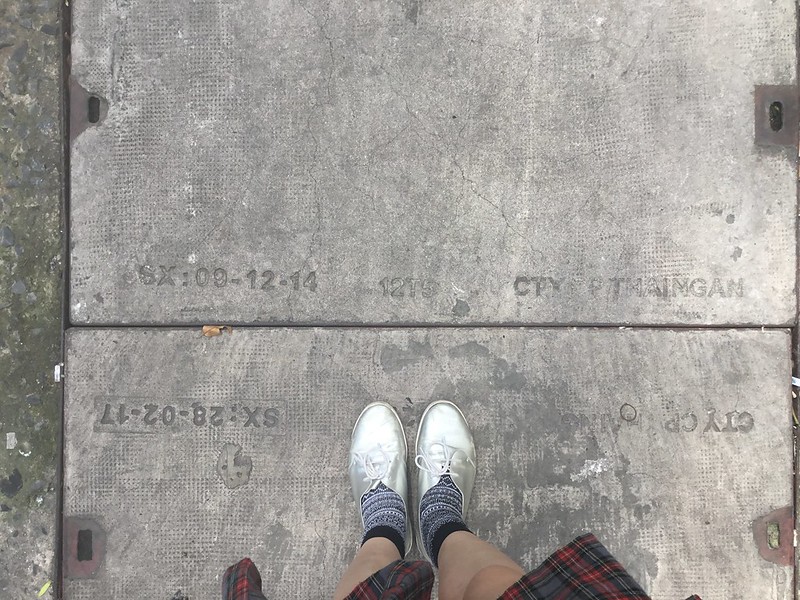
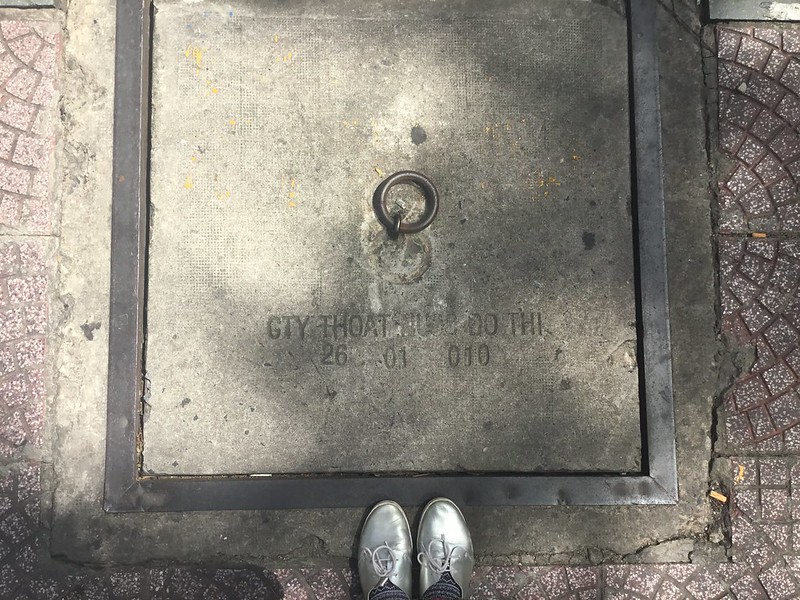
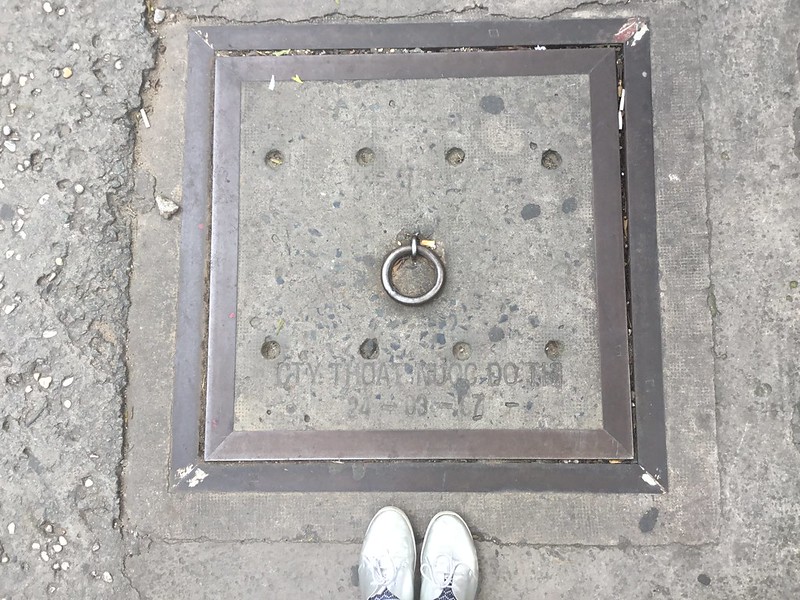
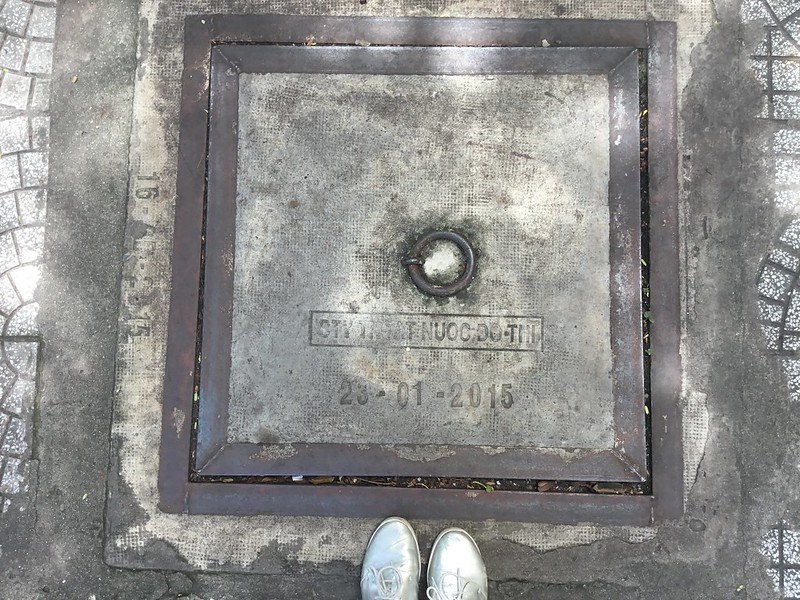
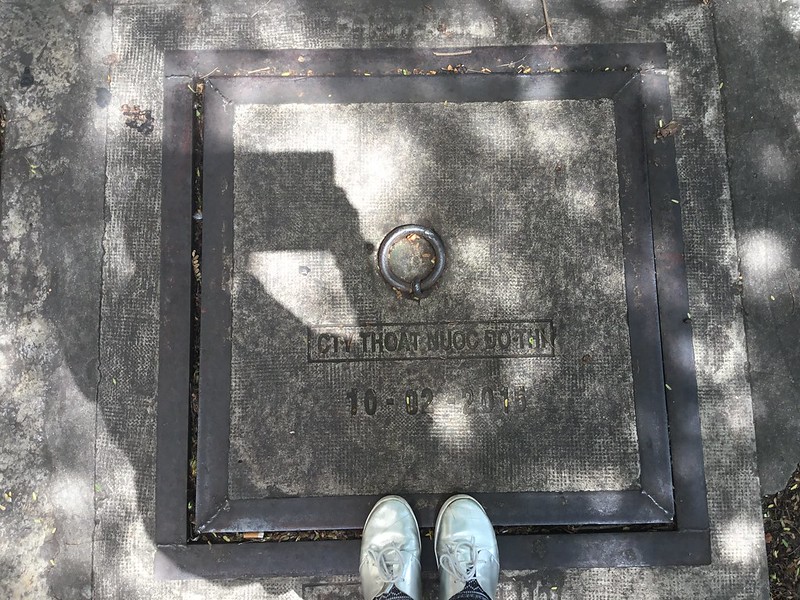
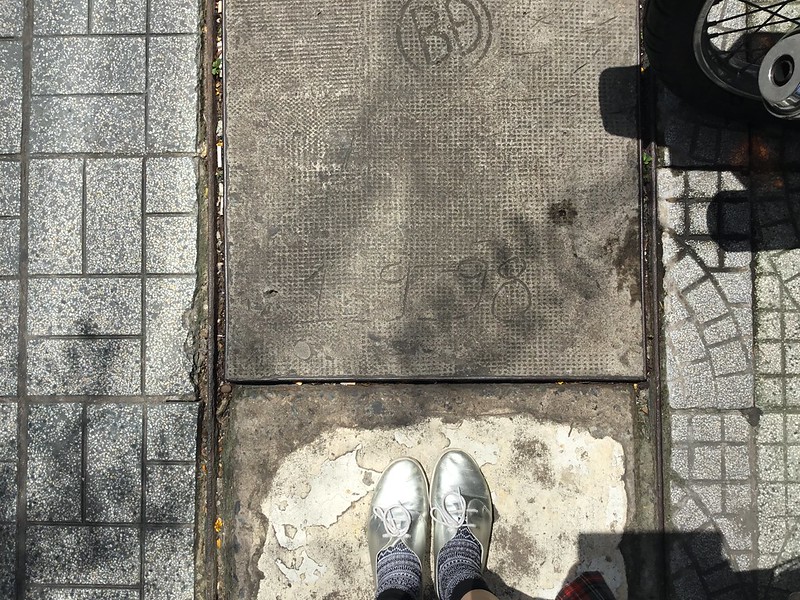
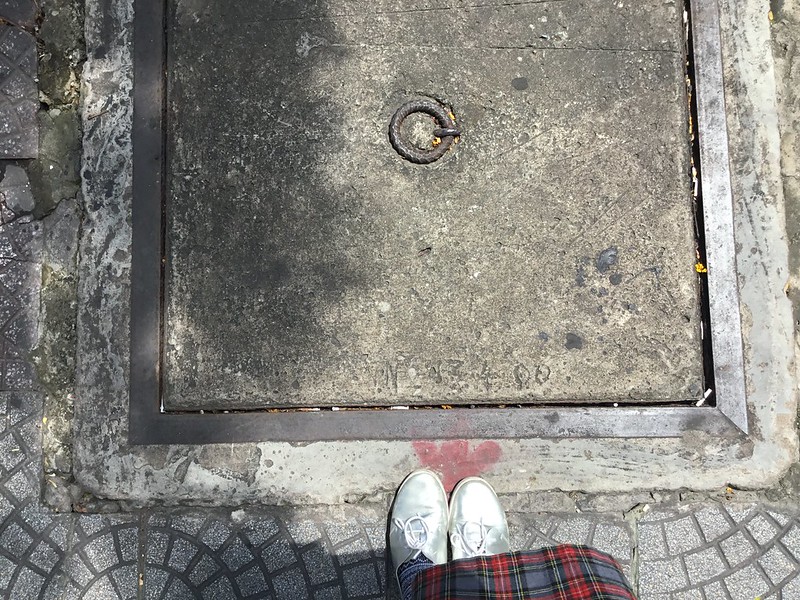
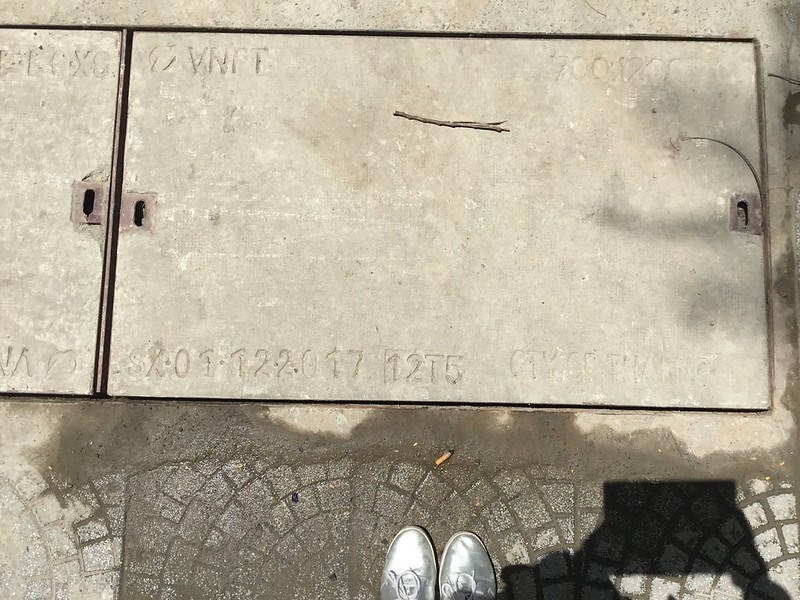
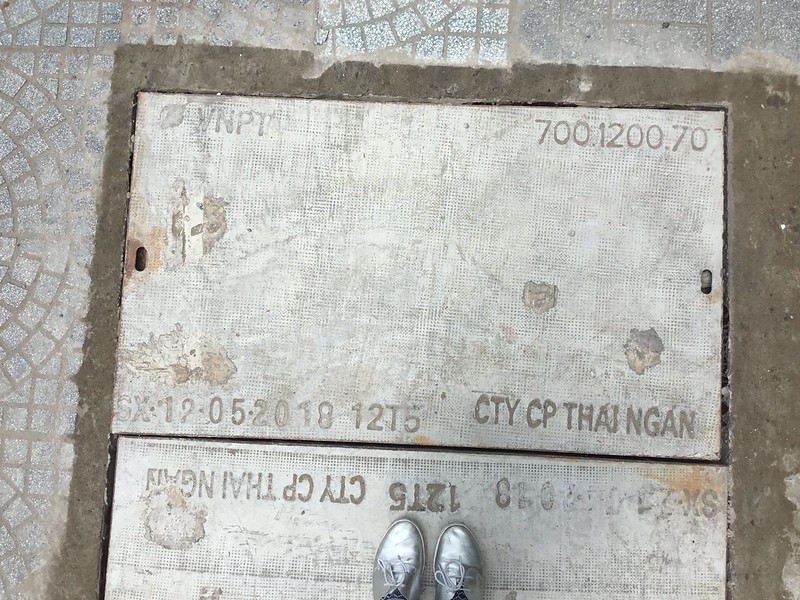
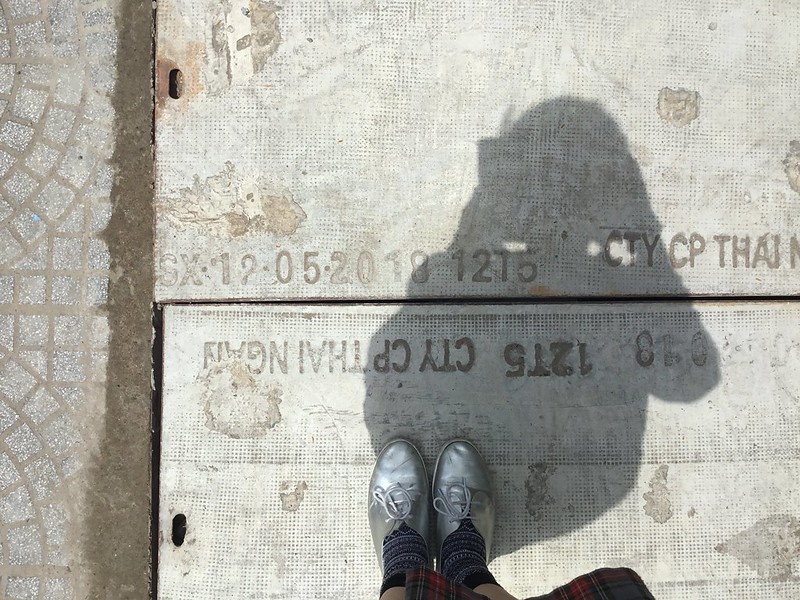
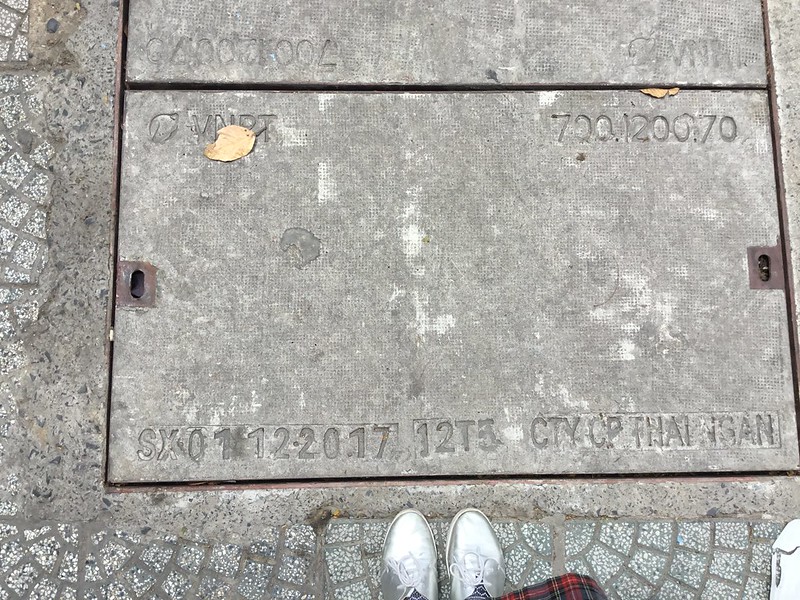
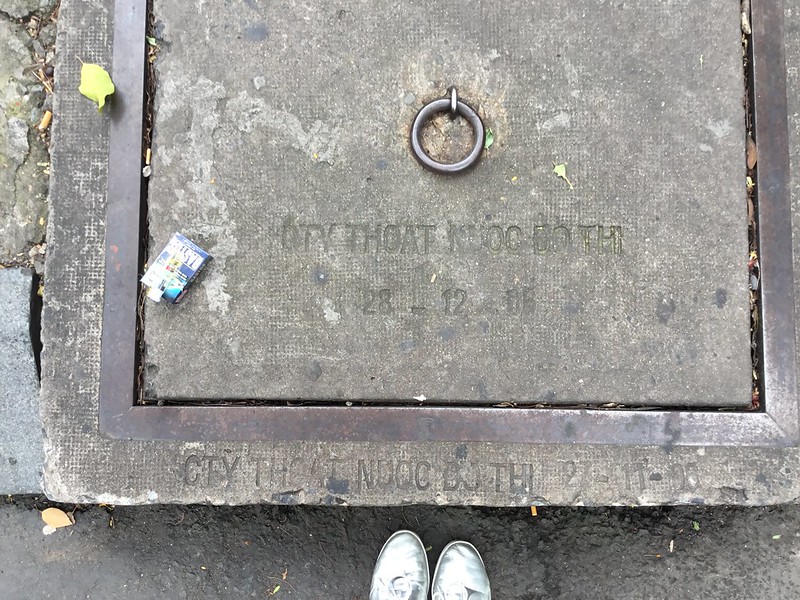
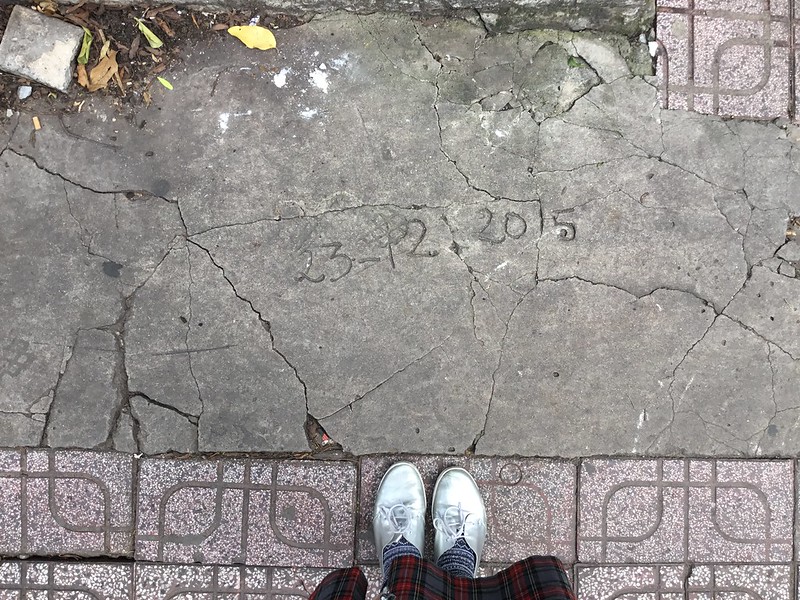
Anyway, despite my instant hatred for crossing roads in Ho Chi Minh City, I eventually found a good reason to get me walking about even though I was fearful of the roads. As it turns out, in Ho Chi Minh City you'll find a lot of dates stamped into the pavements, on the telecomm network and drainage system covers. The words on the pavements indicate that the dates were left by Vietnam Posts and Telecommunications Group (VNTP) and Ho Chi Minh City Urban Drainage (Cong ty Thoat Nuoc Do Thi). I've only seen this in one other city (Paris) where I also spent a lot of time photographing these dates and mapping them out.

Here is a selection of dates inscribed into the pavements of Ho Chi Minh:

Untitled

Untitled

Untitled

Untitled

Untitled

Untitled

Untitled

Untitled

Untitled

Untitled

Untitled

Untitled

Untitled

Untitled

This is not an exhaustive list of photos I took but it seems the earliest one I saw was dated from 1998. My favourites are the hand-made dates. What's pretty interesting as well as is that sometimes the manhole and the cover for the manhole have a different date! Never seen that before in any other city.

More Ho Chi Minh posts coming up...