Saturday, 22 August 2015

Becoming Peranakan

Yesterday night I did a whirlwind tour of the Peranakan Museum during the Night Festival. Halfway through I became very confused at what I was looking at; I had to turn around and go around looking around for the definition of Peranakan. I even went from the top floor to the bottom floor to look through the flyers at the ground floor, but my confusion increased amidst the thick Night Festival crowds.

The most confusing part was the “Great Peranakans” exhibition upstairs. The list of Great Peranakans included Tan Kim Tian (the leader of the teochew community) Tan Kim Ching (president of the Hokkien Huay Kuan), Tan Beng Swee (founder of the Tan Clan temple), Tan Kim Seng (a leader in the Hokkien community), Tan Tock Seng (a leader in the Hokkien community as well), other famous chinese people like Gan Eng Seng, Tan Keong Siak, the opium king Cheang Hong Lim, Seah Liang Seah (leader in the teochew community).. the list goes on.
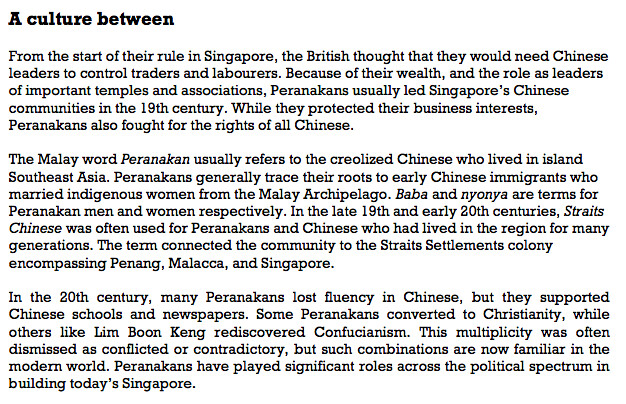
Screen Shot 2015-08-22 at 9.20.37 am

From the exhibition guide to "Great Peranakans"

It is noted that Peranakans refers to “locally born” straits chinese who retain their chinese names and some cultural elements - but who have also embraced malay culture and hybridised it into their own at home. It is also noted that Peranakans were “differentiated” from the rest of the China-born chinese in Singapore because most peranakans tended to be from a higher socio-economic class, and were favoured by the british for their loyalty and fluency in English.

This baffling and preposterous list seems to suggest to me that one becomes a Peranakan by being an ethnic chinese who has many business connections and is very rich and influential and is adaptable to both malay and british culture. The long descriptions for the influential Singaporean Chinese who have been considered “peranakan” shows that whilst some married in or were the descendents of the initial group of 15th century Straits Chinese, many others simply became peranakan just by being really rich and powerful in their dialect communities, and most importantly also were validated by the British authorities as being community leaders.

Our general confusion in what constitutes the definition of “peranakan” seems to have been foreshadowed by the British confusion and difficulty in defining chinese hybrid identities, yet formally requiring some “name” or term to differentiate the original straits chinese (whom they could trust and give power to) from the newer chinese migrants (whom they thought of as being poor, transient, less loyal and more ideologically dangerous).

Before this, I must confess that I knew very little about who was Peranakan in Singapore. The day before I had been at NUS Library (still undoubtedly the best library in Singapore) and I had picked up a paper by mistake about the decline of the babas (babas refer to peranakan males, nyonyas refer to peranakan females). The title was very long and poetic so it attracted my attention and I skimmed through it quickly. I took a picture of one of the pages because the lines jumped out at me:

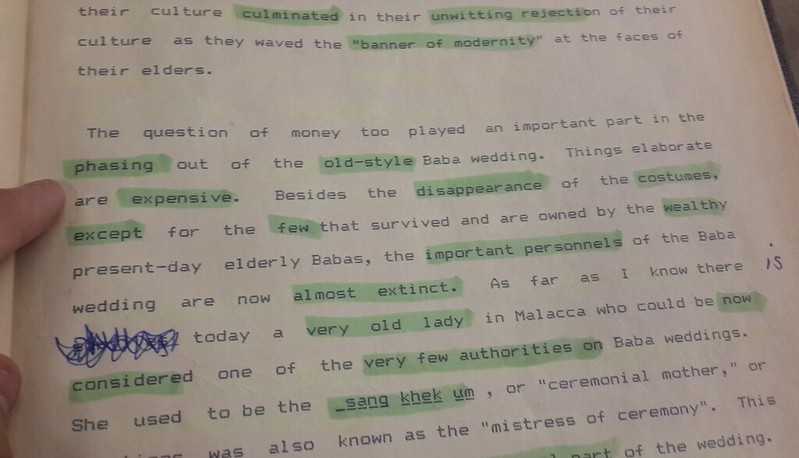
Screen Shot 2015-08-22 at 9.56.18 am

Screen Shot 2015-08-22 at 9.57.26 am

...their culture culminated in their unwitting rejection of their culture as they waved the “banner of modernity” at their elders... The question of money too played an important part in phasing out of the old-style baba wedding....

If the identity of the peranakan is defined by its flexibility and adaptiveness in hybridizing the chinese and malay cultures, then why isn’t it more prominently mentioned everywhere that this same adaptiveness also involved money! Being rich allowed one to ostentatiously spend on cultural objects, and fund the creation and design of hybridised cultural objects. And another thing is that it clearly involved becoming modernised, or in some part perhaps even being an anglophile? What

What I am disturbed by is: why does the Peranakan Museum seem so fixated on displaying the aspect of it being an asian fusion of malay and chinese? What of their westernisation, and their willingness to embrace modernity? Isn't this foresight and embracing of modernity something which predisposed these 'peranakans' to becoming shrewd businessmen and community leaders? Is the notion less marketable as a ‘cultural attraction’ if the peranakans are also seen as being ethnic chinese who basically modernised and absorbed BOTH malay and british culture?

I mean, I am a locally born ethnic Chinese; I only speak English with my parents; I cannot speak Hokchew dialect and feel no direct connection to my Chinese heritage; I can speak a smattering of functional malay words; I often eat and cook malay/indo/chinese fusion dishes at home; I’m self-confessed anglophile who spent four years studying English Literature and another four years (so far) living in London; perhaps if I tried I could pull off the outward pretense that I’m somehow becoming richer and more influential and more upper-class (hur hur hur).. so..

...GUYS, I THINK I'M BECOMING PERANAKAN.

On next week’s reality tv episode:
Debbie has announced that she has decided she is becoming Peranakan and tries to get George (British Person) to validate her Peranakanism so she can design and throw a lavish peranakan wedding. But George has other ideas. And where will they get all that money? What will happen in the next episode of the Great Peranakan Dream? Stay tuned to find out...

Wednesday, 19 August 2015

Moire Colour Banding

moirendp

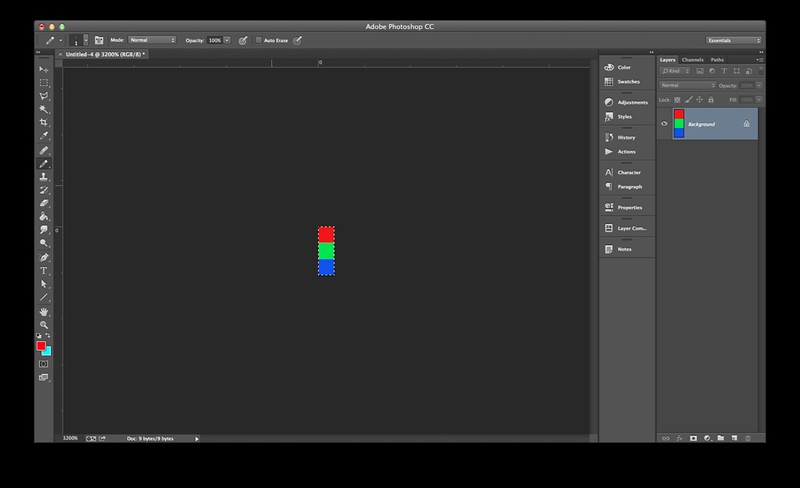
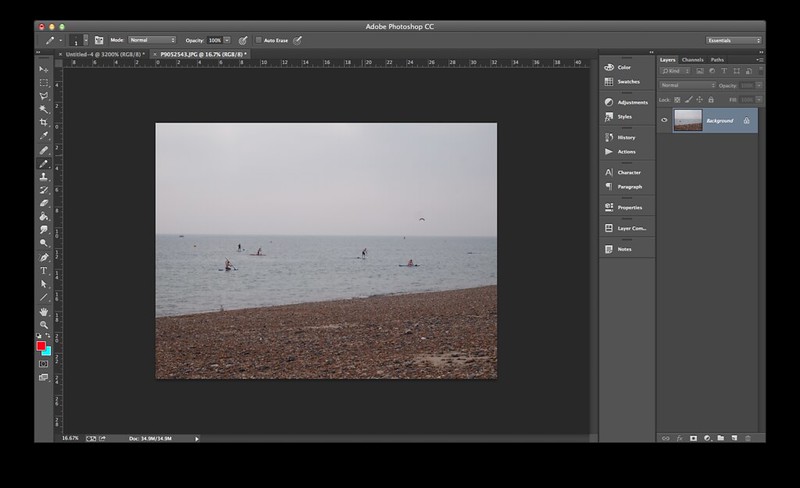
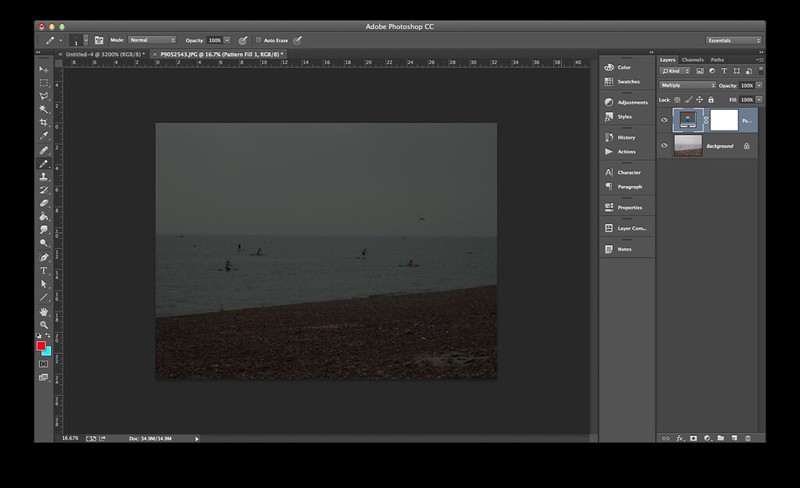
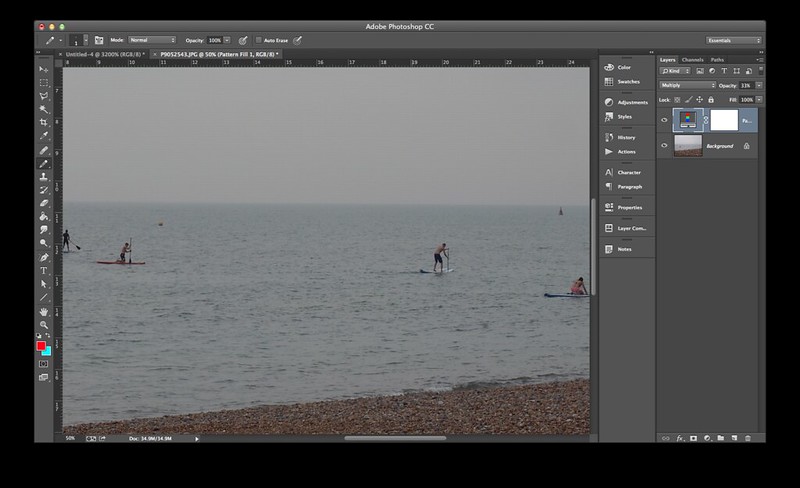
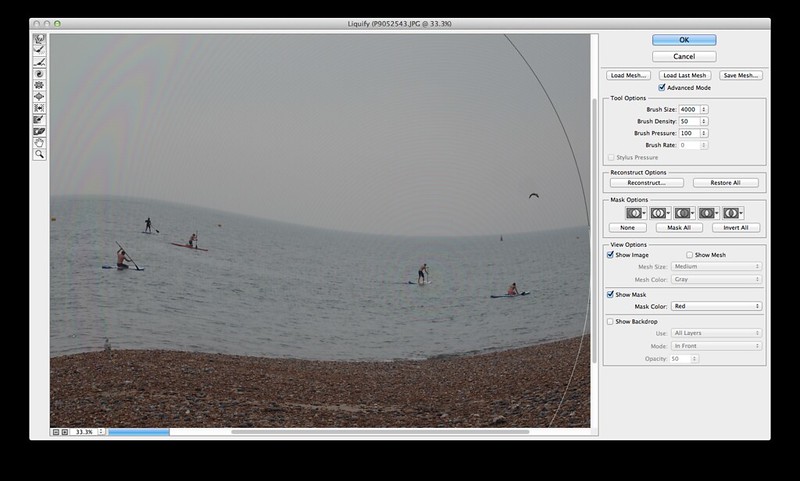
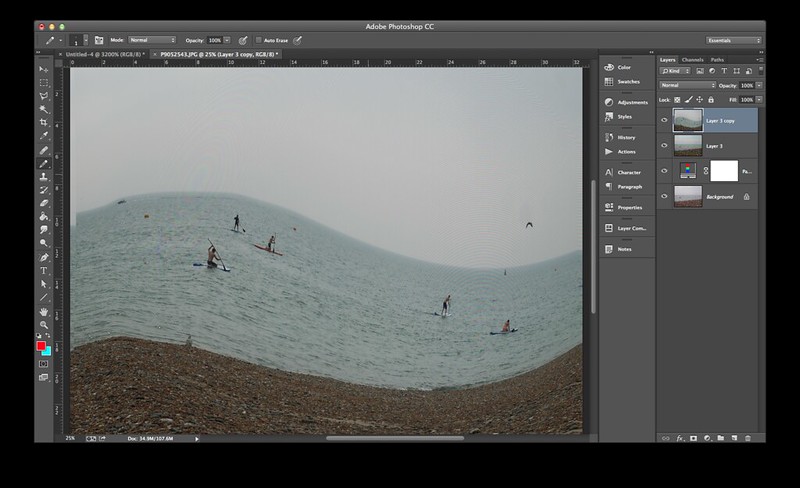
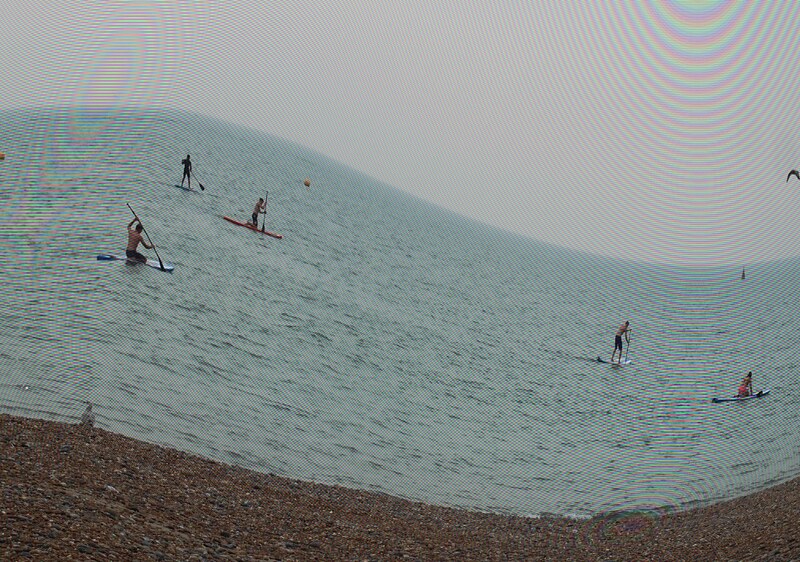
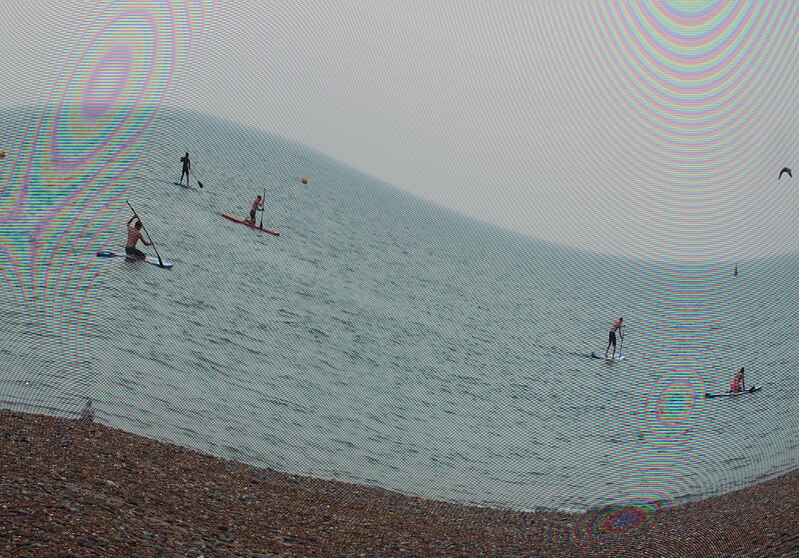
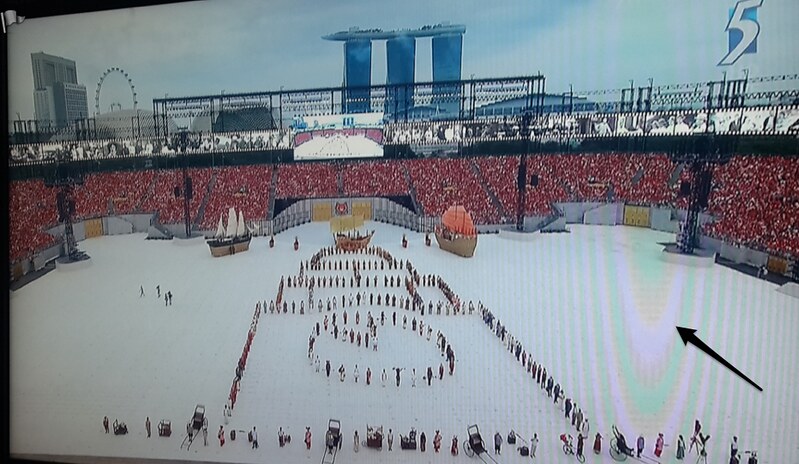
Moire patterns occur when two patterns are superimposed upon each other, such as the scan lines of a tv meeting the way in which a mobile phone camera's CMOS chip scans the scene line by line. A similar effect can be easily reproduced in photoshop. Create a small 1x3px or 1x6px RGB grid and turn it into a pattern in photoshop, overlay or multiply the pattern layer over a photograph, lower the opacity of the pattern layer to something visibly acceptable, then liquify.

Screen Shot 2015-08-19 at 10.13.20 pm

Red/Green/Blue pattern

Screen Shot 2015-08-19 at 10.15.54 pm

Photograph taken on Brighton Beach, 2014

Screen Shot 2015-08-19 at 10.16.12 pm

Multiplied with RGB layer

Screen Shot 2015-08-19 at 10.16.23 pm

Zooming in reveals tiny bands

Screen Shot 2015-08-19 at 10.18.47 pm

Liquify (Under Filter > Liquify...)

Screen Shot 2015-08-19 at 10.21.43 pm

Screen Shot 2015-08-19 at 10.26.29 pm

Screen Shot 2015-08-19 at 10.53.54 pm

Sunday, 9 August 2015

FFF/FDM (Fused Deposit Modelling) vs SLA (Stereolithography)

P1000727

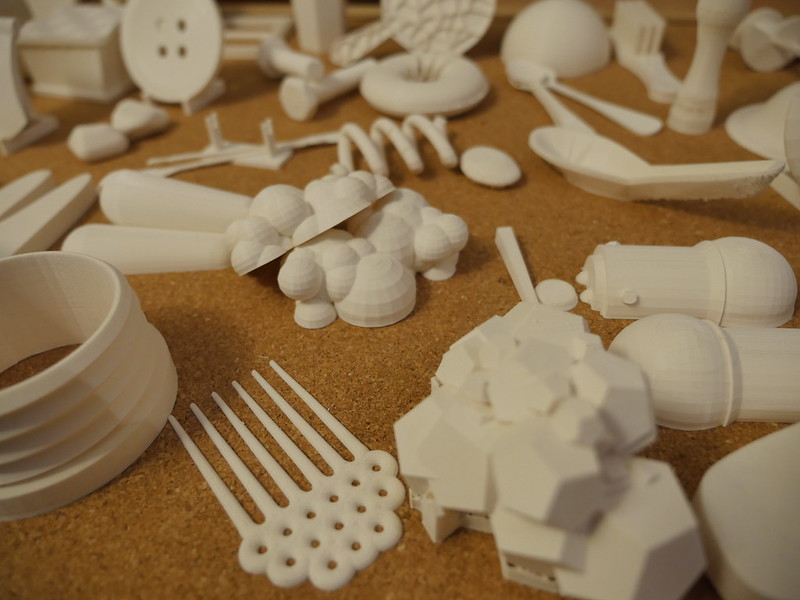
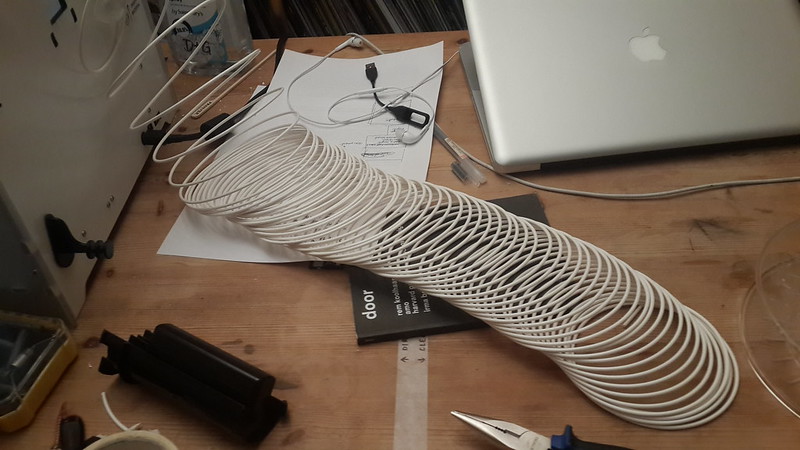
I spent the last few months producing over 100 prototypes for an exhibition which is showing at NUS Museum at this moment (It was also the work I showed at my graduation show at RCA). In practical terms, this meant that I pretty much sat next to the 3D printer the entire time tuning it. The conclusion? I NEVER EVER WANT TO RUN A RAPIDFORM SHOP THAT PRINTS THINGS FOR OTHER PEOPLE. Whatever the advertisements tell you about the miraculous magical instant dream of 3D printing - ITS A LIE. There are still many material limitations.

I have also thought very seriously about selling off the UM2 (FDM printer) to get the Form 1+ (SLA printer), but have come to the conclusion that it is not worth it. Here are some of my thoughts on both types of machines:

FFF/FDM PRINTER


20150311_112027_Burgoyne Rd

FDM stands for Fused Deposit Modelling but technically Stratasys owns the term FDM, so an alternative term for it (if you care about the legal semantics) is also FFF or Fused Filament Fabrication. The reason for so many cheap FFF machines is that the patent has expired on this technology so many cheap and DIY version of FFF machines have been developed.

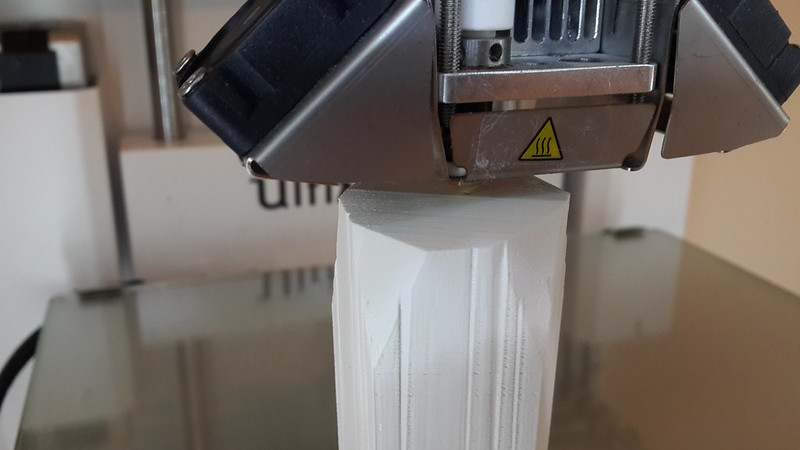
Imagine a tiny jet extruding tiny blobs of plastic which solidify into a larger solid - which makes your object. Its that simple. I've been using the Ultimaker 2 so far, as it has had some of the best reviews. Although the UM2 technically can do up to 150mm/s, 50mm/s is usually the top speed that I can go if I want really high quality and no risk of unexpected under-extrusion. Most times if I see a "difficult" portion coming I might even tune the speed down slowly.

Printing notes:

1. Slowing down the first layer helps: If a print lifts off the heated bed on the first layer with a newly calibrated bed, I sometimes stop the printer and force the printer to start the first layer at a face-slappingly slow 15-20mm/s. This actually seems to make all prints work better in general. If the print is not well stuck on the first layer, the whole print may be problematic.

P3284763
Fused Deposit Spaghetti Machine - first layer failed to stick to bed

2. Level the print bed: You can mislevel the bed such that if you are doing 4 prints on the same bed at each corner of the bed, then just one or two of them will be less "stuck" to the bed. So levelling the bed is important. At times, it just seems impossible to do right!...

20150314_120700_Burgoyne Rd
Three were fine but one had a terrible and stringy brim

3. Don't print multiple prints too close to each other: If you print multiple objects on the same bed at the same time, sometimes the heat from the nearby prints can cause general warping or for parts of the "foot" of a print to curl up from the bed. I try to print objects one after another, not all at once, it seems to work better.

4. Increasing the temperature by 5-10 degrees can help - but only for a while: Raising the temperature slightly can help some prints along at times. But if you set the temperature too high for too long, it will burn the filament (it will turn brown in parts) and cause a filament jam.

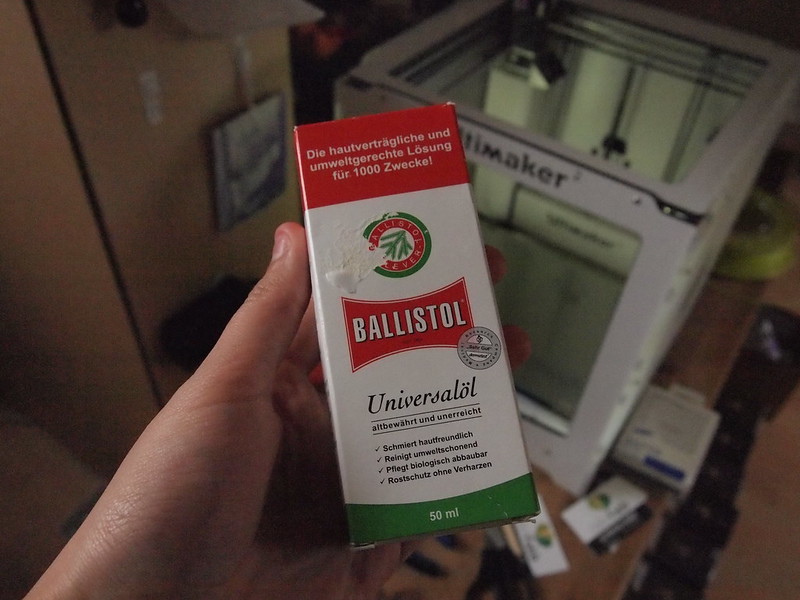
5. Get some good lubricant: You're supposed to oil the machine once in a while. I ended up buying Ballistol which is suitable for use as a gun parts lubricant. I'VE TRIED MY BEST, IS THAT STILL NOT ENOUGH FOR YOU, MACHINE?

P4255303

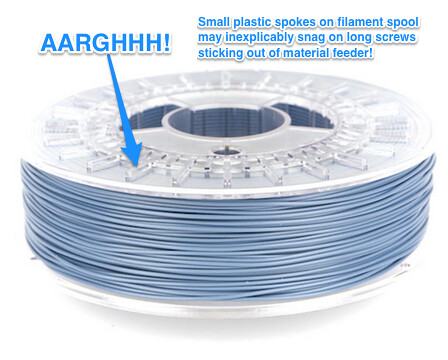
6. Check for random problems: Finally, I had a period where all my prints weren't working for a few days and it turned out that the colorfabb roll has a design which makes it snag on the especially long M3 screw I had sticking out of a new material feed that I had installed. AARGHHH! There was no choice as my local hardware shop only sells M3 bolts in a few fixed dimensions and that was the only one I could use. There was no way to stop it from accidentally snagging, and I couldn't find replacement bolts immediately, so I eliminated the filament spool entirely and unrolled it out. Actually, after this I managed to print without A SINGLE FILAMENT JAM for a few solid weeks. MIRACLE!!!

Screen_Shot_2015-08-09_at_3_30_13_pm

20150525_004407_Burgoyne Rd
Who cares if this looks like crap on the table if it works

P3184546
Countless ways to do it wrong

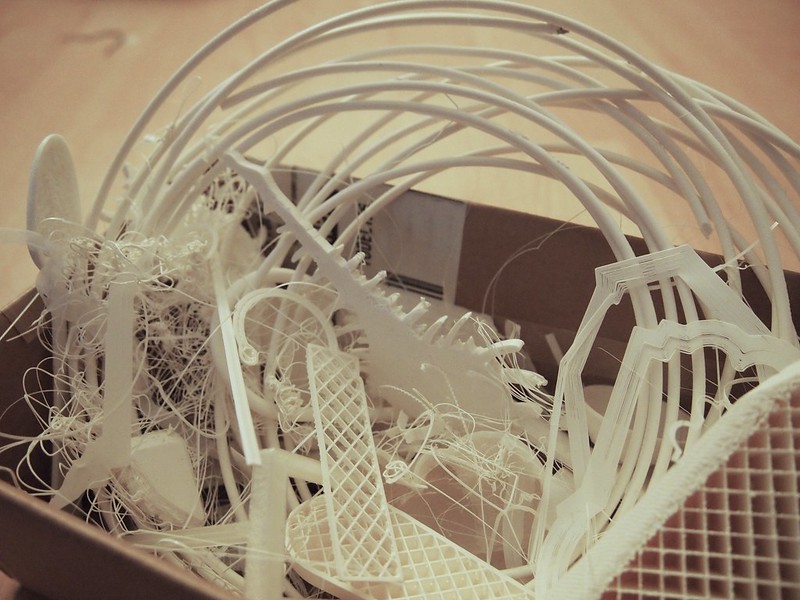
Basically FDM printers can seem frustratingly temperamental because they won't tell you exactly what is wrong with them, so you have to figure out what went wrong. Most of the time the under-extrusion problem can be due to filament jam (mechanical issues), temperature problem, speed problem, etc.

SLA PRINTER

In Stereolithography, laser shoots through a photo-reactive resin/polymer bath and solidifies parts of the liquid into a solid, then the print emerges from the liquid bath like terminator.

The main reason why I never got an SLA printer in the first place was because the 3D Printer was going to live in a home environment. But since George and I moved to a big new house in March I thought for one brief moment of madness that maybe, maybe, I could allocate some space to a Form 1. But the problem is that I still cannot justify having a machine with such toxicity to humans and environment, as the prints would require curing treatment, which can also affect the size of the print (possible shrinkage/curling). And although SLA prints would have the potential to have thinner walls and higher detail without as much overhang problems, the type of materials and colours in which I could print with would be much more limited.

My assessment is that as a user I mainly want:
- large range of colours
- large range of cheap materials
- a dry work room (no "dirty" sinks)
- not having to potentially contaminate my living/working space with fumes

So FFF/FDM wins over SLA.

20150304_071721_W Bank

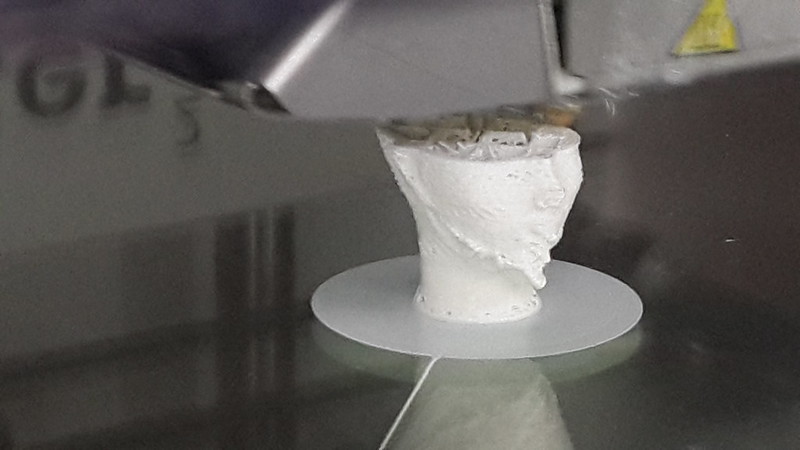
Maybe I will just have to embrace the UGLY OVERHANG aesthetic...

I also don't know how our pet snails feel about having the 3D printer next to their tank. There is no precedent for this even - I can't simply google for "Are snails disturbed or traumatised by stepper motor sounds? Or do snails enjoy the vibrations from 3D printers?". Anyway, more on our friendly domestic slimeballs in the next few overdue updates of this page...

In Praise of Insignificant Details

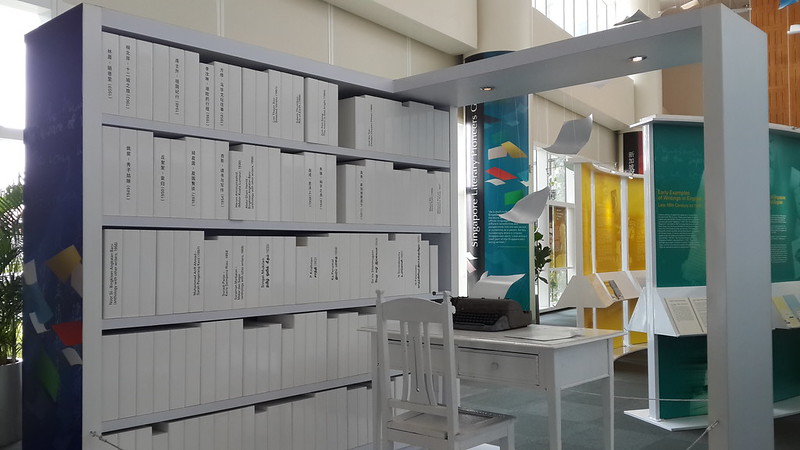
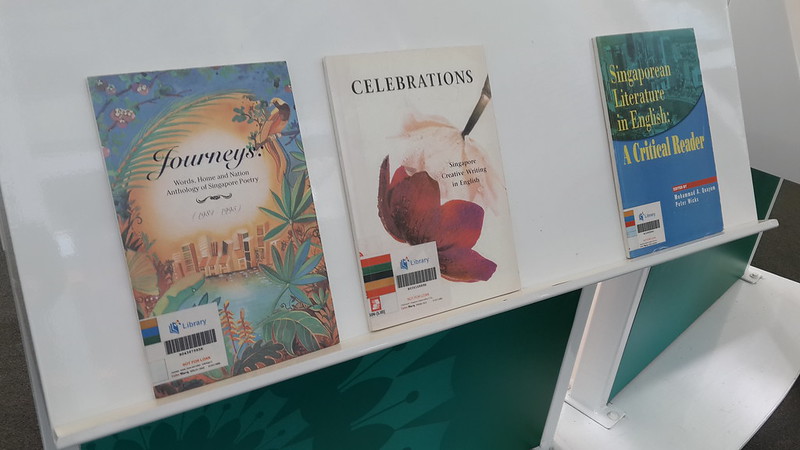
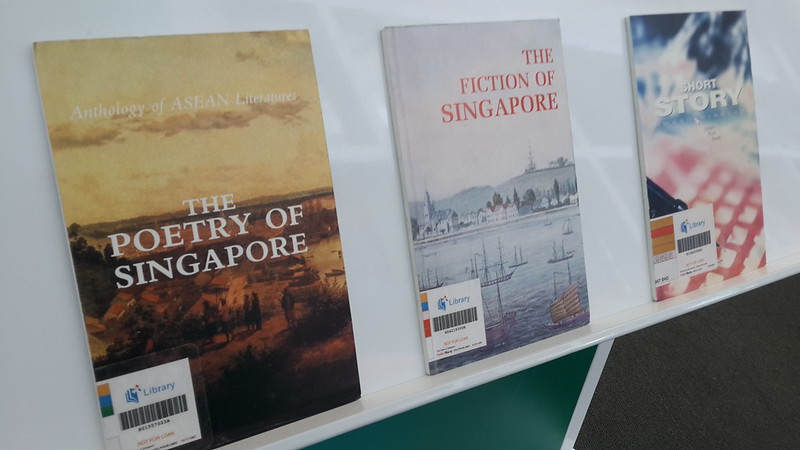
The other day I had a dream in which I wandered into a room and there was a white table with papers flying off into the sky. Behind it, there were shelves in which the books of all of Singapore's literary pioneers were arranged, as if these books had been magically plucked out from the shelves of the library and lovingly collected into one room for our easy access...

20150805_103108_Middle Rd

Oh wait! I'm kidding, it wasn't just a dream, it was real, and you don't even need to wait a moment longer to experience the exact same thing in person if you're in Singapore, for this very exhibition has actually been up at the National Library for the last ten years at Level 11. (Wait, what? Ten years??)

20150805_102723_Middle Rd

20150805_102852_Victoria St

20150805_102800_Middle Rd

20150805_102706_Middle Rd

20150805_102633_Middle Rd

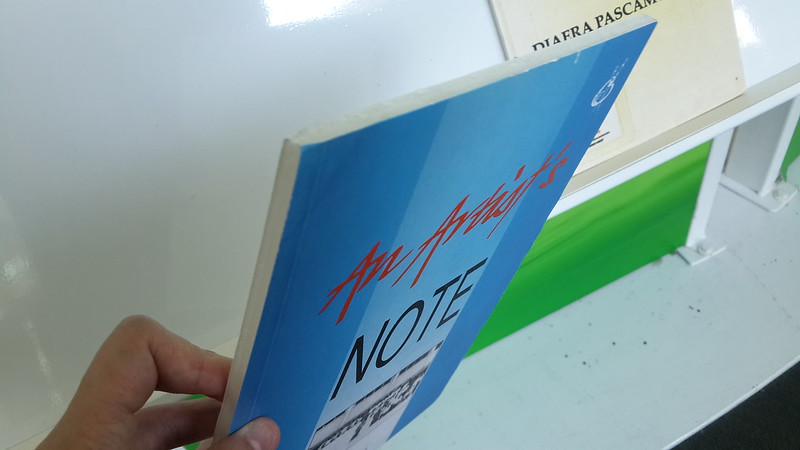
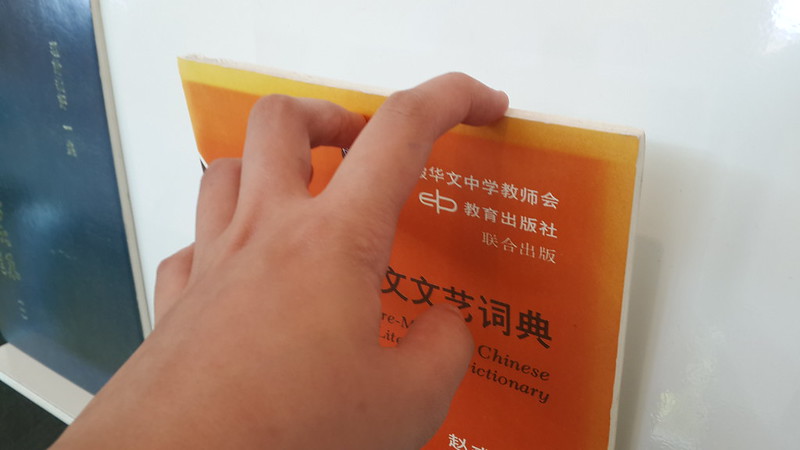
Some of the books on these shelves lay in a disarray, as if others had also picked them up and flipped through them recently before replacing them back onto these shelves. So I picked up a book...

20150805_102643_Middle Rd

20150805_102640_Middle Rd

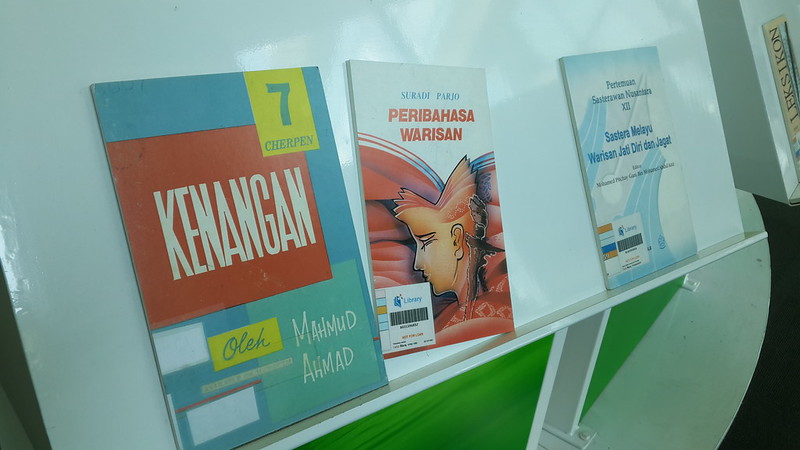
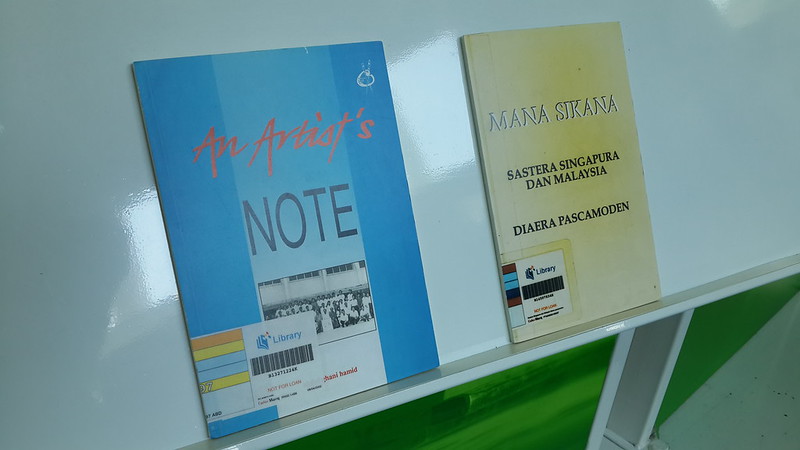
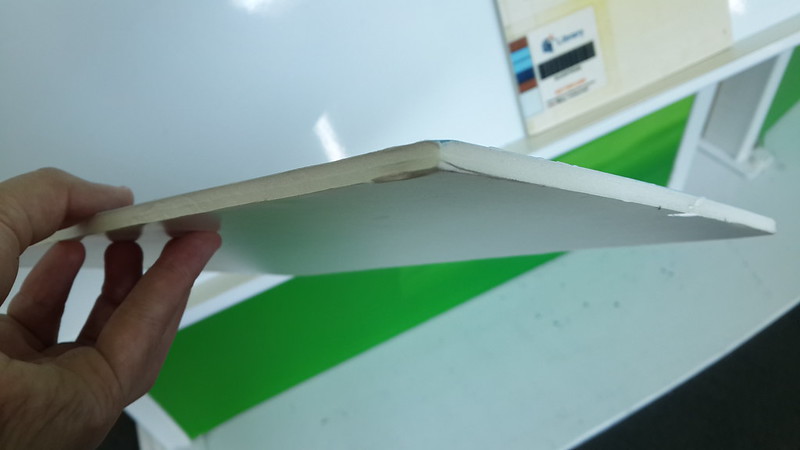
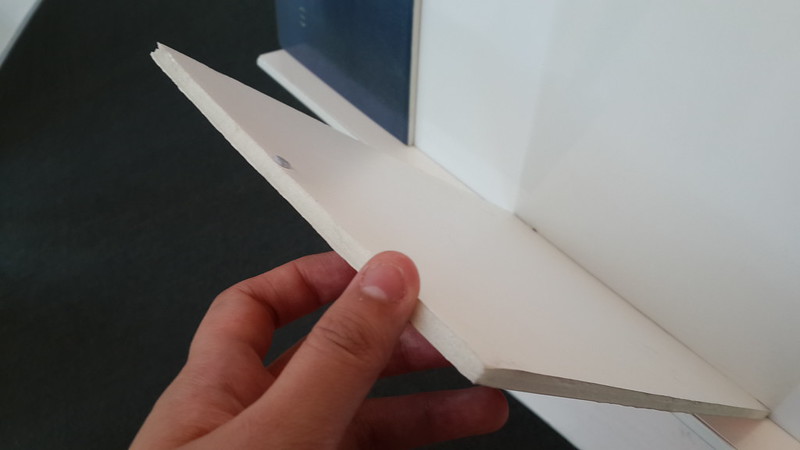
It was at that point that I realised it was not a book! It was just a solid block of foam with a scanned reproduction of the book cover printed on top of it! A bizarre Cronenburg-esque moment, all around me, what seemed like regular National Library books with the distinctively colour-coded stickers on their side turned out to be nothing more than hollow blocks of foam, devoid of words or detail on the inside!

20150805_102930_Middle Rd

20150805_102932_Middle Rd

Curious as to the origins of this exhibition, I looked it up and found records which show that the "Singapore Literary Pioneers" exhibition originally opened in November 2005, along with the National Library's move to Victoria Street. Perhaps at some point during the past, these shelves in this exhibition actually held the original books, yet by this point they had all been put back into the collections, leaving nothing more than the skeletal, hollow foam board simulacrums of themselves behind...

The National Library has now been at its Victoria Street site for ten years now! Prior to that, the National Library had been at Stamford Road behind The Substation since 1958. In 1953 the rubber and pineapple king Lee Kong Chian donated a large sum to set up a national library which would be open to the public; in 1957 he laid the foundation stone for that iconic red-bricked building. But in 2000 it was announced that the building was to be demolished for the construction of a road tunnel and the new SMU campus. So the site of the former red-bricked NLB building unfortunately became a vehicular tunnel; a cruel twist which seemed almost emblematic of the denigration of people's fondly remembered cultural spaces in the process of urban redevelopment - the library's architectural and historical merits apparently insufficient for it to be have been gazetted as a national monument.

There was also a practical reason for the NLB's move; I was reading the 1989 report of the advisory council on Culture and the Arts, which noted that book holdings in the National Library building in Stamford Road had already "exceeded the space available" - which was to the detriment of Singapore's cultural development. So moving to a new building on Bras Basah would in theory allow for much more space - space for more collections, more books and more exhibitions.


I've graduated from RCA and I'm back in Singapore now! I have lots of things to document from the last few months (which I will document here in due course), but right now I'm working on something in September, on behalf of The Substation. I’ve been spending a lot of time at The Substation and the National Library building of late, constantly pondering the dilemma of writing text for an exhibition that is about an art space - but the exhibition will be held in a site other than its own - it will be at a library!

Mind you, I've also basically spent two years at a design programme being reminded that the gallery is not a library, and that the number of words in a gallery and museum should be kept as few as possible, because people came to look at things, not to read! But even now, when I'm preparing an exhibition to be set in the library, where the words should be more plentiful, where we shouldn't need to be shy about shoving books in people's faces, the caveat about not overwhelming the reader/viewer with too many words still exists.

I wonder, if that is why there aren't words inside the books in the Level 11 exhibition? Would the presence of so many words in the space make everyone less likely to engage with the content fully? Perhaps it was feared that putting the actual books on show would induce viewers to get stuck at the first book they came upon, rather than skimming through this condensed history of Singapore's literary landscape.

Maybe this is a matter of exhibition design. Let's talk about in numbers, since most Singaporeans seem to understand things better in terms of numbers. How many words can we realistically hope that the average person will read at an exhibition? The average reading speed of a native English language speaker is said to be between 250 to 300 words per minute. Let's give it a bit of wiggle room and assume that the bilingual Singaporean (in a moment of idle distraction!) reads only 200 words per minute.

If an average visitor spends half an hour in our exhibition space, but only spends 50% of his or her time actually reading the text on the wall (the other 50% being spent on talking to people, looking at the pretty pictures, looking out of the window at the skyline, or watching the videos), then perhaps we can hope for 15 minutes x 200 words or about 3000 words to be consumed during an average visitor's half-hour long trip to an exhibition - if we are so lucky!

This means that if I write more than 300 words for each of the 10 sections of the exhibition, then maybe most people won't be able to read everything I've written in an average visit to the exhibition.

But how can I possibly tell you the 25 year history of The Substation within 3000 words - scarcely more than an essay's length? Would it be better if I put more shiny pictures on blocks of hollow foam? But the photos are so few. And all I have are so many of these texts, quotes, paraphrased rumours, and snippets - surely this amounts to more and more words being packed into the show!

But maybe the most important thing is not just the big, beautiful, totalising statement that will sum up everything within my 300 word count. The things I want to tell you come in the form of almost insignificant details. Maybe there isn't anything metaphorical about it.

I'd like to believe that what seems like textual fluff, the description of events and people and programmes and objects and their seeming insignificance in relation to the larger narrative, actually is key to our understanding of it. In his essay The Reality Effect, Barthes argues that these small insignificant details, when put together, signify the real, the l’effet de reel.

For me, there is something so important about all these insignificant, longwinded details. In La Nuit des prolétaires: Archives du rêve ouvrier (which was published in English as “Nights of Labor”, or “Proletarian Nights: The Workers' Dream in Nineteenth-Century France”), Rancière presents a series of fragmentary, seemingly insignificant details and contradictory accounts of a small group of worker-intellectuals in the 1830s and 1840s. I like his seemingly anti-sociology, anti-historicising approach in digging through the archives to excavate these accounts. In the introduction, Rancière writes:

If the protests of the workplace are to have a voice, if worker emancipation is to possess a human face, if workers are to exist as subjects of a collective discourse which gives meaning to their multifarious assemblies and combats, those representatives must already have made themselves other in a double, hopeless rejection, refusing both to live like workers and to talk like the bourgeoisie.

This is the history of isolated utterances, and of an impossible act of self-identification at the very root of those great discourses in which the voice of the proletariat as a whole can be heard. It is a story of semblances and simulacra which lovers of the masses have tirelessly tried to cover up.

The night forms the grey area where poor workers unexpectedly double up as clandestine intellectuals; Rancière chooses to give significance to quotes from hybrid figures, painting a much more incongruous picture of the digressions, distractions and conflicting motivations behind each individual that is often taken to be part of a whole, giving significance to the words and stories which could have easily dismissed as meaningless since they were hard for us to process or to summarise into a 'pure' or neat theory.

In choosing to structure an exhibition around “spaces”, I feel that the goal of my role as 'curator' or 'mediator' of the archive would be to position these hundreds of extracts from the Substation's archive in a space between a conventional confinement to their “place” in time and space - and a completely utopian or metaphorical abstraction of the spaces...

Tuesday, 12 May 2015

The Ridiculous Handrail and other oblique functions

Several events conspired to keep me from writing here in the last few months; first, we found a beautiful new flat and moved to a hill on Haringey, where I ended up without internet for some weeks before travelling to Singapore and France, meaning that I was forced to tether to the slowest mobile internet in the world in order to send massive files to various printers and people, meaning that there was no bandwidth for uploading photographs and no time for my frivolous warblings on this blog.

ANYWAY! I’ve got a big backlog of writing to push out here, but I wanted to start off with a story of a curious handrail I saw at the National University of Singapore (my alma mater) when I was back there in March...

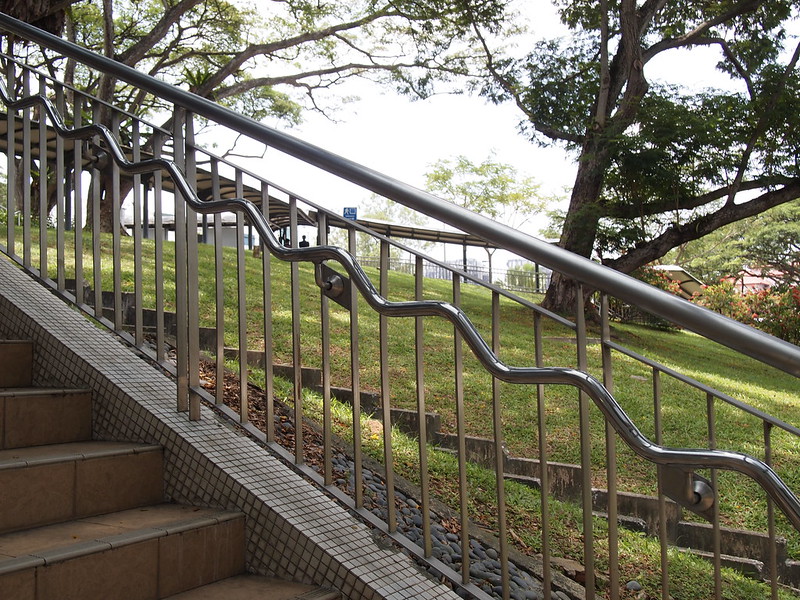
P3254584

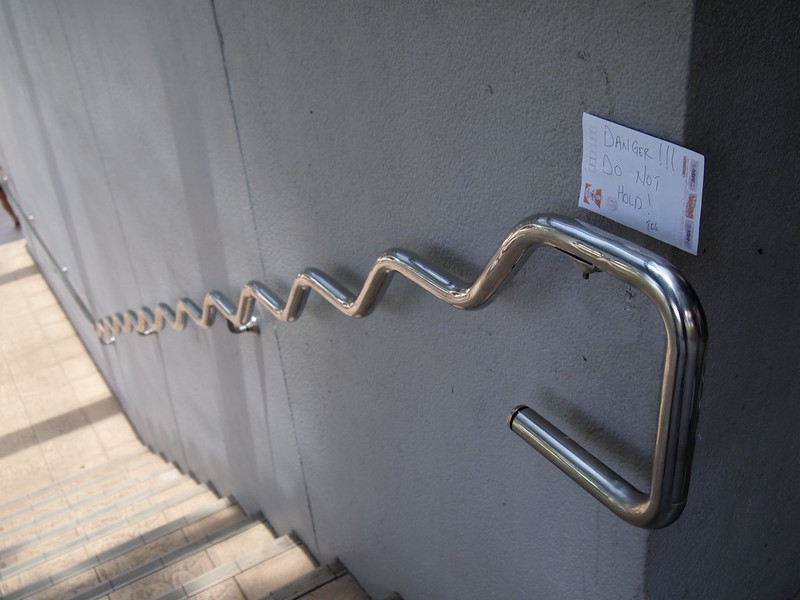
I was very amused by this redundant handrail design at Yusof Ishak House. When I saw it for the first time, I was not even sure if this was some practical joke or art installation of a handrail - for it was an awkward design for a handrail, and it wasn't even properly secured to the wall. If its in the same shape as the step below it, then how does one expect to run one's hands up it for support as one walks along? Who on earth made this handrail, or ordered its installation here?

Today all stairs of a certain rise are required to be constructed with a handrail. Although the handrail is defined within part of the building code itself in Singapore, which means that most stairs will require a handrail, it is more common to see the handrail designed separately from the stair, or considered separately from it.

P3254588

Someone had taken the initiative to warn users of its dangers - but only at the top of the stairs! (Too bad for the people at the bottom of the stairs)

I have always thought it apt that both National University of Singapore and Nanyang Technological University are constructed on hills and sloped land; I've spent significant time in both in the past and associated the stairs and slopes with a kind of semi-leisurely pursuit of knowledge - procrastinating on school work by obstinately lying down on the slug and ant infested slopes of NUS's AS3 for a picnic, scaling the turfed roof of NTU ADM and peering over for a laugh, conducting midnight walks to test out the urban myth of the "yellow line" which runs from Arts to Science; conveniently idle explorations of each universities' geographies as momentary distraction from one's studies.

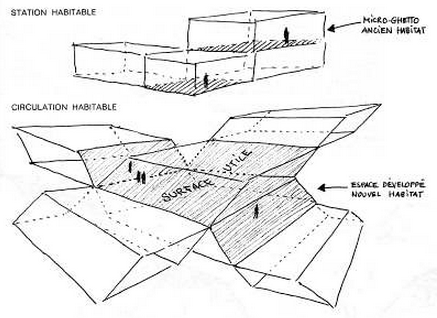
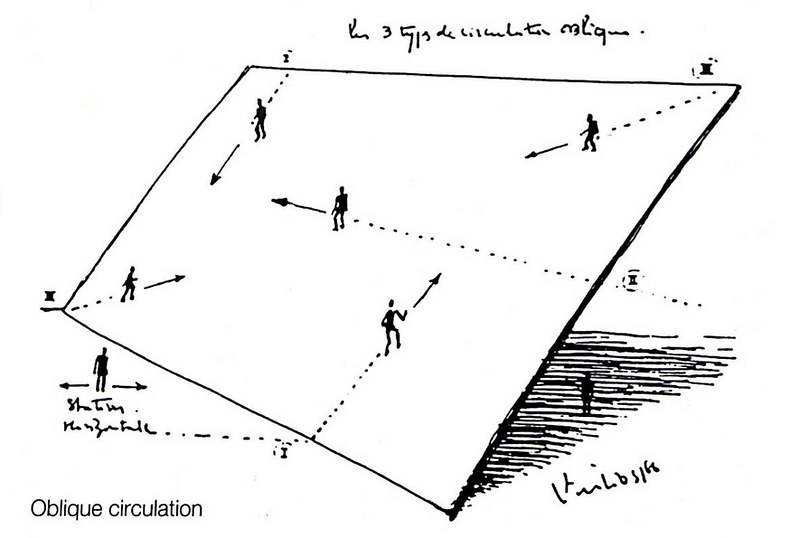
I’ve been reading the writing of Claude Parent and Paul Virilio on the notion of the Fonction Oblique (Oblique Function), in which they eschewed the verticality of cities for slopes and oblique planes. They propose an architecture of disequilibrium, using these oblique angles to express a kind of dynamism in the space - by changing our relationship with the horizontal. The idea would be that you would no longer need to find a chair, you only had to lie down on the slope; the stairs would be redundant if everything was constructed in angles, where we would be challenged to scale these ramps on our own. The conventional notion of the door, wall or pillar and so many other things would potentially be transformed if we thought of it as a "domestic landscape" and designed everything in an oblique fashion.

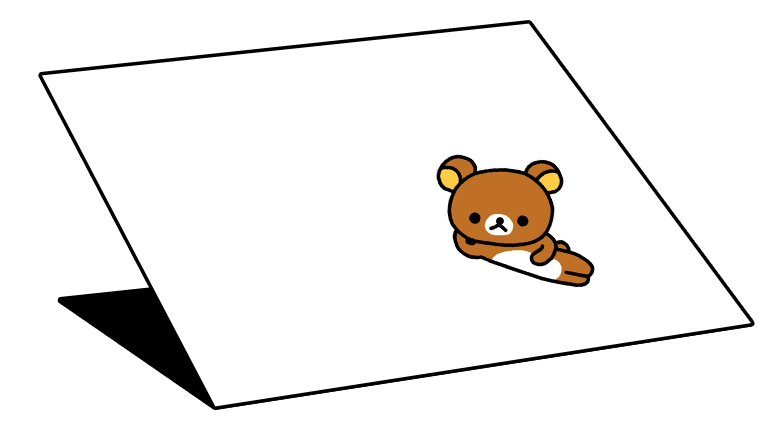
slope2

On an aside, it explains why I like the Rilakkuma bear so much. It is never pictured with furniture, yet it is always at rest, lounging in abstract space. It doesn't need a chair or sofa because it can just lounge on some imaginary sloping surface. As a consciously designed toy character, it was made to convert any surface into "a napping space" with its body.

Screen Shot 2015-05-12 at 11.18.33 am

I suppose I am attracted to the idea (or reading about it) partly because for me the slope cannot be separated from the sensation of vertigo. I suspect that I experience more vertigo than the average person - it is something I've developed only in adulthood and for me it is a complete mystery where it came from! I feel a lurching sense of vertigo in moving lifts, on swings, whilst standing on breakwaters or on piers, and am consistently reduced to crawling on all fours on anything that is a little more steep than usual.

In recent years I have developed more and more vertigo, to the point where if my feet are completely concealed from my view, then I cannot balance or even ascend or descend a flight of stairs. Normally I have zero problem with stairs, but if I am carrying a big box that hides my feet from my view then I am suddenly unable to use the stairs! I don't know where this came from. I got stuck in the tube recently with a heavy big box with the prospect of taking a few more connections home, and after googling ahead to see if the stations had disabled ramp or lift access, I saw there was none so I gave up and took a cab. There is no physical reason why I cannot go up and down stairs if my feet are concealed from view, yet for some reason, I find it really difficult!

Vertigo seems to present itself as a physiological sensation that is caused directly by my experience of space itself, and I can either read it as something which is there to warn me or dissuade me from going further (if this is part of my primitive fight-or-flight response to mistakenly perceived danger), or it can be read something which excites me by being physically challenging. I think I prefer the latter reading, unless I get stuck in one place for too long and end up requiring rescuing, like a cat stuck on a tree.

slope

For me, it reminds us that the surface that we stand upon doesn't have to be a calm, generic flat plane which is there to reassure us of the rationality and stability of the world we live in. Perversely, I suppose that maybe the idea of installing a ridiculous handrail is a bit like that...
Tuesday, 17 February 2015

The Spherification of Edible Liquids for Impatient People

P2174381

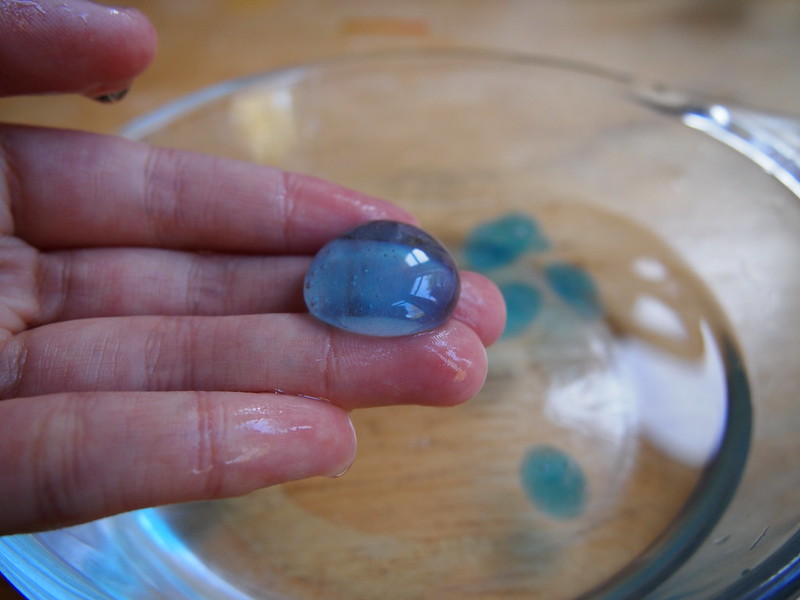
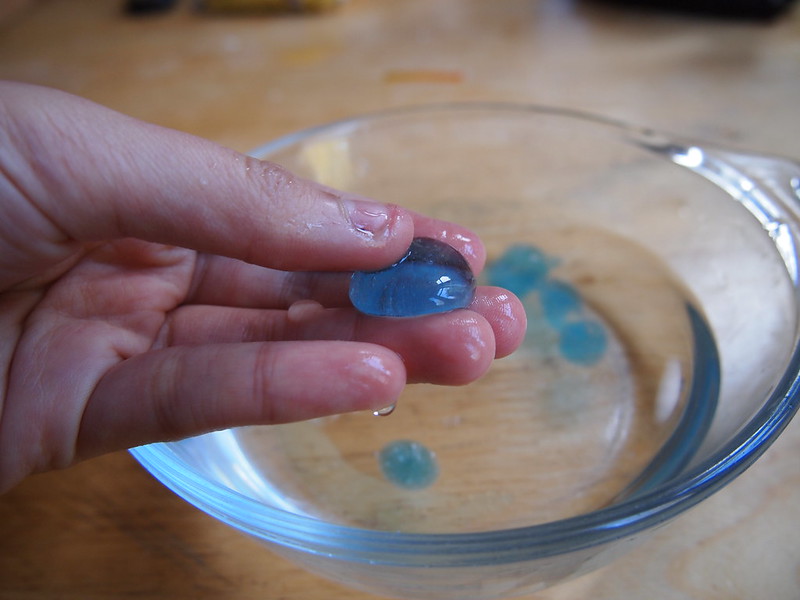
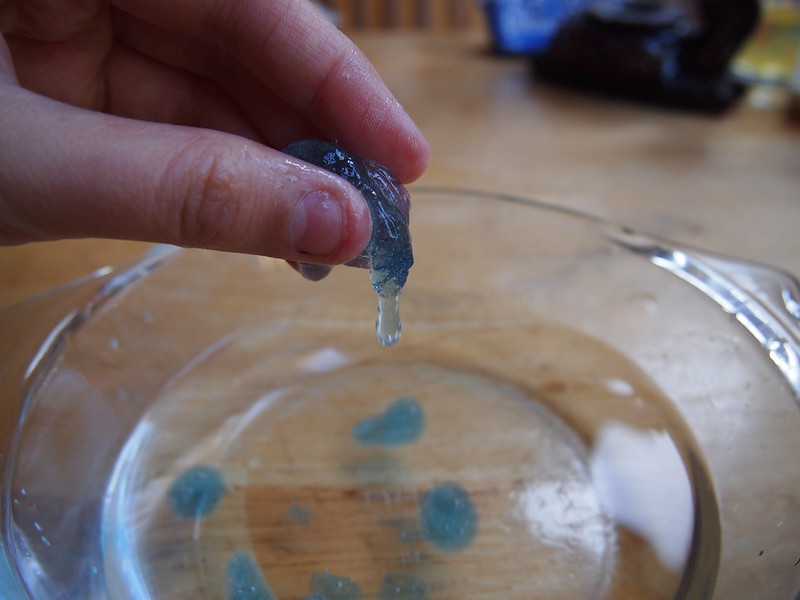
After a few hits and misses doing spherification experiments over the last few years for fun, here is a collation of some personal observations or lessons learnt about spherification that people don't generally seem to explain properly in all the other recipes or online posts about spherification.

Basic Spherification
1% Calcium Lactate Bath (1g to 100g mixture)
0.5% Sodium Alginate Mixture (0.5g to 100g mixture)

Reverse Spherification
0.5% Sodium Alginate Bath (1g to 100g mixture)
1% Calcium Lactate Mixture (1g to 100g mixture)
[better for milky/alcoholic mixtures]

Why do some people use Calcium Lactate instead of Calcium Chloride?

I noticed a lot of people online have suggested that people can use Calcium Chloride. The problem is that I don't like Calcium Chloride because it has a salty/bitter taste, where as Calcium Lactate doesn't really have a taste. You can "wash" off the salty taste in water, but the fact is that I don't really like Calcium Chloride, after I learnt that Calcium Chloride reacts strongly to humidity. I brought a bag of it from London to Singapore, and my double-plastic-wrapped bag of Calcium Chloride must have gotten a tiny hole in it, which allowed the humid air in, and next thing I knew I had a mysterious chemical spill on my wooden floor which was near impossible to remove. Turns out that if Calcium Chloride is exposed to humid air, it will absorb a few times of its own weight in water. I have never heard of such a ludicrous thing happening with Calcium Lactate. And since I really don't want to worry that one day my food chemicals will be reduced into a big puddle of water in my toolbox, I'm steering clear of Calcium Chloride from now onwards just to be safe.

Do I really need to use distilled water?

Yes, this is very important because many cities have very hard tap water, even if you use boiled water or water filters. This means that all your alginate mixtures will become very goopy instantly if you don't use distilled water. London tap water causes the sodium alginate to start its gelling reaction almost immediately. Even the utensils should also be washed in distilled water before and during use, otherwise gelling will occur on them as well when preparing the bath or mixture.

Do I really have to wait 24 hours for the bubbles to leave the Alginate bath/mixture?

The bubbles can be really huge. If you don't care about the bubbles like me, then don't bother leaving it overnight. I find it still works the same, just not as pretty and perhaps disrupting the illusion of it being a perfect sphere of liquid. Also if you used tap water (eg London) then you will already have huge bubbles whilst stirring because the gelling will have started by now and you will have stirred bubbles into the goopy alginate bath.

Do I really need an immersion blender?

It would be ideal and it really makes a difference. But it will work even if you don't use an immersion blender or hand blender to mix it up. You can also use just a spoon, if you're all DIY or lazy like me. But remember, that for some reason all of these chemicals HATE to be dissolved into water and you will spend what seems like hours grinding a spoon into a big bowl of water and powder and screaming at the bowl of water.

Is it really necessary to pre-freeze the mixture into half-spheres for Reverse Spherification?

You will have seen the half-sphere silicone moulds, seemingly sold on every other molecular gastronomy webstore. The reason why people do this is that it does truly takes skill to make the shapes spherical with the Reverse Spherification process. You can't just "drip" it into the bath, half-heartedly, (as you might do with Basic Spherification, and get away with it). You have to throw or plop it down bravely, but yet not too much otherwise it will hit the bottom of the bowl and become flat, which I find to be quite difficult to do. Basic Spherification seems to be more forgiving in terms of technique, you'll probably end up with something roundish even if you have poor hand-eye coordination. So in order to give their spheres a better chance of having a better shape when doing Reverse Spherification, people pre-freeze their mixtures into half sphere shapes.

What if I "guess-timated" the amounts and it doesn't work? How can I fix this confusing gloopy mess?

After several "guess-timation" failures on my part, I've learnt that this is a matter of understanding the ratio/texture that the mixes ought to reach - it mainly means that the concentration for either the alginate or the calcium is inaccurate, and usually it means it was too little. So as a possible way of fixing things, for basic spherification, add slightly more alginate to the mixture, and for reverse spherification add slightly more calcium to the mixture. For the alginate, the goal is to reach 0.5%. For the calcium, the goal is to get to 0.18% calcium, which is usually 0.5% Calcium Chloride, 1% Calcium Lactate, and 2% Calcium Lactate Gluconate.

P2174382

P2174383

And finally, yes, if you squeeze your spheres, they can and they will explode.

I'd love to hear from other people who have been playing with their foods like I have. Are there other tips or suggestions for impatient people who want to do some spherification of their edible liquids?

Tuesday, 10 February 2015

RiTA Toolkit: Markov and other text experiments for the Masses

This week I became aware of Markov generators for the masses! Yes! Now anyone can have instant word glossolalia! And now up to 200% more easy to use! Because the future is already here! The future came and then left the building some time ago! I think it came around last tuesday, did you miss it? Did you not already hear?? Aw man.

TO DEMONSTRATE THIS I WILL PROCEED TO WRITE THIS POST IN UNDER 5 MINUTES!!!

The challenge was to find the easiest way to do a markov generator mashup of two texts. A friend who was unfamiliar with programming asked me what was the easiest way to make a text mashup. Recently I saw Pete's Unpredictive Text installation at the WIP show and I found out he was using a library called RiTA so I downloaded it and realised it was oh so so so simple to play with...
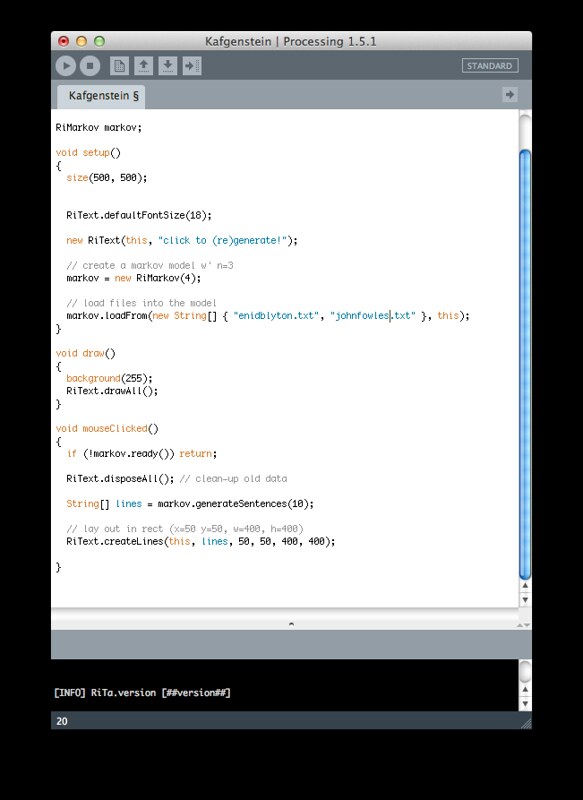
First you need to install Processing, and then you have to install the RiTA library into Processing. I had almost forgotten how to install libraries actually, due to not using Processing in some months, but the long and short of it is that you just need to find the "Processing" folder which will have been automatically created in your Documents folder when you installed Processing.

On a mac it will probably be
MacHD/Users/Username/Documents/Processing

On a windows it will probably be
C:/My Documents/Processing

In this folder you create the folder "libraries" and copy in the "library" folder which will be inside the RiTA zip package you downloaded. The library should now be here like this:

/Processing/libraries/rita/library/rita.jar

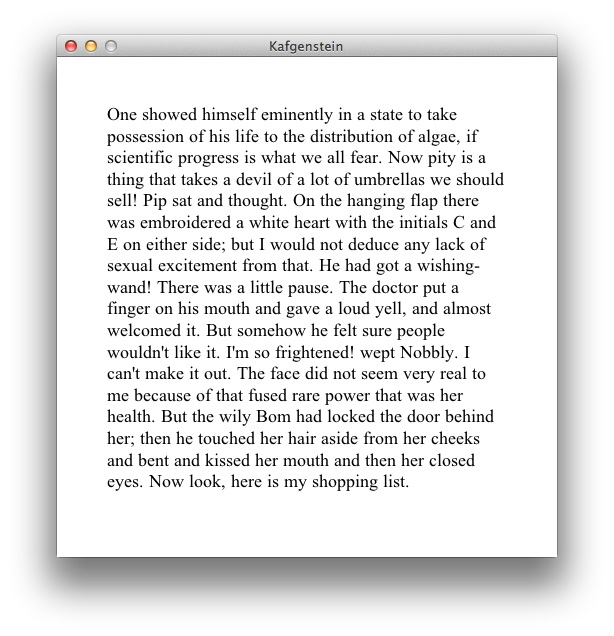
Look in the examples folder for Kafgenstein.pde. That's the kafka+wittgenstein mashup. The text files are in the folder /data. Make your own text files, substitute them in the markov.loadFrom line.

Screen Shot 2015-02-10 at 1.01.16 pm

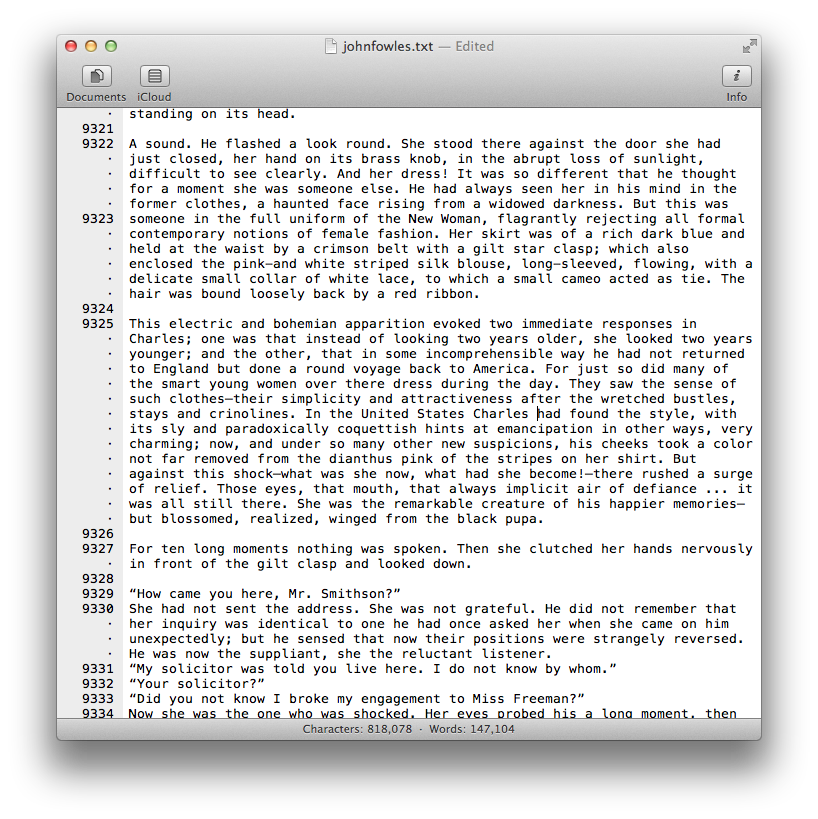
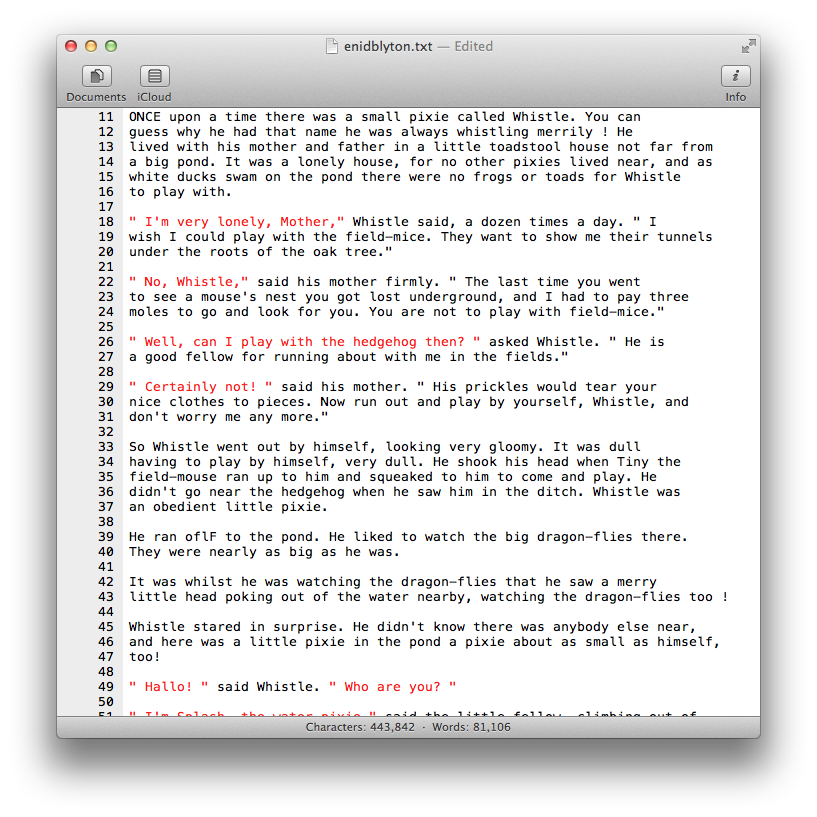
Here is Enid Blyton's Holiday Book meets John Fowles' The French Lieutenant's Woman.

Screen Shot 2015-02-10 at 1.08.05 pm

+

Screen Shot 2015-02-10 at 1.08.03 pm

=

Screen Shot 2015-02-10 at 1.01.09 pm

The other examples are equally interesting to play with.

No need to thank me. All thanks to RiTA.


Actually I lied, this post took 15 min to write cos, y'know, it takes time to make screenshots and upload them.

More of my previous markov experiments here:
Ghost Trap - Markov Text Generator
A Dream Generated from Other Dreams

Google Street View Vanishing Point

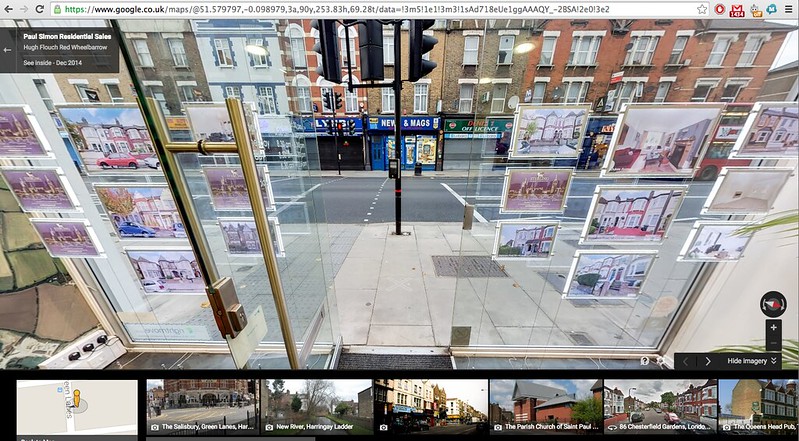
Drowned in a dozen different digressions at once! The news in my side of the woods is that me and G are moving house to Green Lanes next month, to a lovely place with a conceptual shed on the Haringey Ladder, one minute from Haringey Station. We began snooping around in Street View and discovered oddly that many businesses in Green Lanes have got INTERIOR STREET VIEW. You can look inside individual businesses….

Screen Shot 2015-02-04 at 10.28.16 pm

I’m on the inside... looking outside...
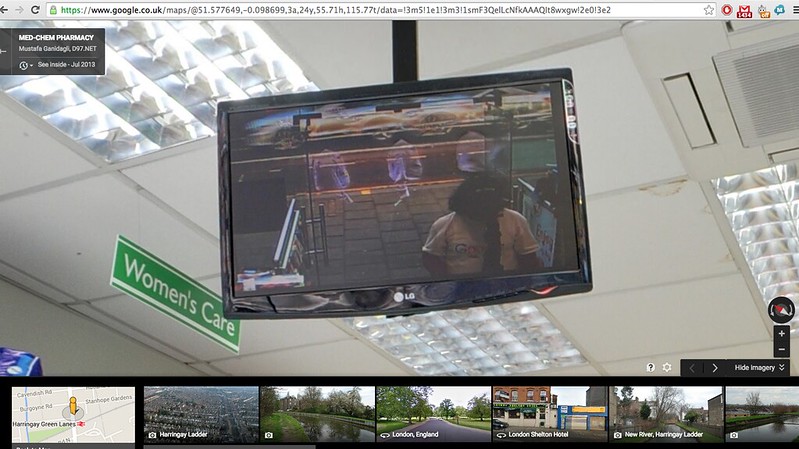
And you can see the different street view operators themselves in CCTV cameras at times if you zoom in…

Screen Shot 2015-02-04 at 10.17.05 pm

Why hello there...

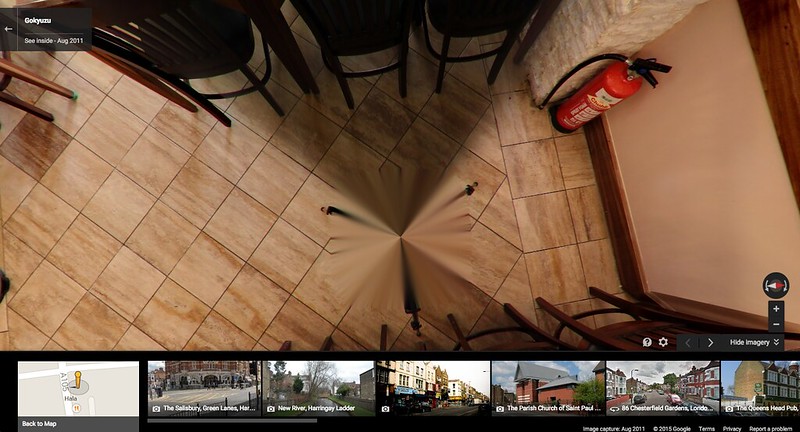
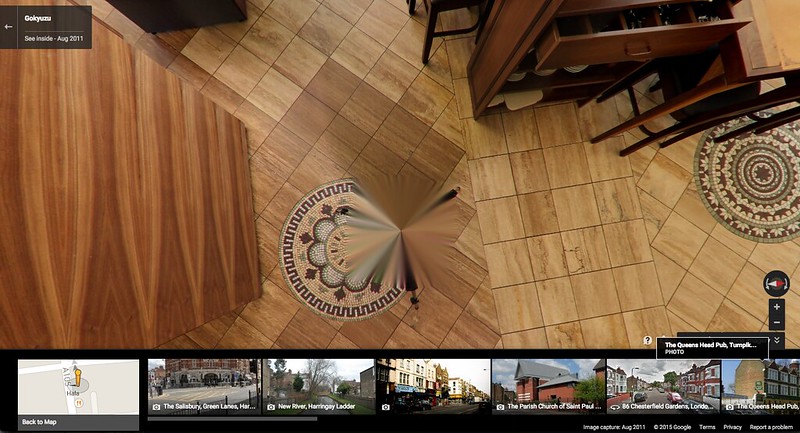
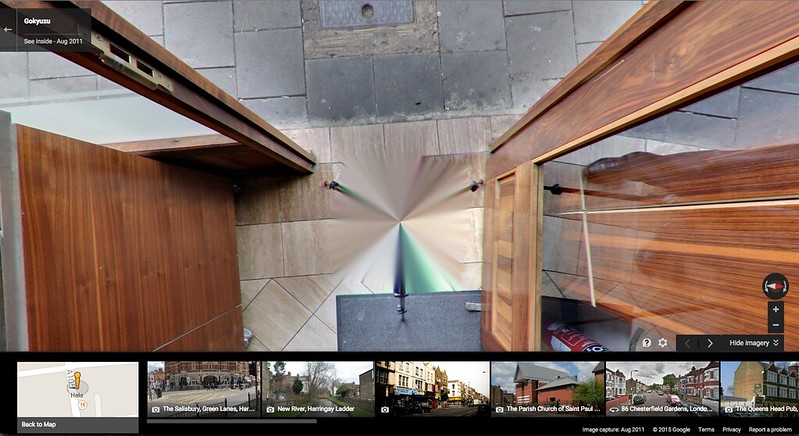
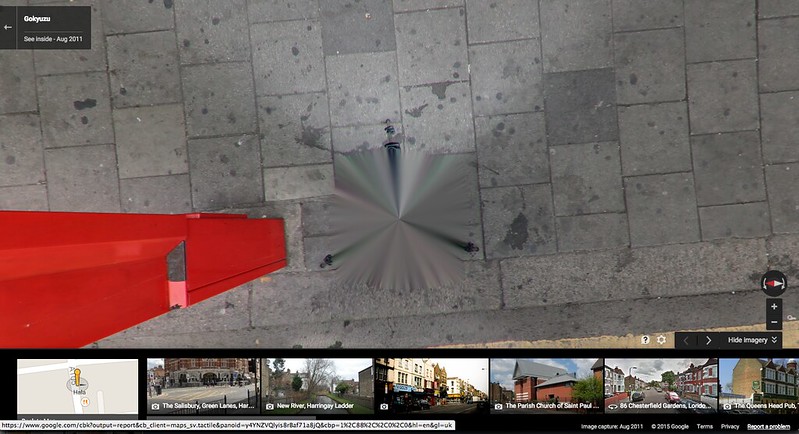
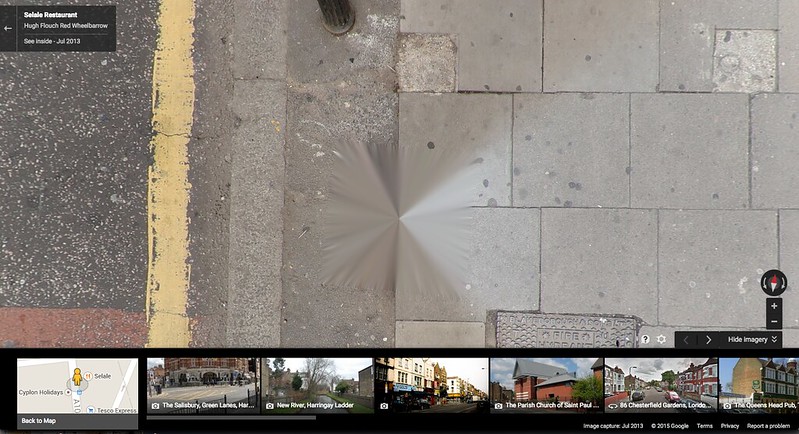
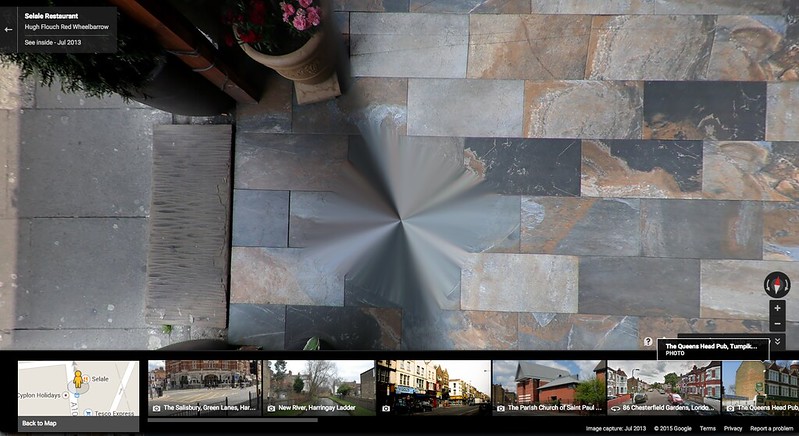
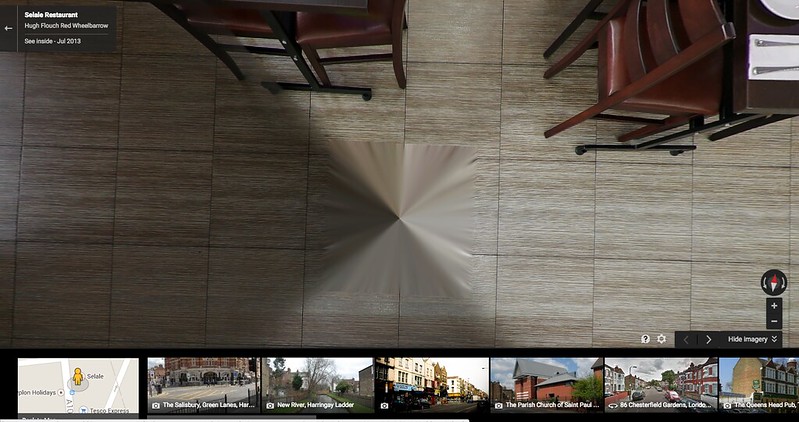
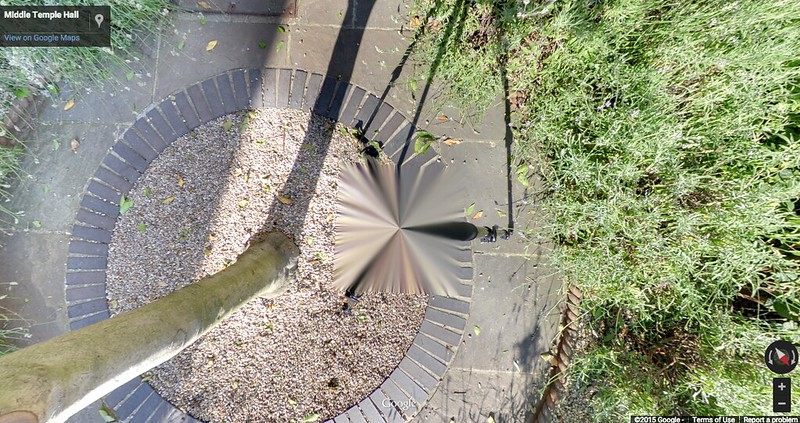
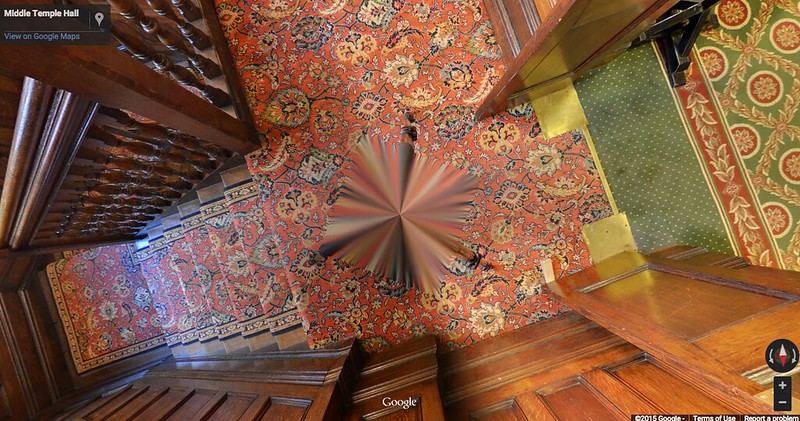
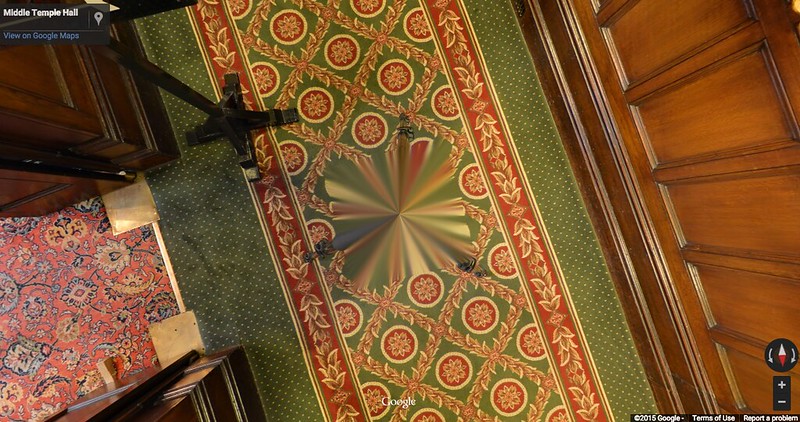
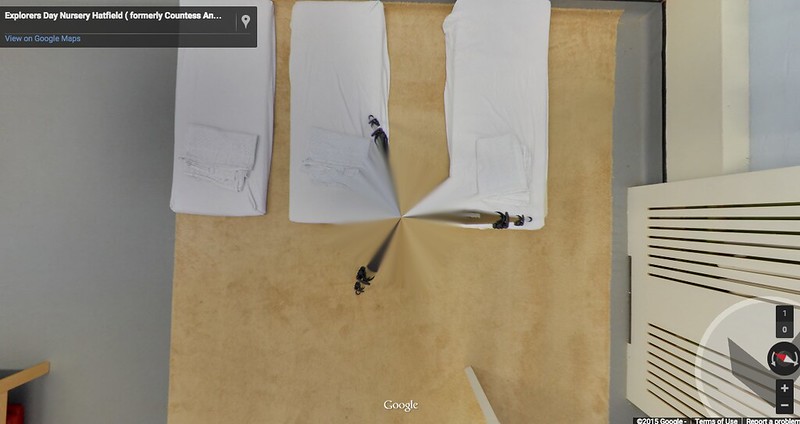
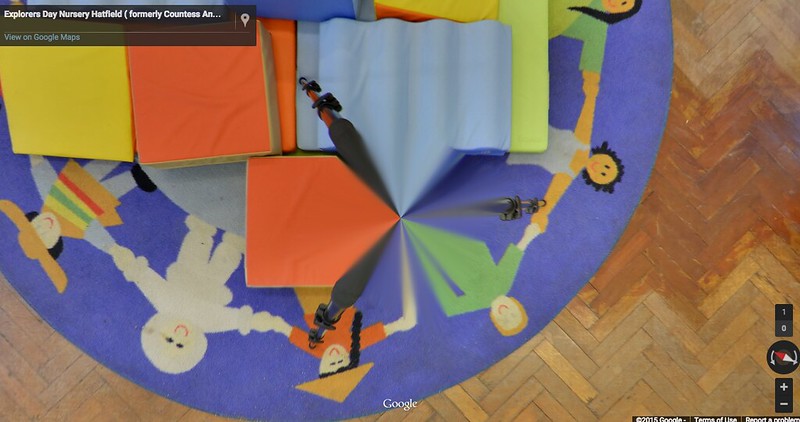
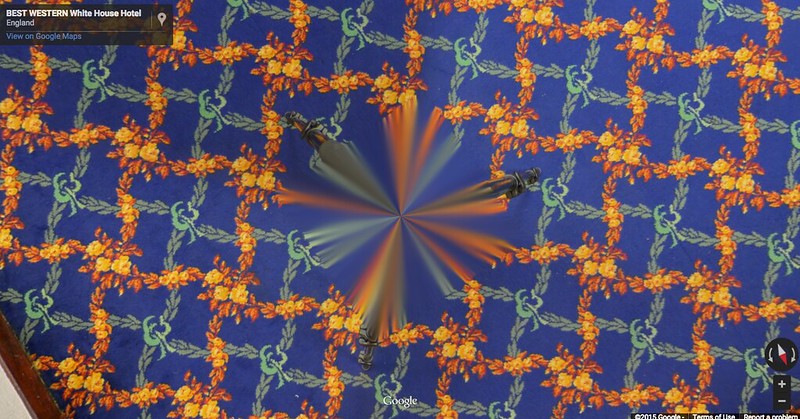
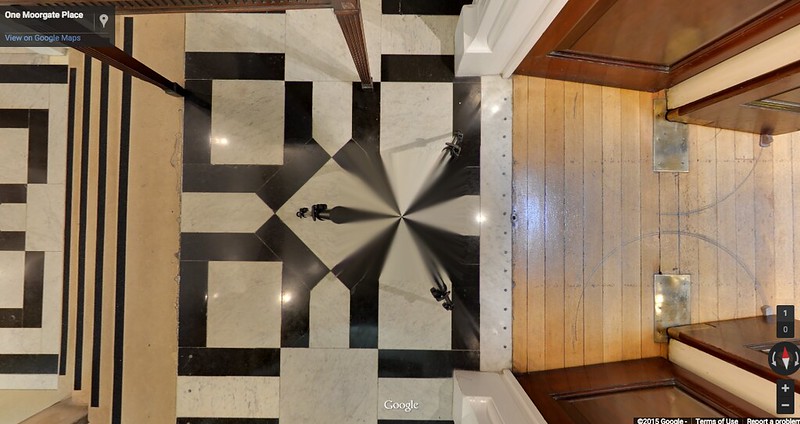
In fact these interiors open up a whole world of exciting opportunities, full of mirrors and reflections and cctv cameras feedings back into a loop of street view. But one of the things I noticed was that interior street views often have a “vanishing point” if you look at the ground….

Screen Shot 2015-02-04 at 10.38.56 pm

Screen Shot 2015-02-04 at 10.38.36 pm

Screen Shot 2015-02-04 at 10.38.11 pm

Screen Shot 2015-02-04 at 10.38.01 pm

Screen Shot 2015-02-04 at 10.35.54 pm

Screen Shot 2015-02-04 at 10.35.38 pm

Screen Shot 2015-02-04 at 10.35.46 pm

Screen Shot 2015-02-04 at 10.35.02 pm

I went to google and it seems these interior street views are now an independent thing where approved photographers can do it on behalf of street view, so a photographer must have gone around and done it for the businesses up and down Green Lanes in particular. Browsing through a list of approved photographers for street view in London, you can look at some of the general galleries of interiors they have shot in London, for example:

http://www.biztour.co.uk/portfolio/
http://weeks360.com/gallery.php
http://idealinsight.co.uk/360-google-virtual-tour-portfolio/

Screen Shot 2015-02-10 at 12.12.47 pm

Screen Shot 2015-02-10 at 12.12.20 pm

Screen Shot 2015-02-10 at 12.12.12 pm

Screen Shot 2015-02-10 at 12.11.02 pm

Screen Shot 2015-02-10 at 12.10.42 pm

Screen Shot 2015-02-10 at 12.09.36 pm

Screen Shot 2015-02-10 at 12.10.02 pm

Screen Shot 2015-02-10 at 12.10.08 pm

See more:

"Google Street View: Capturing the World at Street Level" (Dragomir Anguelov, Carole Dulong, Daniel Filip, Christian Frueh, Stéphane Lafon, Richard Lyon, Abhijit Ogale, Luc Vincent, Josh Weaver. Computer, vol.43, no. 6, pp. 32-38, June 2010, doi:10.1109/MC.2010.170)
Google Business View